WORLD
WORLD
Hototo
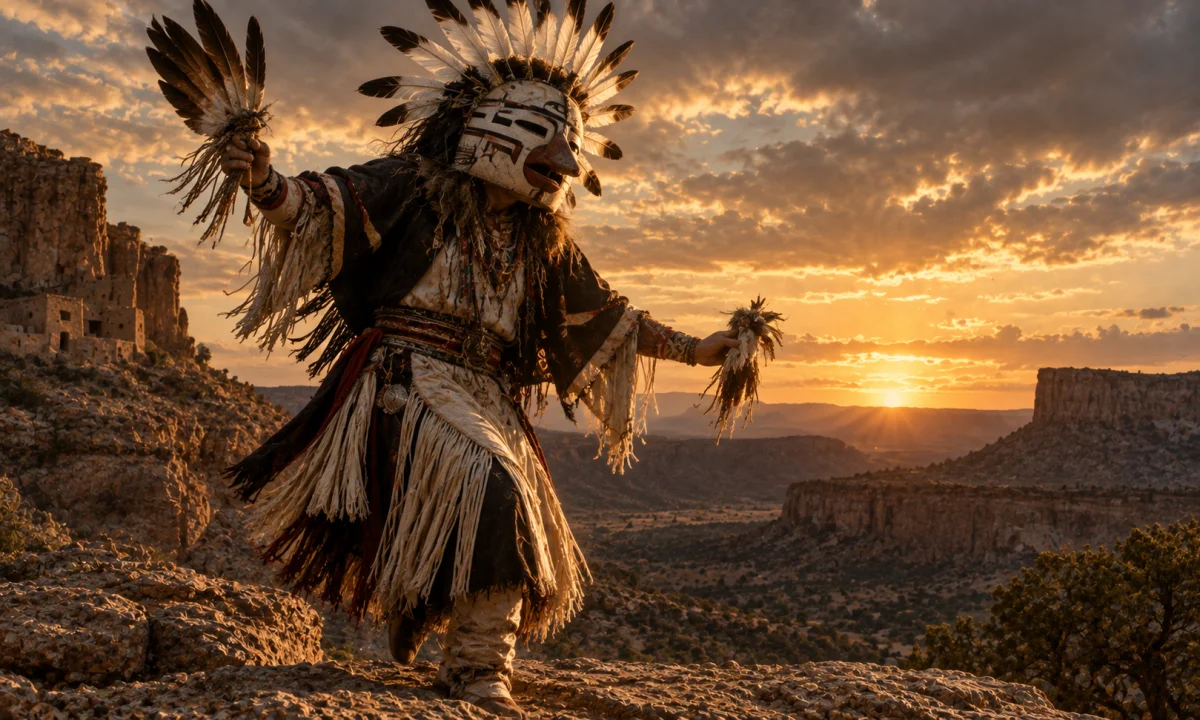
Hototo is a name associated with a katsina—often written “kachina” in English—within Hopi religious and ceremonial traditions of northern Arizona. Hototo is not one of the universally standardized figures of Hopi mythology. Descriptions of the being, the spelling of the name, the mask used in performances, and the role assigned to Hototo vary among communities and published accounts. For that reason, Hototo is best understood through the broader Hopi katsina tradition rather than as a figure with one fixed story or universally agreed appearance.
Hopi religious and cultural setting
The Hopi are Pueblo people whose villages are located on mesas in what is now northeastern Arizona. Hopi religious life is closely connected with the land, seasonal change, agriculture, rainfall, ancestral presence, and the maintenance of balance within the community. Ceremonies are not simply performances for entertainment. They are parts of a living religious system involving prayers, songs, dances, ritual knowledge, and responsibilities held by particular societies and families.
The word katsina is commonly used in English for several related things. It may refer to a spiritual being, to a masked human performer representing that being, or to a carved wooden figure made for teaching and remembrance. Hopi usage distinguishes these meanings more carefully than the English word “kachina” often does. A carved figure is not itself the complete spiritual being, and a dancer wearing a mask is not ordinarily understood as merely pretending to be a character. In the ceremonial context, the performer represents and ritually embodies the presence of a katsina.
Katsinam, the plural form often used in Hopi discussions, are connected with rain, clouds, fertility, crops, moral instruction, social relationships, and the well-being of people and animals. Some are benevolent, some are frightening, and some are humorous or corrective. Their activities are organized through a complex ceremonial calendar, and their meanings can differ between Hopi villages. The tradition is therefore not a single mythology with one authoritative list of characters. It is a network of local practices, inherited teachings, and ceremonial relationships.
The name Hototo
Hototo is also sometimes written with different spellings or presented under an English descriptive name. Such variation is common when Hopi words are recorded by outsiders using changing systems of transcription. Pronunciation and orthography may not be represented consistently in older ethnographic books, museum catalogues, and commercial accounts.
The identity of Hototo is also uncertain in general reference material. Some descriptions treat Hototo as a distinct katsina associated with senior or chiefly katsinam. Other accounts emphasize a relationship with Eototo, a prominent katsina known in connection with the ceremonial leadership of the katsinam. Still other descriptions give Hototo a more specialized ritual or musical role. These accounts should not automatically be combined. They may reflect different village traditions, different periods of documentation, or confusion caused by similar names and changing interpretations.
There is no single ancient Hopi text that supplies a definitive biography of Hototo. Hopi religious knowledge has traditionally been transmitted through oral teaching, ceremony, initiation, family responsibilities, and participation in community life. Written descriptions were produced mainly by visitors, anthropologists, missionaries, collectors, and later artists. Those records can preserve valuable information, but they do not represent every Hopi interpretation, and they may describe a ceremonial figure outside the context that gives the figure meaning.
Hototo as a katsina
When Hototo is identified as a katsina, the name refers to a spiritual presence represented in ceremony by a masked dancer. The figure should not be treated as a god in the exact sense used for the gods of ancient Greek or Roman mythology. Katsinam belong to a different religious framework. They may be understood as powerful spiritual beings connected with the world of the living, the ancestors, natural forces, and the ceremonial order through which people seek rain and communal well-being.
Descriptions of Hototo’s attributes are not consistent enough to establish one canonical costume. Published illustrations and commercial carvings may show a mask with particular colours, feathers, facial markings, or other ornaments, but the design of a katsina doll does not by itself prove that every Hopi community represents Hototo in the same way. Even where a recognizable form is customary, artists may interpret details differently, and a modern carving may be intended as a teaching object, an artistic work, or a market item rather than as a precise record of a ceremonial mask.
Some accounts place Hototo among important or senior katsinam and associate the figure with the ceremonial order of other powerful beings. In these descriptions, Hototo’s significance comes less from a long narrative of personal adventures than from a position within the network of katsinam. The figure may appear in relation to more prominent ceremonial leaders, helping communicate the idea that the katsinam form an organized spiritual community rather than a collection of unrelated spirits.
Other accounts connect Hototo with sound, song, or ritual presentation. These associations are not sufficiently uniform to be stated as universal attributes, but they fit the broader importance of music in Hopi ceremonies. Songs carry inherited words and teachings, establish the rhythm of dances, and help create the sacred atmosphere in which the katsina presence is recognized. A musical association, where it occurs, should not be reduced to the idea that Hototo is simply a “music god.” It is part of a larger ceremonial system in which sound, movement, costume, and prayer work together.
Relationships with other katsinam
The name Hototo is most often discussed alongside Eototo. Eototo is a major katsina in Hopi ceremonial life and is commonly presented in general accounts as a senior or chief figure among the katsinam. Some descriptions call Hototo a companion, assistant, or associated figure of Eototo. The exact nature of this relationship, however, is not uniform across all sources.
Terms such as “father,” “chief,” “helper,” and “companion” can be misleading when removed from their ceremonial setting. They may describe a ritual rank, a teaching relationship, or a conventional way of explaining the relationship between figures rather than a literal family genealogy. Hopi ceremonial relationships do not always correspond to the sort of mythic family trees familiar from classical mythology. A statement that one katsina is related to another therefore requires attention to local usage and context.
Hototo should also be distinguished from Aholi, another well-known katsina connected with major Hopi ceremonies. Aholi is sometimes represented alongside Eototo in descriptions of the Powamu ceremony, and the prominence of these figures can lead general sources to group several senior katsinam together. Similar ceremonial importance does not mean that Hototo, Eototo, and Aholi are interchangeable names. They are treated as distinct figures in accounts that recognize them, even though their relationships and roles may be described differently.
Ceremony, teaching and social order
Understanding Hototo requires understanding what katsina appearances do within Hopi life. During the season when katsinam are present in the villages, masked dancers take part in ceremonies that address the needs of the community. Rain and crop growth are central concerns, but the ceremonies also teach children and adults about discipline, generosity, respect, cooperation, and the obligations of belonging to a community.
Katsina performances can include humour, sudden appearances, frightening behaviour, dances, songs, and the distribution of gifts. Such features are not merely decorative. They create a social and religious environment in which people learn how to behave toward one another and toward the spiritual world. A katsina may reward appropriate conduct, correct disorder, frighten people into attentiveness, or remind the community that survival depends on relationships extending beyond the individual.
In this setting, a figure such as Hototo may be significant even when no lengthy story about the figure survives in public written form. A katsina’s importance can lie in when it appears, with whom it appears, how it dances, what songs accompany it, and what ceremonial knowledge is entrusted to the people who represent it. The absence of a widely circulated narrative should not be taken to mean that the figure lacks religious meaning.
Katsina dolls and the problem of popular descriptions
Carved katsina figures are among the most recognizable forms of Hopi art. Traditionally, such carvings were made for children and served as visual instruction about the katsinam. They helped children learn the identities and characteristics of spiritual beings represented in ceremonies. Over time, katsina carving also became an important artistic tradition, with individual carvers developing distinctive styles and producing works for collectors and galleries.
A carved Hototo figure may therefore preserve a local understanding of the katsina, an artist’s interpretation, or a design based on an earlier published image. It should not automatically be treated as an ancient idol or as a literal portrait. The common English term “kachina doll” can encourage that misunderstanding. The object has a history as a teaching figure and artwork, while the spiritual being represented in ceremony belongs to a living religious tradition.
Commercial websites sometimes assign confident but unsupported attributes to Hototo, including a fixed colour scheme, a universal title, a single animal identity, or a specific mythic genealogy. Such claims should be approached cautiously. Museum labels and popular books may repeat one another, and a description created for the art market can become detached from the ceremonial context of the figure. A reliable account should indicate when an interpretation is local, variant, or uncertain rather than presenting every catalogue description as an established religious fact.
Distinguishing Hototo from similar names
Hototo should not be confused with every figure whose name begins with a similar sound. Hopi katsina names can be altered in English transcription, and neighbouring Pueblo traditions have their own ceremonial beings, names, and systems of classification. Similarity in spelling does not establish a shared identity or common origin.
Hototo is also distinct from the general term kachina. “Kachina” is an English umbrella term that may refer to many different Hopi katsinam, to the masked performers who represent them, or to the carved figures sold as art. Hototo is the name of a particular figure or ceremonial identity within that wider category. Calling Hototo “a kachina” is broadly understandable in English, but it does not explain the figure’s specific local meaning.
Nor should Hototo be treated as a generic nature spirit or as a monster from a fixed catalogue of Native American mythology. Hopi religious traditions are specific to Hopi communities, languages, histories, and ceremonial institutions. Comparisons with other Indigenous traditions can be useful only when they respect those differences.
Cultural significance and responsible interpretation
Hototo illustrates why Indigenous religious figures cannot always be represented accurately through a short list of powers and physical traits. In many written mythologies, a character can be described through a stable set of stories. In Hopi ceremonial life, meaning may be carried by performance, restricted knowledge, local practice, and participation as much as by publicly narrated myth.
Information about katsinam is not equally open to everyone. Some teachings are intended for particular societies, age groups, or ceremonial participants. Public descriptions may therefore be partial by design. The uncertainty surrounding Hototo in general reference material does not give outsiders permission to fill the gaps with invented stories. It is more accurate to acknowledge the limits of published knowledge and to recognize that a living religious tradition cannot be completely defined by museum records or popular encyclopedias.
Hototo is consequently best presented as a Hopi katsina whose identity and ceremonial attributes vary in available accounts, with some traditions placing the figure in relation to senior katsinam such as Eototo. The safest interpretation emphasizes the Hopi katsina system, the importance of ceremony and community, and the difference between a spiritual being, its masked representation, and the carved artwork made in its image.