WORLD
WORLD
Angak Chin Mana
Angak Chin Mana is a female katsina figure in Hopi religious tradition, usually identified in English as the Long-Hair Maiden or Long-Haired Woman. The name appears in several spellings, including Angak'china, Angak Chin Mana and Angakchin Mana. Accounts differ in their transcription, translation and description, so the figure should not be treated as a single character with a universally fixed appearance or story.
Hopi religious and cultural setting
The Hopi are an Indigenous people whose villages are located in what is now northeastern Arizona. Hopi religious life includes an extensive body of traditions concerning katsinam, the plural form of katsina. In English, the word is often written “kachina,” although “katsina” is closer to the Hopi form used in many contemporary discussions.
Katsinam are spirit beings associated with the natural world, the ancestors, seasonal cycles and the well-being of the community. They are not simply equivalent to gods, fairies or fictional characters. Their meanings depend on Hopi religious practice, ceremonial relationships and the particular community in which a tradition is maintained.
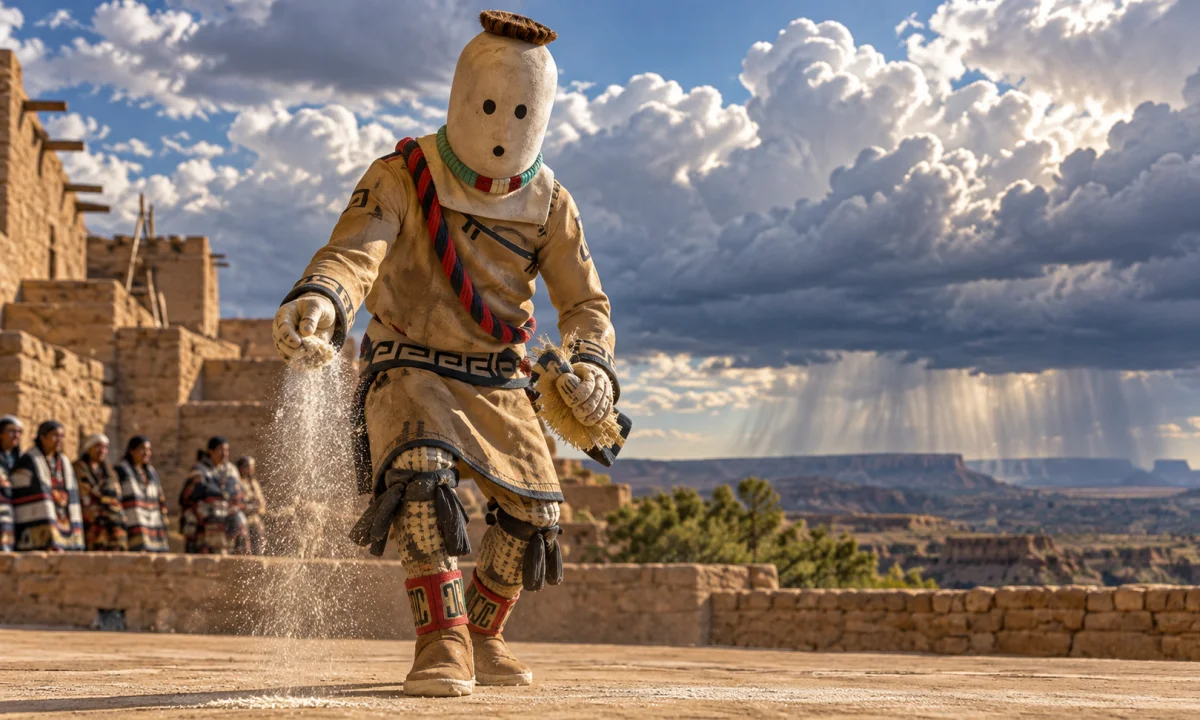
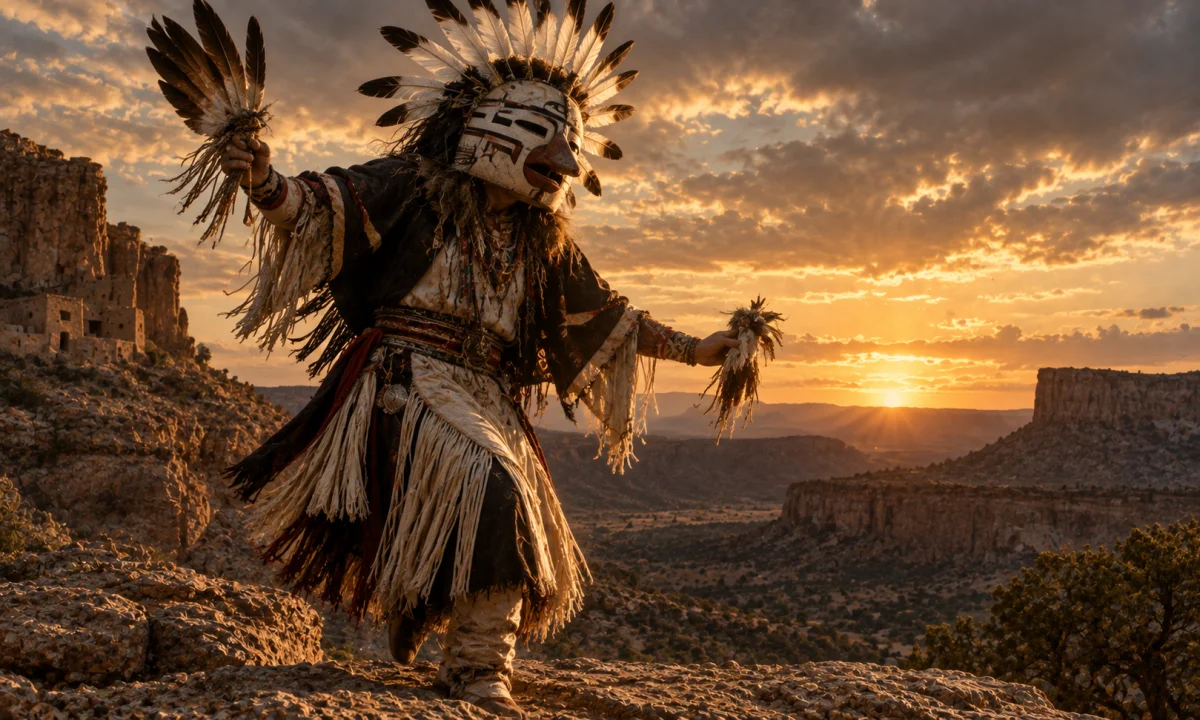
During the katsina season, masked men who have received the appropriate ceremonial knowledge may represent katsinam in public dances. The dancer is not merely acting in a theatrical sense. The mask, costume, songs, movements and ceremonial setting establish a relationship between the human community and the katsina being represented. The dances may be connected with prayer, rain, agricultural prosperity, social instruction and the transmission of religious knowledge.
Katsina figures are also represented in carved wooden objects commonly called “kachina dolls.” The Hopi term tithu is often used for these figures. A tithu is traditionally more than a decorative souvenir: it can help children learn to recognize katsinam and understand aspects of ceremonial life. It is not itself the same thing as the spirit represented in a dance.
Name and identity
The name Angak Chin Mana is not standardized in English. Older ethnographic records, collectors’ catalogues and art-market descriptions have used different spellings, punctuation and word divisions. The forms Angak'china and Angakchin Mana are especially common. These differences may reflect attempts to represent Hopi sounds through English spelling, as well as differences between sources and communities.
The name is frequently translated as “Long-Hair Maiden” or “Long-Hair Girl.” This translation is useful as a general identification, but it should not be assumed to settle every question about the name’s grammar or historical meaning. English-language descriptions sometimes treat “Angak Chin Mana” as though it were the name of a fully documented individual goddess. Hopi katsina traditions do not necessarily organize these beings according to that model.
Angak Chin Mana is better understood as a named katsina presence with a recognizable ceremonial identity. Like many katsinam, she may be known through dance, costume, songs, oral teaching and carved representations rather than through a single written myth. The available descriptions do not establish one universally accepted biography, genealogy or set of adventures for her.
Appearance and identifying features
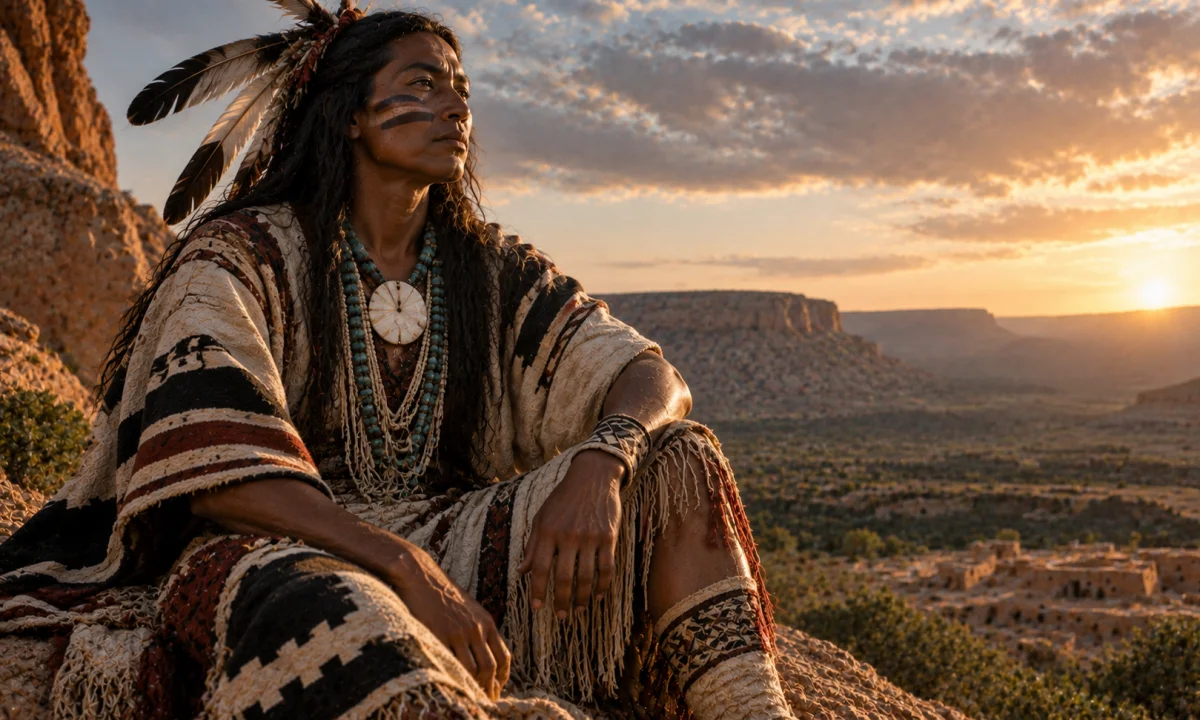
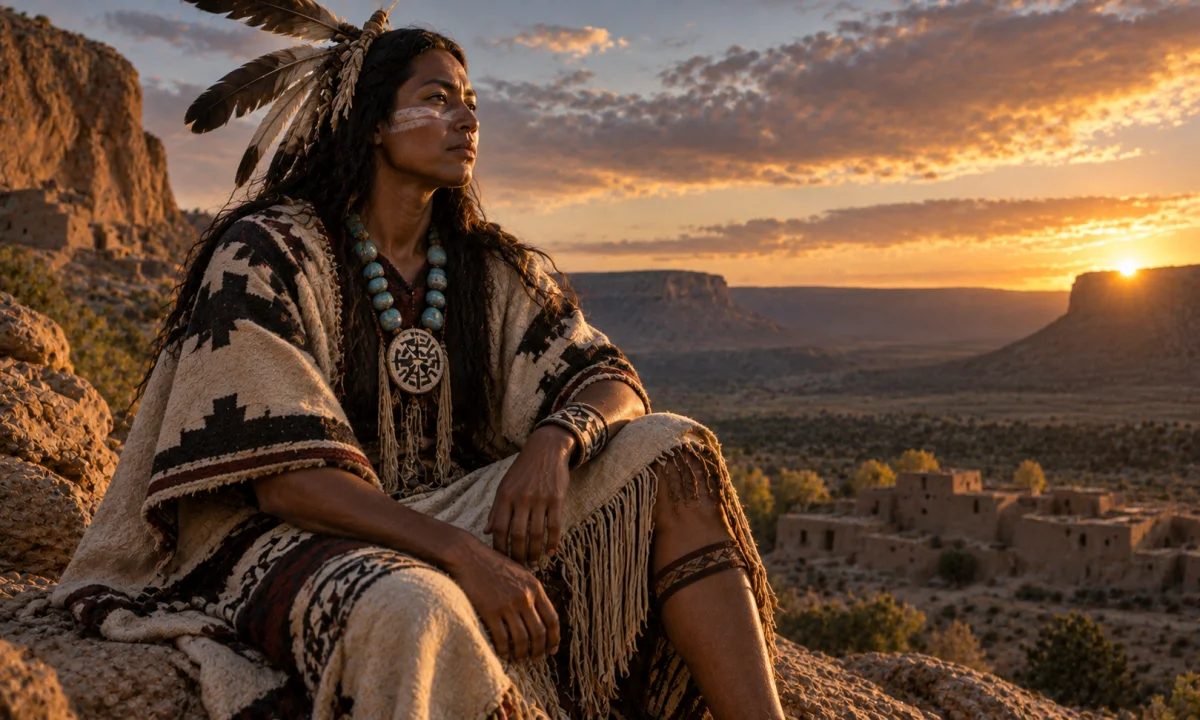
The most consistent identifying feature associated with Angak Chin Mana is long, flowing hair. In representations made for the art market or for teaching, the hair may fall down the back in thick strands, sometimes extending well below the shoulders. The figure is generally presented as a young woman or maiden rather than as an animal, warrior or elderly female spirit.
Her clothing is not completely uniform across representations. Carved figures may show a dress, skirt, shawl or other garments based on the artist’s knowledge and artistic style. Colours, facial markings, hair treatment and accessories can vary. Some objects labelled Angak Chin Mana may therefore look quite different from one another without one automatically being incorrect.
Descriptions that focus only on a carved figure can be misleading. A wooden figure is a static representation, while a ceremonial katsina is encountered through a combination of movement, sound, costume and ritual setting. The visual feature of long hair helps identify Angak Chin Mana, but it does not by itself convey the whole religious meaning of the figure.
Some commercial descriptions associate the Long-Hair Maiden with beauty, rain, fertility or feminine grace. Such associations may reflect particular interpretations, local explanations or the language of dealers and collectors. They should not be presented as a universal Hopi doctrine. The significance of any katsina can be shaped by the ceremony in which it appears and by the community’s own teachings.
Role among the katsinam
Angak Chin Mana belongs to the broad class of female or maiden katsinam. Female katsinam are not merely symbolic versions of human women. As with other katsinam, their identities can connect human life with forces that sustain the community, including seasonal change, weather, reproduction, agriculture and social continuity.
Rain is especially important in Hopi life because agriculture in the high-desert environment depends on careful cultivation and limited moisture. Katsina ceremonies commonly include prayers and performances concerned with rain and the growth of crops. It is therefore understandable that later descriptions may connect a female katsina with fertility or rainfall. Nevertheless, a general relationship between katsina ceremonies and rain does not prove that Angak Chin Mana has one exclusive function as a “rain goddess.”
The figure’s feminine identity may also carry social meanings connected with adulthood, courtship, family life and the continuation of the community. These themes should be approached carefully. Hopi ceremonial symbolism is not a simple code in which every female figure has the same meaning. A katsina’s role may be specific to a dance, a village tradition, a ceremonial society or a particular period of use.
Stories and ceremonial knowledge
No single, widely attested narrative about Angak Chin Mana is known in the way that Greek myths describe Athena or Norse myths describe Freyja. Her identity is primarily preserved through the katsina ceremonial system and through representations of her form. This absence of a famous written story does not make her unimportant. In Hopi tradition, religious knowledge is not dependent on having a long literary biography.
Much Hopi knowledge has been transmitted orally and ceremonially. Information about a katsina may include its name, costume, songs, movements, relationships with other katsinam and place within the annual cycle. Some knowledge is intended for particular people or ceremonial contexts rather than for unrestricted public explanation. Published descriptions therefore provide only a partial view and may combine Hopi information with outside interpretation.
Accounts of Angak Chin Mana can also differ because a dance name, a spirit name and a name used by collectors for a carved figure are not always identical in scope. One source may use Angak'china for the figure represented in a ceremony, while another may apply a similar label to a particular style of doll. These usages should not be treated as evidence that every object or performance described by the name has exactly the same meaning.
Relationship to Hopi katsina dolls
Angak Chin Mana is particularly familiar outside Hopi communities through carved wooden figures. In museum collections and commercial catalogues, the figure may be described as a “kachina doll,” “kachina carving” or “Long Hair Kachina.” These labels can encourage the mistaken idea that the object is a little idol worshipped in the same way everywhere.
Traditionally, a tithu teaches recognition and cultural knowledge. Its value lies partly in the relationship between the object, the child who receives it and the ceremonial world it helps explain. Contemporary artists may also create carvings for collectors, galleries and museums. Such works can be informed by tradition while also reflecting individual artistic decisions and the economic conditions of the modern art market.
Not every long-haired female carving is necessarily Angak Chin Mana. Artists may depict different katsinam with long hair, and dealers have sometimes applied names inconsistently. Identification should take account of the figure’s stated name, costume, markings, provenance and the artist’s own explanation rather than relying on hair alone.
Distinguishing Angak Chin Mana from similar figures
Angak Chin Mana should not be casually merged with other female figures in Hopi or neighbouring Pueblo traditions. Pueblo peoples share certain broad cultural features, including ceremonial dances and masked spirit representations, but each nation and community has its own religious vocabulary, histories and restrictions.
She is also distinct from Spider Woman, one of the important female beings in several Southwestern Indigenous traditions. Spider Woman is associated in different accounts with creation, emergence, protection, weaving or instruction. Angak Chin Mana, by contrast, is generally identified as a female katsina whose characteristic feature is long hair. Similarities in popular descriptions—such as calling both figures protective, maternal or spiritually powerful—do not make them the same being.
She should likewise not be confused with generic “maiden” figures, fertility goddesses from other cultures or modern fantasy characters wearing long hair and ceremonial clothing. A visual resemblance is not evidence of a shared origin. Nor should the term “kachina” be used as a general label for every Southwestern spirit, mask or doll.
Interpretation and cultural significance
The long hair associated with Angak Chin Mana gives the figure a strong visual identity. Hair can communicate gender, age, vitality and social presentation, but its meaning is not necessarily reducible to a universal symbol of fertility or beauty. The significance of the hair depends on the cultural setting in which the katsina is named, performed and taught.
The figure also illustrates why Hopi religious beings are difficult to describe through short lists of “powers.” A catalogue may say that Angak Chin Mana brings rain, represents fertility or encourages prosperity, yet such statements can flatten a complex ceremonial relationship into the language of a character encyclopedia. Katsinam participate in communal religious life rather than functioning only as individual supernatural personalities.
For the Hopi, the annual appearance of katsinam can reinforce obligations between people, the land, the ancestors and the forces that sustain life. Children learn names and forms; adults fulfil ceremonial responsibilities; dancers embody the presence of the katsinam; and the community joins in songs and prayers. Angak Chin Mana belongs to this living system, even when she is encountered by outsiders only as a carved figure or a name in a catalogue.
Modern reception
Angak Chin Mana has no major, widely recognized role in mainstream film, television or contemporary fantasy. Her modern visibility comes mainly from museum displays, books about Southwestern art and the market for Hopi katsina carvings. These settings have helped spread the English translation “Long-Hair Maiden,” but they have also encouraged simplified descriptions and inconsistent spellings.
Modern representations are best understood with attention to their context. A Hopi artist’s carving, a ceremonial mask, a museum label and a commercial reproduction may all use related terminology while serving very different purposes. Respectful interpretation keeps the traditional religious identity of the katsina distinct from the later history of collecting, tourism and popular presentation.