WORLD
WORLD
Aholi
Aholi is a katsina figure in Hopi religious tradition, associated especially with the ceremonial life of the Hopi villages in northeastern Arizona. Like other katsinam, Aholi is not simply a character in a fixed storybook mythology. The name may refer both to a sacred spirit and to the masked dancer who represents that spirit in ceremony. Descriptions of Aholi’s appearance, duties and relationships vary among Hopi communities and in the accounts recorded by outside observers.
Hopi religious and cultural setting
The Hopi are a Pueblo people whose villages are located on and around three mesas in what is now northeastern Arizona. Hopi religious life includes ceremonies concerned with rain, fertility, agriculture, social balance and the continuity of the world. The katsinam form an important part of this ceremonial system.
The word katsina is often written kachina in older English-language sources. The latter spelling became widespread through non-Hopi usage, while katsina more closely reflects current scholarly and community-preferred forms in many contexts. A katsina can be understood as a spiritual being, a ceremonial impersonator, and, in some contexts, a carved representation of such a being. These meanings are related but should not be treated as identical.
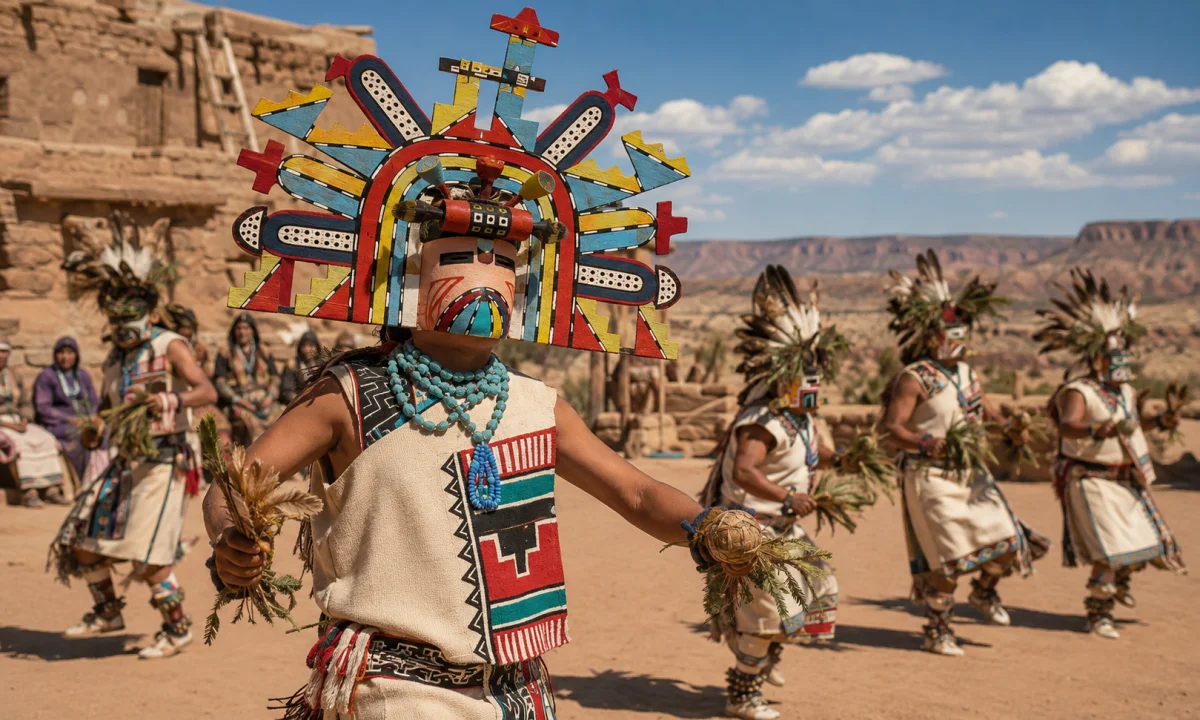
During the katsina season, which traditionally begins in winter and continues into the summer ceremonies, men and boys who have been initiated into the appropriate societies may appear in masks and ceremonial clothing. They are understood to embody the presence of the katsinam rather than to perform a theatrical imitation for entertainment. Ceremonies include public dances as well as restricted rites whose details are not part of the public record.
Aholi therefore belongs to a living religious tradition. Information available to the general public is selective, and the meaning of a figure may depend on the village, ceremonial society and occasion in which that figure appears. Museum labels and early ethnographic descriptions can be useful, but they do not provide a complete or final account of Hopi knowledge.
Name and identity
Aholi is the most familiar English spelling of the name, although spellings can differ in published material. The name is also encountered in expressions such as “Aholi Katsina.” The use of the word “kachina” in older sources has produced additional variation in spelling and classification.
Public descriptions commonly place Aholi among the important or prominent katsinam associated with the ceremonial order. He is frequently described as a companion, assistant or associate of Eototo, another important Hopi katsina. Some accounts connect the pair with the leadership of the katsinam and with ceremonies involving prayers for rain and the renewal of life. These descriptions should be treated as broad interpretive summaries rather than as a single universally accepted definition. Hopi ceremonial knowledge is not necessarily identical from one village to another.
Aholi is sometimes classified as a rain-related figure. That classification reflects the central place of rain in Hopi agriculture and religion, but it does not mean that Aholi is merely a personification of weather. Katsinam may have several interconnected responsibilities: they can participate in dances, instruct children, enforce social behaviour, carry prayers and blessings, and express relationships between human communities and the wider spiritual world.
Appearance and ceremonial representation
There is no single standard appearance of Aholi that applies to every carving or every ceremonial appearance. Carvers produce figures according to local conventions, personal style and the information they have received. Museum examples may also have lost parts of their original clothing, paint or attachments, making precise reconstruction difficult.
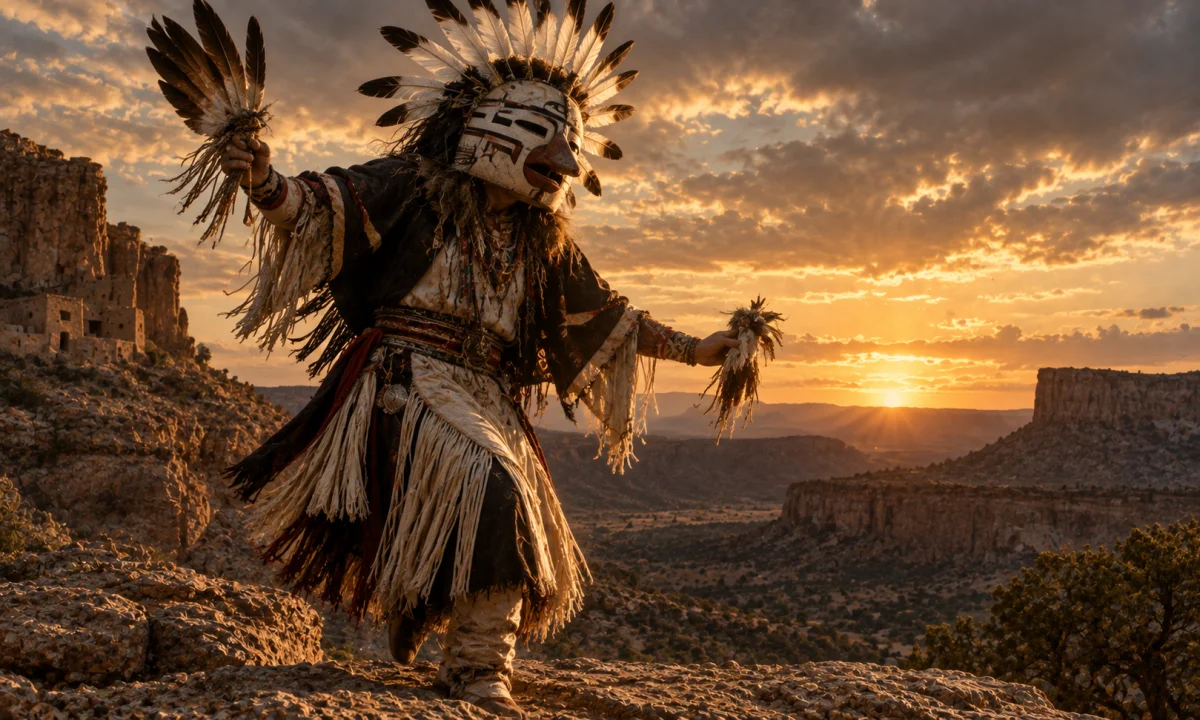
Representations commonly show Aholi as a masked male katsina with a strongly marked face and elaborate headgear. The colours, facial patterns, feathers, ornaments and other details vary in published examples. Some carvings emphasize a dark face, a projecting mouth or beak-like feature, and a tall or distinctive headdress. Such features should not be assumed to have exactly the same meaning in every representation.
The ceremonial mask is especially important. In a Hopi religious context, the masked dancer is not simply wearing a costume identified with a mythical personality. The mask and the associated ritual actions help establish the presence of the katsina during the ceremony. After the ceremonial season, the mask and clothing are not normally treated as ordinary decorative objects. Their significance comes from the ritual relationship that they embody.
Wooden figures sold or displayed outside the villages are often called “kachina dolls.” The term can be misleading if it suggests a toy. Traditionally, such carvings, more accurately called tithu in many Hopi contexts, have served as visual representations of katsinam and as objects through which children learn to recognize the beings encountered in ceremonial life. Their religious meaning is distinct from that of the masked dancer who appears in a ceremony.
Associations with Eototo and ceremony
The strongest recurring association in public accounts is the relationship between Aholi and Eototo. Eototo is often presented as a senior katsina, while Aholi appears as his companion or assistant. In some descriptions, the two are connected with ceremonial leadership and with the arrival or departure of the katsinam during significant seasonal observances.
Public sources have linked Aholi and Eototo with the Soyal ceremony, also called Soyalangwul, which takes place during the winter season. Soyal is a complex Hopi ceremony concerned with the return or ordering of the sun, the renewal of life and the preparation of the ceremonial cycle. It includes prayers and ritual actions relating to the welfare of the community. Accounts differ in how they describe the exact participation of particular katsinam, and restricted elements of the ceremony should not be reconstructed from general descriptions.
Aholi is also associated in some accounts with other seasonal appearances and with rain-making symbolism. The Hopi ceremonial year contains many dances and rites, and a katsina may have different functions depending on the setting. It is therefore unsafe to reduce Aholi to one isolated festival or to claim that every Hopi community gives him the same role.
Relationships among katsinam often express a ceremonial order rather than a family genealogy in the ordinary human sense. When Aholi is called an assistant, companion or associate of Eototo, the wording may describe ritual cooperation and rank. It should not automatically be interpreted as evidence of a fixed mythological family tree.
Role and symbolism
Aholi’s reported connection with rain reflects the practical and religious importance of water to Hopi life. Hopi farming has historically depended on limited and variable rainfall, especially for the cultivation of maize. Rain is therefore not only a natural resource but also part of a moral and ceremonial relationship linking human conduct, prayer, the katsinam and the renewal of the earth.
Rain symbolism in Hopi tradition is often expressed through clouds, lightning, colours, feathers, plant forms and movement. A figure associated with rain may help communicate hopes for healthy crops and the continuation of communal life. Yet ceremonial beings do not operate as mechanical controllers of nature. The ceremonies involve obligations, discipline, reciprocity and proper relationships rather than a simple command that produces rain.
Katsinam also have an educational function. During the ceremonial season, children learn the names and appearances of different beings and become familiar with the responsibilities of their community. Aholi’s relationship with other prominent katsinam can consequently communicate ideas about cooperation, ceremonial authority and the ordered participation of spiritual beings in village life.
The presence of a masked katsina can also be socially instructive. Katsina performances may praise good conduct, warn against disorder or remind people that actions have consequences beyond the individual. These dimensions are inseparable from the religious setting. Treating the figures solely as decorative characters removes much of their significance.
Stories and variations
Unlike figures whose stories survive in one widely circulated written epic, Aholi does not have a single canonical biography available to the general public. Hopi traditions have been transmitted primarily through oral teaching, ceremonial practice and community participation. Accounts written by anthropologists, collectors and visitors record only portions of that knowledge and may organize it according to categories that do not exactly match Hopi understandings.
As a result, statements about Aholi can differ in several ways. One source may emphasize his position beside Eototo; another may focus on his association with rain; a third may describe a particular mask or dance observed in one village. These differences do not necessarily indicate that one version is false. They may reflect local ceremonial variation, different levels of access to religious knowledge, changes over time or the limitations of the observer’s vocabulary.
Some popular accounts present a sharply defined list of Aholi’s powers, a precise origin story or a fixed place in a universal hierarchy of Hopi gods. Such presentations should be approached cautiously. “God” is often an inadequate translation for a katsina, and tidy classifications can obscure the flexibility and community-specific character of Hopi religious tradition.
Aholi and similar names
Confusion can arise because Hopi katsina names are written in several ways, especially when they are transcribed into English. Aholi should not be merged automatically with every figure whose name begins with a similar sound or with every katsina shown wearing dark colours or a prominent headdress.
Aholi is also distinct from Eototo, even though the two are frequently discussed together. Eototo is generally presented as the senior or leading figure in that relationship, while Aholi is described as his companion or assistant. The pair’s association does not make them two names for one being.
The name should likewise be distinguished from unrelated beings in other Native American traditions. “Kachina” has sometimes been used loosely in popular writing for any supernatural figure, but katsina traditions are specifically connected with Pueblo peoples, including the Hopi, and should not be treated as a generic category covering all Indigenous religions of North America.
Carvings, collecting and modern reception
Aholi carvings have appeared in museum collections, galleries and the commercial art market. Their value can include artistic skill, historical importance and the preservation of a recognizable ceremonial form. At the same time, a carving should not be mistaken for a complete explanation of the being it represents. Its meaning depends on Hopi knowledge, the circumstances of its production and the relationship between the carver, the community and the viewer.
Commercial collecting has sometimes encouraged simplified labels and the treatment of katsina figures as exotic curiosities. Contemporary Hopi artists and cultural advocates have emphasized the importance of accurate attribution, respect for ceremonial knowledge and recognition that katsina traditions remain part of a living culture. Not every detail associated with Aholi is intended for public display or unrestricted discussion.
Outside Hopi tradition, Aholi has had little presence in mainstream popular culture compared with more generalized images of “kachina” figures. When he appears in modern books, exhibitions or online material, the most responsible presentations distinguish artistic interpretation from ceremonial knowledge and avoid presenting one museum object or one outsider’s description as the definitive form of Aholi.