WORLD
WORLD
Kachinas
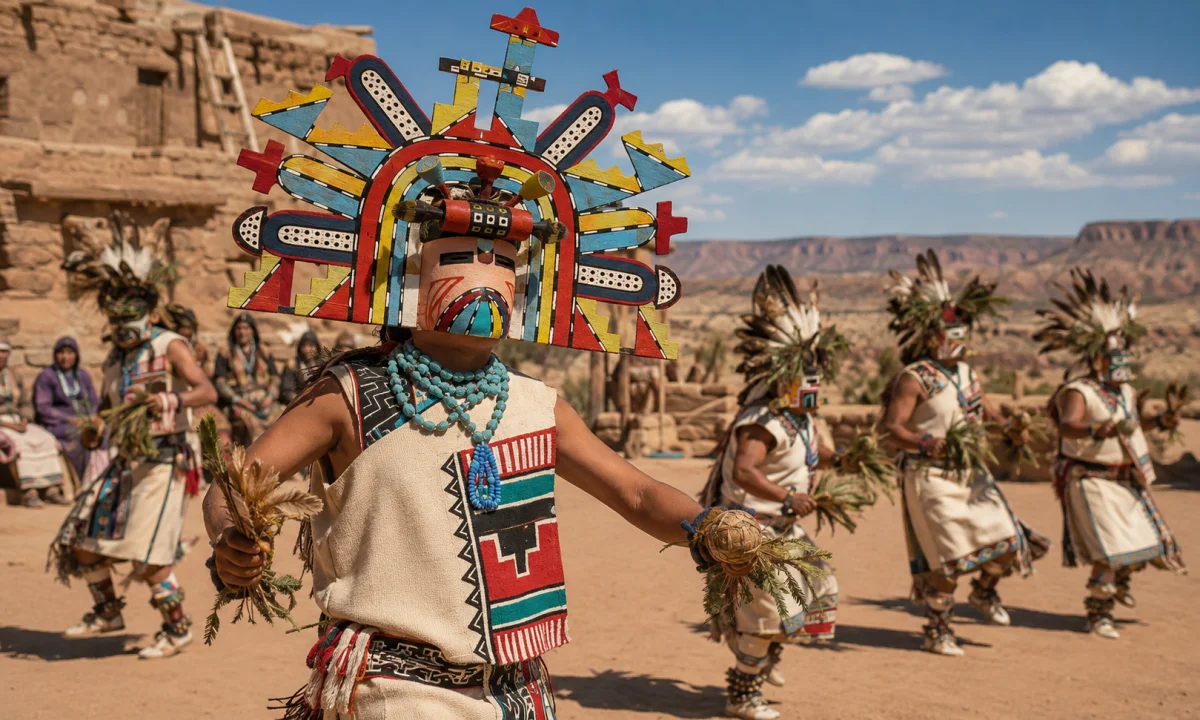
Kachinas, more accurately written katsinam in many Hopi contexts, are sacred spirit beings, ceremonial identities, and masked dancers in the religious traditions of the Hopi people of northeastern Arizona. The English word “kachina” does not name a single god or monster. It is a broad term used for a large and varied community of beings associated with rain, clouds, fertility, moral conduct, healing, ancestry, and the proper relationship between human communities and the wider world.
Katsina traditions remain part of living Hopi religious practice. They are expressed through ceremonies, songs, dances, masks, teachings, and carved representations commonly sold in English as “kachina dolls.” These elements cannot be understood simply as characters from an ancient mythology. For Hopi communities, they belong to a religious system that continues to carry responsibilities, social meanings, and restrictions concerning what may be shown or discussed publicly.
The Hopi cultural setting
The Hopi are a Pueblo people whose villages are located on three major mesas in what is now northeastern Arizona. Their communities have maintained agricultural, ceremonial, and artistic traditions in a difficult high-desert environment. Corn farming, especially the cultivation of traditional varieties, has long been closely connected with religious responsibility, seasonal observance, and prayers for rain.
Hopi religious life includes ceremonies concerned with the renewal of the world, the health of the community, agricultural success, rain, and the conduct expected of human beings. Katsinam participate in this religious landscape. They are not merely imaginary figures invented for entertainment, and the masked people who appear in ceremonies are not generally treated as actors portraying fictional characters in the modern theatrical sense. Within the appropriate ceremonial context, a dancer wearing a katsina mask and regalia is understood to embody or make present a katsina identity.
Knowledge about particular katsinam is not uniform across all Hopi villages or families. Some teachings are public, while other names, songs, masks, movements, and ritual meanings are reserved for initiated people or for specific ceremonies. Accounts written by outsiders may therefore be incomplete, simplified, or based on observations that do not represent the whole tradition.
Name and identity
Kachina is the spelling that became common in English, partly through Spanish and later American usage. Many Hopi speakers and scholars prefer katsina, with katsinam often used as a plural form. Spellings vary because Hopi sounds do not always fit neatly into English or Spanish writing systems.
The word is sometimes translated loosely as “spirit,” but no single English translation fully captures its meaning. A katsina may be understood as a spiritual person, being, or power. The category includes rain-related beings, animal-associated figures, ancestors, ogres, clown figures, helpers, and other ceremonial identities. Some are benevolent in particular contexts, some discipline improper behavior, and some combine frightening and protective qualities.
It is misleading to describe every katsina as a god. Hopi religious categories do not map exactly onto the familiar European division between gods, demons, spirits, and human ancestors. Katsinam occupy a complex place within a sacred world that also includes creator and culture-hero figures, powerful beings connected with the earth and sky, and the dead. Their exact status may vary according to the figure, ceremony, village, and explanation being given.
Origins in Hopi tradition
Hopi accounts of the origins of the people and their ceremonies are part of a wider body of oral tradition concerning emergence, migration, settlement, and the responsibilities established in the early world. These accounts are not a single standardized story. Different versions and interpretations exist, and some sacred teachings are not intended for unrestricted publication.
In broad terms, katsina traditions connect the human community with powerful beings who helped establish or teach proper ceremonial relationships. Katsinam are often associated with the time before or around the settlement of the present world, and with the seasonal movement between the human villages and a sacred realm. Such descriptions should not be treated as a fixed Hopi doctrine shared in precisely the same form by every community.
One recurring religious idea is that katsinam are especially present during part of the ceremonial year and later depart from the villages. Their return and departure are marked by ceremonies, and their presence is linked with prayers for rain, growth, and communal well-being. The seasonal cycle is not simply a performance calendar. It expresses a relationship in which human beings are expected to show respect, discipline, generosity, and proper ritual conduct.
Appearance and ceremonial presence
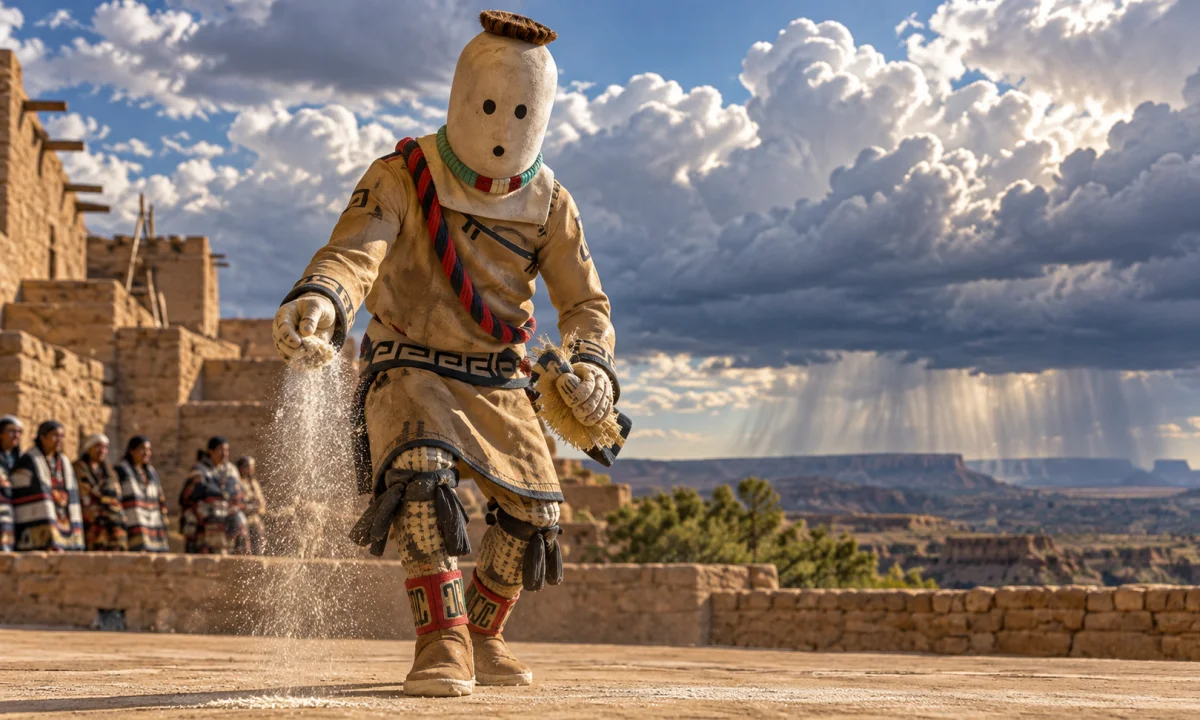
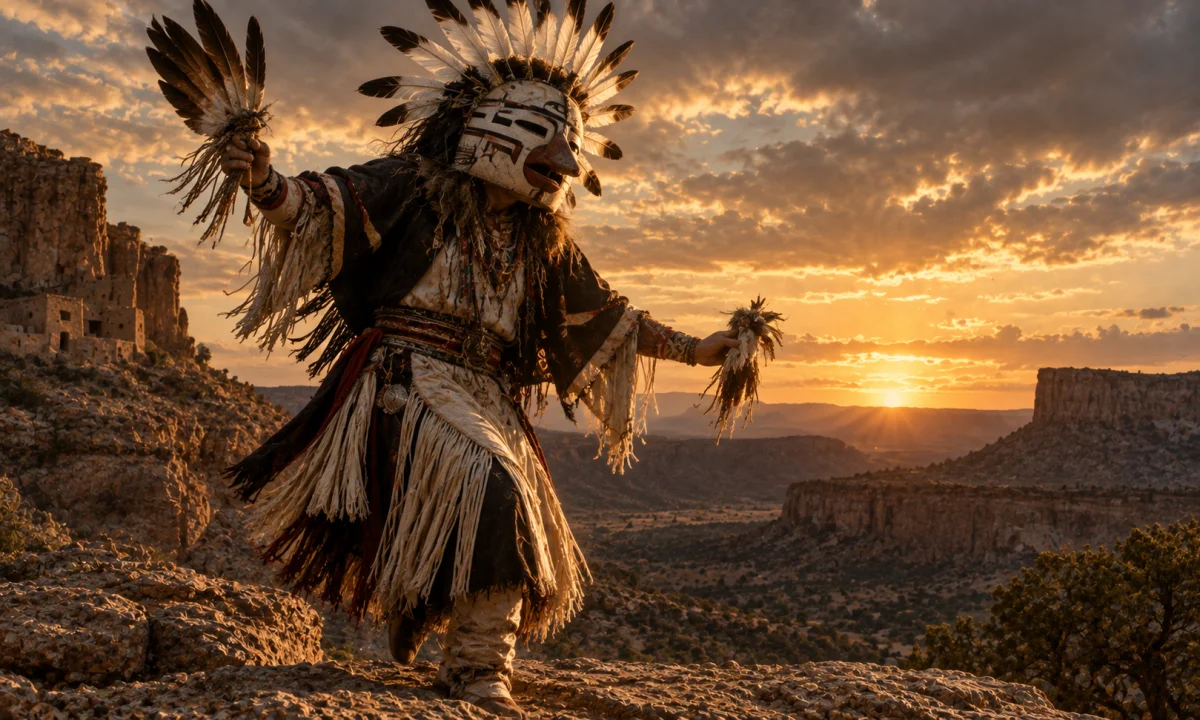
Katsina masks are among the most recognizable features of Hopi ceremonial life. Masks may represent faces, animals, clouds, plants, supernatural beings, or highly stylized combinations of features. Headdresses, body paint, carved ornaments, feathers, yucca elements, clothing, and rattles may also contribute to a particular identity. Colours and designs can carry associations, although their significance is not always stable or universally explained.
A masked dancer is not simply wearing a disguise. The mask and other regalia help establish a ceremonial presence. In traditional understanding, the dancer’s personal identity is set aside during the rite, and the katsina identity becomes active through the prescribed movements, songs, and actions. This is one reason that photographs, reproductions, and public descriptions can fail to convey the religious importance of the ceremony.
Some public dances allow visitors to observe portions of the event, while other ceremonies are restricted. Public visibility does not mean that every element is open for recording, copying, or commercial use. The boundaries surrounding masks, songs, names, and ritual objects are part of the tradition itself.
Roles and powers
Many katsinam are associated with weather, particularly clouds and rain. In the high desert, rainfall is essential to farming, and religious attention to rain is therefore also attention to food, family continuity, and the survival of the community. Katsinam may be approached through songs and dances that express requests for rain and agricultural abundance.
Other katsinam have social or moral roles. Some observe human conduct, correct disorder, frighten children into obedience, or remind adults of communal responsibilities. Certain figures appear as comic or disruptive characters, but humour in ceremony does not necessarily make them insignificant. Clown figures can expose selfishness, greed, rudeness, or violations of expected behaviour by exaggerating such conduct.
Some katsinam have animal-like features or are linked with particular animals and natural forces. These relationships should not automatically be interpreted as simple “animal worship.” Hopi concepts of personhood and sacred power do not correspond exactly to modern Western categories of nature and culture. A bird, cloud, rain-bearing power, ancestor, or masked ceremonial identity may be related through a network of obligations and meanings rather than placed in a separate category.
Katsinam can also be connected with healing, protection, fertility, and the transmission of knowledge. Their powers are not always described as supernatural abilities in the comic-book sense. They are part of a religious system in which correct ritual action, social harmony, prayer, and ethical behaviour affect the condition of the world.
Ceremonies and the katsina season
Hopi ceremonial cycles differ between villages, but the period commonly called the katsina season is a major feature of many descriptions of Hopi religious life. Public dances and other ceremonies may involve masked dancers who visit villages, perform songs and movements, and interact with members of the community.
Winter ceremonies such as Powamu are often associated with initiation, fertility, and the preparation of the community for the coming agricultural cycle. The spring and summer period includes dances connected with rain and growth. The Niman ceremony, frequently called the Home Dance in English, marks the departure of the katsinam at the end of their seasonal presence. English descriptions sometimes present these events as if they formed one identical sequence throughout Hopi country, but ceremonial details and terminology vary by village.
At the end of the season, the departure of the katsinam is not understood as the end of their existence. Rather, it marks a change in their relationship with the villages and the ritual calendar. Their continuing presence is represented through memory, prayer, carved figures, and the expectation of their return in the appropriate season.
Well-known figures and regional variation
Many named katsinam are known beyond Hopi communities, but the meaning and appearance of a figure may differ between villages or ceremonial contexts. A name in an English-language catalogue may also represent an imperfect transcription or a simplified identification.
Angwusnasomtaka, often called Crow Mother in English, is one of the best-known figures associated with initiation ceremonies. She is frequently represented as a powerful female presence and is connected in public accounts with discipline, instruction, and the ordering of young initiates. Descriptions of her precise role should not be treated as identical in every Hopi community.
Hahai-i Wuhti, sometimes called the Earth- or Grandmother figure in English-language descriptions, is associated with an older female identity and may appear in contexts involving instruction, social behaviour, or the care of children. English labels do not fully express the range of meanings attached to the figure.
Eototo and Aholi are important ceremonial figures in some Hopi traditions and public dances. Their masks and appearances are widely reproduced, but their religious significance is more specific than the decorative images found in commercial art. Koyemsi, often called the Mudheads, are clown or comic figures recognizable by their rounded, mud-coloured head coverings. They may entertain, enforce social order, or create controlled disorder within ceremonial performance.
These examples are not a complete pantheon. There are numerous katsinam, and their classification is not a universally fixed catalogue. Some figures are linked with particular villages, societies, ceremonies, or local traditions. A figure’s presence in a museum collection or art market does not establish that its public description is complete or authoritative.
Katsina carvings
Carved wooden figures commonly known as kachina dolls are better understood as tithu or tihu, although spellings vary. They are representations used to teach children about katsinam and their ceremonial identities. Traditionally, such carvings were made and given within Hopi communities, especially in connection with the education of children about religious life.
A tihu is not itself normally regarded as the living katsina present in a dance. It is a material representation, just as a mask, painting, or diagram may represent a sacred identity without being identical to the being represented. Historically, carvings could be relatively simple or highly detailed, depending on their purpose and period. Contemporary Hopi artists have developed carving as an important art form, and individual artists may identify their work with particular styles, villages, and teachings.
The commercial market has often called these objects “dolls,” a term that can make them sound like ordinary toys. Some were used in children’s instruction, but their religious and cultural context is important. Older carvings, ceremonial imagery, and named figures have also been collected and sold outside Hopi communities, sometimes without adequate attention to ownership, permission, or sacred restrictions.
Distinguishing katsinam from similar figures
Katsinam should not be confused with all Pueblo masked dancers. Other Pueblo peoples, including the Zuni, have their own ceremonial beings, masks, societies, names, and religious histories. Similar visual features do not prove that two traditions share the same figure or meaning.
The word “kachina” has also been applied loosely to Native American masks, carvings, and supernatural beings from outside Hopi culture. This usage can obscure important differences. A Zuni ceremonial being is not automatically a Hopi katsina, and a generic museum label may conceal the identity of the community that created or used an object.
Nor should katsinam be equated with “totems,” a term drawn from other Indigenous traditions and often used inaccurately in popular writing. Katsina relationships involve ceremonial presence, teaching, seasonal renewal, and obligations that are not adequately described by the idea of a family emblem or animal ancestor.
Cultural significance and modern representation
For Hopi people, katsina traditions express more than a set of supernatural characters. They provide ways of teaching children, sustaining community identity, renewing relationships with the land, and maintaining ceremonial responsibilities. The dances also connect artistic practice, agriculture, music, kinship, age-group instruction, and religious knowledge.
Modern museums, books, films, tourist displays, and online shops have made kachina imagery familiar around the world. These representations may preserve valuable information about carving styles and public ceremonial imagery, but they can also detach sacred figures from their context. Photographs of masks, the publication of restricted material, and the sale of objects taken from ceremonies have all raised serious concerns among Hopi people and other Pueblo communities.
Contemporary Hopi artists continue to carve, paint, weave, design jewellery, and create other works involving katsina imagery. Their work should not be treated as evidence that all katsina forms are freely available for copying. The distinction between a public artwork made by an identified artist and an appropriated or falsely labelled ceremonial object is significant.
In popular culture, “kachina” may be used as a decorative name for a desert spirit, a fantasy creature, or an Indigenous-inspired figure. Such adaptations generally belong to modern commercial or fictional culture rather than to Hopi religious tradition. They should not be used to explain what katsinam are without first recognizing the living Hopi ceremonial system from which the term comes.