WORLD
WORLD
Eototo
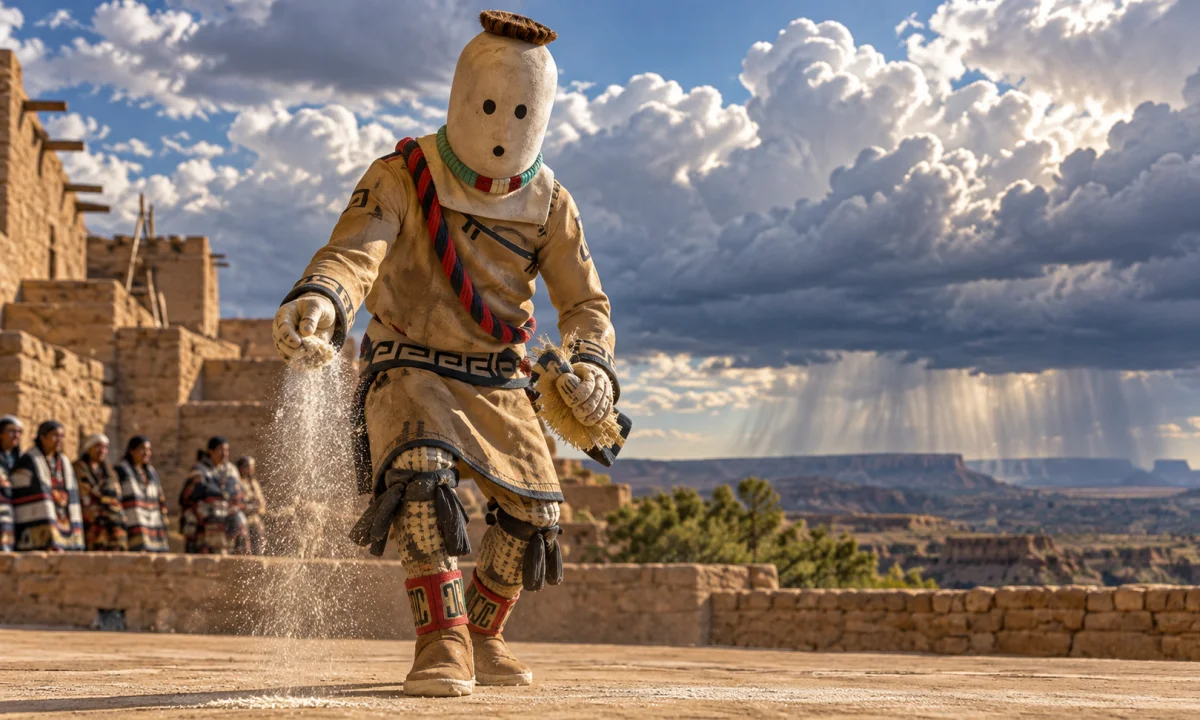
Eototo is a prominent katsina in Hopi religious tradition, often described in English-language accounts as a chief or father of the katsinam. The Hopi word katsina refers both to spiritual beings and, in particular contexts, to masked dancers who embody those beings during ceremonies. Eototo is closely associated with ceremonial authority, the ordering of the katsina community, and the renewal of life through rain, crops, and communal religious practice.
Hopi religious and cultural setting
The Hopi are an Indigenous Pueblo people whose villages are located on mesas in northeastern Arizona. Hopi religious life includes ceremonies concerned with rain, agriculture, fertility, health, social order, and the relationship between human communities and the wider living world. Katsinam are central to many of these ceremonies, although the meaning and importance of particular katsinam can vary between villages and ceremonial societies.
In Hopi understanding, a katsina is not simply a fictional character or a supernatural “monster.” Katsinam may be understood as spiritual persons or powers associated with ancestors, natural forces, animals, plants, places, and moral or social qualities. During the ceremonial season, men wearing sacred masks and regalia embody particular katsinam. Their presence is part of a religious exchange: the katsinam bring blessings, instruction, rain, and protection, while people maintain the ceremonies, observe obligations, and provide offerings and respectful participation.
The term kachina is widely used in English, especially in older ethnographic writing, museum catalogues, and the art market. Katsina is closer to current Hopi usage in many contexts, and katsinam is commonly used as the plural. English descriptions often simplify a complex religious system by treating every katsina as a separate “god.” That comparison can be misleading. Hopi religious concepts do not fit neatly into categories borrowed from classical European mythology.
Eototo’s identity
Eototo is generally presented as a high-ranking katsina, frequently called the chief of the katsinam or the father of the katsina community. These descriptions communicate his authority, but they should not be understood as a universally fixed biography. Hopi ceremonial knowledge is transmitted through communities, religious societies, families, and initiated participants. Public accounts are therefore partial, and descriptions of Eototo may differ according to village, ceremony, speaker, and the limits of what may properly be discussed outside ritual settings.
The name is commonly written Eototo in English. Spelling and pronunciation can vary when Hopi words are represented through English orthography. Some popular descriptions gloss the name as “father,” or use the expression “father of the katsinas.” Such glosses are useful for conveying his ceremonial position, but they should not be treated as a complete translation or as proof that every Hopi tradition defines the name in exactly the same way.
Eototo is often associated with Aholi, another important katsina. In descriptions of ceremonial performances, the two may appear as companions or as figures who cooperate in maintaining order and presenting the authority of the katsinam. Aholi is sometimes described as Eototo’s helper, lieutenant, or counterpart. These English labels are approximate, and the relationship should not be reduced to a simple family relationship or to the structure of a royal court.
Role in ceremony
Eototo’s importance lies less in a single adventure than in his ceremonial role. He belongs to the group of powerful katsinam who represent the organized presence of the supernatural community. His appearance can signal that the katsinam are acting collectively rather than as isolated figures. Through this role, Eototo is connected with discipline, leadership, instruction, and the continuation of religious obligations.
Accounts of Eototo often connect him with the Powamu, or Bean Dance, a winter ceremony associated with preparation, growth, initiation, and the wellbeing of the community. Powamu is one of the major events in the Hopi ceremonial cycle. Beans and other plants are grown in controlled conditions during the winter, and the ceremony includes teachings, dances, initiations, and prayers for the coming agricultural season. The presence of powerful katsinam in such a setting reflects the relationship between spiritual instruction and the practical conditions required for life in a dry environment.
Because Hopi ceremonial cycles are not identical in every village, it is unwise to claim that Eototo has exactly the same place in Powamu everywhere. Public descriptions may also combine material from different mesas or from different periods of ethnographic observation. Nevertheless, the recurring association between Eototo, ceremonial leadership, and the renewal of life helps explain why he is regarded as one of the more important katsinam.
A masked dancer representing Eototo is not merely acting out a story for entertainment. In the ceremonial context, the dancer’s identity is transformed by the mask, clothing, movements, songs, and ritual setting. The performance makes the katsina present to the community. For this reason, details about masks, performances, and initiation practices may be restricted or treated with care. Public images and descriptions do not provide complete access to the religious meaning of the figure.
Appearance and ceremonial representation
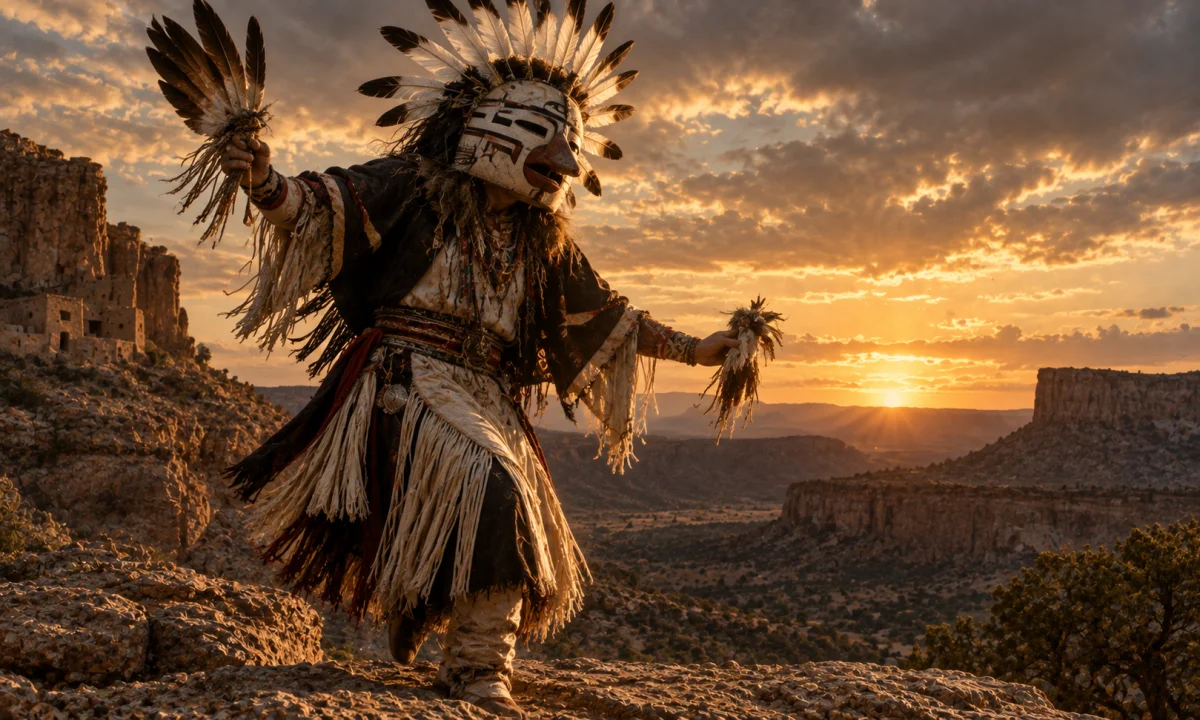
There is no single universally standardized appearance of Eototo comparable to the fixed illustrations of a character in a modern book. Mask design, colors, clothing, feathers, body paint, and accessories can vary according to local practice and the particular artist or performer. Museum objects and commercial carvings may also emphasize different features.
Older English-language accounts sometimes describe Eototo as a strikingly decorated male figure with a mask marked by strong contrasts and elaborate elements above or around the head. Such descriptions should be treated cautiously. A carved figure made for sale, a teaching image, and a mask used in a restricted ceremony do not necessarily have the same purpose or appearance. The phrase “Eototo doll” can therefore refer to an artistic representation rather than to a precise model of one official form.
Hopi carved figures are traditionally known in English as kachina dolls, although Hopi terminology distinguishes these objects from the spiritual beings and masked dancers they represent. Contemporary Hopi artists commonly use the term katsina carving or related wording, and many regard the carving as a teaching object, an artwork, or a representation rather than an idol used for worship. Earlier non-Hopi descriptions sometimes misunderstood these objects by placing them into categories such as “fetish” or “idol,” categories that do not accurately describe their place in Hopi life.
Authority, order, and renewal
Eototo’s traditional significance is closely tied to the idea that religious power must be approached through proper relationships and disciplined practice. As a chief-like katsina, he can symbolize the ordered cooperation of many spiritual forces. Rain, plant growth, health, and prosperity are not represented as automatic gifts. They depend on ceremonial knowledge, respectful conduct, communal participation, and the fulfilment of obligations.
This connection between authority and renewal is especially meaningful in the Hopi environment. Agriculture depends on seasonal rain, careful cultivation, and long-established knowledge of the land. Ceremonies involving katsinam address both spiritual and material concerns: they seek rain and abundance while also teaching children and initiates how the community understands its responsibilities.
Eototo’s status may consequently be interpreted on several levels. He is a powerful katsina; he is a leader among katsinam; he is a figure associated with the continuity of ceremony; and he represents the principle that spiritual forces operate within an ordered community. These interpretations are related, but none should be treated as a complete substitute for Hopi religious knowledge.
Stories and traditions
Eototo is not best known through a long cycle of individually titled myths. His importance appears more strongly in ceremonial performances, relationships among katsinam, and explanations of the katsina societies. This differs from traditions in which a god or hero is primarily known through a sequence of narrative adventures.
Some public accounts describe Eototo and Aholi as traveling together, overseeing other katsinam, or participating in events connected with initiation and the winter ceremonial season. Such accounts preserve broad features of their public representation, but they may omit sacred details or blend observations from different Hopi communities. A story told for general educational purposes should not be assumed to reproduce the complete content of a Hopi ceremony.
Hopi traditions are also not frozen in a single ancient form. Ceremonies have been maintained through periods of colonial pressure, missionary interference, cultural misunderstanding, and changes in village life. Their continued practice reflects adaptation as well as continuity. The fact that public descriptions differ does not necessarily indicate that one version is simply a “wrong myth”; it may reflect local variation, restricted knowledge, or the difference between ritual practice and an outsider’s written account.
Distinguishing Eototo from related figures
Eototo should not be confused with every figure called a “kachina” in popular writing. Katsina is a broad category, not the name of one being. Many katsinam have distinct names, appearances, ceremonial functions, and relationships with particular animals, weather phenomena, plants, ancestors, or social concerns.
Eototo is also distinct from Aholi, even though the two are frequently linked. Their partnership in some ceremonial representations does not make them two names for the same being. Aholi has his own identity and ceremonial significance. Nor should Eototo be merged with a generic “Kachina Chief” invented by modern catalogues or with a figure from another Pueblo tradition simply because the roles appear similar.
The Hopi are one of several Pueblo peoples with traditions involving masked ceremonial beings, but related practices among Zuni, Acoma, Laguna, and other Pueblo communities are not interchangeable. Similarities may reflect a broad regional history, while names, rituals, meanings, and restrictions remain specific to each community. Eototo belongs specifically to Hopi ceremonial tradition.
Sources of knowledge and cultural limits
Knowledge of Eototo comes through Hopi oral tradition, ceremonial practice, community teaching, artistic representation, and the observations of outside researchers. Written ethnographies and museum records can preserve valuable information, but they were often produced by non-Hopi observers who had limited access to religious life and sometimes interpreted Hopi concepts through Christian or classical categories. They should therefore be read as records of particular encounters, not as complete or final definitions of Eototo.
Many Hopi religious teachings are not intended for unrestricted publication. A public description may properly identify Eototo as a chief katsina while saying little about songs, prayers, mask preparation, initiation, or the precise actions performed in a kiva. This is not a lack of information to be filled by speculation. It is part of the cultural boundary surrounding sacred knowledge.
Respectful discussion also requires distinguishing a ceremonial impersonator from the individual who wears the mask. In ordinary social terms, the performer is a person from the community. In the ritual setting, however, he embodies Eototo according to established religious rules. Treating the mask as a costume or the ceremony as theatre alone misses the spiritual and communal dimensions of the performance.
Modern representations
Eototo appears in contemporary Hopi art, especially in carved representations produced by Hopi artists. These works may be made for teaching, personal expression, ceremonial use, or the art market, and their meanings are not identical. A commercially available carving should not automatically be treated as a sacred object, but neither should it be assumed that all representations are merely decorative.
The wider tourist use of the term “kachina” has often separated katsina figures from the religious setting that gives them meaning. Reproductions may be sold as generic Southwestern souvenirs, with inaccurate names or invented stories attached to them. Eototo is better understood through Hopi cultural context than through such generalized imagery. His significance rests on his place within a living ceremonial tradition, not simply on the visual appeal of a masked figure.
Modern popular culture has not established a single widely accepted version of Eototo comparable to a comic-book character or a fantasy-game creature. When he is removed from Hopi religious context and presented as a generic supernatural warrior, “chief,” or monster, the result is a modern invention rather than a faithful account of the traditional katsina.