WORLD
WORLD
Ahe’a
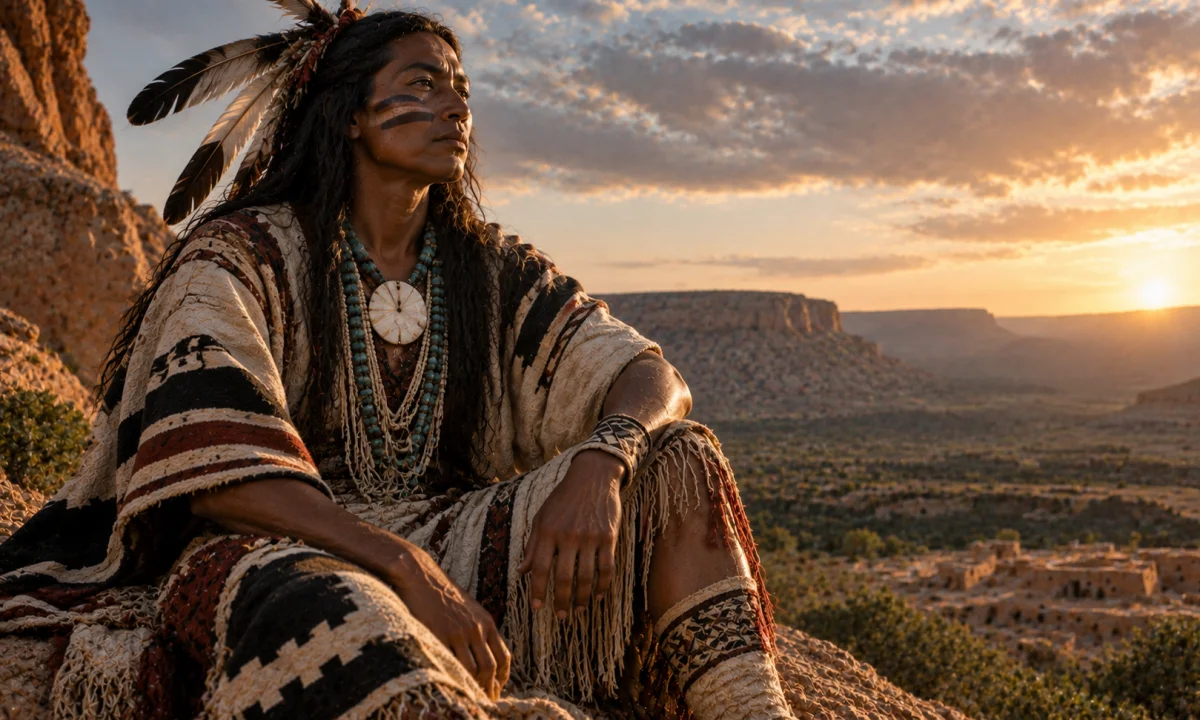
Ahe’a is a name associated in some modern references with Hopi religious tradition, but its identity is not securely established across the surviving documentation of Hopi culture. The spelling appears in several forms, including Ahe'a and Aheya, and different sources may use these forms for different beings—or may preserve a name inaccurately. It is therefore unsafe to describe Ahe’a as a universally recognized Hopi god, goddess, monster or hero.
The uncertainty surrounding Ahe’a is important because Hopi religious knowledge does not exist as a single, fixed mythology with one official list of characters. Hopi communities have maintained traditions through ceremonies, clan histories, oral teachings, songs, ritual performances and relationships with particular sacred beings. Names and descriptions can vary between villages, families, ceremonial societies and periods of documentation. English-language lists of “Native American gods” often remove names from that setting and assign them simplified roles that the original evidence does not support.
Hopi cultural setting
The Hopi are an Indigenous Pueblo people whose communities are located principally in northeastern Arizona. Hopi religious life is closely connected with the land, agriculture, seasonal ceremonial cycles and the responsibilities of living in harmony with other beings. Traditional knowledge includes accounts of emergence into successive worlds, the ordering of the cosmos, ancestral migrations, sacred places and the proper performance of ceremonies.
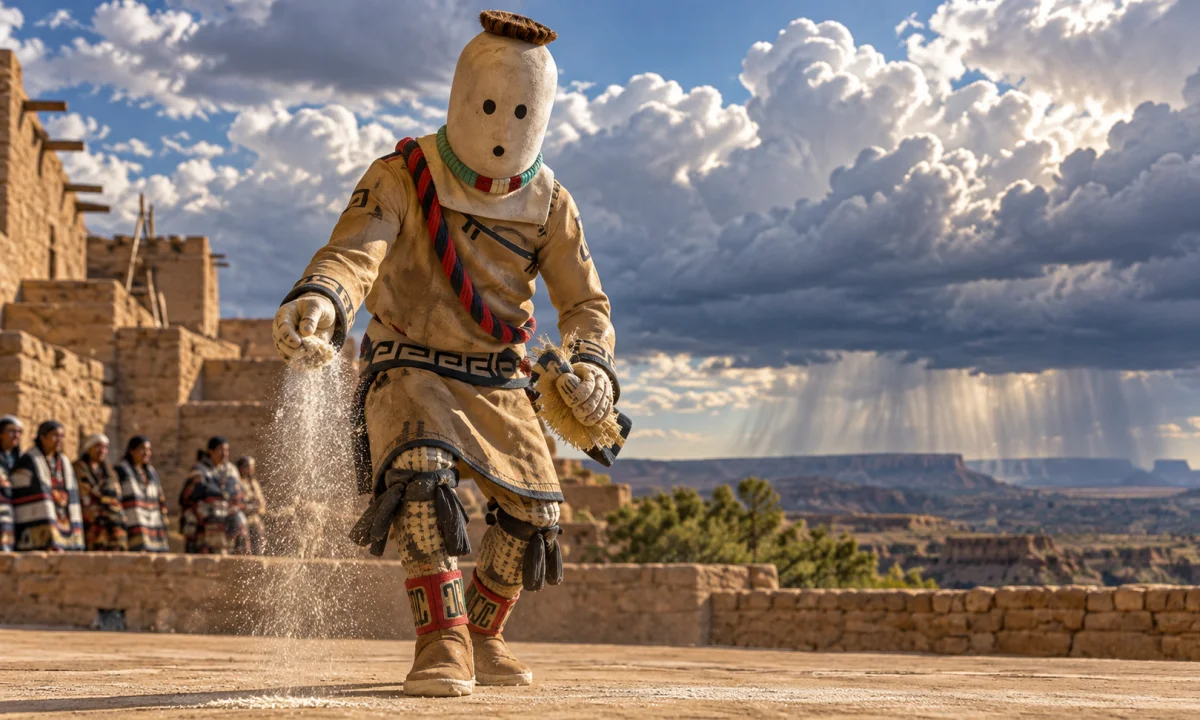
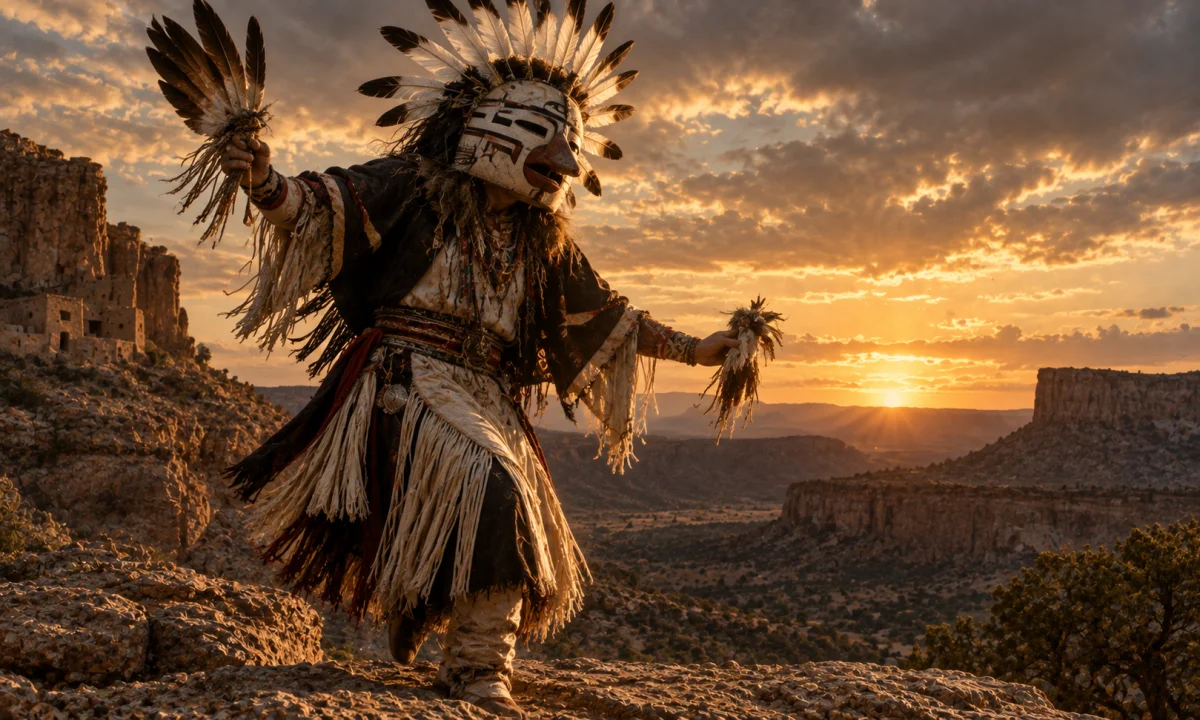
Hopi ceremonies often involve the katsinam, commonly written in English as kachinas. The singular term is frequently given as katsina, although English spelling and pronunciation vary. Katsinam are not simply characters in stories. They are sacred beings, powers or ancestral presences who may be represented by masked dancers during particular ceremonies. The dancers are understood within the ceremonial context to embody or manifest the katsina rather than merely perform a theatrical imitation.
Hopi religious knowledge has also been interpreted through outside categories such as “deity,” “spirit,” “demon” and “mythological creature.” Those categories can be misleading. A being connected with rain, fertility, clouds, animals, the dead or a ceremonial society may not fit neatly into the Western idea of a separate god with a fixed biography. The meaning of a name may depend on who is using it, where it is used and what ceremony or teaching surrounds it.
The name Ahe’a
The form Ahe’a contains an apostrophe that may represent a glottal stop or another feature of pronunciation in a particular transcription system. Older records, museum labels and popular reference works do not always mark Hopi sounds consistently. A name written as Ahe’a may therefore appear elsewhere without the apostrophe, with a different vowel, or with a spelling such as Aheya.
Spelling variation alone does not prove that all of these forms refer to the same being. Indigenous languages can contain names that look similar to outsiders while having different meanings. Conversely, a single traditional name may be rendered in several ways by non-Hopi writers. The forms should be compared only when the accompanying description, ceremonial setting and community context also agree.
There is no reliable basis for presenting Ahe’a as a major pan-Hopi creator, supreme deity or ruler of the underworld. Claims of that kind commonly arise when an isolated name is copied from an unspecialized mythology list and supplied with a generic function. Such descriptions should not be treated as established Hopi tradition without corroborating cultural and linguistic evidence.
Identity and classification
The precise classification of Ahe’a remains uncertain in widely available English-language material. Some modern references place the name among Hopi katsinam, while others give no ceremonial information at all. A name appearing in a catalogue of kachina figures does not by itself establish a complete mythological identity. Museum and commercial catalogues have sometimes used broad labels for carved figures, masks or dances, and those labels may reflect the catalogue-maker’s terminology rather than a full account of Hopi religious knowledge.
It is also important to distinguish a katsina from a katsintithu, often called a kachina doll in English. A katsina is a sacred being or presence connected with religious practice. A carved figure given to a child may represent a katsina and may teach the child to recognize ceremonial beings, but the object is not itself automatically the being. English-language discussions often collapse these distinctions and treat every carved figure as evidence for a clearly defined mythological character.
Without a dependable account of Ahe’a’s ceremonial role, appearance, songs, society, village distribution or associated narratives, it is not possible to assign the name confidently to a particular class. It may refer to a katsina, to a local or variant name, or to a transcription that has been separated from its original context.
Attributes and appearance
No single traditional appearance can be securely assigned to Ahe’a on the basis of the name alone. Images found online or in commercial listings should not be assumed to depict the same figure. Hopi ceremonial masks and clothing can carry meanings connected with clouds, animals, colors, directions, weather and ritual responsibilities. A visual similarity between two masks does not demonstrate that they represent the same katsina.
Descriptions of Hopi ceremonial beings also need to be handled carefully. A mask, body-paint pattern, feather, staff or dance movement may be meaningful within a particular ceremony, but its meaning cannot automatically be converted into a universal symbolic attribute. Nor should a ceremonial figure be described as having “powers” in the manner of a fantasy character. Rainmaking, agricultural renewal and healing are part of a wider network of religious relationships and obligations, not merely supernatural abilities possessed by an individual character.
For the same reason, unsupported claims about Ahe’a being male or female are best avoided. Hopi ceremonial traditions include beings and roles that do not correspond simply to modern Western gender categories. A name may also be connected with a masked performer, a ceremonial role or a represented presence without functioning as a personal identity in the ordinary sense.
Stories and relationships
No widely attested, standard narrative about Ahe’a can be identified with confidence from the name alone. In particular, there is no secure evidence that Ahe’a belongs in the well-known emergence narratives or that Ahe’a is a spouse, child, enemy or companion of figures such as Sotuknang, Spider Woman, Masaw or Tawa. Those beings belong to important bodies of Hopi traditional material, but attaching Ahe’a to them without a specific source would create a relationship that may not exist.
Hopi traditional accounts are not always organized as biographies. A being may appear in a ceremonial context, a teaching about correct conduct, an account of ancestral movement or a story explaining a relationship between humans and the natural world. The absence of a long narrative does not make such a being unimportant, and the presence of a story in an outsider’s book does not make that version authoritative for all Hopi people.
Some general accounts of Hopi religion describe katsinam as visiting villages during the ceremonial season and as being connected with rain, clouds, crops and the well-being of the community. These broad features belong to the religious setting of many katsinam and should not be treated as specific attributes of Ahe’a unless a particular tradition identifies them as such.
Why accounts of Ahe’a differ
Several historical factors can produce uncertainty around a name such as Ahe’a. Hopi knowledge was recorded by visitors who did not always understand the languages or ceremonial restrictions involved. Some information was given selectively, while other teachings were not intended for public explanation. Transcribers represented Hopi sounds through different English spelling systems, and early ethnographic records sometimes treated local terms as if they were names shared by every Hopi community.
Later reference works may copy one another without returning to Hopi speakers or to the original context. A short entry can then become the basis for a longer internet description, with invented details gradually presented as fact. The addition of a familiar label such as “goddess of,” “spirit of” or “guardian of” can make an uncertain name appear more definite than the evidence allows.
These problems do not mean that Ahe’a is meaningless or that every occurrence of the name is erroneous. They mean that the name must be treated as a question of cultural and linguistic context. The most responsible description is provisional: Ahe’a is a variably spelled name found in some modern accounts associated with Hopi tradition, but its exact referent and ceremonial identity are not consistently documented.
Distinguishing Ahe’a from related names
Ahe’a should not automatically be equated with every Hopi name that resembles it in English transcription. In particular, Aheya, Heheya and other similar-looking forms may represent separate names, dialectal spellings or errors introduced during copying. A resemblance in letters is not enough to establish identity.
Ahe’a should also be distinguished from better-documented Hopi figures whose names are sometimes included in the same generalized lists. Angwusnasomtaka, for example, is widely discussed as a powerful maternal katsina associated with the ceremonial katsina community. Ahola and Eototo are prominent ceremonial figures in published descriptions of Hopi traditions. Their relatively familiar status does not clarify the identity of Ahe’a, and details belonging to them should not be transferred to an uncertain name.
Nor should Ahe’a be confused with the broad category of “kachina,” with carved kachina figures, or with the Hopi concept of a sacred being in general. These terms describe different levels of classification. Treating them as interchangeable obscures the ceremonial and community-specific nature of Hopi religion.
Cultural significance
The most significant lesson offered by the uncertain record of Ahe’a concerns how Indigenous religious traditions are classified. Hopi ceremonial knowledge is not merely a collection of supernatural characters available for extraction from their cultural setting. It is part of an active religious system involving community responsibilities, seasonal observance, relationships with the land and the transmission of knowledge between generations.
Respectful discussion therefore requires more than finding an English spelling and assigning a role. It requires attention to who recorded the name, which Hopi community or ceremony was involved, how the name was pronounced, and whether the information was intended for public explanation. When those details are unavailable, uncertainty is more accurate than a confident but unsupported biography.
For Ahe’a, the evidence currently available in general English-language reference material does not justify a fixed appearance, genealogy, domain or canonical story. The name is best presented with its spelling variants and documentary uncertainty intact, rather than turned into a conventional fantasy-style deity. Any more specific interpretation would need to be grounded in a clearly identified Hopi tradition and in the cultural context in which the name is used.