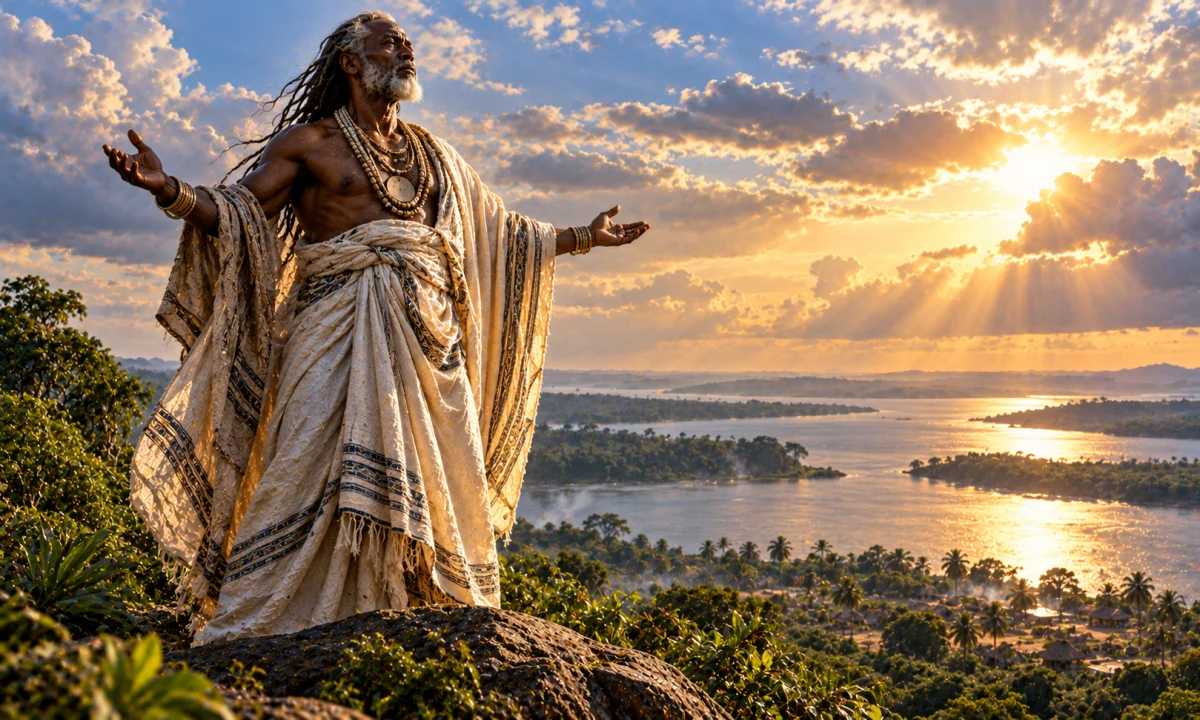
WORLD
WORLD
Soko
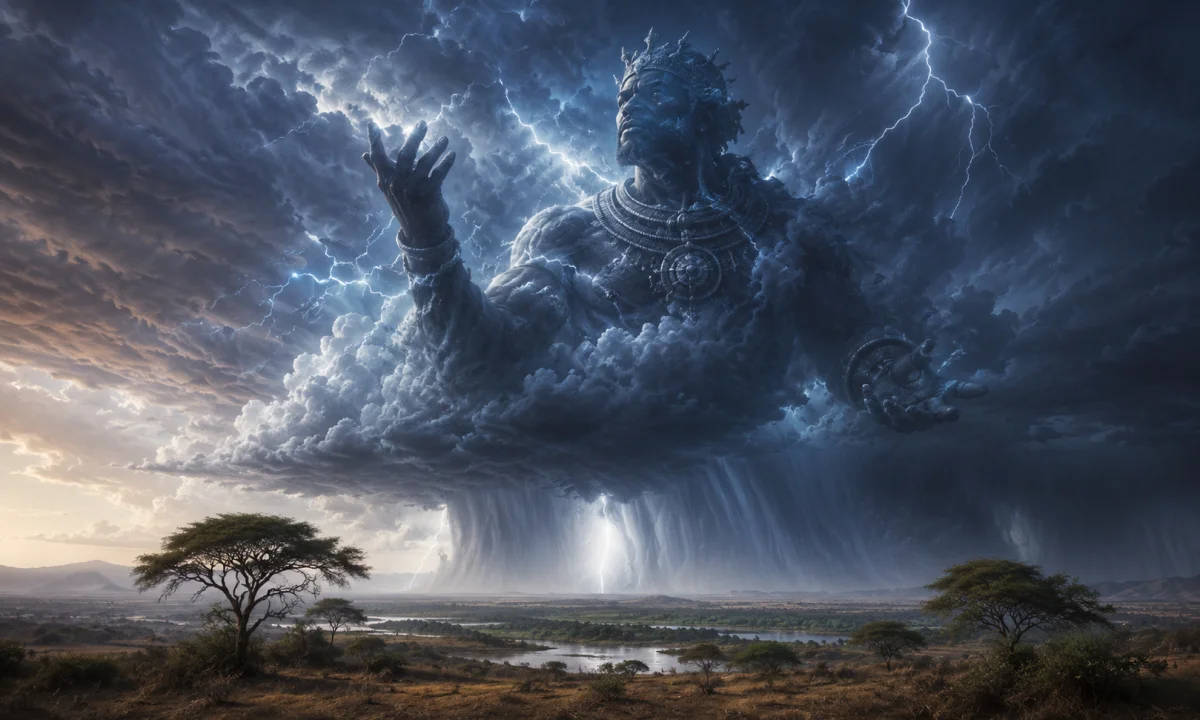
Soko is a name associated primarily with the supreme creator being of the Nupe people of central Nigeria. In accounts of traditional Nupe religion, Soko is understood as the source of the world and of life, often described in terms comparable to a high god or sky deity. The available descriptions are limited and vary in emphasis, however. Soko is not a universally shared African god, nor should the name be treated as the title of one deity worshipped throughout the continent.
Origins and cultural setting
The Nupe, also called the Nupé, are a people whose historic homeland lies mainly around the middle Niger River and parts of the Niger–Benue region of Nigeria. Their cultural centre has traditionally included areas around Bida and the surrounding Niger State region. Nupe society has long combined farming, fishing, crafts, trade, political institutions and religious practices shaped by contact with neighbouring peoples.
Traditional Nupe religious ideas were transmitted chiefly through oral teaching, ritual practice, family knowledge and community specialists rather than through a single canonical scripture. As a result, accounts of Soko do not form one uniform mythology with a fixed set of stories. Early descriptions by outsiders also used terms such as “God,” “creator” or “supreme being” to translate Nupe concepts into European religious vocabulary. Those translations are useful but cannot always show the full meaning of the original tradition.
Islam became highly influential among the Nupe, especially through the growth of Muslim political power in the nineteenth century and the development of the Bida emirate. Islam did not erase every older religious idea or practice immediately. In many African societies, older concepts of a creator, spirits, sacred places and ancestors continued to influence local religious life even when people identified primarily as Muslims or Christians. The relationship between Soko and later religious beliefs therefore belongs to a history of adaptation and reinterpretation, not to a simple replacement of one system by another.
Name and identity
Soko is generally presented as a Nupe name for the creator or supreme deity. The word is sometimes treated in English-language summaries as though it were the equivalent of a fully documented personal name. That description should be used carefully. In an oral religious tradition, a divine name may also function as a title, a description of divine power or a conventional way of referring to the highest spiritual reality.
Descriptions of Soko commonly place the deity above the other spiritual beings recognised in traditional Nupe belief. Soko is associated with the creation of the world and with the origin of living things. Some accounts portray the deity as remote from ordinary human affairs, while others stress continuing dependence on divine power for existence, fertility and the order of nature. These emphases are not necessarily contradictory: a high god may be regarded as the ultimate source of life while worshippers approach more immediate spiritual powers in everyday ritual.
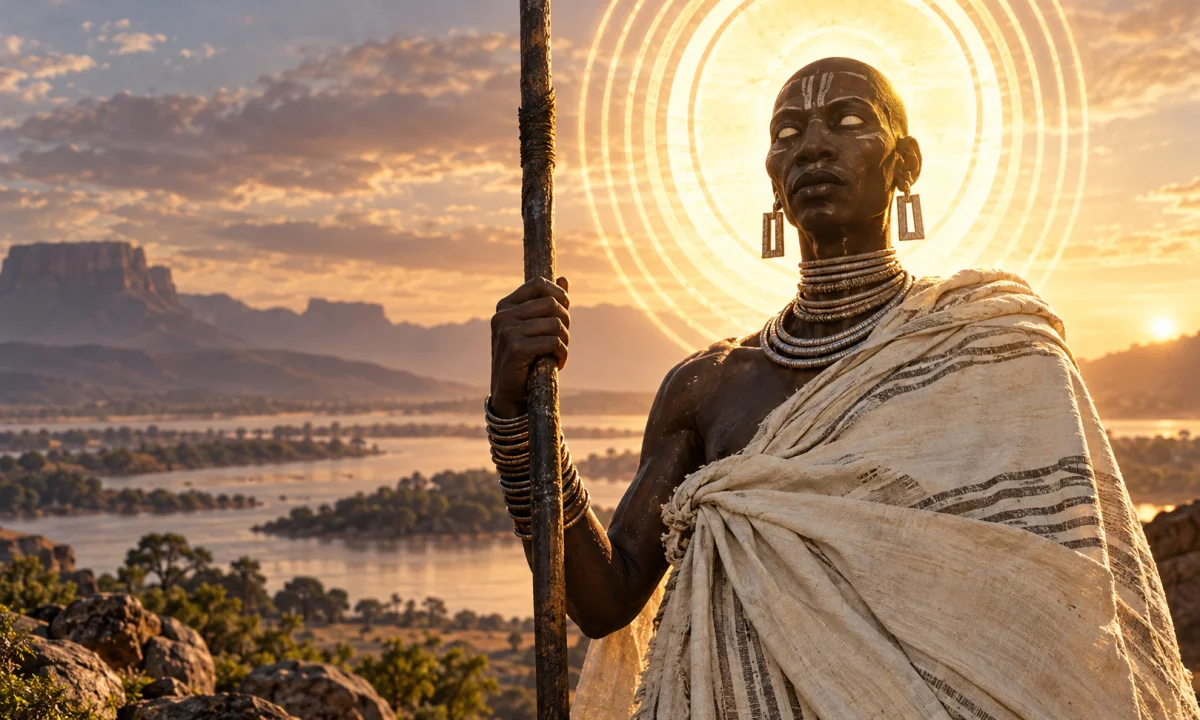
There is no secure basis for assigning Soko a single standard appearance. The traditions most often discussed do not provide a consistent human form, costume, animal shape or physical dwelling comparable to the detailed iconography of some ancient Mediterranean gods. Soko is better understood as a transcendent or cosmic being than as a hero who regularly appears in the form of a human character.
Soko as creator and high god
The central feature of Soko is the role of creator. In broad terms, Soko represents the power responsible for the existence of the heavens, the earth and living beings. This makes Soko a figure of ultimate origin rather than a specialised spirit concerned with only one activity, such as war, hunting, rivers or craft.
Accounts of African creator beings often describe creation in concise theological statements rather than in long narrative myths. The same appears to be true of much of the surviving material about Soko. The tradition is important because it expresses a view of the universe as dependent on a supreme source, even though it does not preserve a large cycle of detailed creation episodes. Claims that Soko has a complete, standardised biography or an extensive series of adventures go beyond what the evidence securely establishes.
The title “sky god” is sometimes used for Soko. Such a description does not necessarily mean that Soko was imagined as a weather spirit or as a personification of the visible sky. In many religious systems, the sky is associated with height, transcendence, distance and authority. A deity connected with the sky may therefore be understood as one who stands above the human world and governs the cosmic order.
Rain, fertility and agricultural life could naturally be interpreted in relation to a creator who gives or sustains life, particularly in a farming society. Nevertheless, Soko should not automatically be classified as an agricultural god. The available descriptions more securely support the broader role of creator and supreme deity. Specific claims about a distinctive agricultural cult, a fixed festival calendar or a particular set of offerings require evidence from a clearly identified Nupe source.
Relationship with other spiritual beings
Traditional Nupe religious life included more than belief in a supreme creator. As in many West African traditions, the spiritual world could include spirits connected with natural features, places, communities and particular kinds of danger or benefit. Ancestors also held an important place in many forms of African religious thought, although the exact role of ancestors and local spirits varied by community, family and period.
Soko's position in this wider structure is usually described as superior to such beings. A remote creator may not be the spirit most directly approached in every ordinary ritual. People may turn to ancestors, local powers or ritual specialists because these are understood as closer to human affairs. This does not necessarily reduce the status of Soko. Instead, it places the creator at the highest level of a layered religious universe.
It is important not to assume that every intermediary spirit was a child, servant or named companion of Soko. The sources do not provide a stable divine family comparable to the genealogies of Greek or Norse mythology. Nor is there a well-established body of stories giving Soko a spouse, offspring, enemies or a distinctive court of gods. Later summaries sometimes fill this gap by arranging African religious figures according to familiar categories, but such arrangements can make separate traditions appear more systematic than they were in practice.
Worship and religious significance
The limited information about Soko makes it difficult to reconstruct a single form of worship. There is no universally accepted description of one temple, image or priesthood dedicated exclusively to Soko. This absence should not be interpreted as proof that the deity was unimportant. A high god may be honoured through prayers, moral customs, seasonal observances, family rites or respect for the natural and social order without requiring a monumental shrine.
In many African religious traditions, the creator is regarded as too distant or exalted to be approached in the same way as a local spirit. Ritual action may therefore be directed toward powers believed to mediate between humans and the supreme source of life. Where this pattern is applied to Soko, it should be treated as an interpretation of the religious structure rather than as a universally documented rule of Nupe worship.
Soko can be understood symbolically as expressing several connected ideas:
- Origin: all life and the ordered world depend upon a creative power beyond humanity.
- Transcendence: the highest deity is not limited to one village, river, profession or natural object.
- Cosmic order: the world is not regarded as accidental or without spiritual meaning.
- Human dependence: communities remain dependent on forces they cannot fully control, including life, death, weather and the fertility of the land.
These themes are interpretive rather than a list of fixed doctrines. Nupe religious thought was not preserved as a single creed, and the significance of Soko could differ according to the speaker, historical period and religious context.
Stories and the limits of the evidence
Soko is less famous for an extensive narrative cycle than for the theological role attached to the name. Popular mythology websites sometimes present short creation stories in which Soko makes the earth, creates human beings and establishes the division between the divine and human worlds. Such summaries may reflect broad traditional ideas, but they should not automatically be treated as verbatim Nupe myths or as evidence of a single canonical version.
The Nupe tradition also includes important historical and legendary figures who should not be confused with Soko. Tsoede, for example, is associated with Nupe royal and political traditions and with stories about the formation of Nupe power. A culture may preserve both stories about a human founder and beliefs about a supreme creator, but the two figures serve different functions. Tsoede belongs to political and heroic tradition; Soko belongs to religious explanations of ultimate origin.
Because oral traditions change through performance and transmission, different communities may emphasise different aspects of a deity. Muslim and Christian interpretations, colonial descriptions, local memory and modern educational writing have also affected how Soko is represented. A careful account should therefore distinguish between a generally repeated identification of Soko as creator and more detailed claims that lack consistent documentation.
Distinguishing Soko from similar names and figures
Soko should not be treated as another name for every African creator god. West and Central Africa contain many traditions with supreme beings, but these figures belong to distinct languages and cultures. Yoruba traditions speak of Olodumare or Olorun; Igbo traditions commonly refer to Chukwu or Chineke; Akan traditions include Nyame; and Fon religious traditions associate creation with Mawu-Lisa. These figures may share themes such as supreme power, creation or distance from ordinary human life, but shared themes do not make them the same deity.
The name can also be confused with Sokoto, the city and region in north-western Nigeria and the historical Sokoto Caliphate. Similar spelling does not establish a religious identity or common origin. Soko should be discussed specifically in relation to Nupe tradition unless a source clearly identifies another cultural context.
Nor should Soko be confused with the word “soko” as it appears in other African languages or with unrelated personal names and place names. African languages are numerous, and the same sequence of sounds can have entirely different meanings in different linguistic communities. Correct identification requires attention to the people, language and source associated with the name.
Modern interpretation
In modern reference works, Soko is often placed under the broad label “African mythology.” That label is convenient, but Africa contains thousands of cultural and religious traditions rather than one unified mythology. Presenting Soko as “the African creator god” would erase the specifically Nupe setting in which the name is meaningful.
Contemporary retellings may also describe Soko using categories borrowed from comic books, fantasy fiction or comparative mythology. Such treatments can make the figure easier to recognise, but they may add powers, symbols, family relationships or dramatic stories that are not established in Nupe tradition. A responsible modern presentation keeps those creative interpretations separate from the historical and religious evidence.
Soko's importance lies less in a large collection of surviving adventures than in the way the name preserves a Nupe understanding of ultimate creative power. The tradition points toward a supreme source of the world while leaving much of the deity's character outside the detailed narrative and visual forms familiar from other mythologies.