WORLD
WORLD
Payatamu

Payatamu is a figure associated with Hopi religious tradition, especially with flute playing, music, seasonal growth and the ceremonial renewal of life. The name is also written Paiyatamu and in other variant forms. In many modern descriptions, Payatamu is called a Hopi “kachina,” although katsina is the more accurate form for the spirit beings and ceremonial figures of Hopi tradition. His identity and attributes are not presented in one universally fixed account, and descriptions can differ according to community, ceremony, language and source.
Hopi religious and cultural setting
The Hopi are an Indigenous Pueblo people whose villages are located in northeastern Arizona. Hopi religious life is closely connected with the land, agriculture, rainfall, seasonal change and the responsibilities that link human communities with spiritual powers. Ceremonies are not simply performances or theatrical retellings of myths. They are part of a living religious system involving prayer, discipline, communal obligations and the maintenance of harmony.
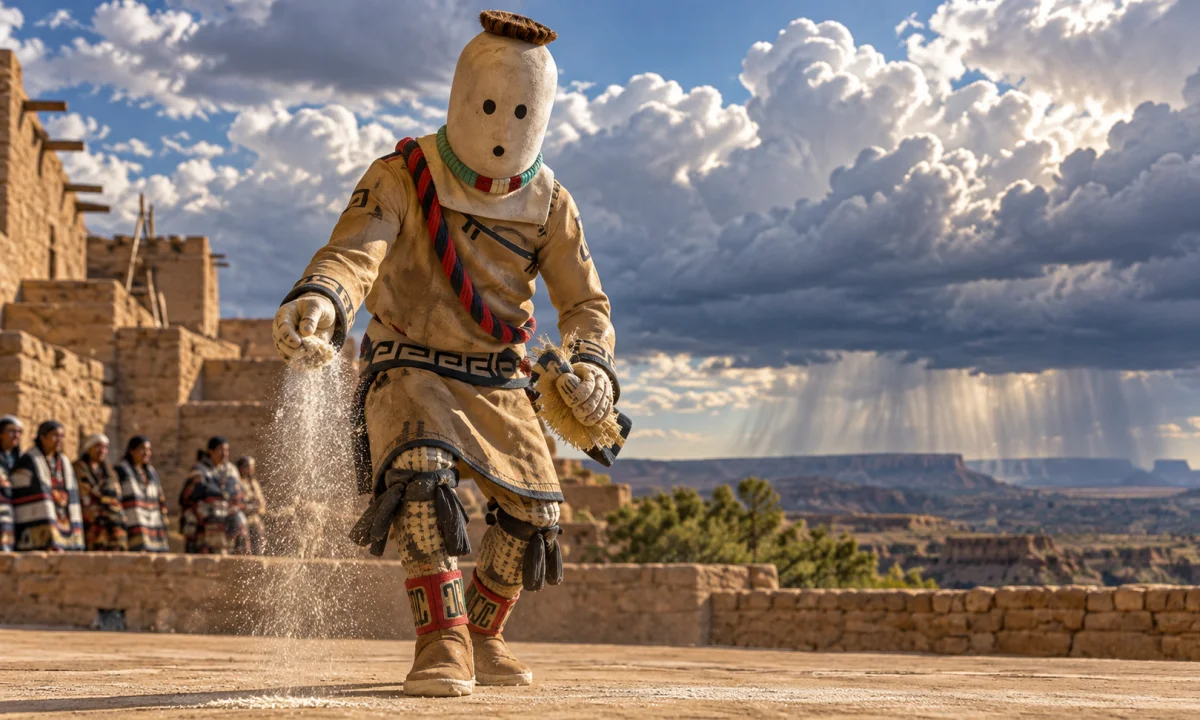
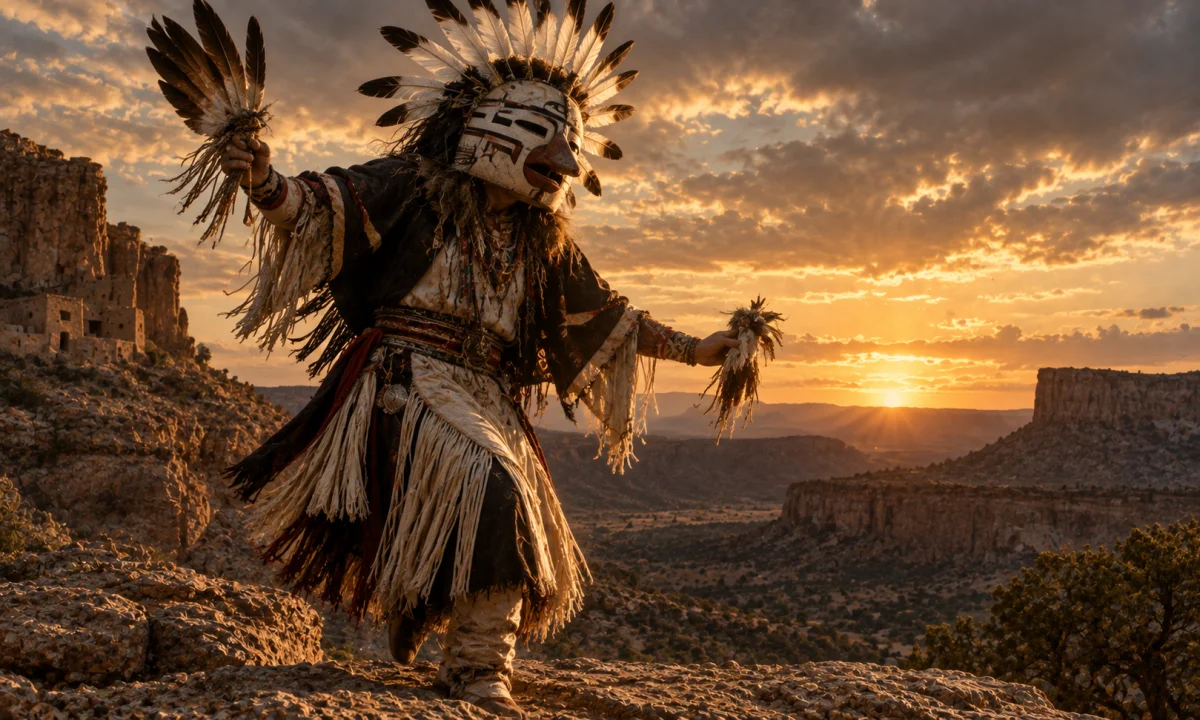
Within this system are the katsinam, often rendered in English as “kachinas.” Katsinam are spiritual beings connected with natural forces, ancestors, places, animals, plants, weather and other aspects of existence. During appropriate ceremonial seasons, men who have received the necessary instruction may represent these beings by wearing masks and regalia. The masked person is not merely pretending to be a character. In the ceremonial context, the dancer is understood to manifest or embody the presence of the katsina.
Hopi children may also receive carved wooden figures representing katsinam. These objects are frequently called kachina dolls in English, but the traditional term tithu is often preferred in discussions of Hopi usage. Such figures teach children to recognise the beings and to understand their place in Hopi religious life. They should not be confused with idols in the simplistic sense of objects worshipped independently of ceremony and community practice.
Payatamu belongs within this wider network of katsina traditions rather than standing outside it as an isolated deity. English-language sources sometimes describe him as a “god” of music, fertility or rain. Those labels can be useful shorthand, but they may obscure the specifically Hopi understanding of katsinam as spiritually powerful beings involved in relationships among people, the natural world and the sacred order.
Name and identity
The spelling Payatamu is common in general reference works, while Paiyatamu and other spellings also occur. English transcriptions of Hopi names vary because Hopi sounds and grammatical forms are not always represented consistently in older publications. A spelling difference does not necessarily indicate a different being, but neither should every similar-looking name automatically be treated as identical. The available descriptions are not uniform enough to support a single definitive biography.
Payatamu is most often identified as a flute-playing katsina. Some accounts connect him with music and dance, while others emphasise the generative powers associated with the flute, springtime, crops and human fertility. These themes overlap in Pueblo ceremonial thought, where music is not merely entertainment. Sound, movement and prayer can participate in the renewal of the world and in the appeal for rain and agricultural abundance.
It is therefore safer to describe Payatamu as a flute-associated katsina with connections to growth and ceremonial renewal than to assign him a rigid office equivalent to a European-style god of music. The details of his role may be emphasised differently in different accounts, and published summaries sometimes expand a limited ceremonial identification into a much broader mythological profile.
Flute, rain and agricultural renewal
The flute is the most recognisable attribute associated with Payatamu. In Hopi and other Pueblo traditions, flute music can carry religious meaning connected with attraction, communication, growth and the arrival of life-giving moisture. The instrument’s sound may be understood symbolically as a call or prayer, particularly in a landscape where farming depends on carefully timed rainfall.
Payatamu’s association with the flute has consequently led writers to connect him with rain, fertility and the growth of plants. These associations should not be interpreted as a simple mythological equation in which one being controls one natural resource. Hopi ceremonial life involves many beings, societies and ritual actions, and rain is part of a larger moral and communal relationship rather than a commodity controlled by a single supernatural ruler.
The connection with fertility can have several dimensions. It may refer to the germination and growth of crops, the continuation of human communities and the general renewal of life after a dry or dormant period. Modern summaries sometimes reduce this symbolism to sexual fertility alone, but that narrow interpretation does not adequately express the agricultural and communal meanings attached to seasonal renewal.
Music also has a social dimension. A flute-playing figure can represent the union of artistic expression, prayer and communal participation. The sound of the instrument is not simply an ornament added to a ceremony; it helps establish the atmosphere and purpose of the event. In this context, Payatamu is significant because he brings together sound, movement, seasonal change and hopes for the continuation of life.
Appearance and ceremonial representation
There is no single universally standardised portrait of Payatamu comparable to the fixed iconography of a figure in a widely circulated written scripture. Descriptions of his appearance usually focus on his role as a flute player and on the mask or costume used in a particular ceremonial setting. A representation may therefore vary according to the tradition being followed, the community involved and the artistic conventions of the carver or dancer.
Painted and carved representations commonly show a human-like katsina holding or playing a flute. The details of facial paint, clothing, headdress and other equipment should not be assumed to have one timeless meaning in every example. A museum label or commercial catalogue may identify a figure as Payatamu on the basis of a particular regional or ethnographic classification, while Hopi knowledge holders may place greater importance on the ceremony and relationships in which the being appears.
The wooden figures made for teaching are also not exact substitutes for the masked ceremonial presence. They provide a way for children to learn the forms and names of katsinam, but a carved figure does not by itself reproduce the full religious event. The meaning of Payatamu is therefore found not only in his visible attributes but also in the actions, songs, dances and obligations connected with his appearance.
Stories and variants
Payatamu is not associated with one single, universally accepted narrative that functions as his definitive myth. Hopi traditions include accounts of emergence, migration, encounters with spiritual beings, the establishment of ceremonies and the proper conduct of human communities. Much of this knowledge has been preserved through oral teaching and ritual practice rather than through a canonical written mythology.
Public descriptions of Payatamu often consist of a short identification—usually “flute player,” followed by references to fertility, rain or music—rather than a cycle of detailed stories. When a source presents a more elaborate account, it is important to ask whether the material comes from a specific Hopi tradition, an ethnographer’s interpretation, a museum classification or a later popular retelling. These categories are not interchangeable.
Hopi ceremonial knowledge has also not historically been intended for unrestricted publication. Some religious teachings are reserved for initiated people or for particular societies and ceremonies. Consequently, the limited public information available about Payatamu should not be taken to mean that the figure has no deeper significance. It may instead reflect the boundaries surrounding the transmission of sacred knowledge.
Accounts may also vary in the way they classify Payatamu. One writer may call him a deity, another a kachina, another a spirit of the flute, and another a ceremonial dancer. These descriptions can be attempts to translate Hopi religious concepts into categories familiar to English-speaking readers, but they do not necessarily carry the same implications within Hopi tradition.
Cultural significance
Payatamu’s importance lies less in a list of supernatural powers than in the relationships represented by his flute. Music connects the human community with the seasonal world, while agricultural growth connects religious practice with everyday survival. The figure therefore belongs to a tradition in which spirituality is woven into farming, weather, education, family life and communal responsibility.
The flute can also be understood as an emblem of communication. Its sound moves through the open air and can symbolise a message directed toward spiritual powers or toward the wider living world. This does not mean that Hopi tradition treats the instrument as a magical device operating independently of proper ritual conduct. Ceremonial effectiveness depends on knowledge, preparation, community participation and the ethical order that gives prayer its meaning.
Payatamu also illustrates why the word “mythology” must be used carefully. In ordinary English, mythology can suggest a collection of old fictional stories. For Hopi communities, religious narratives and ceremonies are part of an ongoing cultural and spiritual inheritance. A catalogue of characters separated from their ceremonial context may be convenient for reference, but it can make a living tradition appear more static and more uniform than it is.
Distinction from Kokopelli and other flute figures
Payatamu is frequently confused with Kokopelli, the humpbacked flute player widely known through modern Southwestern art and tourism. The two figures should not be automatically merged. Kokopelli is a name associated especially with imagery derived from ancient rock art and with traditions among several Pueblo and other Indigenous peoples of the American Southwest. The meaning and history of those images are complex, and the modern pan-Southwestern version of Kokopelli is not a direct equivalent of every Pueblo flute-playing being.
Payatamu belongs specifically to Hopi religious and ceremonial contexts. Similarities between the figures—particularly the flute and associations with fertility—have encouraged popular writers and artists to treat them as interchangeable. That comparison can erase important differences among Hopi, Ancestral Pueblo and other Indigenous traditions. A shared motif does not prove that two beings are the same, nor does it establish that one tradition borrowed its figure directly from another.
Payatamu should also not be confused with every katsina who carries a flute or appears in a ceremony involving music. Katsina names, forms and functions can be difficult to classify from photographs or commercial descriptions alone. Identification depends on knowledge of the relevant tradition, not simply on whether a carved figure holds an instrument.
Later representations and popular culture
Payatamu appears mainly in reference works, collections of Hopi katsina figures, museum displays and discussions of Pueblo religion rather than in major mainstream films, novels or games. In these settings, he is often reduced to a generic “kachina god of music” or a fertility figure. Such descriptions may preserve part of his commonly reported profile, but they can detach him from Hopi ceremony and from the wider responsibilities associated with katsina traditions.
Commercial art has also encouraged a broad market for labelled kachina carvings. A carving identified as Payatamu may be valuable as an example of a particular artist’s work or ceremonial style, but it should not be treated as a complete statement of Hopi theology. The category “kachina” has often been used by outsiders as if it referred to a single fixed pantheon, whereas Hopi religious knowledge is more contextual, communal and varied.
Responsible discussion of Payatamu therefore keeps several distinctions in view: the difference between Hopi religious tradition and outside classification; the difference between a ceremonial katsina and a carved teaching figure; and the difference between a documented association with flute, growth and renewal and later claims that assign the figure a fully developed mythology unsupported by reliable tradition.