WORLD
WORLD
Kokopelli
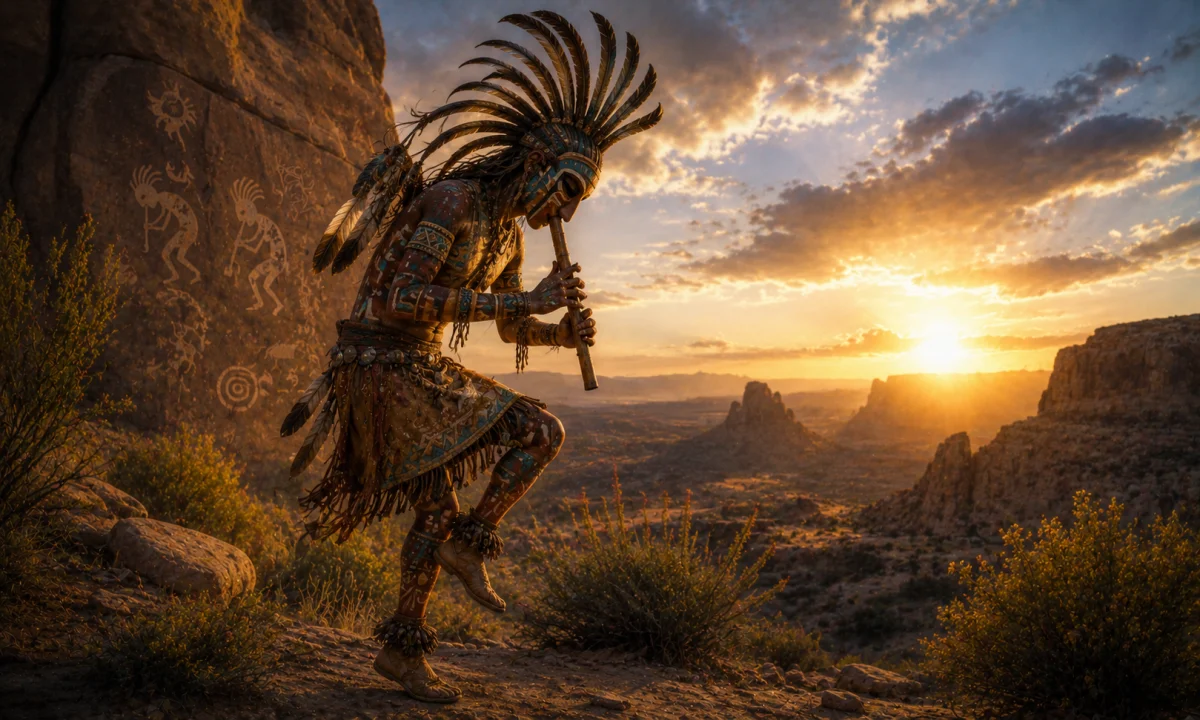
Kokopelli is the name commonly given to a humpbacked flute player associated with the ancient and modern Indigenous cultures of the American Southwest. He is especially linked in popular accounts with the Hopi, although the figure’s history is more complex than the label suggests. Images of humpbacked musicians occur in rock art and other archaeological settings across the Southwest, and their original names, meanings and ceremonial roles are not always known. “Kokopelli” is therefore best understood as a modern umbrella name applied to a family of related-looking images and traditions rather than as the universally accepted name of one clearly defined deity.
Cultural setting
The Hopi are an Indigenous Pueblo people whose homeland is in northeastern Arizona. Hopi religious life is closely connected with seasonal ceremonies, rain, agriculture, ancestral presence and the responsibilities that bind people to their communities and landscape. Ceremonial knowledge is not a single public mythology, and many religious practices are understood through particular societies, villages, families and ritual contexts.
The broader Pueblo world includes several culturally distinct peoples, including the Zuni, Acoma, Tewa, Keres and others. Similar-looking figures can appear across this region without necessarily representing the same being. Ancient rock art also predates the modern identities of many present-day Pueblo communities. For that reason, it is unsafe to assume that every flute player carved on a cliff or painted on pottery was specifically a Hopi figure.
Hopi and other Pueblo traditions are often discussed in connection with katsinam, commonly rendered in English as kachinas. Katsinam are spirit beings associated with rain, clouds, agricultural fertility, ancestors and ceremonial relationships. During public ceremonies, masked dancers may embody particular katsinam, while carved figures made for children are often called katsina dolls. The exact status of Kokopelli in relation to Hopi katsinam is not uniform in modern descriptions. Some popular accounts identify him as a Hopi fertility or rain spirit, while other interpretations treat “Kokopelli” as a later name for a visual motif that cannot be confidently assigned to one Hopi religious category.
Ancient images of the flute player
Humpbacked anthropomorphic figures appear in rock art throughout parts of the American Southwest. They are found among petroglyphs, pictographs and archaeological representations associated with Ancestral Puebloan and other regional cultures. Some images show a figure apparently playing a flute; others show a bent-backed person carrying a burden, dancing, standing with raised arms or accompanied by marks whose significance is uncertain.
The term Ancestral Puebloan refers to the societies that built settlements and produced art in the region before the emergence of the modern Pueblo peoples. Archaeologists can sometimes estimate the age of rock art through its relationship to dated surfaces, patination, nearby structures or other evidence, but the meaning of an individual image is much harder to establish. A figure that resembles the modern popular image of Kokopelli may be many centuries old, yet its original name and story may not have survived in a form that can be securely documented.
Some researchers have proposed that the humpback represents a burden basket or pack rather than a physical deformity. In this interpretation, the person may be a travelling merchant, a bringer of valuable goods or a visitor arriving from another community. Other readings emphasize the flute, dance or apparent sexual symbolism. Because the images were created in different places and periods, no single explanation necessarily applies to all of them.
The name “Kokopelli”
The origin and early history of the name are uncertain. “Kokopelli” is often presented as a Hopi word, but the spelling used in English does not by itself establish a precise Hopi etymology. English-language forms may reflect transcription, adaptation or commercial standardization, and different writers have proposed different explanations for the name. The name is also sometimes connected with forms such as Kokopilau, though the relationship between these terms and particular Indigenous traditions is not consistently documented.
It is important not to treat the name as proof that all ancient flute-player images belonged to the Hopi or that they all represented one supernatural being. A name applied by later observers, artists, museum displays or tourism businesses can gather together images that originally had different meanings. The modern popularity of “Kokopelli” has made the word familiar across North America, but familiarity should not be confused with a complete historical record.
Appearance and attributes
The standard modern image shows a small, humpbacked figure in profile, holding a flute to his mouth. He may have a feathered headdress, a crest, antenna-like ornaments, a large nose, thin limbs or a dancing posture. Some versions show a bundle or pack on his back. Others portray him as a lively traveller with a prominent phallus, a feature that has become common in certain modern interpretations but is not present in every ancient image.
The flute is the most consistent attribute in the popular representation. Music can suggest movement, attraction, celebration and communication, but its precise meaning varies. In modern retellings, Kokopelli’s playing is often said to call spring, bring rain, encourage crops to grow or awaken desire. These associations are plausible within a broadly agricultural and ceremonial setting, yet they should not be presented as one universally preserved doctrine.
The bent back has also received several interpretations. It may represent a pack carried by a travelling trader, an exaggerated artistic posture or a supernatural body. Some modern stories say that the pack contains seeds, songs, babies or gifts. Such details are widespread in retellings, but they are not equally supported by archaeological evidence or by a single, consistent body of Hopi oral tradition.
Roles attributed to Kokopelli
Traveller and trader
One interpretation presents the flute player as a travelling merchant who arrives from distant places carrying goods, news and songs. Exchange was important among the peoples of the Southwest, where communities traded agricultural products, stone, shell, pottery and other materials across considerable distances. A humpbacked figure carrying a pack can therefore be read as a symbolic visitor or trader.
In popular storytelling, the trader’s burden has become a magical bundle filled with seeds, fertility or unborn children. The image of a visitor bringing abundance fits the figure’s later reputation, but the surviving ancient images do not explain their own symbolism. The trader interpretation remains an informed possibility rather than a universally established identification.
Bringer of rain and fertility
Because Pueblo agriculture depends heavily on seasonal rain, fertility and renewal are central concerns in many regional religious traditions. Modern descriptions frequently call Kokopelli a fertility deity, rain bringer or agricultural spirit. His flute is said to melt winter, summon clouds or make plants grow, while his arrival marks the return of abundance.
These associations connect naturally with the wider Pueblo emphasis on rain and agricultural balance. They should not, however, be reduced to a simple “fertility god” label. Pueblo religious beings may have several overlapping responsibilities, and fertility can refer to crops, animals, people, community relationships and the continuity of ceremonial life. In addition, the specific role assigned to a figure may differ between communities and periods.
Music, courtship and sexuality
Another group of interpretations emphasizes courtship and sexual vitality. In some modern stories, Kokopelli plays music to attract young women, and his visit is linked with pregnancy or marriage. His exaggerated body and occasional phallic depiction have encouraged comparisons with fertility figures from other cultures.
Such comparisons can be misleading when they treat sexuality as the figure’s only or primary meaning. Ancient Pueblo imagery does not come with explanatory captions, and the presence of a flute or an unusual body shape cannot by itself prove a story about seduction. Modern artists and writers have also amplified erotic elements that may have been less prominent, or understood differently, in older traditions.
Stories and variations
There is no single canonical Kokopelli myth comparable to a fixed literary cycle. Different retellings describe him as a musician, a trader, a rainmaker, a fertility spirit, a mischievous visitor or an ancestor-like figure. Some stories say that his music brings spring and rain; others focus on his ability to carry seeds or blessings from one settlement to another. These narratives circulate widely in popular books, educational materials and tourism, but their attribution to a specific Hopi ceremonial tradition is often unclear.
Hopi oral traditions themselves are not simply a collection of public stories detached from ritual life. Narratives may be connected with particular ceremonies, societies, landscapes and responsibilities. Some knowledge is intended for specific cultural contexts rather than unrestricted publication. Consequently, a short popular account that presents Kokopelli as a fully standardized Hopi god may flatten a much more varied and carefully situated religious world.
The name may also be applied to images that modern observers believe to be related but that could have represented different beings. A flute-playing figure from one archaeological site should not automatically be identified with a figure from another site, and neither should automatically be equated with a contemporary ceremonial personage.
Relationship to other Pueblo figures
Kokopelli is sometimes confused with a general “kachina,” but these terms do not mean the same thing. Katsina is a broad Hopi and Pueblo religious category with many distinct beings and ceremonial embodiments. A modern image of Kokopelli may borrow visual features associated with katsina dolls or ceremonial dancers, but that does not establish that every Kokopelli representation is a katsina, or that the figure holds the same place in every Pueblo community.
Nor should Kokopelli be treated as a Native American equivalent of a generic European fertility god. Pueblo traditions developed within their own histories, landscapes and ceremonial systems. Similar themes—rain, crops, music, sexuality and renewal—occur in many religions, but shared themes do not demonstrate identical identities or origins.
Interpretation and cultural significance
Kokopelli’s enduring appeal comes partly from the openness of the image. A bent traveller playing a flute can evoke movement between communities, the arrival of rain, the circulation of songs and the renewal of life. The figure also reflects the importance of sound and performance in societies where religious knowledge is enacted through ceremony, dance and music rather than preserved only in written texts.
At the same time, the image demonstrates the difficulties of interpreting Indigenous antiquity. Archaeological art can survive while its original language, ritual setting and explanation are lost or remain restricted. Later observers may then combine separate motifs, translate an uncertain name and create a simplified character that becomes more familiar than the original traditions.
Responsible interpretation therefore distinguishes among several layers: ancient images, living Pueblo religions, scholarly hypotheses, popular folklore and commercial design. It is possible to appreciate Kokopelli as a powerful Southwestern symbol while acknowledging that the modern figure does not provide a complete or uncontested account of Hopi religious tradition.
Modern reception
During the twentieth century, Kokopelli became one of the most recognizable symbols of the American Southwest. The figure appears on jewellery, pottery, murals, hotel signs, restaurant décor, souvenirs and municipal logos. His image is often used to suggest Arizona, New Mexico, desert landscapes, music, travel or an uncomplicated connection with Indigenous antiquity.
These adaptations frequently make the figure more cheerful, playful and commercially accessible than the uncertain archaeological and cultural record permits. They may also detach him from Pueblo communities and use a sacred or culturally meaningful image as a generic regional ornament. Contemporary artists and educators sometimes respond by emphasizing the diversity of Pueblo peoples and the limits of outsiders’ interpretations.
In popular culture, Kokopelli may be portrayed as a mischievous trickster, a romantic wanderer or a magical bringer of luck. Those portrayals belong to modern adaptation unless they can be tied to a particular documented tradition. The ancient flute-player images remain significant precisely because they invite interpretation while resisting a single definitive explanation.