WORLD
WORLD
Oshunmare
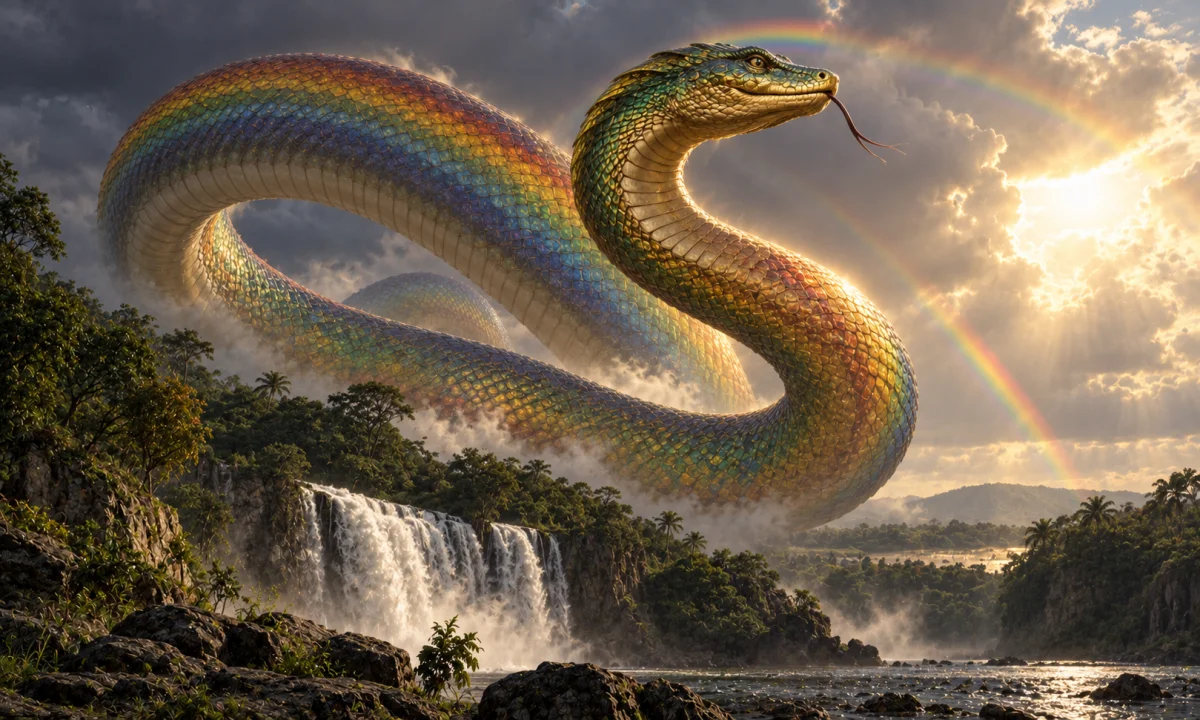
Oshunmare is a Yoruba orisha associated above all with the rainbow, the serpent, movement between realms, and the continuous circulation of life’s forces. The name is also written Ọ̀ṣùmàrè, Osumare, or, in Brazilian religious traditions, Oxumarê. English-language spelling often removes Yoruba tonal and under-dotted characters, which can obscure distinctions in pronunciation and meaning.
Oshunmare belongs to the religious world of the Yoruba peoples of West Africa, especially in present-day Nigeria and neighboring areas. Yoruba religion does not consist of a single standardized creed or one universally fixed mythology. Its traditions have been transmitted through ritual practice, praise poetry, divination, initiation, oral narratives, and regional lineages. As a result, descriptions of Oshunmare can differ between communities and between African and Afro-Atlantic traditions.
Name and identity
The Yoruba name Ọ̀ṣùmàrè is commonly associated with the rainbow. In religious interpretation, however, the rainbow is not merely an atmospheric spectacle. It may represent a visible connection between heaven and earth, the circulation of divine power, and the return of rain and fertility. Oshunmare is therefore often understood as a power of continuity, transformation, and cosmic connection.
Oshunmare is generally classified as an òrìṣà, a divine power or sacred being within Yoruba religion. The English word “god” is sometimes used as a rough translation, but it can be misleading. Orishas are not simply equivalent to the gods of every other religious system. They are understood in different ways as divine beings, manifestations of sacred forces, ancestral powers, and intermediaries within a religious cosmos governed by the supreme being, commonly called Olódùmarè or Ọlọ́run.
In some interpretations, Oshunmare’s identity is closely tied to the image of a great serpent or serpent-like being. The rainbow may be imagined as a serpent stretched across the sky, or as a sign of a powerful being whose movement joins different levels of existence. Not every Yoruba community presents the figure in exactly this form, so the serpent imagery should be treated as an important traditional association rather than a universally identical doctrine.
Origins and religious setting
Yoruba religious traditions developed over many centuries in a region containing numerous kingdoms, towns, and local ritual centers. Important historical centers included Ifẹ̀, Ọ̀yọ́, and other Yoruba-speaking states, but the worship of individual orishas has never been entirely uniform across the region. Each orisha may have several local cults, praise names, ritual specialists, and bodies of oral tradition.
The most important surviving body of religious knowledge connected with Yoruba divination is the Ifá tradition. Ifá is associated with Ọ̀rúnmìlà, the orisha of wisdom, divination, and the knowledge of destiny. Its extensive corpus contains verses, narratives, ethical teachings, ritual instructions, and reflections on the relationships between human beings, the orishas, and the unseen world. Oshunmare appears in some Ifá-related traditions and interpretations, although the precise stories and emphasis vary according to the particular corpus, lineage, and region.
These traditions were preserved primarily through memorization and performance rather than through one canonical book. A story connected with Oshunmare may therefore exist in several versions, with differences in names, events, gender presentation, or relationships. A printed retelling may represent one regional or religious interpretation rather than a definitive account of all Yoruba belief.
The rainbow and the serpent
The rainbow is Oshunmare’s most recognizable sign. Its arc appears to connect the visible sky with the earth, and its emergence after rain naturally lends itself to ideas of renewal, fertility, and restored balance. Rain is essential to agriculture and human survival, while the rainbow marks a moment when storm, water, sunlight, and sky meet. Oshunmare’s symbolism consequently includes the movement and exchange on which life depends.
The serpent adds another layer of meaning. Snakes move close to the ground but can also disappear into holes, vegetation, or water. They shed their skins, making them powerful symbols of renewal and transformation. In many traditions, serpent imagery also evokes hidden knowledge, the earth’s depth, fertility, and dangerous but necessary power. These associations should not be treated as evidence that all Yoruba traditions imagined Oshunmare in one fixed physical form. Rather, the serpent is one of the principal images through which the orisha’s power has been expressed.
Some religious interpretations describe Oshunmare as a being whose movement sustains the world or allows wealth and life-giving forces to circulate. If the rainbow were to vanish permanently, the symbolic flow between realms would be broken. This helps explain why Oshunmare can be associated not only with weather but also with prosperity, abundance, renewal, and the ordered movement of existence.
In this context, wealth is not necessarily limited to money. It may include children, crops, health, social well-being, status, and the general blessing required for a household or community to flourish. As with other orishas, these meanings are expressed through ritual, praise poetry, offerings, and personal relationships with the sacred power.
Gender and changing form
Oshunmare is sometimes described as having both masculine and feminine aspects. Popular accounts may say that the figure changes gender or appears as male for part of the year and female for another part. Such descriptions are influential, particularly in discussions of Brazilian Candomblé, but they should not be presented as a single rule accepted everywhere.
Different traditions understand Oshunmare’s gender in different ways. Some emphasize a masculine form, some a feminine form, and some describe a dual or changeable nature. The association with changing form fits the broader symbolism of the rainbow, the serpent’s renewal, and the passage between states. It may also reflect religious traditions in which divine identity is more flexible than modern categories often suggest.
It is important not to turn this complexity into a simple claim that Oshunmare is “the transgender god” in a modern political or medical sense. Traditional Yoruba concepts of gender, sacred embodiment, and ritual identity developed within their own cultural and religious frameworks. Modern readers may find useful points of comparison, but those comparisons should not erase the historical context of the traditions themselves.
Roles and attributes
Oshunmare’s principal roles are connected with circulation and connection. Common associations include:
- The rainbow: the most direct visible sign of Oshunmare and a symbol of the meeting between sky and earth.
- The serpent: an image of renewal, hidden power, earthly depth, and continuous movement.
- Rain and fertility: the return of life-giving water to the land and the agricultural abundance that follows.
- Wealth and prosperity: the movement of blessings, resources, and productive energy through households and communities.
- Transformation: the ability to pass between forms, conditions, or realms without being confined to one state.
- Cosmic connection: the joining of divine and human domains, especially through the image of a bridge or arc.
Some accounts also connect Oshunmare with rivers, water, or aquatic symbolism. This does not mean that Oshunmare should automatically be identified with every water or river orisha. Water has many meanings in Yoruba religion, and local traditions may assign particular waters to different sacred beings. The rainbow’s connection with rain and moisture is a central part of Oshunmare’s symbolism, but it is not sufficient reason to merge the figure with another orisha.
Stories and oral traditions
There is no single universally authorized “myth of Oshunmare” comparable to a fixed literary biography. Accounts connected with the orisha are found in oral traditions, ritual praise, Ifá interpretation, and later written presentations. Some narratives focus on the rainbow’s role in maintaining the relationship between heaven and earth. Others emphasize the orisha’s changing appearance, the distribution of prosperity, or the consequences of disrupting sacred balance.
In many Yoruba narratives, an orisha’s importance is shown through what the being does rather than through a complete life story. A divine figure may appear in several episodes associated with different ritual problems, moral questions, or patterns of human destiny. The same orisha can therefore be portrayed as generous in one context, demanding in another, and dangerous when neglected or insulted. Such variation is normal in oral religious traditions and should not be mistaken for contradiction in the modern literary sense.
Oshunmare’s myths and praise traditions often encourage attention to balance. Life depends on circulation: rain must return, wealth must move, and human beings must maintain proper relationships with the divine and social worlds. Hoarding, stagnation, or disrespect can be symbolically opposed to Oshunmare’s flowing nature. At the same time, movement without order can be destructive, so the figure is not simply a personification of unrestricted change.
As with other orishas, ritual specialists may approach Oshunmare through offerings, prayers, songs, divination, and initiation practices. The details are not uniform and may be restricted within particular religious communities. General descriptions should therefore avoid treating ritual knowledge as public folklore or assuming that every devotee follows the same procedures.
Oshunmare and related figures
The name Oshunmare is sometimes confused with Oshun, written Òṣun. The two are distinct orishas. Oshun is strongly associated with rivers, sweetness, beauty, sexuality, diplomacy, healing, fertility, and forms of feminine power. The similarity between the English spellings “Oshun” and “Oshunmare” can create confusion, but Oshunmare is not simply another name for Oshun.
Oshunmare may also be compared with serpent or rainbow beings from other African and Afro-diasporic traditions. Comparisons can be valuable when they concern broad themes such as fertility, water, renewal, or the joining of cosmic levels. They do not prove that the figures are the same. Dan in some Fon and Ewe traditions, Damballa in Haitian Vodou, and serpent beings in other religious systems belong to distinct cultural histories and ritual contexts, even where their imagery overlaps.
Oshunmare should likewise not be confused with a generic “rainbow serpent” figure from Indigenous Australian traditions. Rainbow-serpent traditions occur in many cultures, but resemblance in imagery does not establish a shared origin. The Yoruba orisha must be understood within Yoruba religious language, history, and ritual practice.
Oshunmare in the African diaspora
Yoruba religious ideas traveled across the Atlantic through the forced migration of enslaved Africans and continued to develop in the Americas. In Brazil, Oshunmare is widely known as Oxumarê within Candomblé, especially in traditions shaped by Yoruba-derived religious systems. Brazilian religious practice has its own history, vocabulary, initiatory structures, songs, visual forms, and relationships among orixás. Oxumarê should therefore be understood as both connected to Ọ̀ṣùmàrè and shaped by the Brazilian context.
In Candomblé, Oxumarê is particularly associated with the rainbow and serpent imagery, cyclical movement, prosperity, and the passage between different conditions. Some houses and lineages emphasize a dual or changeable gender presentation, while others interpret the orixá differently. The spelling, pronunciation, colors, ritual objects, and ceremonial details can vary by nation, house, and religious authority.
The Atlantic diaspora did not preserve Yoruba religion as an unaltered museum piece. Enslaved communities adapted religious forms under colonial persecution, brought traditions into contact with other African systems, and created new institutions in changing social environments. Continuity with Yoruba religion is real, but so are the transformations produced by Brazilian and other American histories.
Modern interpretation
Today, Oshunmare is often discussed in writing about African mythology, religious symbolism, gender diversity, ecology, and the cultural history of the African diaspora. Artists and contemporary spiritual communities may use the rainbow and serpent as symbols of fluid identity, resilience, abundance, or environmental interdependence. These interpretations can be meaningful, but they are modern readings and should be distinguished from claims about historical Yoruba belief.
Oshunmare is less prominent in global popular culture than some better-known orishas, although the figure appears in works influenced by Yoruba religion, Brazilian Candomblé, fantasy literature, games, visual art, and contemporary spiritual media. Such adaptations may combine Oshunmare with unrelated serpent deities, generic rainbow-serpent imagery, or modern ideas about gender and magic. Those creative combinations should not be mistaken for evidence about the original religious traditions.
The enduring significance of Oshunmare lies in the way a natural phenomenon becomes a language for religious ideas: the rainbow expresses connection, the serpent expresses renewal, and their union expresses the movement through which life, rain, prosperity, and sacred power continue from one state to another.