WORLD
WORLD
Osanyin
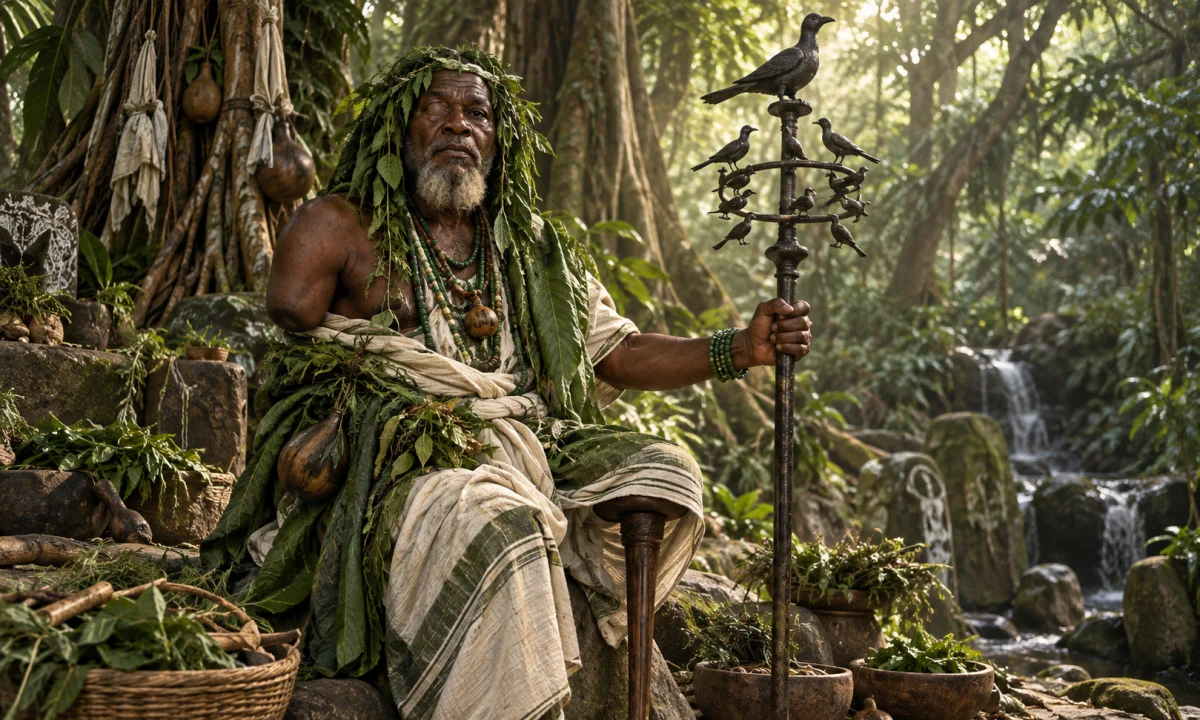
Osanyin is a Yoruba orisha associated with leaves, herbal knowledge, healing, and the powerful life of the forest. His name is also written as Òsányìn, Osain, or Osaín, depending on the language, orthography, and religious setting. In Yoruba religious thought, Osanyin is not simply a “god of medicine” in the modern Western sense. He represents the sacred knowledge through which plants, spoken formulae, ritual actions, and human skill can be brought together for healing and protection.
Osanyin in Yoruba religious tradition
Yoruba religion includes many orisa, sacred powers or divine beings connected with aspects of the world, human life, natural forces, and the divine order. These powers are not always best understood as completely separate personalities with fixed biographies. Their identities may overlap, develop through regional traditions, and be expressed through worship, praise poetry, ritual, divination, and stories preserved in oral performance.
Osanyin belongs especially to the religious world of medicinal plants and the forest. The forest is a place of danger and abundance: it contains food, timber, poisons, medicines, animals, and plants whose uses are not immediately visible. In Yoruba thought, this hidden knowledge has a spiritual dimension. A plant is not regarded only as a chemical substance. Its effectiveness may depend on the circumstances of its gathering, the words spoken over it, the person who prepares it, the patient’s condition, and the ritual restrictions surrounding its use.
Osanyin is therefore closely connected with specialists who know leaves and medicines. These practitioners may be called oníṣègùn, often translated as herbalists or traditional medical practitioners. Knowledge of plants can also belong to diviners, priests, midwives, hunters, farmers, and families who preserve particular remedies. Osanyin is important within this wider network of expertise rather than being a replacement for every human healer.
Name, spelling, and classification
The Yoruba form is commonly written Òsányìn, with tone marks indicating pronunciation. English-language writing often omits the marks and uses Osanyin. In Yoruba-derived religious traditions outside West Africa, related forms include Osain or Osaín in Cuba and Ossaim or Ossanha in Brazil. These names reflect changes in pronunciation and language rather than proving that every community understands the figure in exactly the same way.
Osanyin is usually described as an orisha, although translations sometimes call him a deity, spirit, or god of herbs. Each of these words captures part of the idea but can also mislead. “God” may suggest a figure from a fixed mythology with a single universal biography, while “spirit” may understate Osanyin’s religious importance. The term orisha is often preferable because it preserves the specific Yoruba framework in which sacred powers are approached through lineage, ritual, divination, possession, praise names, and relationships with other orisa.
Descriptions of Osanyin’s gender also reflect different contexts. Yoruba accounts and many diasporic traditions commonly present him as male, but religious identities do not always fit modern assumptions about personality, gender, or bodily form. His ritual presence is more stable than any single visual or literary portrait.
Leaves, medicine, and hidden knowledge
The most important attribute of Osanyin is knowledge of ewe, a Yoruba term often translated as leaves or medicinal plants. Ewe can refer broadly to plant materials and to the knowledge associated with them. Such knowledge includes identifying a plant, knowing where it grows, collecting it correctly, combining it with other materials, and applying it in a suitable ritual or medical setting.
Yoruba healing traditions have never consisted of one uniform system. Remedies may involve infusions, powders, baths, ointments, incisions, dietary restrictions, protective preparations, and spoken invocations. Some practices address physical symptoms, while others respond to spiritual attack, broken taboos, misfortune, or an imbalance in a person’s relationship with the unseen world. These categories do not map neatly onto the modern division between medicine and religion.
Speech is especially important. A healer may recite an ofò, a verbal formula intended to activate or direct the power of a prepared substance. The formula is not merely an explanation of the remedy. In the ritual understanding, correctly spoken words help establish the remedy’s efficacy. Knowledge therefore includes memory, authority, timing, secrecy, and ethical responsibility. A person who knows the name of a plant but does not know its ritual conditions does not necessarily possess Osanyin’s kind of knowledge.
Osanyin’s association with the forest also emphasizes that valuable knowledge is often concealed. Plants may look alike while having very different effects. A useful species may grow beside a poisonous one. The forest demands careful observation and respect, and Osanyin embodies both the benefits and the dangers of entering that domain.
Appearance and ritual emblems
Osanyin is frequently represented as an unusual or physically incomplete figure. Images and oral descriptions may show him with one leg, one eye, one arm, or other distinctive features. The details are not uniform across Yoruba communities, and no single bodily description should be treated as universally authoritative.
The one-legged image is particularly well known. It may evoke the idea of a figure rooted like a tree or moving in an uncanny way through the forest. Other interpretations connect bodily difference with Osanyin’s isolation, his dangerous power, or his position outside ordinary human society. These interpretations belong to symbolic and ritual readings; they should not be turned into a simple claim that Yoruba tradition assigns a single meaning to disability or bodily difference.
A major emblem associated with Osanyin is the ọ̀pá Ọ̀sányìn, often rendered in English as the staff of Osanyin. It is an iron ritual staff, frequently made with a central stem and branching forms, birds, bells, or other metal elements. The exact design varies. The staff may be displayed in a shrine or used as a sign of the authority of herbal and ritual knowledge.
Birds on or around the staff are often interpreted in connection with spiritual power, perception, messages, or the hidden forces of the night. Such explanations are not always identical from one community or artist to another. The staff is not simply a decorative portrait of Osanyin; it is a charged ritual object whose meaning depends on its maker, use, consecration, and religious setting.
Iron also carries associations with force, technology, tools, and the forest in Yoruba religious symbolism. This can create points of contact between Osanyin and Ogun, the orisha strongly associated with iron, hunting, roads, and skilled work. Contact between their spheres does not mean that Osanyin and Ogun are the same being.
Stories and relationships
Osanyin appears in stories connected with the transmission and control of sacred knowledge. Many such narratives are preserved through Ifa, the Yoruba divination tradition, whose verses contain accounts of orisa, ancestors, human beings, moral problems, rituals, and the consequences of ignoring proper knowledge. Ifa material is extensive and performed orally, so stories may differ in sequence, emphasis, and detail.
A recurring pattern presents Osanyin as the keeper of the secrets of leaves. Other beings or human specialists want access to this knowledge, but Osanyin does not surrender it casually. The story may then explain how knowledge becomes available through divination, cooperation, conflict, or a change in Osanyin’s circumstances. In some versions, Orunmila, the orisha associated with wisdom and Ifa divination, plays an important role in discovering or organizing knowledge of medicinal plants.
These accounts should not be reduced to a rivalry between “magic” and “science.” They often address a more complex question: who is qualified to use powerful knowledge, and what happens when knowledge is hoarded, misused, or separated from proper ritual conduct? Osanyin’s secrecy can signify the real danger of medicines, while the eventual sharing of knowledge can express the social need for healing.
Another group of popular retellings connects Osanyin’s unusual body with conflict involving other orisa, sometimes especially Shango or Ogun. In these versions, an attack, punishment, or violent encounter leaves Osanyin physically altered. The details vary considerably, and some versions are more common in modern summaries than in particular local traditions. They should be presented as variant narratives rather than as one definitive explanation of his appearance.
Stories involving Osanyin and Shango may contrast the quiet, hidden power of plants with the visible force of thunder and lightning. Stories involving Osanyin and Ogun may place forest medicine beside iron tools, hunting, and technical skill. These relationships are meaningful because Yoruba religious narratives frequently show sacred powers as interdependent, competitive, or mutually necessary. The existence of one power does not eliminate the importance of the others.
Osanyin and the ethics of healing
Osanyin’s significance extends beyond the ability to cure illness. His tradition raises questions about the responsibilities that accompany knowledge. A remedy can heal, but plants can also poison; a ritual can protect, but improperly performed actions can produce harm; secrecy can preserve expertise, but excessive secrecy can prevent people from receiving help.
Knowledge of leaves is therefore connected with character and discipline. A healer must know what to gather and how to prepare it, but also when not to act, whom to consult, and what restrictions apply. In many Yoruba religious settings, divination helps identify the ritual circumstances surrounding a problem. Osanyin’s domain is consequently related to judgment and discernment, not merely to the possession of a list of medicinal ingredients.
This perspective also helps explain why the forest has such a strong symbolic role. It is not an untouched wilderness imagined outside society. People enter it to hunt, farm, gather materials, and perform religious work, yet it remains a place where human control is limited. Osanyin expresses the knowledge required to live with that uncertainty.
Distinguishing Osanyin from related figures
Osanyin is sometimes confused with other Yoruba orisha because several have associations with forests, healing, or specialized knowledge.
- Ogun is strongly associated with iron, tools, hunting, roads, warfare, and the transformative work of technology. Ogun may appear in stories about the forest and may be important to healers who use iron instruments, but he is not the same as Osanyin, whose central domain is leaves and medicinal knowledge.
- Orunmila is associated with Ifa, wisdom, divination, and the interpretation of destiny. Orunmila may appear in stories about discovering or organizing herbal knowledge, but he is distinct from Osanyin.
- Obaluaye, also known in some traditions as Babalu-Aye, is connected with disease, epidemic illness, healing, and the earth. His relationship to illness differs from Osanyin’s role as keeper of plant and herbal knowledge.
- Yemoja and other water-associated powers may be involved in healing, fertility, or the care of children in particular traditions. Their presence in healing practices does not make them forms of Osanyin.
These distinctions are useful, but Yoruba religious practice also permits cooperation among orisa. A ritual may call upon several powers because a problem involves health, destiny, protection, tools, family, and the environment at the same time.
Sources of tradition and regional variation
There is no single canonical book containing one complete biography of Osanyin. Knowledge about him survives through oral traditions, praise poetry, Ifa verses, shrine practices, ritual objects, songs, personal instruction, and the work of religious specialists. Written accounts produced by outsiders or later observers can preserve valuable information, but they may simplify local differences or use categories that do not exactly match Yoruba concepts.
Regional variation is therefore important. A community may emphasize Osanyin’s role as a forest power, another may focus on herbal medicine, and another may give greater attention to the ritual staff or relationships with particular orisa. Spelling also changes when Yoruba names are written without tone marks or adapted to other languages. Differences in spelling do not automatically indicate different beings, but similar names should not be merged without examining their religious context.
Traditional knowledge is also not necessarily public knowledge. Some information belongs to initiatory or professional settings and is transmitted through supervised practice. Respectful descriptions should recognize that not every ritual detail is intended for general publication, and that the absence of a detail from a public account does not mean the detail is unimportant.
Osanyin in the African diaspora
Yoruba religious traditions travelled to the Americas through the forced migration of enslaved Africans and later continued through communities, families, ritual specialists, and religious houses. Related forms of Osanyin appear in several Afro-Atlantic traditions, including Cuban Lukumí, where the name is often written Osaín or Osain, and Brazilian Candomblé, where forms such as Ossaim or Ossanha are used.
These traditions preserve major themes associated with Osanyin, especially leaves, healing, and the knowledge required to prepare sacred plants. At the same time, they are not merely unchanged copies of one Yoruba system. They developed under different historical conditions and in conversation with other African, Indigenous, European, and American religious influences. Ritual languages, songs, initiation structures, visual forms, and relationships among sacred beings can differ from those found in Nigeria and neighbouring Yoruba-speaking regions.
In the diaspora, the importance of leaves can be especially visible in ceremonies where plants are used to prepare sacred baths, cleanse participants, establish ritual power, or consecrate objects. The presence of Osanyin in these settings demonstrates the continuing importance of African-derived botanical and religious knowledge, while the exact practices remain specific to each tradition and community.
Contemporary significance
Osanyin remains relevant in discussions of traditional medicine, environmental knowledge, cultural memory, and the protection of forests. His tradition does not provide a simple equivalent of modern pharmacology, and it should not be used to make unverified medical claims. It does, however, express a sophisticated cultural understanding that plants require observation, classification, responsible handling, and respect for the places where they grow.
Contemporary artists and religious practitioners may draw on the image of the one-legged forest figure, the bird-topped staff, or the idea of hidden botanical knowledge. Museums, books, films, and online discussions sometimes present Osanyin as a generic “African plant god,” but that label removes him from the Yoruba religious setting that gives his symbols their meaning. A fuller understanding recognizes him as an orisha whose power lies in the relationship among forest life, healing practice, ritual speech, and the disciplined transmission of knowledge.