WORLD
WORLD
Odomankoma

Odomankoma is a creator figure in Akan religious thought, especially associated with Fante traditions of Ghana. The name is also used in some Akan contexts as a title or descriptive name for the supreme divine power. Depending on the community and the source recording the tradition, Odomankoma may appear as an independent creator, as one aspect of a larger conception of God, or as a name closely related to Nyame and Onyankopon. There is no single authoritative Akan scripture that fixes one universal account of Odomankoma’s identity.
Akan religious setting
The Akan peoples include several related cultural and linguistic communities in present-day Ghana and parts of Côte d’Ivoire. Among them are the Fante, Asante, Akuapem, Akyem, Bono and others. Their religious traditions have been transmitted largely through oral teaching, ritual practice, proverbial language, family memory and stories told by specialists. As a result, names and theological descriptions can vary between regions and languages.
Akan religion commonly recognises a supreme divine reality associated with the sky, creation and the ordering of existence. This supreme power is known by names such as Nyame, Onyame, Nyankopon and Odomankoma. These names do not always function in exactly the same way. In one account, they may refer to distinct divine persons or powers; in another, they may be honorific names for one God. Translators and early observers also sometimes treated related names as though they represented a neatly organised pantheon, even when local religious ideas were more fluid.
The supreme deity is not the only sacred presence in Akan religion. The abosom are powerful divinities connected with particular places, natural forces or aspects of communal life. Ancestors are also important as guardians of moral and social continuity. Asase Yaa, the earth goddess, is associated with the fertility of the land and with moral prohibitions governing human conduct. These beings should not automatically be treated as equivalent to Odomankoma. Odomankoma belongs primarily to the level of creation and ultimate divine power, whereas abosom and ancestors have more immediate relationships with particular communities and human affairs.
The name and its interpretation
The meaning of Odomankoma is not completely uniform in English-language discussions. It is frequently translated with expressions such as “the creator,” “the infinite creator,” “the one who has no end,” or “the creator of all things.” Such translations convey aspects of the name but should not be treated as a universally agreed word-for-word definition. Akan languages contain meanings and associations that can be difficult to reproduce in a single English phrase.
The spelling may also vary. Akan names are written according to different local and scholarly conventions, and forms such as Odomankoma, Odomankoma Nyankopon or related combinations may appear in discussions of Akan theology. A variation in spelling does not necessarily indicate a different being. At the same time, identical or similar names should not be assumed to have precisely the same meaning in every Akan-speaking community.
One important issue is whether Odomankoma is a separate deity or a name for the supreme God. In some Fante descriptions, Odomankoma is clearly presented as the creator. In broader accounts of Akan religion, the name can function as one of several names for the highest divine power, alongside Nyame or Onyankopon. Some theological interpretations distinguish these names as different manifestations or functions of God, while others understand them as titles emphasising different attributes. The evidence does not support imposing one fixed system on all Akan traditions.
Odomankoma as creator
Odomankoma’s central attribute is creative power. He is associated with the origin of the world, living things and humanity. The title therefore expresses more than the skill of a craftsman: it refers to the divine source of the ordered universe. In traditions where Odomankoma is distinguished from other names of God, he may represent the activity of bringing things into existence, while another divine name is associated with life, authority or the sky.
Descriptions of Odomankoma are generally theological rather than visual. There is no widely standardised portrait, costume or bodily form comparable to the iconography of many ancient Mediterranean gods. The supreme deity is often understood as transcending ordinary physical representation. This does not mean that Akan religious traditions lack sacred objects or artistic symbols, but Odomankoma is not usually identified by a universally recognised image.
As creator, Odomankoma can be understood as the source of order, dependence and purpose. Human beings do not exist independently of the divine world; they live within relationships linking the creator, the earth, the ancestors, the divinities and the community. Akan religious thought often expresses these relationships through ritual duties and moral laws rather than through abstract doctrine alone.
The creator’s greatness is also reflected in the common Akan idea that the supreme deity is powerful yet not approached in exactly the same manner as a local divinity. People may pray directly to God, but ritual specialists, family heads and traditional religious authorities also work through appropriate relationships with abosom and ancestors. The forms of worship differ among communities, and it is misleading to describe the supreme deity simply as either “worshipped” or “not worshipped” without considering local practice.
Creation stories and narrative variations
Stories about Odomankoma survive in more than one form. A recurring theme in some Fante accounts is that Odomankoma is connected with the making of human beings, while another divine power supplies or authorises the vital element that makes them alive. The precise roles differ in retellings. Some versions describe a partnership or complementarity between Odomankoma and Nyankopon; others give Odomankoma the more comprehensive role of creator.
Another group of narratives links Odomankoma with the origin of mortality. In these accounts, a conflict, separation or death involving a primordial creator helps explain why human life is limited. The story may present Odomankoma as creating human beings and then dying, being killed or becoming separated from the living world. The motive and sequence are not consistent across all versions. Some tellings involve rivalry between divine figures; others are less concerned with blame than with explaining why death became part of the human condition.
These narratives should be treated as variants of oral tradition rather than chapters from a single canonical creation epic. Oral stories can change through performance, translation and local interpretation. A storyteller may stress the origin of death, the dependence of humanity on the supreme deity, the distinction between creator and life-giver, or the dangers of rivalry. A version recorded in a Fante setting should not automatically be presented as the belief of every Akan-speaking people.
Some modern summaries combine Odomankoma with the creator roles of Nyame, Onyankopon, Nyankopon or Asase Yaa and then present the result as one standard Akan myth. This can make the material easier to read, but it can also erase meaningful regional differences. In particular, the presence of several divine names does not always indicate a pantheon of separate gods in the same sense as the Olympian gods of Greek mythology.
Relationships with Nyame and Onyankopon
Nyame or Onyame is commonly understood as the sky deity or supreme God in many Akan traditions. Nyankopon, sometimes written Onyankopon, is another major name associated with the highest divine power. English-language accounts vary in how they distinguish these names. Some describe Nyame and Nyankopon as separate but closely related divine beings; others treat them as names or aspects of one supreme God.
Odomankoma is especially likely to be interpreted through this network of names. In one theological model, Odomankoma is the creator, Nyame is the sky God and Nyankopon is the great or supreme God. In another model, all three names describe the same ultimate reality from different perspectives. Neither model should be assumed to represent all Akan communities.
The difficulty is partly linguistic and partly methodological. A name used in prayer, a title used in praise poetry and a figure appearing in a story may not have identical status. European missionaries and later writers sometimes translated Akan religious terms using categories such as “god,” “spirit,” “person” or “attribute,” even when those categories did not map neatly onto local ideas. Careful descriptions therefore preserve uncertainty instead of forcing every name into a rigid classification.
Relationships with Asase Yaa and the created world
In Akan religious thought, the earth is not merely inert matter. Asase Yaa is widely honoured as the earth deity, associated with agricultural fertility, moral order and the ground on which human society depends. The relationship between Odomankoma and Asase Yaa varies by tradition. In some accounts, the creator brings the world into being while the earth deity embodies or governs the fertile earth that sustains life. In others, the two are placed within a broader divine order without a detailed genealogical relationship.
This distinction is important. Odomankoma’s role is primarily cosmic and creative; Asase Yaa’s role is more closely connected with the earth, crops, social obligations and the moral consequences of human actions. Treating Asase Yaa simply as Odomankoma’s female counterpart can impose a modern symbolic scheme that is not present in every tradition.
The same caution applies to ancestors. Human ancestors do not normally become interchangeable with the creator after death. They remain members of the spiritual community and may intercede, protect or judge within the family and lineage, but their authority is different from the ultimate creative power attributed to Odomankoma or the supreme God.
Symbolism and religious significance
Odomankoma symbolises the origin and continuity of existence. The name can express the conviction that the world is not self-created and that life depends on a power beyond human control. It also places humanity within a moral universe: creation is not only a physical event but the establishment of relationships and obligations.
In this context, religious life is not based solely on belief in a distant creator. It includes respect for the earth, observance of taboos, care for family and lineage, rituals connected with agriculture, and proper relations with divinities and ancestors. The creator is therefore part of a wider system in which cosmic order and social morality reflect each other.
The idea of an exalted creator who is not represented by a fixed human image also reflects a difference between theological importance and ritual proximity. Odomankoma may be the highest source of being while everyday religious practice focuses more directly on local divinities, shrines, ancestors and community ceremonies. This does not make the creator irrelevant; rather, it shows that Akan religious traditions organise sacred relationships at several levels.
Sources and the problem of variation
Knowledge of Odomankoma comes mainly from oral traditions and from written records made by outsiders or by later scholars and religious writers. Such records are valuable, but they do not constitute a single ancient text preserved unchanged from the distant past. Accounts may reflect the language, region, religious affiliation and interpretive assumptions of the person who recorded them.
Christian and Islamic influences, colonial administration, literacy and modern national identities have also affected how Akan religious terms are explained. Some writers have presented the Akan supreme deity in ways that resemble the monotheistic God of Christianity or Islam. This may highlight genuine similarities, but it can also reduce the distinctiveness of Akan categories. Conversely, descriptions that arrange every divine name as a separate supernatural individual may overstate the separation between concepts that local worshippers understand as related.
For that reason, statements about Odomankoma should use terms such as “in some Fante traditions,” “in certain Akan accounts” or “often interpreted as.” The variations are not evidence that the tradition is confused. They are a normal feature of a large, diverse religious world transmitted through oral performance and lived practice rather than through one central canon.
Distinguishing Odomankoma from similar figures
- Nyame or Onyame: commonly a name for the Akan sky deity or supreme God. In some traditions, Nyame is distinct from Odomankoma; in others, the names refer to one divine reality or to related aspects of it.
- Nyankopon or Onyankopon: a major Akan name associated with the supreme deity. It may be treated as a separate figure in some narratives, but it should not automatically be placed in a fixed hierarchy beneath or above Odomankoma.
- Asase Yaa: the earth deity, connected with fertility, agriculture and moral restrictions. She is not simply another name for Odomankoma.
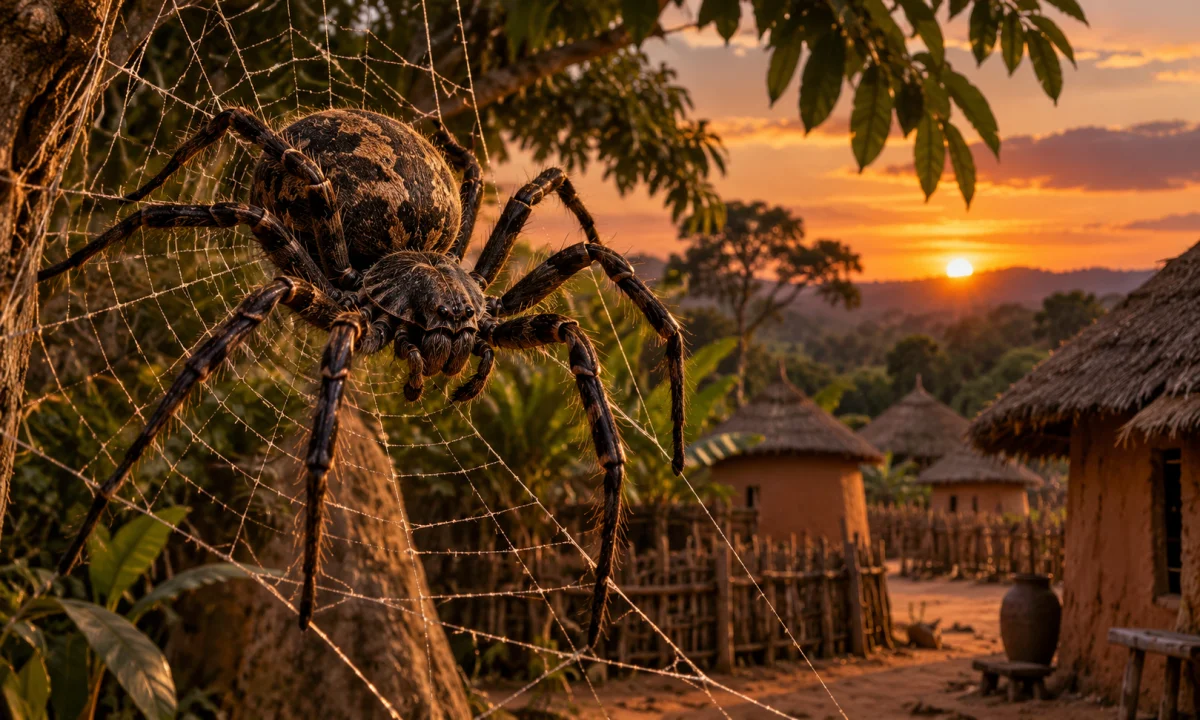
- Ananse: the famous Akan spider trickster and culture hero. Ananse belongs to a different narrative and symbolic category. Stories that connect him to divine or human origins in particular retellings do not make him the creator represented by Odomankoma.
- Abosom: divinities associated with particular forces, places or communities. Their functions differ from the comprehensive creative role attributed to Odomankoma in traditions that recognise him as the creator.
Later interpretation and modern use
Odomankoma appears today mainly in discussions of Akan religion, African philosophy, theology, cultural history and the study of Ghanaian traditions. Akan Christians and other modern interpreters may use the name as a traditional designation for the Creator, while others preserve distinctions between Odomankoma, Nyame and Nyankopon. These uses are part of continuing religious and cultural interpretation, not simply repetitions of a frozen ancient system.
Odomankoma has not developed a single, widely recognised popular-culture portrayal comparable to figures such as Ananse. When the name appears in online mythology lists, fantasy writing or general discussions of “African gods,” it may be turned into a generic omnipotent deity with a fixed appearance and standard set of powers. Such portrayals are modern inventions unless they are specifically grounded in a local Akan tradition. Traditional accounts provide a religious title and a group of related creation concepts, not one universally agreed character design.