WORLD
WORLD
Nyankopon
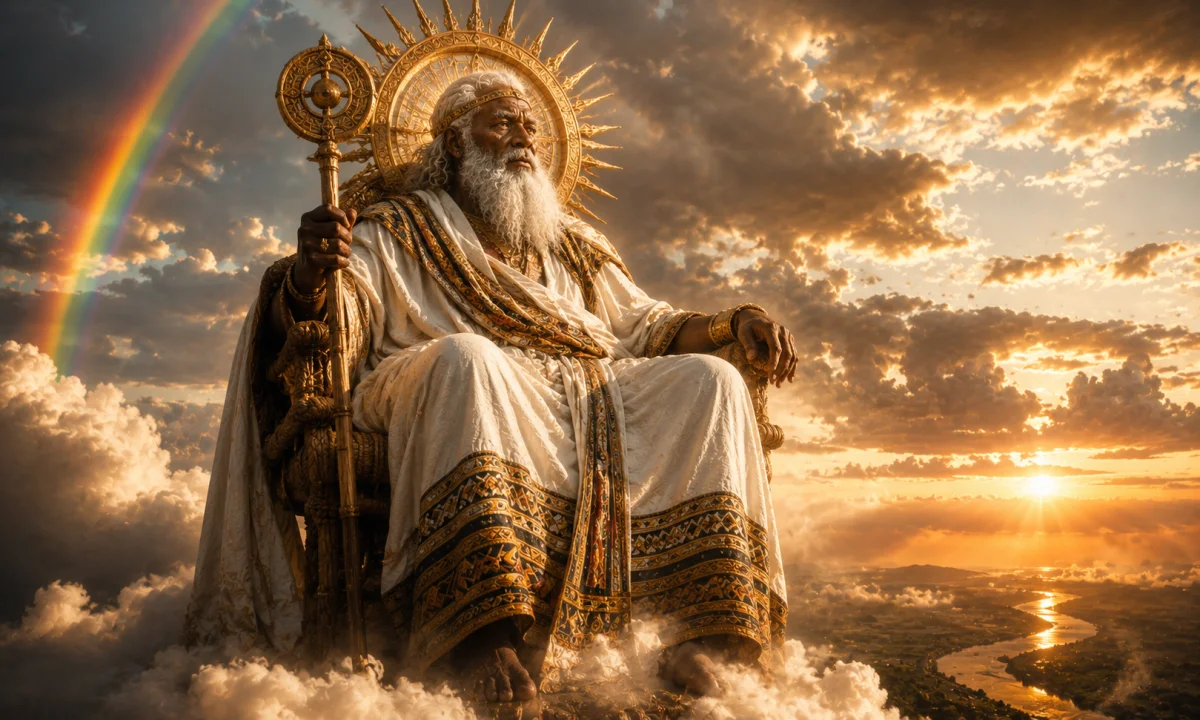
Nyankopon is a name for the supreme divine power in Akan religious traditions of West Africa, especially among Akan-speaking peoples in present-day Ghana and parts of Côte d’Ivoire. The name is also written Nyankɔpon or, in a longer form, Onyankopɔn. Depending on the community and the source, Nyankopon is understood as the one supreme God, as one aspect or name of the supreme deity, or as a figure closely associated with Nyame and Odomankoma.
Akan religious and cultural setting
The Akan peoples include several related cultural groups, among them the Asante, Fante, Akuapem, Akyem and Bono. Their traditional religious systems are not based on a single canonical scripture. Knowledge has been preserved through oral teaching, ritual practice, praise names, proverbs, priestly traditions, family histories and stories told in particular communities.
For this reason, Akan ideas about the supreme deity are not identical everywhere. A description recorded among Asante speakers may not represent the beliefs of all Akan communities. Spellings also vary because Akan languages use different orthographies and because European writers often transcribed Akan names in inconsistent ways.
Traditional Akan religion recognises a supreme creator and sustainer of existence, together with a complex spiritual world. This world includes the abosom, often translated as lesser deities or divinities, and the spirits of deceased ancestors. These beings are not simply equivalent to gods in every Western sense. Their roles, status and relationship to the supreme deity are explained differently in different traditions.
Nyankopon belongs to this wider religious framework. The name should not automatically be treated as the name of a separate mythological character with a single fixed biography. In many contexts, it refers to the highest divine power rather than to a deity with a human-like appearance or a sequence of adventures.
Name and identity
The forms Nyankopon, Nyankɔpon and Onyankopɔn are related forms used in discussions of Akan belief, although their exact use depends on language, spelling system and context. The name is frequently translated into English as “the great one,” “the unique great one” or “the supreme one.” These translations are useful approximations rather than universally agreed literal definitions.
Another important name is Nyame, commonly associated with the sky and with the supreme deity. In some accounts Nyame and Nyankopon are simply different names for one God. In others, they appear as distinct but closely related expressions of divine power. Some descriptions also include Odomankoma, a name connected with creation and the ordering of the world.
There is no single universally accepted interpretation of this group of names. Earlier ethnographic and missionary writings sometimes presented Nyame, Nyankopon and Odomankoma as a fixed divine trinity. That model can be misleading if it is applied to every Akan community. The terms may function as personal names, titles, poetic descriptions or regional theological concepts, rather than as the names of three independently defined gods.
Nyankopon as the supreme deity
Where Nyankopon is used as the name of the supreme being, the deity is associated with the creation and maintenance of the universe, human life, natural order and moral authority. Nyankopon is generally understood to be greater than the abosom and ancestors, even when those beings play a more visible role in everyday religious practice.
The supreme deity is often described as powerful, wise and beyond ordinary human limitation. Nyankopon is not usually represented through a standard human-shaped image. The lack of a single widespread physical form is significant: divine reality is expressed through names, attributes, proverbs, prayers and relationships with the visible world rather than through one canonical portrait.
Descriptions of Nyankopon may include creative power, providence, knowledge of human affairs and control over life and death. These qualities should be understood as broad theological themes, not as a fixed list of powers shared identically by every Akan group.
Some accounts describe the supreme deity as remote from daily human affairs. This does not necessarily mean that the deity is absent or unimportant. Rather, communication and ritual attention may be directed through divinities connected with particular places, natural forces, occupations or communities, as well as through ancestors who remain involved in family and social life.
Creation and the ordering of the world
Akan traditions contain several creation accounts, and these accounts do not always assign the same actions to the same divine names. Some narratives describe the supreme deity as the source of heaven, earth, living beings and the principles that make society possible. Other stories give a prominent creative role to Odomankoma or describe creation through a relationship among Nyame, Nyankopon and other divine powers.
In certain versions, a creator or supreme sky deity once remained close to human beings but withdrew into the sky after being disturbed by human activity. One common form of the story involves a woman pounding food beneath the sky and repeatedly striking or inconveniencing the deity with the pestle. People then tried to reach the sky by piling objects one on top of another, but the attempt failed. Details vary considerably, and the deity in such stories may be identified as Nyame, Nyankopon or another name for the sky power.
The story is not simply an explanation of physical distance. It can express a broader theme in Akan thought: the world contains a separation between the supreme divine realm and ordinary human life, while spiritual communication remains possible through ritual, moral conduct and intermediary powers. The narrative also provides an imaginative explanation for why humans cannot directly handle or possess the sky.
Other creation traditions focus on the origin of death, human limitations or the separation of different parts of the cosmos. These should not be assembled into one single official mythology. Akan oral traditions permit local versions, and the same divine name can acquire different functions in different narratives.
Relationship with Nyame, Odomankoma and the abosom
Confusion often arises because Akan religious vocabulary contains several names for divine power. In one interpretation, Nyame represents the sky deity, Nyankopon expresses the supreme and uniquely great God, and Odomankoma is associated with creative activity. In another interpretation, all three names refer to aspects of one supreme reality. A further interpretation treats them as distinct figures within a theological system, while still placing them above the lesser divinities.
These interpretations cannot be reduced to one universally correct chart of relationships. They reflect different communities, languages, periods of documentation and scholarly approaches. A careful account therefore identifies the variation instead of presenting a rigid family tree of Akan gods.
The abosom occupy a different level from the supreme deity in many Akan systems. They may be associated with rivers, hills, forests, storms, fertility, healing, warfare or particular settlements. Their influence is often understood as more immediate and local. Ritual specialists may serve particular abosom, while families maintain relationships with their ancestors. Nyankopon, by contrast, is the highest source of existence and authority.
This hierarchy does not mean that the supreme deity is irrelevant to ordinary life. It indicates that Akan religion can operate through multiple levels of spiritual relationship. A person may honour the supreme God while also seeking help from a local divinity or guidance from ancestors, without necessarily seeing these practices as contradictory.
Worship, prayer and religious practice
Traditional Akan religious practice has no single form of worship that can be attributed to every community. Prayer, offerings, libations, festivals, taboos, sacred objects and consultation with ritual specialists all occur in different settings, but their meanings vary.
Nyankopon may be addressed directly in prayer or invoked through praise names and formulaic speech. The supreme deity is also recognised in everyday expressions, personal names and proverbs. Such language can acknowledge divine power, express dependence on providence or comment on the limits of human control.
In many communities, ritual attention to the supreme deity is combined with respect for ancestors and local divinities. Libations may name several spiritual powers in an ordered sequence, placing the supreme deity first or acknowledging the relationship between the highest God, the abosom and the ancestors. The exact wording and order depend on the occasion and community.
It is inaccurate to assume that the absence of a large statue or permanent shrine means that Nyankopon was not worshipped. A supreme deity may be approached through speech, moral obligations, ritual specialists and the spiritual powers believed to govern particular parts of life. Conversely, descriptions of Akan religion that focus only on visible shrines can understate the importance of the supreme God.
Attributes and symbolism
Nyankopon is most strongly associated with transcendence, creation and supreme authority. The sky is an important symbolic setting because it suggests height, distance, rain, light and the power beyond human reach. In Akan thought, however, the sky should not be treated as a simple physical residence comparable to a human king’s palace. It is part of a wider symbolic and religious relationship between the visible world and the divine realm.
Rain and fertility can also carry religious significance because agriculture depends on them. Yet particular rain, earth or river powers may be associated with abosom rather than directly with Nyankopon. The supreme deity’s role is therefore broader than control over one natural force.
The name Nyankopon can also carry a moral meaning. The supreme deity stands above human rulers and social institutions, making divine authority a standard against which human behaviour may be judged. Akan moral thought is additionally shaped by family obligations, communal responsibility, respect for elders, ritual rules and the consequences of violating taboos.
Nyankopon and the problem of fixed mythology
Nyankopon is sometimes presented in popular reference works as though the deity had a standard set of myths, a fixed appearance and clearly defined divine relatives. That approach reflects the way classical pantheons are often organised, but it does not fit the evidence of Akan oral religion particularly well.
The surviving record comes from a combination of oral traditions, local religious practices and written accounts produced at different times. Written descriptions may simplify complex beliefs, translate Akan concepts into Christian or European categories, or treat one regional tradition as representative of all Akan people. Oral traditions themselves may change in emphasis as they are retold.
Consequently, statements about Nyankopon should distinguish between broad patterns and specific local claims. It is reasonable to identify Nyankopon with Akan concepts of supreme divinity where the name is used that way. It is less reliable to assign every creation story, gendered attribute or relationship involving Nyame or Odomankoma to Nyankopon without noting the variation.
Distinguishing Nyankopon from similar figures
Nyankopon should not be confused with a nature spirit, ancestor or local abosom simply because those beings may appear in the same religious system. The supreme deity occupies a different theological position. Nor should Nyankopon be automatically equated with the Christian God in a way that erases Akan meanings. Akan Christians may use the name Onyankopɔn for the Christian God, but this later religious usage exists alongside, and is historically related to, older Akan concepts without making every traditional account simply Christian.
The name should also be distinguished from words for the sky, creator or deity that belong to unrelated African religious traditions. Many African cultures have supreme beings connected with the sky or creation, but similarities do not prove that they are the same figure or that their traditions share one origin. Nyankopon is specifically rooted in Akan language and religious culture.
Modern use and cultural significance
Nyankopon remains meaningful in Ghanaian cultural and religious language, including contexts shaped by Christianity, Islam, urban life and modern education. The name may appear in personal names, music, literature, public speech and discussions of Akan heritage. Its use today can therefore reflect traditional belief, Christian theology, cultural identity or a combination of these influences.
Modern popular culture sometimes treats Nyankopon as a fantasy-style deity with a standard design, a complete list of powers or a role in a fictional pantheon. Such portrayals may be creative reinterpretations, but they should not be mistaken for a single traditional description. The historical and religious Nyankopon is better understood through the flexible, oral and regionally varied traditions of the Akan-speaking peoples.