WORLD

Chuku
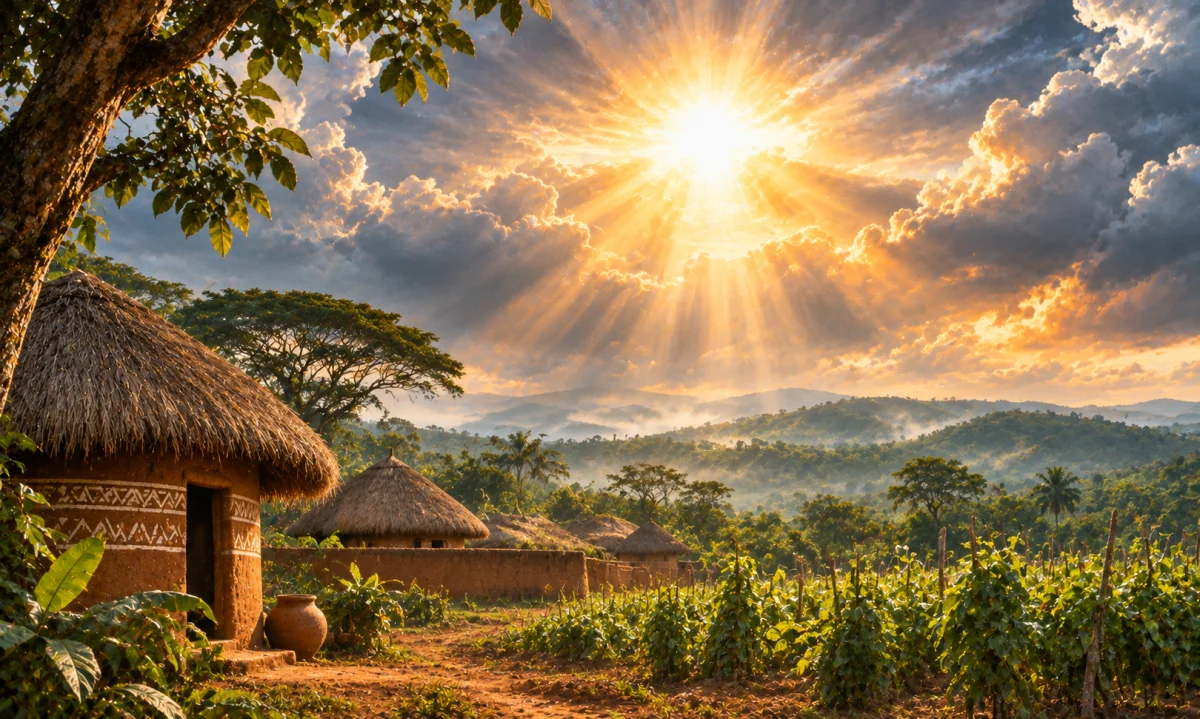
Chuku is a spelling used for Chukwu, the supreme creator deity in many Igbo religious traditions of southeastern Nigeria and adjacent areas. Chukwu is commonly understood as the highest divine power, the source of life and the author of the ordered world. Igbo religious practice, however, has never been completely uniform. Different communities use different names, explanations and ritual emphases, so “Chuku” should not be treated as the name of a single, universally defined figure in every Igbo tradition.
Origins and cultural setting
The Igbo are a large culturally related group whose communities historically developed through village, town and regional networks rather than through one centralized religious institution. Igbo-speaking peoples live mainly in southeastern Nigeria, with related communities in parts of the Niger Delta and nearby regions. Their religious traditions were preserved primarily through oral teaching, ritual, proverbs, personal names, festivals, art and the authority of elders and ritual specialists.
There is no single ancient Igbo scripture setting out a fixed theology of Chukwu. Accounts recorded by missionaries, colonial administrators, anthropologists and later scholars were usually based on particular communities and informants. Such records are valuable, but they do not represent every Igbo understanding. They also sometimes translated Igbo religious concepts into categories familiar from Christian or European theology. For that reason, descriptions of Chukwu as simply an “Igbo equivalent” of a deity from another religion can be misleading.
Across many traditions, Chukwu is associated with creation, life, destiny and the ultimate ordering of existence. The deity is often described as remote from ordinary human affairs, while other spiritual powers, ancestors and personal spiritual forces are involved more directly in daily religious life. This does not necessarily mean that Chukwu is inactive or unimportant. Rather, it reflects a religious system in which divine power is expressed through several interconnected levels.
The name Chuku and the name Chukwu
Chukwu is the spelling most widely used in modern English-language discussions of Igbo religion, while Chuku appears in older spellings, variant transcriptions and some modern popular references. The difference is largely connected with the representation of Igbo sounds in writing. English-language writers who worked before Igbo orthography became more standardized often recorded names in forms that do not match current usage.
The element Chi is important in Igbo religious vocabulary, although its meaning cannot always be reduced to one English word. Depending on context, chi may refer to a personal spiritual principle, a guardian or destiny-related force, or a divine presence. The element ukwu is commonly translated as “great,” “large” or “supreme.” Chukwu is therefore often explained as “great Chi” or “supreme Chi.” These translations are useful approximations rather than complete definitions.
Some sources also use forms such as Chineke when discussing the creator. In many Christian and post-contact contexts, Chineke became an important name for God, and it is sometimes treated as another name for Chukwu. In traditional and regional usage, however, the relationship between the names can vary. They should not automatically be assumed to have identical meanings in every community. Likewise, the English spelling “Chuku” should not be used to claim that every Igbo-speaking group pronounces or understands the name in exactly the same way.
Chukwu as creator and supreme power
Chukwu is commonly presented as the source of the universe, the maker of human beings and the origin of the forces that sustain life. The deity may be associated with the sky, the earth, fertility, rain and the continuation of the natural order, although these associations are not expressed identically in every tradition.
Creation is not always imagined as a single event comparable to a written creation narrative. In oral traditions, it may be expressed through several related ideas: the formation of the world, the giving of life, the establishment of human society and the separation of divine and earthly realms. These stories often explain why human beings experience death, why the highest deity is distant, or why other spiritual powers have authority over particular aspects of existence.
Chukwu is often regarded as beyond direct physical representation. Unlike some local divinities, the supreme deity may not have a single standardized image, shrine form or human-like appearance shared by all communities. This absence of a fixed image does not mean that Chukwu lacks identity. It reflects a conception of the highest divine power as too encompassing or transcendent to be represented in one ordinary form.
Descriptions of Chukwu’s “powers” should therefore be understood in religious rather than superheroic terms. Chukwu is associated with the origin and maintenance of life, the structure of the cosmos and the conditions under which human beings prosper. The deity may also be invoked in speech, names, blessings and moral reflection. Yet everyday ritual attention may be directed more often toward local divinities, ancestors or personal spiritual forces.
Chukwu and the Igbo religious world
Traditional Igbo religion is not best understood as a rigid hierarchy with a completely standardized list of gods. It contains overlapping relationships among the supreme deity, divinities connected with natural places or social concerns, ancestors, personal spiritual powers and forces regarded as harmful or dangerous. The importance and interpretation of these beings can vary from one community to another.
Ala, also called Ani or by other regional names, is widely associated with the earth, morality, fertility and the ancestral community. Ala is not simply another name for Chukwu. In many traditions, the earth deity has a distinct role in regulating social conduct and protecting the moral order. Offences against Ala can be understood as violations of both religious and communal balance.
Amadioha is a thunder- and lightning-associated deity in some Igbo traditions, especially those of particular southeastern communities. Amadioha is not a substitute name for Chukwu. The figure has a more specific sphere of power and is interpreted differently across regions. Other local divinities may be linked with rivers, hills, market activity, medicine, agriculture, war or particular towns.
The ancestors are also central to many Igbo religious systems. They may be regarded as continuing members of the community who retain an interest in family conduct and social obligations. They are not identical with Chukwu, and respect for ancestors does not necessarily imply that they are worshipped as supreme creators. Their role is closer to that of powerful spiritual members of the lineage who mediate memory, morality and communal continuity.
The concept of a person’s chi introduces another important distinction. A personal chi may be connected with individual destiny, fortune and spiritual identity. Some writers have described it as a personal god, while others emphasize that it does not correspond exactly to the modern Western idea of a separate deity. Chukwu and a person’s chi may be related conceptually, but they are not simply interchangeable terms.
Stories associated with Chukwu
Because Igbo religious narratives were transmitted orally, important stories exist in multiple forms. A story found in one region may be unfamiliar, differently interpreted or absent in another. The following themes are therefore best understood as recorded motifs rather than as a single official mythology.
The origin of death
One widely circulated story explains why human beings die and why the dead do not return to ordinary earthly life. In a common version, Chukwu sends an animal—often a dog—to deliver a message that death will not be permanent or that the dead will eventually return. The messenger delays on the journey. Chukwu then sends another animal, frequently described as a goat or sheep, with a different message: that the dead should be buried and will not come back.
The details vary substantially. Some versions change the animals, the wording of the messages or the reason for the delay. The story should not be presented as a universally shared Igbo account. Its enduring importance lies in the way it explains mortality through a failure of communication between the divine and human worlds. It also gives an origin story for burial customs and the irreversible character of death.
The separation of heaven and earth
Another common motif concerns the former closeness of the sky and the earth. In one version, human activity—sometimes a woman pounding food with a long pestle—strikes or disturbs the sky. Chukwu then withdraws the sky to a greater distance. Other versions explain the separation through human greed, disrespect, smoke, noise or improper conduct.
This story is associated with a broader African pattern of narratives explaining why human beings no longer live in immediate contact with the divine realm. It should not be assumed that the same narrative has the same religious status everywhere among the Igbo. In some settings it functions as a mythic explanation of distance; in others it may be told mainly as a traditional story or moral illustration.
Creation and human destiny
Some accounts describe Chukwu as shaping human beings, granting them life or determining the conditions of their earthly existence. Other traditions give greater attention to the role of a personal chi, the earth deity or ancestral powers in explaining individual destiny. These ideas can coexist without forming a single, uniform doctrine.
Igbo personal names containing references to Chukwu or Chineke often express gratitude, dependence, hope or recognition of divine power. Such names are evidence of the importance of the creator concept, but a name alone cannot prove that every community held an identical theology. Naming practices also changed through Christianization, colonial rule and modern religious life.
Worship, prayer and religious practice
Traditional devotion to Chukwu did not necessarily centre on a single universal temple or an image used by all Igbo communities. Religious practice was often carried out through family observances, community ceremonies, offerings, prayers, vows, divination and rituals addressed to particular spiritual powers. Chukwu could be acknowledged as the highest source of life even when a local divinity or ancestor was the immediate focus of a ceremony.
Prayer and blessing formulas may appeal to Chukwu for protection, success, health, fertility or the fulfilment of a serious undertaking. The deity can also appear in proverbs and moral speech, especially when people reflect on human limitation, destiny and the unpredictability of fortune. Such expressions are part of a living religious and linguistic environment rather than remnants of a single ancient cult preserved unchanged.
Christianity has had a major influence on the modern interpretation of Chukwu. Many Igbo Christians use Chukwu or Chineke as names for the Christian God. This usage does not erase the pre-Christian meanings of the terms, but it does create a layered religious history in which older vocabulary is used within a new theological framework. Traditional, Christian and secular uses of the names may therefore overlap while still carrying different assumptions.
Symbolism and cultural significance
Chukwu represents the idea that existence has a source beyond human society and beyond the powers of any one locality. The deity’s greatness is often expressed through the order of the world, the mystery of life and the limits placed on human control. Chukwu can therefore be associated with both creation and humility: human beings may act, plan and struggle, but they do not command the whole of reality.
The distance often attributed to Chukwu also has interpretive significance. It leaves room for divinities, ancestors and personal spiritual forces to explain the immediate workings of the world. Rather than making the supreme deity irrelevant, this arrangement allows religious life to address both ultimate questions and local concerns. A person might acknowledge Chukwu as creator while turning to a family ancestor, earth deity or local spiritual power in a specific ritual context.
Scholars have sometimes described this structure as a hierarchy, while others emphasize a network of relationships rather than a simple ladder of divine beings. Neither model should be treated as universally definitive. Igbo religious thought is diverse, and its categories do not always correspond neatly to terms such as “god,” “spirit,” “angel,” “saint” or “mythological character.”
Distinguishing Chuku from similar names
- Chuku and Chukwu: These are generally variant spellings or transcriptions of the same Igbo divine name, with Chukwu the more common modern form in English-language writing.
- Chukwu and Chineke: The names can overlap, particularly in Christian Igbo usage, but their relationship varies by context. They should not be declared identical in every traditional account.
- Chukwu and chi: Chukwu is a name for the supreme creator in many traditions, while a person’s chi is associated with individual spiritual identity, destiny or fortune. The concepts are related but not interchangeable.
- Chukwu and Ala: Ala is an earth- and morality-associated divinity in many Igbo communities. Ala is distinct from the supreme creator, even where both are part of one religious worldview.
- Chukwu and Amadioha: Amadioha is a distinct thunder- and lightning-associated deity in particular regional traditions. The figure should not be merged with Chukwu simply because both are powerful divine beings.
Later reception
In contemporary Nigeria and the wider African diaspora, Chukwu appears in religious discussion, literature, cultural education, personal names and explanations of Igbo heritage. Modern writers sometimes present Chukwu as a neatly defined “African supreme god,” but such summaries can conceal the diversity of Igbo traditions and the effects of colonial translation. Other writers use Chukwu within Christian theology, where the name refers to the Christian God rather than to a reconstruction of pre-Christian ritual practice.
Chuku and Chukwu are also occasionally used in general mythology lists, fantasy writing and online discussions of African deities. These modern presentations may simplify the figure by assigning a fixed appearance, weapon, family tree or pantheon rank. Such details are not established features of the traditional material and should not be treated as authentic simply because they appear in a contemporary retelling.