WORLD
WORLD
Obassi Osaw

Obassi Osaw is a supreme divine figure associated with the traditional religious thought of the Efik people of southeastern Nigeria, especially the Cross River region. He is commonly described as a sky or heavenly deity and as the creator or highest source of life, order and authority. Accounts of Obassi Osaw come mainly through oral tradition and later descriptions of Efik religion, so details vary. The figure should not be treated as belonging to a single fixed mythology with one universally accepted set of stories.
Cultural setting
The Efik are an ethnic group historically centred around the lower Cross River, the Calabar area and neighbouring parts of southeastern Nigeria. Their language and culture developed within a region where Efik communities interacted with other Cross River peoples, including the Ibibio, Annang and related groups. Religious ideas, divine names and ritual practices could therefore resemble one another without necessarily referring to identical beings.
Traditional Efik religion recognised a supreme creator together with a complex world of spiritual powers, ancestors and forces connected with places, natural phenomena and human communities. The supreme deity was not always approached in the same direct, personal manner as local spirits or ancestors. Religious life could involve family obligations, community rites, divination, healing practices and observances connected with the dead, while the highest god remained the ultimate source of existence and moral order.
Christianity became highly influential in Efik communities from the nineteenth century onward, particularly through missionary activity and the growth of Calabar as a major commercial and religious centre. As a result, many Efik people today are Christian, and traditional religious concepts may be discussed as ancestral beliefs, cultural heritage or elements of folklore rather than as an active public cult. This later religious context has also influenced the way Obassi Osaw is translated and interpreted.
Name and identity
The form Obassi Osaw is associated particularly with Efik descriptions. The word Obassi is often translated as “God” or “deity,” while Osaw is commonly connected with the sky or the heavenly realm. Translations are not always exact, however. African religious terms can carry meanings that do not fit neatly into the categories “god,” “spirit” or “creator,” and early descriptions were often written using foreign spelling systems.
Variant forms such as Obasi, Abasi and other spellings occur in discussions of southeastern Nigerian religions. These forms may reflect related languages, differences in transcription or attempts to represent sounds that were unfamiliar to European writers. A similar name does not automatically establish that two traditions are speaking of the same being. Obassi Osaw is best identified specifically with Efik tradition unless a source clearly places a particular form in another cultural setting.
Obassi Osaw is generally classified as a male or masculine sky deity, especially in accounts that pair him with Obassi Nsi, a figure associated with the earth. This gendering reflects the way some traditions organise the relationship between heaven and earth, but it is not necessarily uniform in every oral account. Descriptions of the deity may also use “God” in a way that makes ordinary human categories of sex and bodily form less important than the deity’s position as creator and ruler.
Obassi Osaw and the sky
The most consistent feature attributed to Obassi Osaw is his association with the sky, heaven or the upper world. In many African religious systems, the sky is connected with rain, light, thunder, fertility and the remote power that sustains life on earth. These associations help explain why a sky deity can also be understood as creator, guardian of cosmic order and ultimate judge, even when the tradition does not preserve a detailed mythology about the god’s physical appearance.
Obassi Osaw is therefore often presented as a deity whose power extends over the whole created world rather than over one narrow function. He may be described as the origin of human beings, the source of natural life and the authority behind the rules that govern relations between people and the spiritual world. Such descriptions should be understood as broad theological interpretations rather than as evidence of a standard Efik creed expressed in identical words by every community.
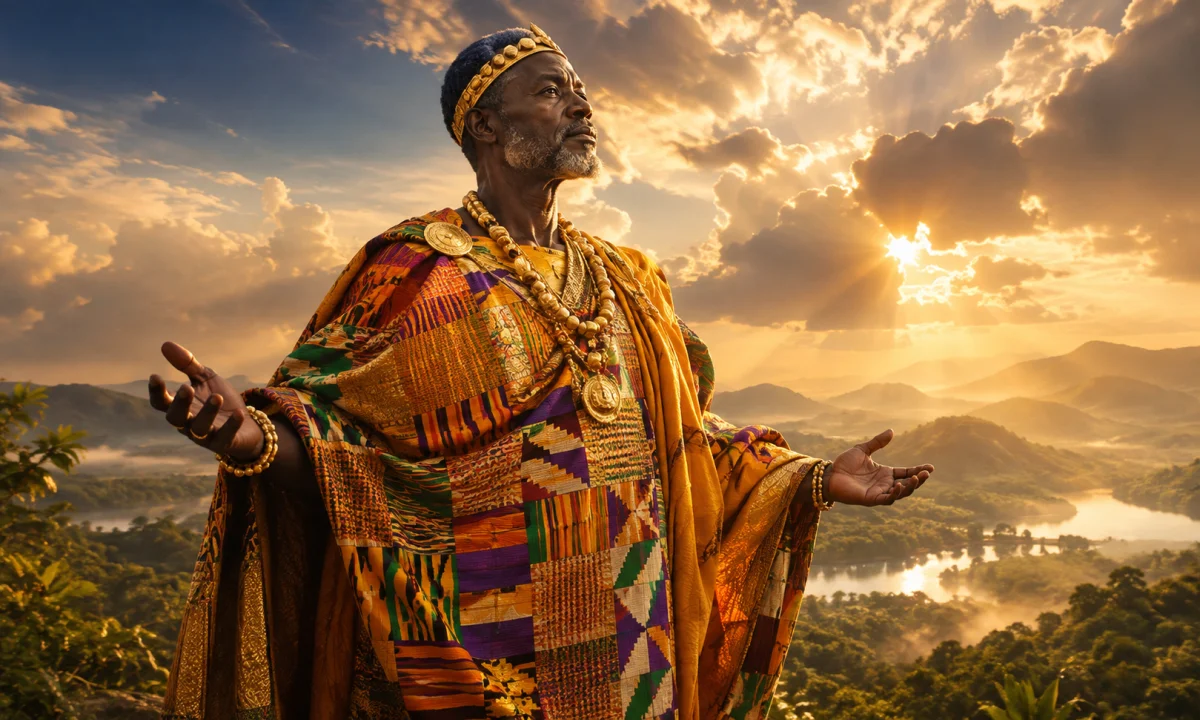
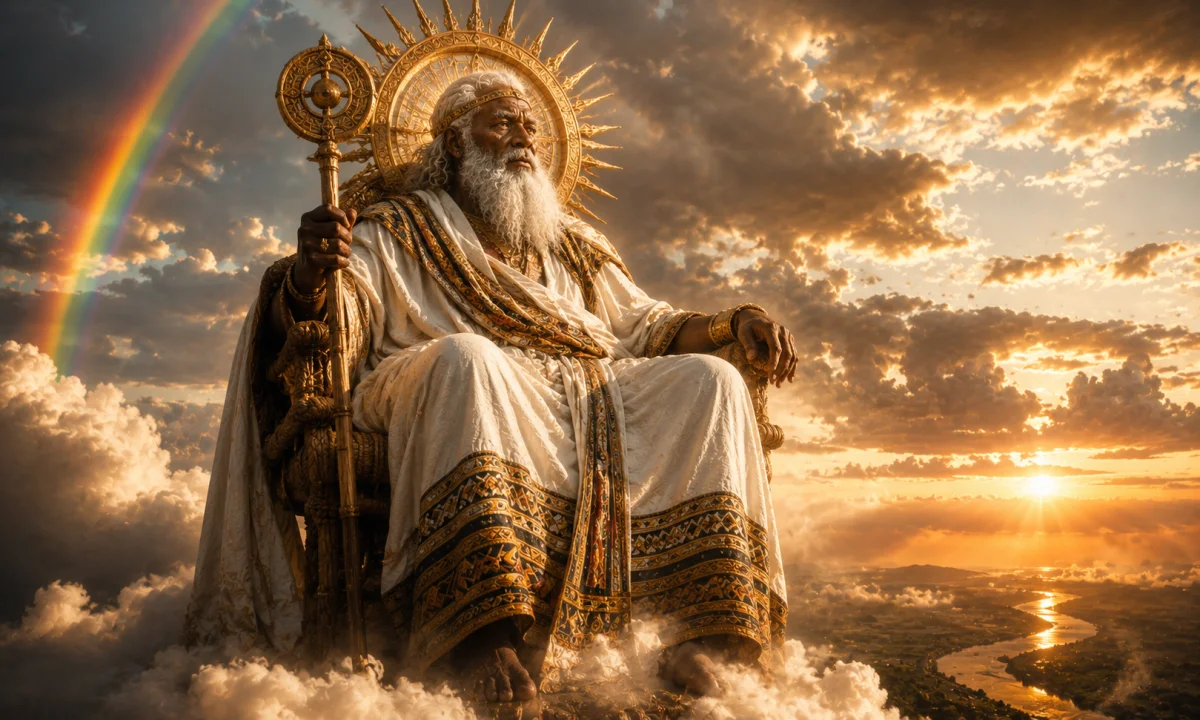
There is no widely established traditional image of Obassi Osaw comparable to the statues or anthropomorphic portraits of some ancient Mediterranean gods. The available material does not provide a consistent canonical appearance, costume or set of physical attributes. His significance lies more in his position above the visible world than in a distinctive visual form. Artistic representations that show him as a human-like king, a bearded sky father or a radiant celestial being are generally modern interpretive choices, not securely documented features of Efik tradition.
Obassi Osaw and Obassi Nsi
Obassi Osaw is frequently discussed alongside Obassi Nsi. The name Nsi is associated with the earth or land, and Obassi Nsi is commonly characterised as an earth deity or earth power. In some accounts, the two figures form a complementary pair: Obassi Osaw represents the sky, while Obassi Nsi represents the earth. This pairing expresses the relationship between the upper and lower realms, rain and soil, divine power and material fertility.
Some retellings describe Obassi Nsi as female and as the wife or counterpart of Obassi Osaw. Other descriptions are less concerned with a family relationship and instead treat the names as symbolic ways of distinguishing heavenly and earthly dimensions of divine power. Because the surviving accounts are not a single sacred text, it is safer to describe them as varying traditions rather than to insist on one definitive genealogy.
The relationship between the two figures should not be reduced to a simple equivalent of a married sky god and earth goddess from another mythology. Similar pairings occur in many cultures because agricultural life makes the interaction of sky, rain and earth especially meaningful. The Efik context gives the names their particular significance, and comparisons with Greek, Roman or other African deities can obscure rather than clarify the local tradition.
Creation and the ordering of the world
Obassi Osaw’s role as creator is usually expressed in general terms. He is understood as the source of the world, humanity and the conditions that make life possible. Traditional accounts do not form a single, universally preserved creation narrative with a fixed sequence of events, named companions and agreed details. Instead, information about the supreme deity appears through religious explanations, oral narratives, proverbs and descriptions of customary belief.
Stories about a former closeness between heaven and earth, followed by a separation, are sometimes connected with Efik or neighbouring traditions. In such narratives, an act by human beings causes the sky to withdraw from the earth, explaining why people can no longer approach the creator as they supposedly once did. The precise incident varies, and similar motifs are widespread across African folklore. A story of this kind should not automatically be presented as the definitive myth of Obassi Osaw without identifying its local version and context.
When such separation themes are associated with Obassi Osaw, they can be interpreted in several ways. They may explain the distance between the supreme deity and ordinary human life, account for the need for ritual mediation, or express the idea that the world is governed by boundaries that people must respect. They can also provide a mythic explanation for death, suffering or the loss of an earlier condition of abundance. These are interpretations of the narrative pattern, not necessarily fixed teachings shared by all Efik communities.
Religious role and symbolism
Obassi Osaw’s importance is theological rather than merely narrative. As the heavenly creator, he represents the ultimate source of existence. His name can be invoked in discussions of fate, moral responsibility, blessing and misfortune, although the exact use of divine names in everyday speech has varied by period and community.
The sky symbolism attached to Obassi Osaw gives the deity several related meanings:
- Creation: the power responsible for the existence of the world and living beings.
- Cosmic authority: the higher order that stands above human chiefs, families and political institutions.
- Rain and fertility: the life-giving connection between the heavens and the earth.
- Moral order: the idea that human conduct exists within a larger spiritual framework.
- Distance and transcendence: the perception that the highest deity is more remote than ancestors or local spiritual powers.
These themes do not mean that Obassi Osaw functioned as a specialised rain god in the narrow sense. Nor should every weather event or agricultural practice be attributed directly to him. The sky association is better understood as part of his broad status as the supreme deity, within which rain, life and authority are connected.
Sources and limits of the evidence
Knowledge of Obassi Osaw is not based on an ancient Efik scripture or an archaeological temple complex bearing a continuous written record. Much of the evidence comes from oral traditions and from descriptions made by visitors, missionaries, administrators and ethnographers. Such records are valuable, but they were produced in particular historical circumstances and may simplify local religious ideas into categories familiar to European readers.
Oral traditions are not unreliable simply because they are oral. They can preserve names, relationships and theological ideas over many generations. At the same time, oral transmission allows variation according to community, storyteller, ritual setting and historical change. A description that identifies Obassi Osaw as a male creator and Obassi Nsi as his female earthly counterpart may coexist with another account that places less emphasis on gender or marital relationship.
Translations also create difficulties. The English word “god” can suggest a person with a clearly defined personality, while a local term may include meanings connected with sacred power, creatorhood and the ordering of the universe. Likewise, the words “sky” and “heaven” may carry different theological implications. Care is therefore needed when turning brief traditional names into elaborate mythological biographies.
Distinguishing Obassi Osaw from related figures
Obassi Osaw should be distinguished from Obassi Nsi, even though the two names are closely associated. Obassi Nsi is linked with earth and land, while Obassi Osaw is linked with the sky and the supreme heavenly realm. They may appear together in accounts of creation or cosmic balance, but they are not simply two names for one deity.
He should also be distinguished from ancestors and local spirits. Ancestors may remain active within family and community relationships, while other spiritual beings may be connected with rivers, forests, illness, fertility or particular places. Obassi Osaw occupies a higher and more universal position in the traditional hierarchy of beings. Treating every Efik spiritual figure as a manifestation of the supreme god erases distinctions that are important within the religious system.
Finally, Obassi Osaw should not be casually identified with creator figures from neighbouring Igbo, Ibibio, Annang or other West African traditions merely because they share sky, creator or moral attributes. Regional traditions influenced one another, and linguistic relationships can be significant, but similar religious ideas do not prove complete identity. The most responsible description recognises both the connections and the differences.
Modern reception
In contemporary writing, Obassi Osaw may appear in surveys of African mythology, comparative religion and Nigerian cultural history. These treatments sometimes present him as an “African sky god” in a broad comparative scheme. That description can be useful as a starting point, but it risks making a complex Efik religious concept seem like a character from a standard pantheon.
Modern retellings may also give Obassi Osaw a detailed appearance, a long sequence of adventures or a role in fantasy settings. Such creative portrayals can draw inspiration from the traditional name while adding material that is not documented in Efik religious tradition. Games, novels, online mythology lists and other popular formats should therefore be read as adaptations unless they clearly distinguish invention from cultural history.
For traditional context, the central point remains Obassi Osaw’s place as the heavenly and supreme divine power in Efik religious thought, alongside the earth-associated Obassi Nsi and within a wider world of ancestors and spiritual forces. The surviving tradition is important precisely because it shows how Efik communities understood the relationship between creation, heaven, earth and human obligation without requiring a single fixed canon of myths.