WORLD
WORLD
Obassi Nsi
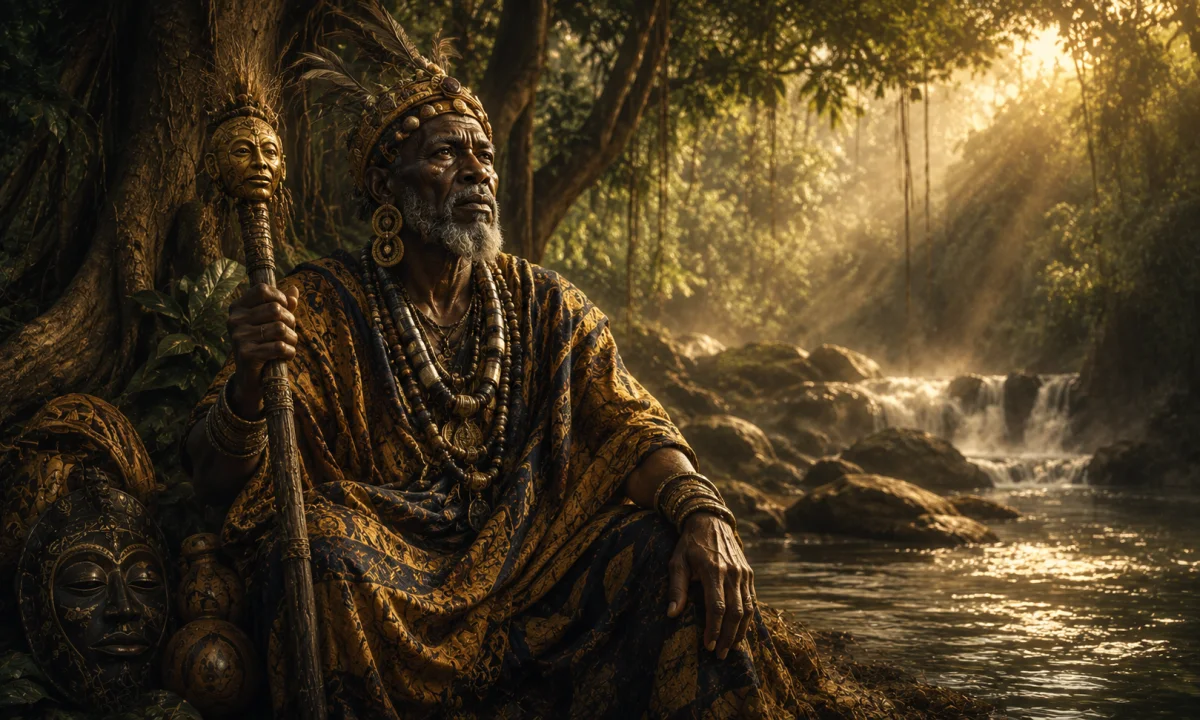
Obassi Nsi is an earth-associated deity in accounts of the traditional religious world of the Efik people of southeastern Nigeria. The name is commonly presented alongside Obassi Osaw, a sky-associated or heavenly deity. In this pairing, Obassi Nsi represents the earth as the realm of human life, cultivation, fertility and material existence, while Obassi Osaw is connected with the sky and the powers above it.
Information about Obassi Nsi is limited compared with the extensive traditions surrounding better-documented African deities. Much of what is known comes through descriptions of Efik religion, oral traditions and later summaries rather than through a single sacred book or an agreed body of canonical myths. Spellings, translations and interpretations vary, and some accounts describe Obassi Nsi as a goddess, whereas others use more general language such as “earth deity” or “earth god.” These differences reflect both variation in reporting and the difficulty of translating indigenous religious concepts into European categories.
Efik religious and cultural setting
The Efik are an ethnic group whose historic homeland is centred on the Cross River region of southeastern Nigeria, especially the area around the lower Cross River and Calabar. Their religious traditions developed within a wider cultural environment shared in some respects with neighbouring peoples, including other Cross River communities. Similar ideas about a supreme or distant creator, spiritual forces associated with nature, ancestors and local places, and the importance of ritual specialists appear across the region, although names and meanings are not identical from one community to another.
Traditional Efik religion did not necessarily organise divine beings in the same way as the pantheons of ancient Greece or Rome. A deity could be understood through its relationship to a natural domain, a community, a ritual responsibility or a particular aspect of life. The category “goddess” may therefore be useful as a rough English description, but it should not be assumed to reproduce the full meaning of the original religious concept.
In descriptions of Efik cosmology, the universe is often represented through a relationship between the heavens and the earth. The sky is associated with the upper realm and with forces that affect weather, rain and divine authority. The earth is the ground on which people live, farm, build families and bury their dead. Obassi Nsi belongs to this earthly dimension. Her significance is consequently not limited to soil in a physical sense: the earth is also the source of food, the setting of human society and the foundation of continuity between generations.
The meaning and form of the name
The spelling Obassi Nsi is widely used in English-language discussions, but it is not the only form encountered. Variants may result from differences in orthography, pronunciation, older missionary or colonial transcription, and the attempt to render Efik words for a non-Efik readership. The element Nsi is generally understood in connection with the earth or land. Obassi is treated in many accounts as a divine title or word for a deity, although translations can vary according to context.
Names from the Cross River region should not automatically be treated as fixed labels with one universally agreed dictionary definition. Religious names can carry associations that are broader than a literal translation. “Earth deity,” for example, identifies Obassi Nsi’s principal sphere but does not fully describe the rituals, moral ideas and social relationships attached to that sphere.
Obassi Nsi is sometimes compared with earth goddesses elsewhere in Africa because of her association with fertility, agriculture and the ground. Such comparisons can be helpful when they are made cautiously, but they do not prove that the traditions are historically the same. African religious systems are diverse, and an earth figure in one culture may have a different status, mythology or ritual function from an apparently similar figure in another.
Obassi Nsi and Obassi Osaw
The most common presentation of Obassi Nsi places her in a complementary relationship with Obassi Osaw. Obassi Osaw is usually described as the deity of the sky or heaven, while Obassi Nsi is associated with the earth. Some accounts call them a divine couple or husband and wife. Others focus less on marriage and more on the division or balance between celestial and terrestrial powers.
This relationship expresses a basic religious pattern: life depends on the interaction of what is above and what is below. Rain and other heavenly forces reach the earth; the earth receives, holds and transforms them into crops and living things. Human beings depend on both realms. The pairing can therefore be interpreted as a cosmological model of interdependence rather than simply a family story about two supernatural individuals.
Descriptions of the relationship are not entirely consistent. In some retellings, Obassi Nsi is treated as a distinct female partner to the sky deity. In others, the emphasis falls on the names as designations for broad cosmic powers. There is no universally accepted version of a single foundational myth that explains every aspect of their relationship. Claims that assign them a detailed genealogy, a complete creation sequence or a fixed set of children should therefore be treated carefully unless they can be connected to a specific Efik tradition.
Earth, fertility and human life
Obassi Nsi’s central symbolism arises from the importance of the earth in an agricultural and communal society. The earth provides the ground for settlement and cultivation, supports plants and animals, and receives the bodies of the dead. It is thus both productive and ancestral. Human life begins and ends within an earthly cycle, and the condition of the land directly affects the well-being of the community.
As an earth-associated deity, Obassi Nsi may be discussed in relation to:
- Fertility: the power of the land to produce crops and sustain living beings.
- Agriculture: the fields, soils and seasonal processes on which food production depends.
- Human settlement: the earth as the place where households, villages and social institutions exist.
- Burial and ancestry: the ground as the destination of the dead and a continuing link between generations.
- Balance with the sky: the relationship between earthly productivity and heavenly forces such as rain.
These associations should not be mistaken for a complete list of independently documented rites dedicated to Obassi Nsi. Available descriptions do not provide a uniform record of temples, festivals, priesthoods or ritual objects belonging specifically to this deity. In many African religious traditions, reverence for the earth is expressed through wider community practices, agricultural customs, oaths, land relationships and ancestral observances rather than through an exclusive institution devoted to one named figure.
Stories and narrative traditions
Obassi Nsi does not have a large, stable cycle of stories preserved in the manner of a written epic. Brief accounts often mention the earth deity while explaining the relationship between earth and sky, the origin of human conditions or the distribution of divine powers. However, these narratives are not always preserved in the same form, and short modern summaries can make a fluid oral tradition appear more uniform than it was.
Some general retellings describe the sky deity and the earth deity as formerly connected and then separated, a pattern found in creation traditions from many parts of Africa. Such accounts commonly use the distance between heaven and earth to explain why human beings must work, suffer, cultivate the land or communicate with the divine through ritual. Yet the precise details attributed to Obassi Nsi differ between sources. It is safer to identify the separation motif as a possible interpretive pattern than to present one version as the definitive Efik creation story.
Other summaries connect Obassi Nsi with the arrival of agriculture or with the earth’s role in sustaining humans. These associations are consistent with her classification as an earth power, but they should not automatically be expanded into a detailed tale in which she personally teaches named crops, establishes particular ceremonies or acts as the ancestor of a specific people. Such details are often added by later retellings or borrowed from other traditions.
Gender and classification
English-language reference works frequently call Obassi Nsi an earth goddess. This description is useful because it distinguishes her from the sky deity Obassi Osaw and reflects accounts that give the earth a feminine identity. Nevertheless, “goddess” is an interpretive category. The available evidence does not show that every Efik community understood Obassi Nsi in exactly the same personal or gendered way.
Religious beings associated with the earth can occupy several roles at once. They may be imagined as persons, powers, principles or presences that are approached through ritual and social obligations. A strictly anthropomorphic description can obscure this range. Obassi Nsi is best understood as a named divine representation of the earth and its life-sustaining power, with feminine identification in many English accounts but with variation in how that identity is explained.
Distinguishing Obassi Nsi from related figures
Obassi Nsi should not be merged with every African earth mother, fertility goddess or creator figure. The title and tradition belong to the Efik religious context, even though neighbouring peoples may have comparable concepts. Similarity of function does not establish identity.
Confusion can also arise because the name is sometimes written with forms resembling Abasi, a word used in parts of the Cross River region in references to God or a deity. Names such as Abasi Enyong and Abasi Isong appear in discussions of related regional religious traditions, with the latter associated with the earth in some accounts. These terms may reflect linguistic and cultural connections, but they should not be silently substituted for Obassi Nsi. A figure documented under another name may have a different history, ritual setting or theological meaning.
Obassi Nsi is also distinct from prominent earth-associated figures in other African traditions, such as Asase Yaa of Akan religion or Ala of the Igbo. Asase Yaa and Ala have their own names, myths, moral functions and ritual histories. Comparing them can illuminate recurring themes surrounding land and fertility, but it does not make them versions of Obassi Nsi.
Cultural significance
The importance of Obassi Nsi lies less in a long catalogue of adventures than in the way the figure expresses the sacred value of the earth. Land is not merely a resource. It is the basis of food, residence, kinship, burial and collective identity. A cosmology that places an earth power beside a sky power presents human survival as dependent on relationships between different domains of existence.
This perspective also gives the earth a moral and social dimension. To live from the land is to participate in obligations involving family, community and the dead. Even when particular practices are not described as worship of Obassi Nsi, the broader idea that the earth is a spiritually significant order helps explain why land, fertility and ancestry recur so strongly in regional religious thought.
Modern descriptions should preserve the limits of the evidence. Obassi Nsi is a genuine figure in accounts of Efik mythology, but the surviving record does not support an elaborate, universally fixed biography. The most reliable interpretation presents her as an earth-associated divine power, often understood as feminine and paired with Obassi Osaw, while recognising that oral traditions, translations and scholarly summaries may differ in detail.