WORLD
WORLD
Ala
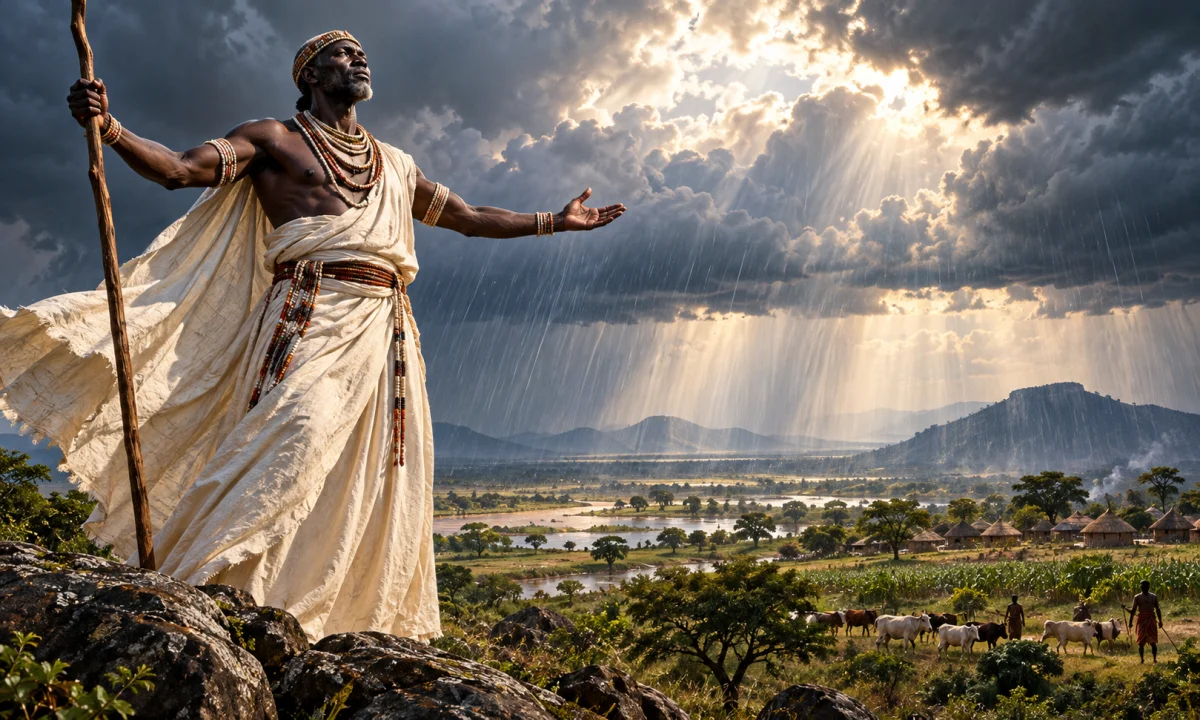
Ala, also known as Ani or by related regional forms such as Alá, is a major earth deity in the traditional religious systems of the Igbo peoples of southeastern Nigeria. She is associated with the earth as land, soil and living environment, but her significance extends far beyond agriculture. Ala is also connected with fertility, human morality, social order, the ancestors and the realm of the dead. In many communities, she is regarded as the mother who sustains life and the divine authority who guards the moral law.
Accounts of Ala vary among Igbo-speaking communities. Igbo religious traditions were historically transmitted primarily through oral teaching, ritual, proverbs, festivals, family customs and shrine practices rather than through a single canonical scripture. As a result, the goddess does not have one universally fixed biography, appearance or genealogy. The names used for her, the details of her relationship with other divine beings and the rituals dedicated to her can differ from one locality to another.
Ala in Igbo religious tradition
Traditional Igbo religion includes a supreme creator commonly called Chukwu or Chineke, along with numerous spiritual powers often described as alusi. These beings may be associated with particular communities, natural forces, moral principles or important aspects of human life. Ala is among the most widely recognized of these powers, although her position and description are not identical everywhere.
The word ala can mean earth, ground, land or soil in Igbo languages. In religious contexts, the term may refer both to the physical earth and to the divine personality understood as its living power. This overlap is important. Ala is not simply a goddess who happens to rule a separate earthly realm; the earth itself is sacred through her presence. Land is the basis of farming, settlement, burial and inheritance, and therefore connects the living, the dead and generations yet to come.
Many Igbo communities traditionally understood human beings as living within a moral and spiritual order overseen by Ala. Rules governing conduct, ritual purity, kinship, sexuality, land use and relations between people were not merely private or secular matters. Serious violations could be regarded as offenses against the earth, often described as nso Ala, meaning an abomination or taboo against Ala. Such offenses threatened the individual, the family and the wider community because they disturbed the balance on which communal life depended.
Mother of the earth and source of fertility
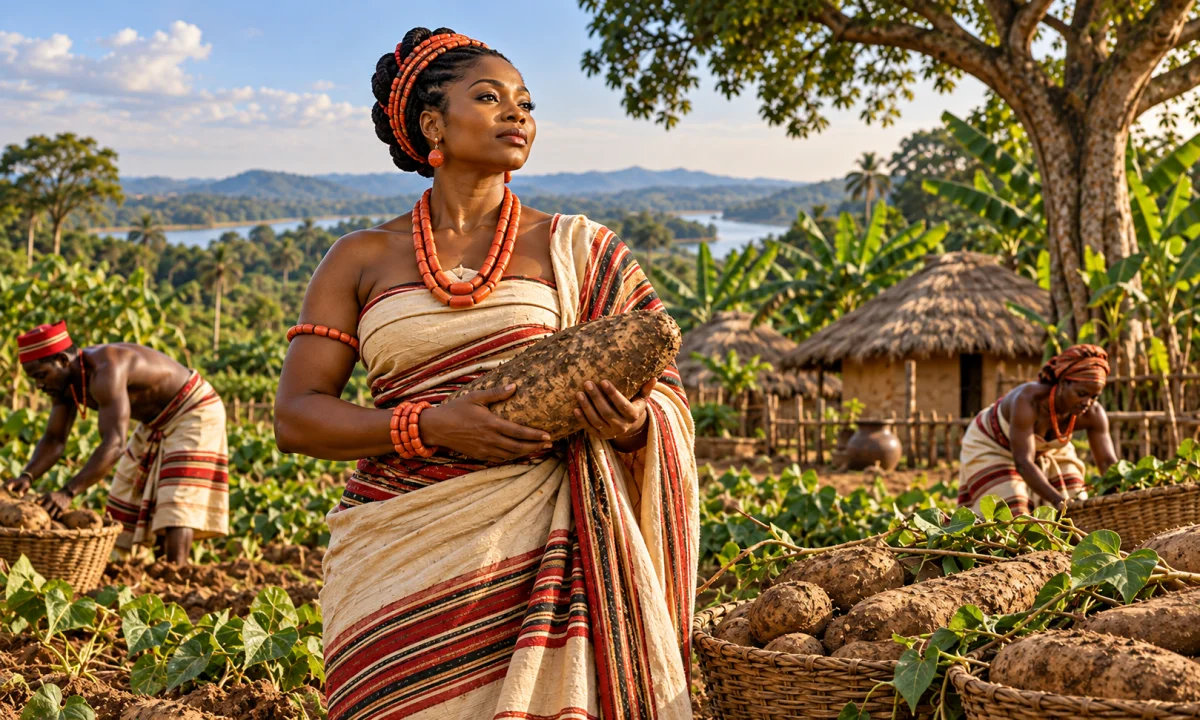
Ala is often called mother earth, mother of the land or Nne Ala. These titles express several connected ideas. The earth receives seeds and makes crops grow; it supports houses, paths and villages; and it receives the bodies of the dead. Human life is therefore understood as emerging from the earth, depending on it and eventually returning to it.
Her agricultural importance is especially clear in farming communities where yam, cassava, cocoyam and other crops form part of the local economy and ritual calendar. The productivity of the soil is not treated as a purely mechanical process. Farming requires respect for the land and observance of taboos, seasonal customs and communal obligations. In many areas, ceremonies connected with planting, harvest and the New Yam season acknowledge the powers that make food possible. These observances are not uniform across all Igbo communities, and not every festival is exclusively or directly a festival of Ala, but the sacred character of the earth is a recurring theme.
Ala’s fertility also has a human dimension. She may be invoked in connection with pregnancy, childbirth, family continuity and the prosperity of descendants. The comparison between the earth receiving seed and a woman bearing children is widespread in traditional agricultural symbolism, but Ala should not be reduced to fertility alone. Her authority includes judgment, moral regulation, death and the ancestral order as well as abundance and birth.
Guardian of morality and social order
One of Ala’s most important roles is the protection of moral law. In traditional Igbo thought, moral behavior is closely tied to the well-being of the community. Acts such as murder, incest, sacrilege, theft, betrayal of kinship obligations or violations of important taboos could be considered offenses against Ala. The precise list of offenses differed between communities and circumstances, and it was interpreted through local institutions, elders, priests and customary law.
Ala’s moral authority does not necessarily operate like the judgment of a human monarch. Rather, wrongdoing is understood to damage the relationship between the offender, the community and the earth. A violation may bring spiritual pollution, social disorder, illness, crop failure or other forms of misfortune. Ritual cleansing, confession, sacrifice, restitution or public reconciliation could be required, depending on the offense and local custom.
This connection between morality and the land gives Ala a distinctive place in Igbo religious life. She represents an order that is both natural and social. The same earth that nourishes crops also provides the ground on which laws, kinship and communal identity are established. To offend Ala is therefore to threaten the conditions that allow human society to exist.
Ala, the dead and the ancestors
Because the dead are buried in the earth, Ala is closely associated with death and the ancestors. The earth may be imagined as receiving the deceased and preserving their relationship with the living community. In many Igbo traditions, ancestors remain active members of family and village life. They may protect descendants, witness important events, receive offerings or punish serious violations of custom.
Ala’s connection with the dead does not mean that she is simply an underworld goddess in the sense found in some other religious systems. Igbo concepts of the afterlife and the ancestral realm vary, and the earth is not always described as a single subterranean kingdom ruled by one goddess. It is more accurate to say that Ala provides the sacred ground through which life, death, burial and ancestral continuity are connected.
Burial customs therefore have religious importance. The treatment of the body, the location of burial and the observance of mourning can express the continuing relationship between a person, the family and the land. Ala’s presence in this context emphasizes that death is not an escape from the moral community. The dead remain part of a larger order that includes the earth and the ancestors.
Sacred places and ritual expression
Ala may be honored at shrines, in sacred groves, at boundaries and in other places recognized by a particular community. Shrines are not identical everywhere, and their forms depend on local religious practice. A priest or priestess may serve Ala, interpret signs, oversee offerings or take part in rituals connected with moral offenses and community welfare. Titles and responsibilities vary according to region and institution.
One of the most visually important forms associated with Ala is the mbari house. Mbari houses are large, open-sided structures containing painted and sculpted figures. They are especially associated with parts of the Owerri area and nearby Igbo communities. An mbari house can include representations of Ala, other deities, human beings, animals, colonial officials, traders and scenes from social life. It is produced through a lengthy communal process and may be dedicated to Ala and other powers.
Mbari art should not be treated as a simple portrait of Ala or as a fixed description of her appearance. The sculptures are symbolic and often combine sacred, social and historical subjects. Their purpose can include honoring the divine, acknowledging prosperity, addressing crisis and displaying the community’s understanding of the world. The prominent position of Ala in many mbari structures reflects her importance as a power of creation, judgment and communal balance.
Appearance and attributes
Traditional accounts do not provide one standardized physical appearance for Ala. She may be represented through symbolic objects, shrine figures, sculpture or artistic compositions rather than through a single canonical form. Artistic representations can show her as a woman, a maternal figure or a dignified divine presence, but these images are not universal rules for how she must look.
Her most consistent attributes are conceptual rather than visual:
- Earth and soil: the ground that supports life, receives the dead and gives crops nourishment.
- Fertility: the power behind agricultural growth, childbirth and the continuation of families.
- Morality: the authority associated with taboos, justice, purity and communal responsibility.
- Ancestors: the sacred connection between the living community, the buried dead and future generations.
- Prosperity: the abundance that allows households and villages to survive.
- Protection of the community: the maintenance of order when people respect the land and one another.
These attributes are interconnected. Fertility without moral order would not guarantee communal well-being, while moral authority without nourishment would not sustain life. Ala’s importance lies partly in the way she brings these dimensions together.
Relationships with other divine powers
Descriptions of Ala’s relationships with other Igbo deities are not uniform. Some accounts place her within a broad divine order associated with Chukwu, the supreme creator. Other traditions emphasize particular local alusi, such as a thunder deity, a river power or a community’s tutelary spirit, without presenting a detailed universal genealogy.
Ala is sometimes described in popular summaries as the wife or consort of Amadioha, a prominent thunder and lightning deity in some Igbo traditions. This pairing can be meaningful in certain interpretations because earth and thunder represent complementary powers: the earth sustains life, while thunder and lightning express dangerous or forceful heavenly energy. However, the relationship should not be presented as a universally accepted feature of Igbo religion. Amadioha is also known by regional names and has different roles in different communities, while Ala’s own relationships are not standardized across Igboland.
Similarly, Ala should not be assigned a fixed family of children or a single mythological genealogy simply because such details appear in a modern retelling or in one local account. Igbo religious traditions are diverse, and local sacred systems do not always conform to the genealogical structures familiar from classical pantheons.
Myths, stories and oral variation
There is no single authoritative myth that defines Ala for all Igbo people. Stories about her may explain why the earth must be respected, how a taboo came to be established, why a community suffered after an offense or how agriculture and human society depend on divine order. Such narratives often function as moral teaching rather than as detached entertainment.
Oral traditions can also change through performance. A story told by an elder, ritual specialist, farmer or village community may emphasize different aspects of Ala’s character. One version may focus on fertility, another on punishment for incest or murder, and another on the obligations surrounding burial and ancestral remembrance. Differences between accounts do not automatically mean that one version is false; they reflect the local and performative nature of the tradition.
Written descriptions of Ala were often produced by outsiders, including missionaries, colonial officials and later scholars. These records can preserve valuable information, but they may also impose categories such as “goddess,” “myth,” “heaven” or “underworld” that do not map perfectly onto Igbo concepts. Modern discussions therefore benefit from distinguishing between community traditions, historical observation and scholarly interpretation.
Cultural significance and changing religious contexts
Ala remains important as a cultural and intellectual symbol even where Christian or other religious practices have changed older forms of worship. Many people of Igbo heritage continue to encounter her through proverbs, literature, art, place-based customs, family traditions and discussions of indigenous identity. This does not mean that all Igbo people worship Ala today or interpret her in the same way. Contemporary religious life is diverse, and traditional beliefs may coexist with, adapt to or be rejected in relation to Christianity, Islam and other outlooks.
Ala also appears in modern literary and artistic representations. Her presence in discussions of Igbo culture has been strengthened by works of fiction and scholarship that explore the moral importance of the earth, ancestral life and communal law. In such works, she may serve as a symbol of indigenous values or as a way to examine conflicts between customary institutions and imported religious or colonial systems. Literary uses should be distinguished from direct evidence about historical ritual practice: a novel may draw on traditional concepts while reshaping them for narrative purposes.
Distinguishing Ala from similar names
The name Ala can cause confusion because similar spellings occur in other African languages and in unrelated mythological traditions. In an Igbo context, Ala generally refers to the earth power described above, with Ani and related forms used in some areas. The meaning and pronunciation can vary by dialect.
Ala should not automatically be identified with every African figure called “earth goddess,” since African religious traditions are not one single system. Yoruba, Akan, Fon, Kongo and other traditions have their own earth powers, cosmologies and ritual institutions. Nor should the Igbo Ala be confused with unrelated figures from European folklore whose names happen to resemble hers. Correct identification depends on language, region and cultural context.
For the Igbo, Ala is best understood as a living religious concept that joins land, fertility, morality, burial and communal continuity. She is not merely a personification of nature. She expresses the conviction that the earth is an active sacred authority: the source that nourishes human life, the ground that receives the dead and the moral order before which individuals and communities are responsible.