WORLD
WORLD
Nyonye Ngana
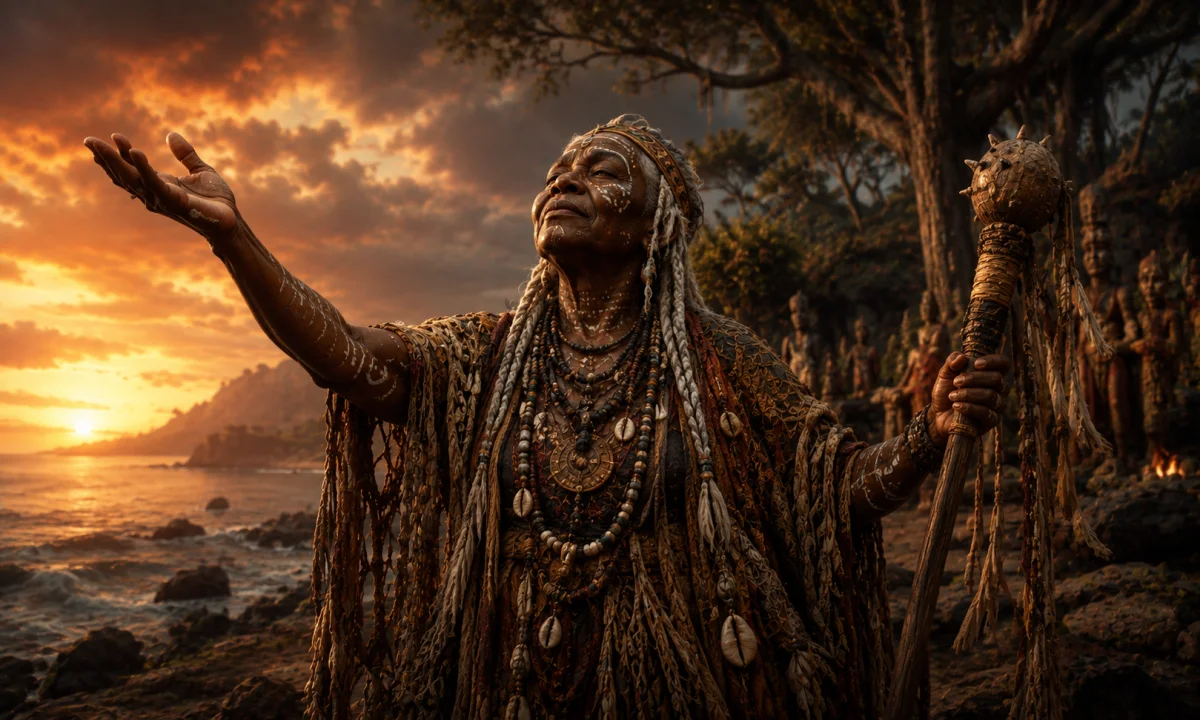
Nyonye Ngana is a little-documented figure associated in some modern accounts with Bantu-speaking traditions of Africa, where she is usually described as a female water spirit or water goddess. The available information about her is limited, and the name does not belong to a single, widely documented mythology with a standard body of stories. It is therefore important to treat descriptions of Nyonye Ngana cautiously rather than presenting uncertain details as universally accepted tradition.
Origins and cultural setting
The term Bantu refers primarily to a large family of languages and to the many societies that speak them across central, eastern and southern Africa. It does not designate one unified religion or one common pantheon. Religious traditions among Kongo, Luba, Fang, Duala, Herero, Tswana, Zulu and many other peoples differ substantially, even when they share broad ideas about ancestors, creator beings, spirits of nature and sacred places.
References to Nyonye Ngana are often presented under the broad heading of “Bantu mythology.” That classification may be useful as a general label, but it does not by itself establish that every Bantu-speaking people traditionally recognized her, or that all descriptions of her come from the same community. In the surviving written record, Nyonye Ngana is not as extensively documented as figures such as Nzambi, Mbombo, Unkulunkulu or Nyami Nyami.
The name appears most often in modern summaries of African mythology and in encyclopedic or popular listings of deities. Those summaries commonly identify Nyonye Ngana with water, but they do not consistently preserve a detailed oral cycle, a specific place of worship, a fixed genealogy or a clearly defined set of myths. The lack of accessible documentation makes it difficult to determine whether all references derive from one tradition, from several related traditions, or from later attempts to organize regional beliefs into a pan-African pantheon.
Name and identity
The spelling Nyonye Ngana should be retained with care. African names can be altered when they pass between oral languages, colonial-era transcriptions, missionary records and modern English-language reference works. Differences in pronunciation, tone, vowel length and the division of words may not be visible in English spelling. At present, there is no broadly established standard set of variant spellings that would allow every occurrence of the name to be traced confidently to one original form.
The word “goddess” is also an interpretive label. In many African religious traditions, beings associated with rivers, lakes, springs, rain, the sea or fertility do not fit neatly into the European categories of “god,” “goddess,” “fairy” or “spirit.” A water being may be a local power, an ancestor, a guardian, a dangerous presence, a source of healing or a manifestation of a greater sacred force. Calling Nyonye Ngana a goddess may reflect the terminology of modern reference works rather than the exact vocabulary used by the communities connected with the name.
For that reason, the most careful description is that Nyonye Ngana is a reported female water being, sometimes classified as a goddess, in accounts associated broadly with Bantu Africa. More specific claims about her family, appearance or mythology require supporting evidence that is not consistently available.
Association with water
Water has profound religious importance in many African societies. Rivers and springs can provide drinking water, fish, fertile soil and routes of travel, while lakes and seas may mark boundaries between human settlements and the unseen world. Rain is often connected with agricultural success, royal authority, ancestral blessing and the well-being of the community. Water can therefore be both life-giving and dangerous.
Against this background, a water spirit such as Nyonye Ngana may be understood through several connected themes:
- Fertility and nourishment: water sustains crops, animals and human communities.
- Healing and renewal: springs, rivers and ritual washing may be associated with restoration and purification.
- Protection: a spirit connected with a particular body of water may guard a place or regulate access to it.
- Danger and taboo: floods, drowning and unexplained illness can give water a threatening spiritual dimension.
- Transformation: water frequently marks movement between ordinary life and the realm of spirits or ancestors.
These themes describe the wider religious significance of water and should not be treated as a complete list of Nyonye Ngana’s personal powers. There is no securely established canonical account that defines precisely which river, lake or sea she rules, nor is there a consistent record of specific ceremonies dedicated to her.
Attributes and representation
Popular descriptions commonly portray Nyonye Ngana as feminine and aquatic. Beyond that, the evidence is uncertain. No single traditional physical form can be stated with confidence. Some modern illustrations may show her as a beautiful woman, a mermaid-like being or a spirit emerging from water, but such images should not automatically be regarded as traditional representations.
Mermaid imagery is particularly easy to misapply. Across Africa, stories of aquatic beings have developed in varied cultural settings. Some are connected with local rivers or coastal waters; others belong to newer, transregional traditions shaped by trade, migration, Christianity, Islam, colonial encounters and the international circulation of images. A woman with a fish tail is therefore not proof of a connection with Nyonye Ngana.
Nor is there reliable evidence that she possesses a fixed set of objects, colours, animals or emblems. Claims that she carries a mirror, comb, shell, necklace or particular weapon may result from the blending of Nyonye Ngana with other water spirits, especially figures associated with the broad phenomenon known as Mami Wata. Such associations should be identified as later comparison or possible conflation, not presented as established attributes.
Stories and relationships
A recurring problem in accounts of Nyonye Ngana is the presentation of a detailed creation story without a clear indication of its cultural and textual origin. Some modern summaries place her within a family of creator beings or describe her as related to Nzambi, a supreme creator figure known in several Kongo-related religious traditions. The relationship is not sufficiently documented to be treated as a universal feature of Nyonye Ngana’s identity.
Nzambi itself is a name with a complex history. In Kongo and neighbouring traditions, related forms such as Nzambi or Nzambi Mpungu have been used for a supreme or creator power, although meanings and theological interpretations vary by community and historical period. The existence of a water goddess named Nyonye Ngana in a modern list does not, by itself, demonstrate that she was traditionally understood as Nzambi’s daughter, consort or companion.
There is likewise no securely attested cycle of adventures, conflicts or marriages that can be summarized as the definitive mythology of Nyonye Ngana. Stories sometimes attributed to her may belong to other African water beings or may be modern efforts to supply narrative detail to a name that appears in a short catalogue entry. A responsible account must distinguish between a figure’s reported classification and a fully documented oral tradition.
Religious interpretation
If Nyonye Ngana represents a genuine local or regional water tradition, her significance would likely depend on the particular community, landscape and ritual system in which the name was used. A spirit of a forest stream would not necessarily have the same character as a being connected with a major river, a floodplain, a lake or the Atlantic coast. Local sacred geography is essential to understanding such figures.
Water spirits are not always benevolent. In many traditions, respect for a spirit involves observing restrictions about bathing, fishing, crossing a river, taking objects from a spring or entering a sacred area. Offerings, prayers or acts of ritual attention may seek protection or favourable conditions, while violations may be associated with illness, misfortune or drowning. These patterns are widespread enough to provide context, but they cannot be assigned specifically to Nyonye Ngana without evidence from a particular tradition.
The feminine classification may also carry several meanings. Female water beings can symbolize generative power, beauty, abundance and healing, but they may also represent the unpredictability of desire, wealth and danger. Such symbolism should not be reduced to a simple idea of a “mother goddess.” African religious systems often distinguish between creator powers, ancestors, territorial spirits and specialized beings, and the roles of these categories vary widely.
Distinction from similar figures
Nyonye Ngana should not automatically be identified with Mami Wata. Mami Wata is a broad and historically changing group of water-spirit traditions found in many parts of Africa and in African diasporic communities. The name, imagery and religious practice associated with Mami Wata have been shaped by coastal exchange, visual culture and contact among African, European and Asian traditions. A female aquatic figure and a general association with wealth or beauty are not enough to establish identity with Nyonye Ngana.
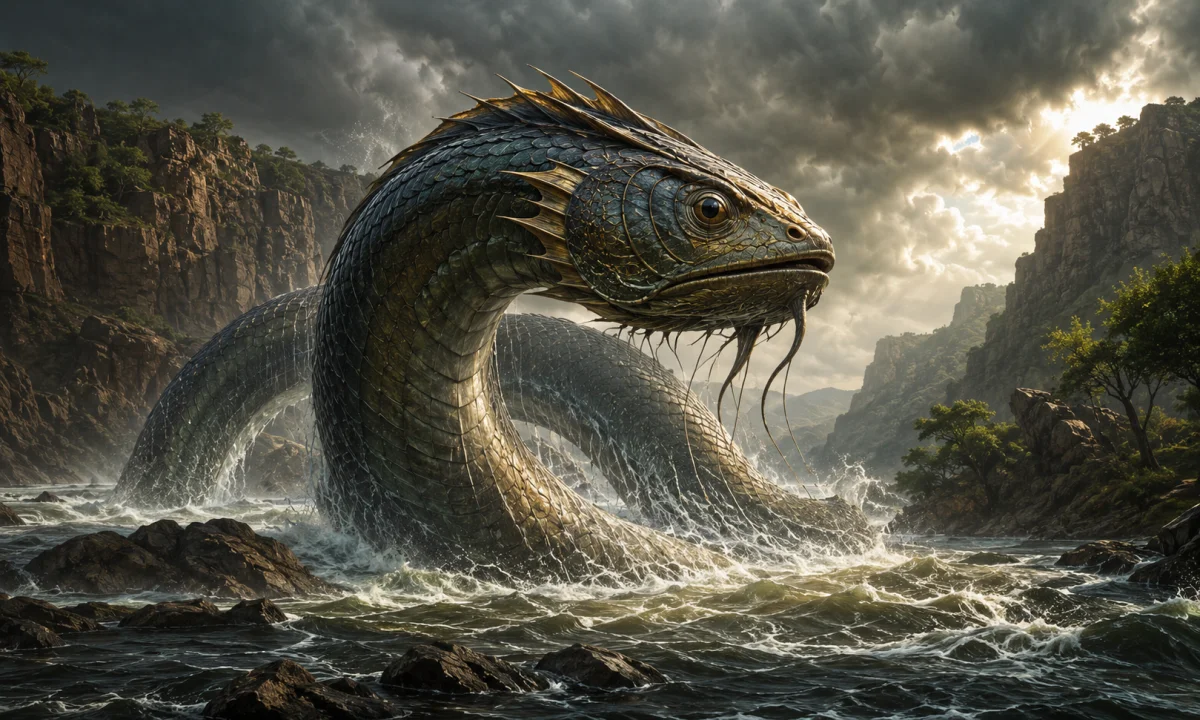
She should also be distinguished from Nyami Nyami, the celebrated serpent or river being associated especially with Tonga traditions around the Zambezi River. Nyami Nyami is commonly represented as a powerful snake-like creature and is connected with a specific cultural and geographical setting. There is no sound basis for treating Nyami Nyami and Nyonye Ngana as different names for the same being.
Nor should Nyonye Ngana be merged with every African creator goddess, earth mother or rain spirit. Names such as Nana Buluku, Asase Yaa, Mawu and other female sacred figures belong to particular West African or regional traditions, each with its own history. Geographic proximity or a shared connection with fertility does not establish a common identity.
Sources and limits of knowledge
Much African religious knowledge was transmitted orally through ritual specialists, elders, families and local communities. Oral tradition is not an inferior form of evidence, but it can be difficult for outsiders to document accurately. Names may be recorded in different languages, stories may be restricted to initiated people, and accounts collected by missionaries, administrators or early anthropologists may omit meanings that were obvious to local speakers.
In Nyonye Ngana’s case, the main difficulty is the scarcity of a clearly traceable tradition in widely available English-language material. Short reference entries often provide a name and a category while leaving out the community, language, location and original informants. Without those details, it is not possible to determine how old the recorded form is, whether the figure was locally important, or whether later writers have combined information from unrelated traditions.
This uncertainty is not a reason to dismiss the name. It is a reason to describe it precisely. Nyonye Ngana can be presented as a figure associated with African water mythology, while acknowledging that her cultural setting and mythology remain insufficiently documented. The distinction protects both historical accuracy and the integrity of the many living traditions that are too often compressed into a single “African mythology.”
Modern reception
Nyonye Ngana has little established presence in globally popular fiction, film or games compared with more widely circulated African figures. When she appears in contemporary mythology websites, fantasy settings or illustrated deity lists, the presentation may expand her into a fully characterized water goddess with a detailed appearance, genealogy and set of powers. Such portrayals can be creative reinterpretations, but they should not be confused with securely recorded traditional material.
Modern interest in lesser-known African sacred figures can encourage further research, especially when it leads readers to ask which language, community and historical source lies behind a name. The most respectful treatment avoids filling documentary gaps with invented stories and avoids treating the diverse religions of Africa as one interchangeable system. Nyonye Ngana is best understood as a cautiously identified water-associated figure whose precise origin and traditional identity require further evidence.