WORLD
WORLD
Nootaikok
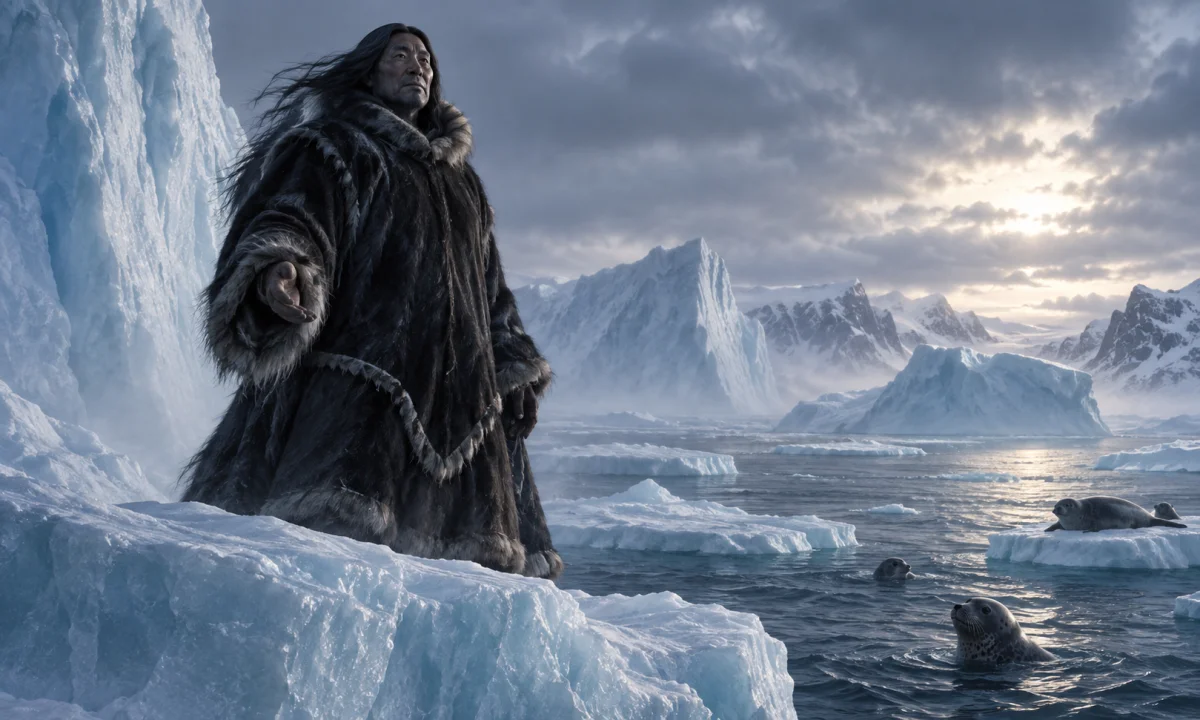
Nootaikok is a little-known figure associated in some modern accounts with Inuit traditions concerning icebergs, ice, and the northern landscape. Unlike widely documented figures such as Sedna, Sila, or Nanook, Nootaikok does not appear consistently across the many regional traditions of Inuit peoples. Information about the figure is limited, and descriptions vary considerably between reference works.
Origins and cultural setting
“Inuit mythology” is a broad modern label for the religious traditions and stories of several related peoples across the Arctic, including Inuit communities in Canada and Greenland, as well as neighbouring Yupik-speaking peoples in Alaska and Siberia. These traditions were never a single, uniform system. Names, spirits, relationships, ritual practices, and stories could differ from one region to another and from one storyteller to another.
Traditional Inuit religious thought generally treated the human, animal, spiritual, and environmental worlds as closely connected. Animals, weather, sea conditions, places, tools, and unusual events could possess spiritual significance. Hunting success and survival depended not only on practical knowledge but also on maintaining proper relationships with animals, ancestors, local spirits, and powerful beings.
In that setting, icebergs were not merely scenery. They could be dangerous, changeable, and essential parts of the Arctic environment. They affected travel, hunting, coastal life, and the movement of sea ice. A figure associated with icebergs would therefore belong to a world in which the landscape itself could be morally and spiritually meaningful.
Most information about Nootaikok is not preserved in a large, continuous cycle of traditional narratives. The name is more commonly encountered in short modern catalogues of mythology and in popular summaries of Inuit deities. Such compilations often provide only a brief description, sometimes identifying Nootaikok as a being connected with icebergs or the frozen landscape. It is difficult to determine from these summaries whether they represent a specific regional tradition, a condensed translation of an older account, or a later attempt to classify a local spirit as a “god.”
Name and identity
The spelling Nootaikok is the form most often used in English-language reference material, although variant spellings may occur. The available information does not establish a single universally accepted English transliteration or a securely documented etymology for the name. It is therefore unwise to assign a definite meaning to the word without identifying the original language, dialect, and source.
Classification is also uncertain. Some references call Nootaikok an Inuit god, while others treat the figure more generally as a spirit or supernatural person associated with the natural world. “God” can be a convenient English label, but it may not correspond precisely to the categories used in a particular Inuit community. Inuit traditions include many kinds of powerful beings, and not all were understood as members of a fixed pantheon comparable to the gods of ancient Greek or Roman religion.
Nootaikok should consequently be described as a poorly documented Inuit-associated supernatural figure linked with icebergs, rather than as a universally recognized pan-Inuit deity. The cautious wording matters because the surviving evidence does not support a detailed, standardized biography.
Association with icebergs and the Arctic landscape
The central attribute assigned to Nootaikok in modern accounts is a connection with icebergs. Some descriptions present Nootaikok as a being who dwells in an iceberg; others simply associate the figure with icebergs, ice, or the northern land. These details should not automatically be treated as elements of one established mythic story. They may reflect different summaries of a limited tradition, or they may have been repeated and elaborated by later writers.
An iceberg is an especially powerful image in Arctic mythology and storytelling. It is immense but mobile, beautiful but hazardous, and only partly visible above the sea. Its submerged mass makes it difficult to judge its true size, while its movement and collapse can alter the surrounding water without warning. Such features readily invite ideas of hidden power, transformation, and danger.
Nevertheless, no securely documented set of powers can be assigned to Nootaikok with confidence. Popular reference entries sometimes describe the figure as controlling icebergs, protecting people, or influencing the environment. These claims are not equally well supported, and they should not be presented as settled features of a broad Inuit belief system. The safest interpretation is that Nootaikok’s significance, where the figure is recognized, arises from the spiritual importance of ice and the dangers of the Arctic environment.
Stories and traditional material
There is no widely attested cycle of Nootaikok stories comparable in fame or documentation to the narratives surrounding Sedna, the sea mother. Nor is there a single well-known creation myth in which Nootaikok plays a clearly defined role. English-language summaries occasionally suggest that Nootaikok is connected with the making or preservation of land, but the evidence for treating this as a standard Inuit creation story is weak.
It is possible that some accounts derive from a localized oral tradition. Inuit storytelling has historically been transmitted through performance, memory, and community teaching rather than through one canonical scripture. A story may be known in one settlement or region and absent from another. Names can also be recorded imperfectly when outsiders write them down, especially when converting Inuit-language sounds into European alphabets.
Oral traditions are not necessarily less meaningful because they vary. Variation is normal in traditions that are transmitted in living communities. The difficulty in Nootaikok’s case is different: much of the material now available in English is so brief that it is hard to distinguish an original regional account from a later encyclopedic label. A responsible description must therefore separate what is repeatedly claimed from what is securely documented.
Religious and symbolic significance
Inuit religious life was closely connected to practical knowledge of the Arctic. Weather, sea ice, animal behaviour, seasonal change, and navigation were matters of survival. Spiritual explanations did not replace observation; they existed alongside detailed environmental expertise. A being linked with icebergs would thus be relevant to a world in which people had to respect both the physical behaviour and the spiritual dimensions of the environment.
Nootaikok can be interpreted, cautiously, as representing the agency and unpredictability of the frozen landscape. Icebergs may provide routes, landmarks, or opportunities for hunting, yet they can also overturn, fracture, or shift unexpectedly. Their presence reminds people that the environment is not passive or entirely subject to human control.
This does not mean that Inuit communities uniformly worshipped Nootaikok as the master of all ice. Inuit relationships with supernatural beings were often practical and relational rather than based on a simple division between “gods” and “worshippers.” People might show respect, follow customary restrictions, observe ritual rules, or tell stories that taught proper conduct. The exact practices associated with a particular being could be local and are not recoverable in the case of Nootaikok from the limited general descriptions available.
The figure also illustrates a wider feature of northern storytelling: natural forms can have personhood or spiritual presence without being reduced to symbols in the literary sense. An iceberg may be a physical object, a dangerous part of the environment, and a manifestation of an unseen power at the same time. Modern readers should avoid assuming that such a being is merely a personification invented to decorate a landscape.
Relationship to other Inuit beings
Nootaikok should not be merged with better-known Inuit figures simply because all are associated with nature. Sedna, for example, is a major sea-associated figure in many Inuit traditions, although her name, story, and role vary regionally. She is commonly connected with marine animals, hunting, and the moral consequences of human behaviour. Nootaikok has no securely established identity as another name for Sedna.
Nor should Nootaikok be confused with Sila. Sila is a complex term and figure in Inuit religious thought, often associated with air, weather, intelligence, consciousness, or the wider life-giving order of the world, depending on the tradition and interpretation. Sila is not simply an iceberg spirit, and there is no sound basis for treating the two names as interchangeable.
Nanook, or Nanuq, is commonly understood as the powerful spirit or master associated with polar bears. Nanook belongs to a different area of traditional concern and should not be identified with Nootaikok. Likewise, Qailertetang, in traditions where she is recognized, is associated with weather, sea animals, and hunting conditions, but this does not make her another form of Nootaikok.
These distinctions are important because popular lists of “Inuit gods” often place many regional beings side by side as though they belonged to one standardized pantheon. Such lists can obscure the differences between named deities, local spirits, animal masters, personified forces, and concepts that have been translated into English using familiar religious vocabulary.
Sources and limits of interpretation
Knowledge of Inuit traditions comes from several kinds of evidence, including oral histories, community knowledge, accounts recorded by missionaries and explorers, linguistic research, ethnography, archaeology, and modern Indigenous scholarship. Each type of evidence has limitations. Older outside observers sometimes misunderstood Indigenous categories or recorded names inconsistently. Modern compilations may remove a story from its local setting and present it as representative of all Inuit people.
The scarcity of detailed material about Nootaikok makes these issues especially significant. A short entry naming Nootaikok as an iceberg deity cannot by itself establish a complete mythology, a universal role, or a precise ancient origin. Nor does the absence of extensive written documentation prove that the figure was unimportant. Many oral traditions were never recorded, and some surviving records preserve only fragments.
It is also important not to describe Inuit religion as a relic of the past. Inuit communities are living societies with contemporary languages, cultural practices, Christian traditions, Indigenous spiritual perspectives, and ongoing efforts to preserve and renew local knowledge. Traditional stories may continue to have meaning, but their significance should be understood through the communities that maintain them rather than through detached lists of mythology alone.
Modern reception
Nootaikok has little established presence in internationally popular culture. The name appears chiefly in online mythology directories, encyclopedic lists, and occasional discussions of obscure Arctic deities. These sources often repeat a short description without providing enough regional or linguistic context to show how the figure was understood traditionally.
When Nootaikok is used in modern fiction, games, fantasy writing, or visual media, creators may expand the figure into an ice god, an iceberg-dwelling guardian, or a ruler of frozen seas. Such portrayals can draw inspiration from the name’s commonly reported association with icebergs, but they are modern adaptations rather than evidence for additional traditional attributes.
The most accurate way to approach Nootaikok is therefore modestly. The name belongs to the wider field of Inuit-associated mythology and is linked in surviving English-language descriptions with icebergs and the Arctic environment. Beyond that central association, identity, regional origin, powers, stories, and religious status remain uncertain. Treating those uncertainties openly preserves the distinction between a fragmentary traditional reference and the much fuller character that later imagination might create.