WORLD
WORLD
Akna
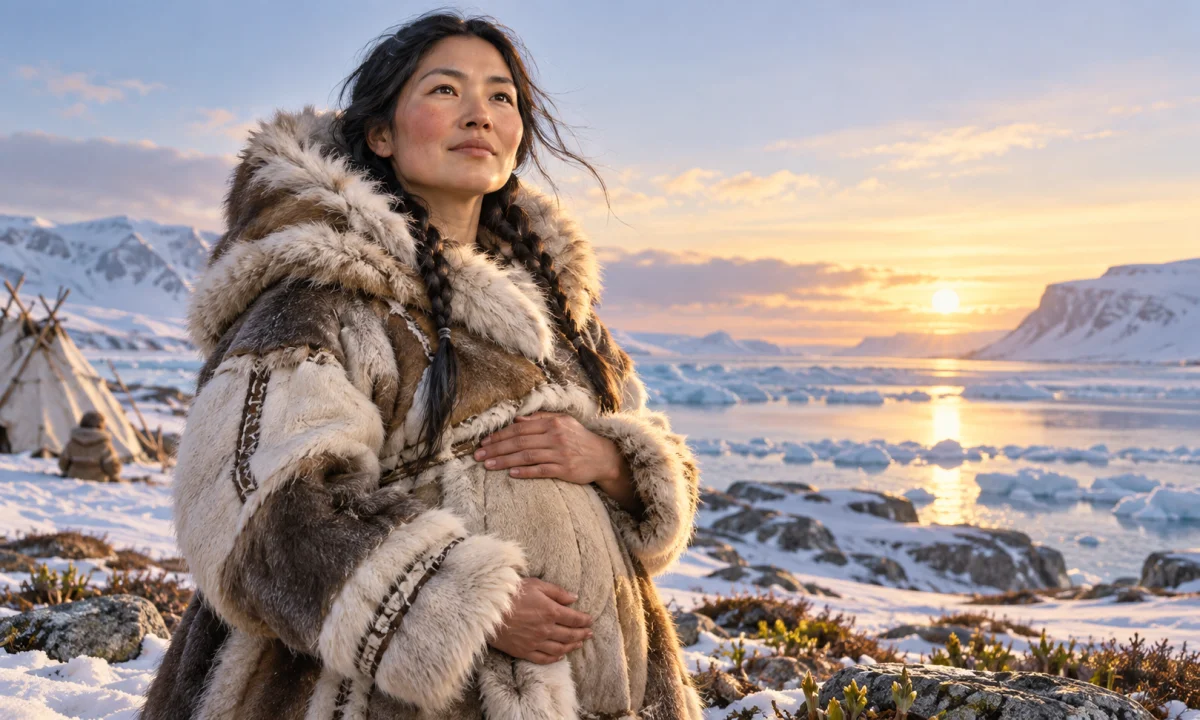
Akna is a name associated with fertility, motherhood, and childbirth in some accounts of Inuit mythology. She is often described as a maternal goddess or female supernatural being, and some modern summaries identify her as the mother of Sedna, the powerful being connected with marine animals. However, Akna is not a uniformly defined figure throughout Inuit-speaking regions. The name, biography, relationships, and religious importance attributed to her vary considerably, and the surviving evidence is much less consistent than popular reference works sometimes suggest.
Origins and cultural setting
“Inuit mythology” is a broad modern label for the traditional religious ideas and narratives of many Arctic peoples, including Inuit communities across Canada, Greenland, and Alaska, as well as related peoples whose traditions developed in distinct local environments. These societies did not possess a single standardized pantheon. Beliefs differed between regions, languages, communities, and historical periods.
Traditional Inuit religious life was closely connected with hunting, weather, illness, birth, death, animals, and relationships between humans and the wider spiritual world. Supernatural beings were not always gods in the classical Mediterranean sense. Some were powerful persons, masters of animals, spirits of places, ancestors, or beings whose influence depended on correct conduct and ritual knowledge. A figure could have several names or titles, while the same name might be interpreted differently in another community.
Most information about Inuit mythology was recorded by missionaries, explorers, ethnographers, linguists, and other outsiders. Such records are valuable, but they are not neutral transcripts of a single ancient religious system. They often reflect the recorder’s language, assumptions, and choice of informants. Oral traditions also change through performance and local interpretation. Consequently, a short description of Akna in a modern mythology dictionary should not automatically be treated as evidence of a pan-Inuit goddess worshipped in the same form everywhere.
The name and identity of Akna
Akna is commonly glossed as a mother or motherly figure, although the exact linguistic explanation depends on the language and spelling involved. Inuit languages use related but not identical words, and names transcribed into English may have several forms. A spelling found in one source may represent a regional pronunciation, a translation, or an attempt to write an Indigenous name using a non-Indigenous orthography.
In general descriptions, Akna is classified as a goddess of fertility. This association includes human reproduction, pregnancy, childbirth, and the generative power of women. The term “goddess” can be useful as a rough English equivalent, but it may also impose categories that do not fit every Inuit tradition. Akna is better understood, cautiously, as a powerful maternal or fertility-related being in those traditions and summaries that preserve her name.
Her identity is sometimes expanded beyond fertility. She may be described as a mother goddess, a creator-like maternal presence, or the mother of an important sea being. These descriptions should not be assumed to belong to one unified story. In many cases, Akna appears in modern compilations as a brief entry rather than in a large body of recorded narratives with a stable character and detailed mythology.
Attributes and sphere of influence
Akna’s principal attribute is motherhood. Her name and classification connect her with the capacity to give life, the continuation of the community, and the physical processes surrounding birth. In an Arctic society where survival depended on cooperation, kinship, and the birth and care of children, fertility had profound social and religious significance.
Her sphere may include:
- Fertility: the ability of people, families, and communities to reproduce and endure.
- Childbirth: the dangers and sacred importance of bringing a child into the world.
- Motherhood: maternal care, lineage, and the relationship between generations.
- Abundance: in broad interpretations, the renewing power that allows life to continue in a difficult environment.
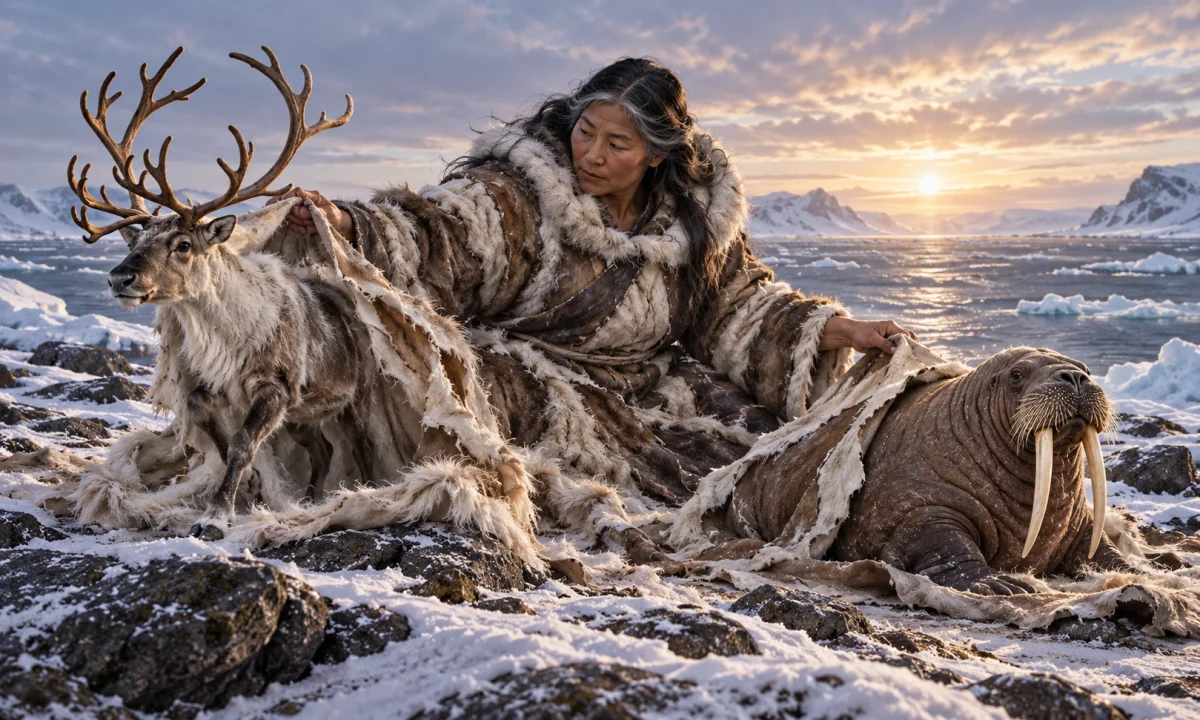
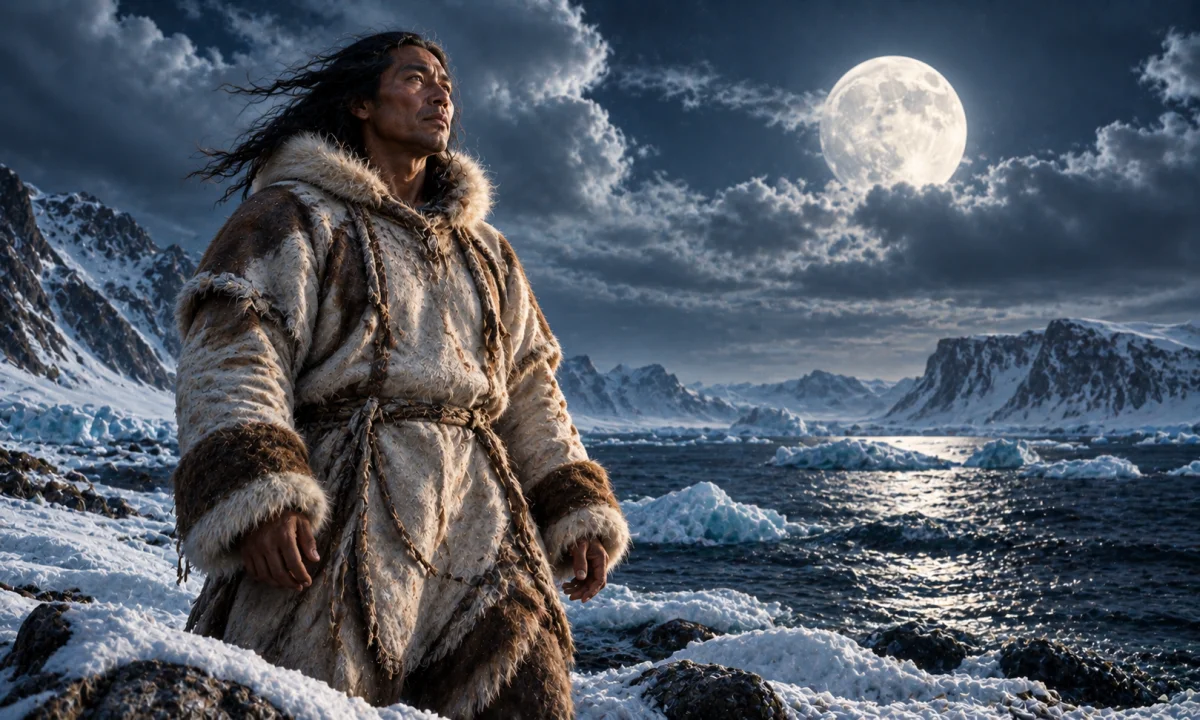
There is no securely established traditional description of Akna’s physical appearance that applies across Inuit cultures. Images of her as a woman, mother, or majestic female deity generally reflect the meaning assigned to her rather than a consistent canonical form. She should not automatically be depicted with the distinctive features associated with Sedna, such as a connection with the sea floor, marine animals, or long hair requiring ritual attention.
Likewise, claims that Akna possesses a fixed set of magical powers should be treated carefully. Fertility-related beings may influence conception, birth, or prosperity in broad mythological interpretation, but the available material does not establish a single standard list of powers, sacred objects, animals, or ritual practices belonging to Akna.
Akna and Sedna
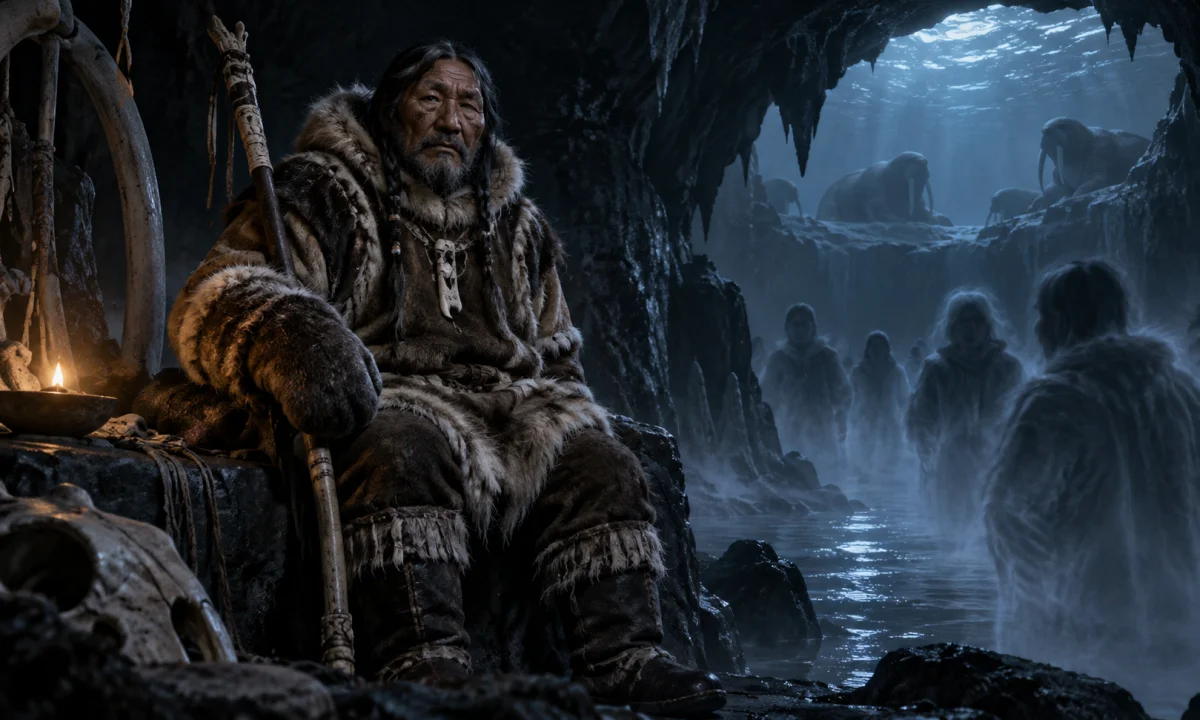
The relationship most often attached to Akna in modern accounts is her supposed motherhood of Sedna. Sedna is one of the best-known figures in Inuit mythology, although her name, character, and stories vary by region. She is associated in many traditions with marine animals and with the conditions governing successful hunting. Depending on the version, she is known as Sedna, Nuliajuk, Taleelayuk, Arnapkapfaaluk, or by other regional names and titles.
Some reference works identify Akna as Sedna’s mother. This creates a simple genealogical structure: Akna represents motherhood and fertility, while her daughter becomes a powerful being of the sea and the animals on which Arctic communities depend. The pairing is attractive because it creates a symbolic relationship between human reproduction and the reproduction or renewal of marine life.
Yet the relationship is not consistently present in all accounts of Sedna’s mythology. The better-known stories of Sedna often focus on her transformation, her descent into the sea, the cutting or entangling of her hair, and the need for ritual specialists to restore order when sea animals become unavailable. These narratives do not always name her parents, and when parents are mentioned, their identities and roles can differ.
For this reason, Akna should not be presented as an essential or universally recognized part of every Sedna story. It is more accurate to say that some modern and regional accounts connect Akna with Sedna as her mother, while other traditions leave the relationship unmentioned or use different names and genealogies.
Fertility and the Arctic religious world
Fertility in Inuit religious thought cannot be separated neatly from the environment. Human life depended on the continuing availability of animals, the health of pregnant women and children, seasonal cycles, and the ability of a community to maintain harmonious relationships with nonhuman beings. A maternal figure such as Akna can therefore be interpreted at several levels: as a being connected with human birth, as an expression of social continuity, and as part of a wider understanding of renewal.
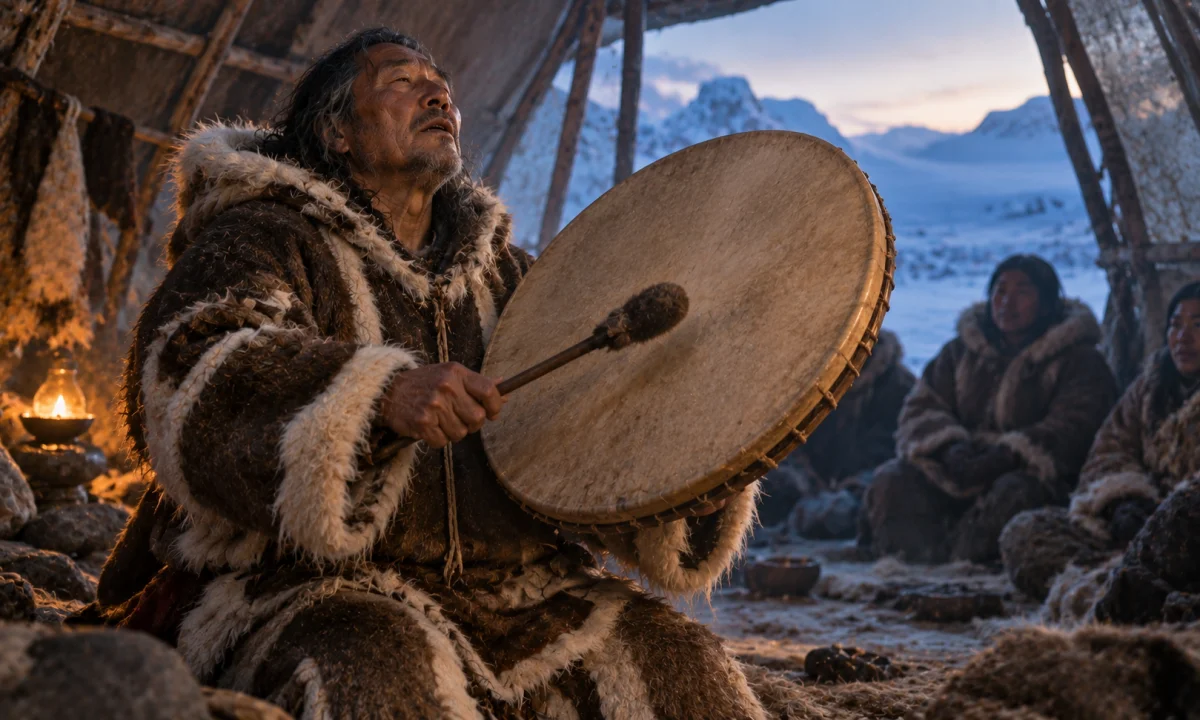
This does not mean that Akna was necessarily worshipped in the manner of a temple deity. Inuit spiritual practices were often local, practical, and relational. Rituals could involve songs, taboo observance, confession, naming, bodily conduct, hunting rules, or the actions of a shaman. The word “worship” may obscure these forms of religious engagement if it suggests permanent shrines, formal priesthoods, or a standardized liturgy.
Pregnancy and childbirth were especially significant because both mother and child could be vulnerable. Communities developed rules and customs concerning pregnancy, birth, naming, food, seclusion, and ritual conduct, though these practices varied widely. A fertility being might be invoked or understood within this larger sacred framework without having a separate mythology devoted exclusively to her.
The maternal symbolism associated with Akna can also be read in relation to kinship. Inuit communities placed importance on family ties, adoption, namesakes, and obligations between generations. A name connected with motherhood could express not only biological birth but also the broader power of nurturing and sustaining social life.
Stories and narrative evidence
There is no single famous cycle of Akna stories comparable in popularity to the many versions of the Sedna narrative. Accounts of Akna are usually brief, and her role is often defined by a title or relationship rather than by a long sequence of adventures. This scarcity is important: it indicates that the figure may have been preserved unevenly, interpreted differently, or simplified by later compilers.
Some descriptions treat Akna as an ancestral or generative mother. Others use the name in a general account of fertility without supplying a distinct myth. A few summaries place her within a family of major supernatural beings, particularly through her proposed relationship with Sedna. These differences may reflect genuine regional variation, differences in translation, or the tendency of encyclopedic sources to combine information from separate traditions.
No responsible account should invent a detailed biography for Akna from these limited references. There is no secure basis for assigning her a universally accepted husband, residence, sacred animal, weapon, or creation story. Nor is there sufficient evidence to claim that she ruled a clearly defined realm or occupied a fixed rank in an Inuit pantheon.
Distinguishing Akna from related figures
Sedna and Nuliajuk
Akna is sometimes confused with Sedna because both may be described as powerful female beings connected with the continuation of life. They are not the same figure in the accounts that distinguish them. Akna is generally associated with motherhood and fertility, whereas Sedna or Nuliajuk is commonly connected with the sea, marine animals, and the moral or ritual conditions affecting hunting.
The names Sedna, Nuliajuk, and related forms should also not be treated as automatically interchangeable in every context. They often represent regional names, related traditions, or different figures that later writers grouped together.
Arnapkapfaaluk and other maternal beings
Arnapkapfaaluk, often translated as “the Big Woman,” is another female supernatural figure associated in some Inuit traditions with sea animals or hunting. Because she is a powerful woman and may be connected with the ocean, she is sometimes confused with Sedna or other marine beings. Akna’s principal association in modern descriptions is fertility and motherhood, not a universal role as mistress of sea animals.
Pinga
Pinga is often described as a powerful female being connected with hunting, childbirth, healing, and the welfare of people in some Inuit traditions. Her functions may overlap with broad descriptions of Akna, especially when fertility and human well-being are discussed. Overlap does not prove that the two names refer to the same being. Regional traditions may preserve distinct figures whose responsibilities are later blended in comparative summaries.
Anguta and family relationships
Anguta appears in some narratives as a father or male relative in stories about Sedna, but his role varies. He should not be assumed to be Akna’s partner simply because a source identifies Akna as Sedna’s mother. The genealogies of Inuit supernatural beings are not standardized across all communities, and many modern diagrams of divine family trees simplify material that was never organized into a single system.
Interpretation and cultural significance
Akna is significant less because of a large, fixed mythology than because the name preserves an important religious idea: motherhood as a sacred and life-sustaining power. Fertility is not merely a private biological matter in this context. It concerns the survival of families, the continuity of communities, and the renewal of life under demanding conditions.
At the same time, Akna demonstrates why Inuit mythology should not be reduced to a list of gods with uniform attributes. A figure’s meaning may depend on a local language, a particular storyteller, or a specific religious setting. The limited evidence encourages careful interpretation rather than confident reconstruction.
Older publications sometimes organized Indigenous traditions according to European concepts such as “goddess,” “pantheon,” and “mythological family.” These terms can make comparisons easier, but they may conceal the diversity of Inuit religious life. Akna can be called a goddess for accessibility, provided that the label is qualified and does not imply a universal, centralized cult.
Akna in modern reference works and popular culture
Akna is far less prominent in modern popular culture than Sedna. Her name may appear in mythology websites, encyclopedias, fantasy character lists, or comparative discussions of fertility deities. Such treatments often give her a clear identity and family relationship, even when traditional sources provide only limited or regionally variable information.
When Akna is adapted for fiction, games, illustration, or modern spiritual writing, creators may expand her into a universal mother goddess, creator, earth mother, or patron of women. These are legitimate modern reinterpretations, but they should be distinguished from documented Inuit tradition. A contemporary depiction should not be presented as an ancient pan-Inuit belief without evidence.
The most careful understanding of Akna remains modest but meaningful: she is a maternal and fertility-associated figure preserved in some accounts of Inuit mythology, sometimes linked with Sedna, whose exact identity and traditional scope vary by source and region.