WORLD
WORLD
Sedna

Sedna is one of the best-known figures in Inuit religious traditions: a powerful woman associated with the sea, marine animals and the continuing relationship between human communities and the natural world. In many traditions, she lives beneath the ocean and controls the animals on which Arctic people depend. When she is offended or neglected, the animals may become unavailable; when a ritual specialist restores harmony, she may release them.
The name Sedna is widely used in English-language writing, but Inuit traditions are not uniform. The figure appears under different names, spellings and forms in different Arctic regions. Names such as Nuliajuk, Nerrivik, Sanna, Arnapkapfaaluk and others may refer to related sea beings, regional versions of the same narrative complex, or figures whose identities should not automatically be treated as identical. The stories also vary considerably. Sedna does not have one universally authoritative biography, appearance or set of powers.
Cultural setting and traditional sources
Inuit peoples live across a vast Arctic region including Alaska, Canada and Greenland. Their languages, local histories and religious traditions differ from one community to another. “Inuit mythology” is therefore a broad modern label for many connected but distinct bodies of oral tradition. Sedna belongs especially to traditions from the eastern Canadian Arctic and Greenland, although related sea-mother figures are known elsewhere.
Knowledge about Sedna traditionally comes through oral transmission, ritual practice, personal experience and relationships with elders, hunters and spiritual specialists. Ethnographers and missionaries recorded some versions during the nineteenth and twentieth centuries, but written records preserve only selected performances and interpretations. A story written down by an outsider may omit local details, translate important terms imperfectly or present a regional figure as though she represented all Inuit communities.
Traditional Inuit religious life did not necessarily divide the world into “myth” and “religion” in the modern European sense. Stories about Sedna could explain the origin and availability of animals, but they also expressed obligations concerning hunting, food, marriage, death, illness and the treatment of clothing and tools. The stories were connected to practical and spiritual responsibilities rather than existing only as entertainment or abstract theology.
Name, identity and classification
The form Sedna became particularly familiar through written accounts of Inuit traditions and later popular culture. It is often associated with the sea-mother figure in the central and eastern Canadian Arctic. However, spelling conventions vary because Inuit languages have several writing systems, and names can be represented differently when transcribed into English or French.
Calling Sedna a “goddess” can be convenient, but it may also be misleading. Inuit religious traditions do not necessarily organize supernatural beings into a single hierarchy of gods and goddesses modeled on Greek or Norse mythology. Sedna is better described as a powerful female being of the sea, a mistress or keeper of marine animals, or a spiritual authority whose relationship with humans must be maintained. In some accounts she is a dead or transformed woman; in others she is an ancient supernatural being whose story explains her dominion.
Her identity is closely linked to the animals of the sea, but she should not be reduced to a simple personification of the ocean. She may be compassionate, angry, lonely, dangerous, or simply responsive to human conduct, depending on the tradition. Her role is relational: hunters, animals, the sea, the community and the spiritual specialist are all connected through her.
Appearance and dwelling
Sedna is commonly imagined as a woman living in the depths of the sea. Descriptions differ, but she may appear as a large or imposing human figure, sometimes with a fish-like or otherwise transformed lower body. Such images are not consistent across all Inuit traditions and should not be treated as a fixed canonical appearance.
Her underwater home is often portrayed as difficult to reach. It may be located beneath the sea floor, in a deep settlement or in a place reached by passing through dangerous waters. The animals that hunters seek are associated with this dwelling. In some accounts, they are kept in a tangled or dirty condition, and a shaman must comb Sedna’s hair or otherwise care for her before she will release them.
The famous image of Sedna with long, tangled hair is especially important in many retellings. Because she has no hands, she cannot comb it herself. A spiritual specialist must descend to her, identify the source of her distress and smooth or wash her hair. This act is not merely cosmetic. It represents the restoration of a broken relationship and the removal of spiritual disorder that has prevented the animals from reaching human hunters.
The best-known origin story
One widespread narrative tells of a young woman who refuses or rejects a number of suitors. The details differ greatly. In one commonly retold version, she eventually marries a man who appears human but is actually a bird or another nonhuman being. He takes her to a remote place and fails to provide the food or shelter he promised. Her father later rescues her, often with the help of other people or spirits.
During the journey home, a storm arises. The cause of the storm varies between versions: it may be connected with the angry husband, with a betrayal, or with a supernatural power. The father becomes frightened and throws his daughter overboard, sometimes in an attempt to save himself or to appease the dangerous being causing the storm. When she clings to the boat, he cuts off her fingers. Her severed fingers become seals, whales, walruses or other sea mammals. She sinks into the sea and becomes the powerful woman who controls those animals.
This narrative is not told everywhere in the same way. Some versions make the father’s action central; others alter the identities of the husband and the companions, or omit significant parts of the episode. The transformation of fingers into animals is also not universal. It is best understood as a major narrative pattern rather than a single definitive account of Sedna’s origin.
The story is disturbing, and traditional tellers have not necessarily presented it as a simple moral tale with one universally agreed lesson. It may involve betrayal, hunger, fear, parental violence, the consequences of broken obligations and the dangerous instability of relations between humans and nonhuman beings. Modern retellings sometimes soften or reorganize the story, while others emphasize its tragedy.
Sedna and the marine animals
In many traditions, Sedna is connected with the supply of seals and other marine animals. Her authority may extend to whales, walruses, fish and birds, although the exact animals depend on the region and the local environment. She does not necessarily “create” every animal in a universal sense. More often, she is understood as holding, guarding or controlling animals that must be made available to hunters.
This relationship reflects the practical importance of the sea to Arctic communities. Marine hunting provides food, clothing, tools and other materials, but it also involves risk and obligation. Animals are not represented merely as passive resources. They participate in a moral and spiritual exchange in which human beings must hunt skillfully, use what they receive properly and observe local rules.
When the animals are withheld, the community may face hunger. A common explanation is that Sedna has become angry or distressed because people have broken a taboo, behaved improperly or failed to observe the required rules after a death or hunt. The particular offence is not identical in every account. It may involve violations concerning food, sexual conduct, clothing, hunting practice, ritual cleanliness or other responsibilities.
The sea’s scarcity is therefore not interpreted only as an environmental accident. It can signal a damaged relationship between the community and the spiritual powers associated with animals. This does not mean that Inuit hunters lacked practical knowledge of weather, animal movement or ecology. Spiritual interpretation and practical observation could exist together rather than excluding one another.
The shaman’s journey
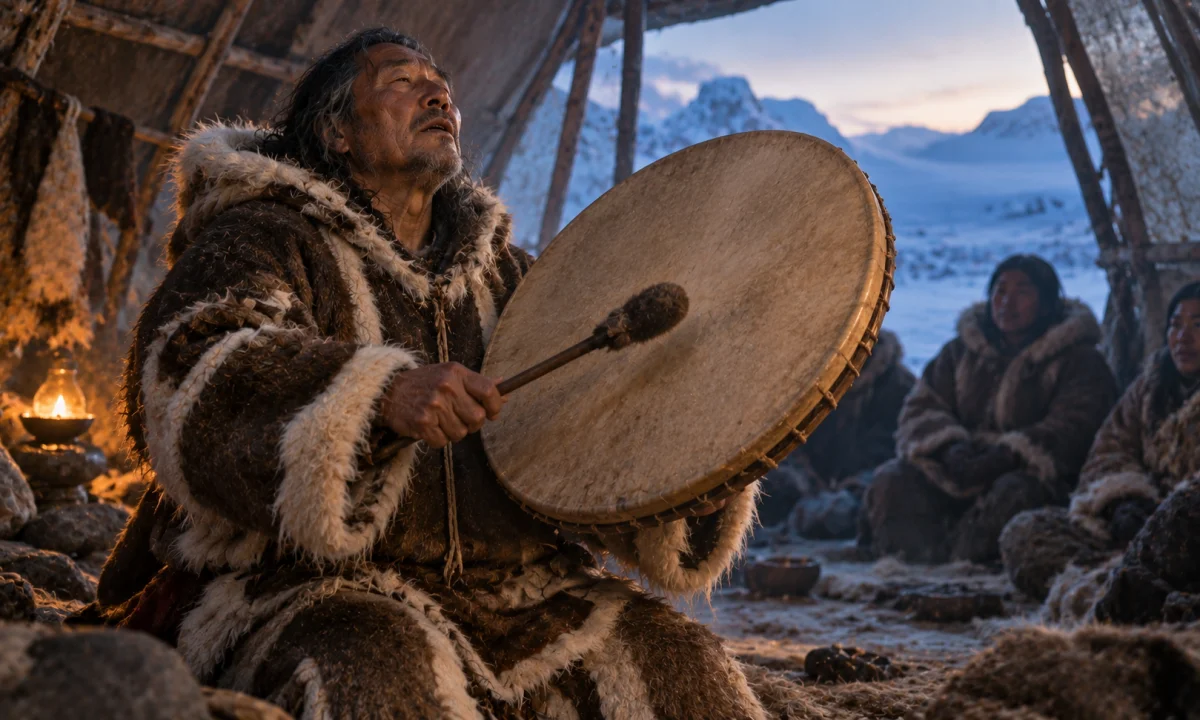
When animals become scarce, a shaman—often called an angakkuq in Inuit contexts—may undertake a spiritual journey to Sedna’s dwelling. Accounts differ in their details and in how directly they connect a particular ceremony with the story. The shaman may travel underwater, confront obstacles, negotiate with Sedna and discover why she is withholding the animals.
The shaman’s task is often described as tending Sedna’s tangled hair. He or she may comb it, wash it or free it from knots. The knots can symbolize accumulated offences, grief, anger or disorder within the human community. Once Sedna is appeased and her hair is put in order, she releases the animals, allowing the hunters to find success again.
This image has sometimes been interpreted as evidence of a universal “hair-combing goddess” across Arctic cultures, but such broad comparisons require caution. The significance of hair, the duties of the shaman and the exact form of the healing journey vary among communities. The story should be understood in its own Inuit contexts before being compared with figures from other traditions.
Taboo, illness and communal responsibility
Sedna’s stories are often associated with the idea that individual actions can have communal consequences. If a person breaks a rule, the result may not affect only that individual. Illness, bad hunting or scarcity can spread across the settlement. The response may therefore require public confession, ritual observance, advice from elders or a spiritual journey on behalf of the whole community.
In some accounts, Sedna is connected with sickness as well as food animals. Her anger may be one explanation for an outbreak or for a period when the community cannot obtain what it needs. Yet it is inaccurate to describe her simply as a demon or a punishing monster. Her role combines danger and dependence. She can withhold life-sustaining animals, but she is also the figure through whom those animals become available.
This dual role reflects a wider theme in Inuit religious thought: survival depends on maintaining respectful relations with persons and powers beyond the human community. The hunter’s success is not portrayed as unlimited human mastery. It depends on skill, courage, luck, animal behavior and observance of inherited obligations.
Regional variation and related figures
Names for sea-mother figures differ across Inuit regions and languages. Nuliajuk is a prominent name in several Canadian Arctic traditions, while Nerrivik is associated with a sea-mother or provider figure in some Greenlandic and eastern Arctic accounts. Other names are recorded in other regions. Some writers use these names as equivalents of Sedna; others preserve distinctions between them.
It is therefore safer to speak of a family of related traditions than to claim that every named figure is exactly the same being. Local stories may give a figure different relationships, moral qualities, physical characteristics or responsibilities. Even within one broad region, different storytellers and communities may preserve different versions.
The word “Inuit” itself refers to many peoples and does not describe one completely uniform culture. Inuit traditions should not be collapsed into a single mythology with fixed characters and standardized legends. The diversity of names and stories is part of the subject’s historical reality, not a problem to be corrected.
Interpretation and cultural significance
Sedna is often interpreted as a figure expressing the precarious balance between human communities and the Arctic environment. The sea provides essential life, but it is also unpredictable and dangerous. Her control over marine animals gives that dependence a personal and ethical form: the animals are available through a relationship that requires respect.
Her story can also be read through themes of trauma, abandonment and transformation. The young woman’s betrayal and mutilation are followed by her elevation to immense power. Yet modern psychological interpretations should not be presented as the original or only meaning. Traditional communities may understand the story through ritual responsibility, family relations, hunting ethics, cosmology and local history rather than through a single symbolic explanation.
For Inuit artists, writers and community educators, Sedna can carry meanings connected with cultural continuity, the protection of marine life and the effects of colonial disruption. Those modern uses are not identical to older ritual traditions, but they may draw on the continuing importance of the sea and of Inuit relationships with animals and ancestral knowledge.
Sedna in modern culture
Sedna has appeared in modern literature, visual art, museum displays, educational materials, fantasy fiction and popular discussions of mythology. She is sometimes depicted as a mermaid, an ocean goddess or a generic Arctic “sea monster.” These forms can make her recognizable to a wider audience, but they may simplify or distort the diversity of Inuit traditions.
The name has also been used in modern astronomy for 90377 Sedna, a distant trans-Neptunian object discovered in the early twenty-first century. Its naming draws on the sea-associated figure, but the astronomical object is not part of traditional Inuit cosmology. Likewise, depictions in films, games and novels are modern adaptations rather than evidence for a single ancient canonical image.
Respectful treatment of Sedna requires keeping these layers separate. Traditional accounts belong to living Inuit cultures and vary by community; ethnographic records are selective historical documents; scholarly interpretations are analyses rather than sacred authorities; and modern popular representations are creative adaptations. Sedna’s enduring significance lies not in a fixed list of fantasy attributes, but in the relationships among people, animals, the sea and the responsibilities that make life possible in the Arctic.