WORLD
WORLD
Angakok
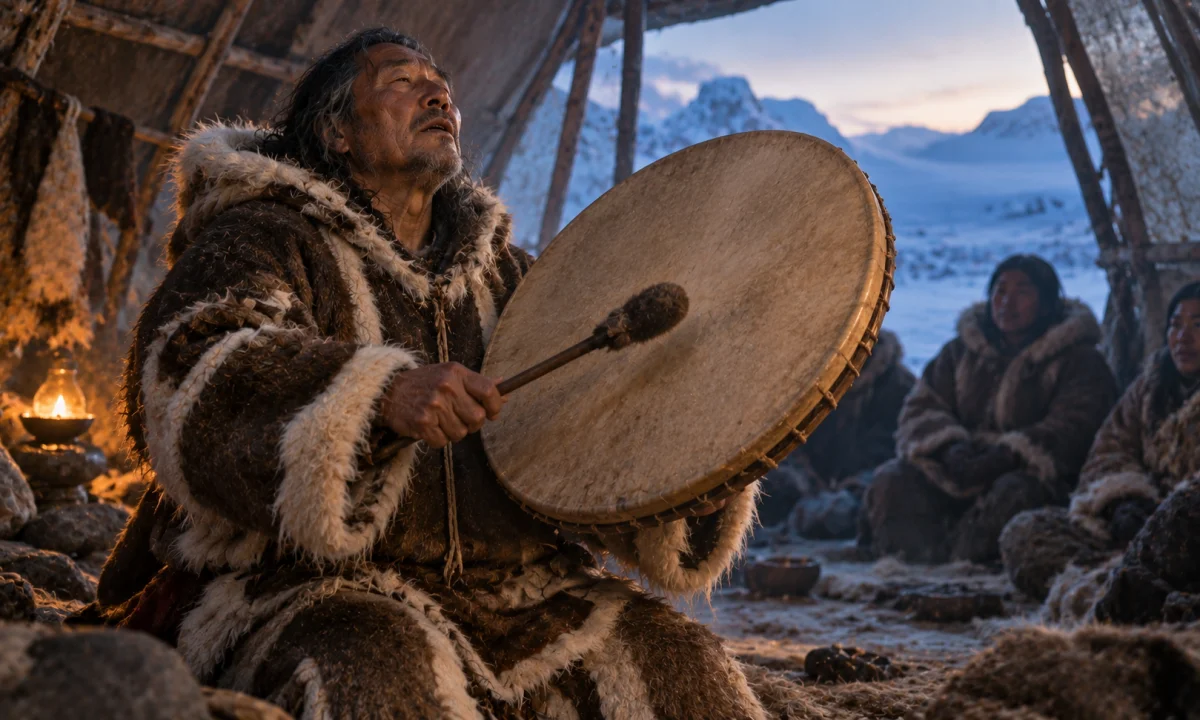
Angakok is an older English spelling for an Inuit religious specialist more commonly rendered today as angakkuq in Inuktitut and by related forms in other Inuit languages. An angakok was not a god, monster, or single legendary character. The word refers to a person who acted as an intermediary between human communities and the unseen powers understood to influence animals, weather, illness, childbirth, hunting, and the observance of ritual rules.
Inuit societies have never possessed one completely uniform religion. Inuit communities across Greenland, the Canadian Arctic, and Alaska developed related but distinct languages, customs, stories, and religious practices. The duties and powers attributed to an angakkuq therefore vary by region and by historical source. Some descriptions present the specialist chiefly as a healer and diviner; others emphasize communication with animal masters, offended spirits, or powerful beings associated with the sea and the sky.
Name and identity
Angakok is a historical spelling that became familiar in English through older accounts of Inuit life, especially accounts influenced by Danish or other European transcriptions. Modern writing more often uses angakkuq, although the exact spelling differs among Inuit languages and writing systems. Related forms include Greenlandic terms such as angakkoq. These forms should not automatically be treated as names for a particular supernatural being.
The word is sometimes translated as shaman. That comparison can be useful because both terms describe ritual specialists who communicate with spirits and enter altered states of consciousness in some traditions. Nevertheless, “shaman” comes from a different cultural and linguistic context, and it can encourage the assumption that all Indigenous religious specialists have identical roles. “Angakkuq” is therefore often preferred when discussing Inuit traditions specifically.
An angakok could be a man or a woman. In some communities, specialists were associated with unusual personal histories, dreams, abilities, or circumstances surrounding their birth. In others, religious knowledge was taught through an established relationship with an experienced practitioner. No single initiation pattern applies to every Inuit society. Accounts describing a chosen apprentice, a period of hardship, or an encounter with a helping spirit reflect genuine elements of some traditions, but should not be imposed on all Inuit communities.
Cultural setting
Traditional Inuit life depended on close attention to animals, sea ice, weather, seasonal movement, and the moral obligations that governed sharing. Religious ideas were not always separated from practical knowledge in the modern Western sense. A successful hunt required skill and environmental understanding, but it could also depend on proper treatment of animals and observance of rules concerning food, clothing, childbirth, mourning, and contact between different categories of people or objects.
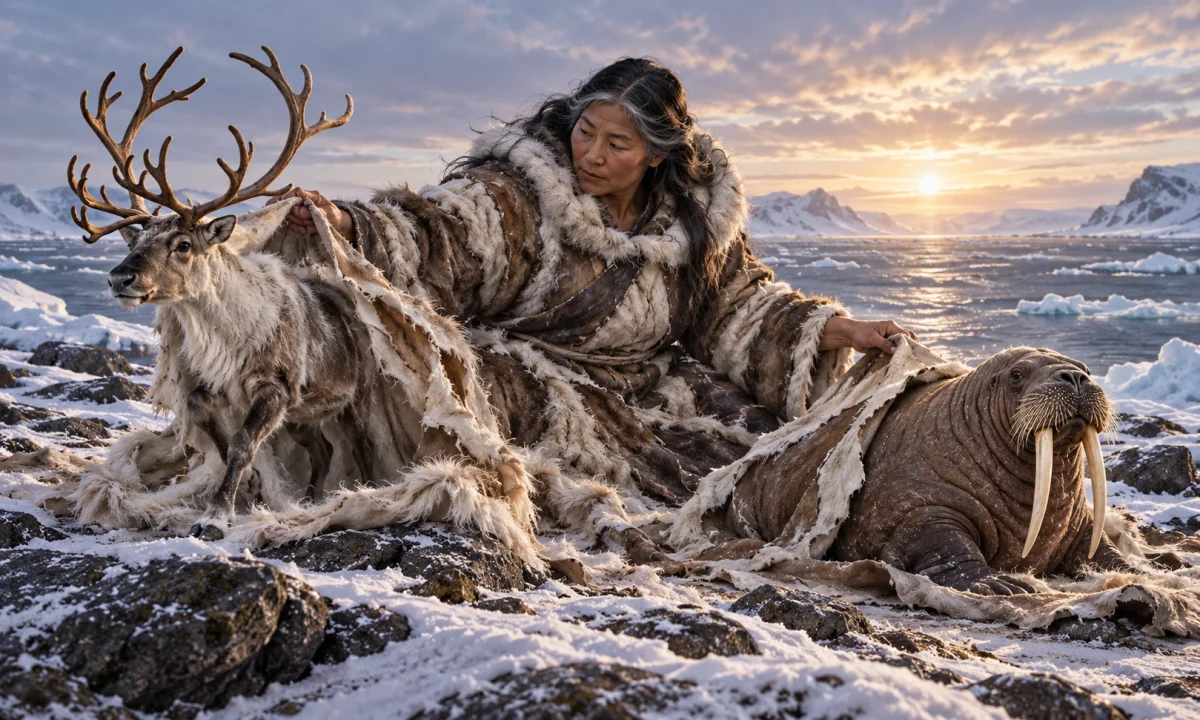
Many Inuit traditions describe animals as beings with their own agency and spiritual significance. Animals were not merely passive resources. Their willingness to become available to hunters could be connected with respect, ritual conduct, and the condition of relationships between humans and the nonhuman world. In this setting, an angakok’s task was often to discover why hunting had failed, why illness had appeared, or why a community had suffered a dangerous disturbance in its relationship with the surrounding world.
Inuit cosmologies also contain powerful beings associated with the sea, the land, the weather, the dead, and particular animal species. Some figures are named differently in different regions. The woman of the sea, for example, is known by names including Sea Woman, Nuliajuk, and Takanaluk-arnaq, among other forms. In certain traditions she is connected with the animals of the sea and with the consequences of human wrongdoing. These stories are not evidence that every angakok served one universal goddess, since local traditions and interpretations differ.
Roles and responsibilities
The work of an angakok could involve several overlapping responsibilities:
- Divination: seeking the hidden cause of a misfortune, failed hunt, illness, or spiritual disturbance.
- Healing: treating illness through ritual, communication with helping spirits, prescribed actions, and sometimes practical remedies.
- Communication: negotiating with spirits, animal powers, or other beings whose goodwill was considered important.
- Protection: defending individuals or communities against harmful spiritual forces, dangerous breaches of taboo, or hostile practitioners.
- Weather and hunting rites: attempting to restore balance when weather, sea conditions, or animal availability became threatening.
- Instruction: explaining ritual obligations and reminding people of rules connected with food, birth, death, sexuality, clothing, and social conduct.
These responsibilities were not necessarily performed by one specialist in exactly the same way everywhere. An angakok might be consulted only during a crisis, or might hold an acknowledged position within the community. Some specialists were respected and sought out; others could be feared, especially if they were believed capable of harmful magic. The boundary between protection and danger could be morally significant: a person thought to use spiritual knowledge for selfish or destructive purposes might be accused of sorcery.
Helping spirits and ritual power
Angakkuit were commonly described as having relationships with helping spirits. A helping spirit could take the form of an animal, a deceased person, or another spiritual presence. Such beings might provide knowledge, strength, protection, or access to places and powers beyond ordinary human perception. The character of these relationships varied widely, and not every surviving account uses the same terminology or describes them as permanent companions.
Some traditions speak of a personal spiritual power often called tuurngaq or by a related regional form. In English-language writing, such terms have sometimes been translated as “helping spirit,” “familiar,” or “guardian spirit.” The translations are approximate. Inuit concepts do not always divide the world into the same categories as European religious vocabulary, and the meaning of a term may change from one community to another.
Ritual activity could include chanting, singing, drumming, confession of broken rules, the rearrangement or examination of objects, and communication with the dead or with powerful beings. Trance or an altered state of consciousness is reported in some traditions, but it should not be assumed that every angakok performed a dramatic public séance. European observers often focused on spectacular rituals and described them using their own expectations, while overlooking quiet forms of counsel, diagnosis, and religious instruction.
Stories of journeys and hidden knowledge
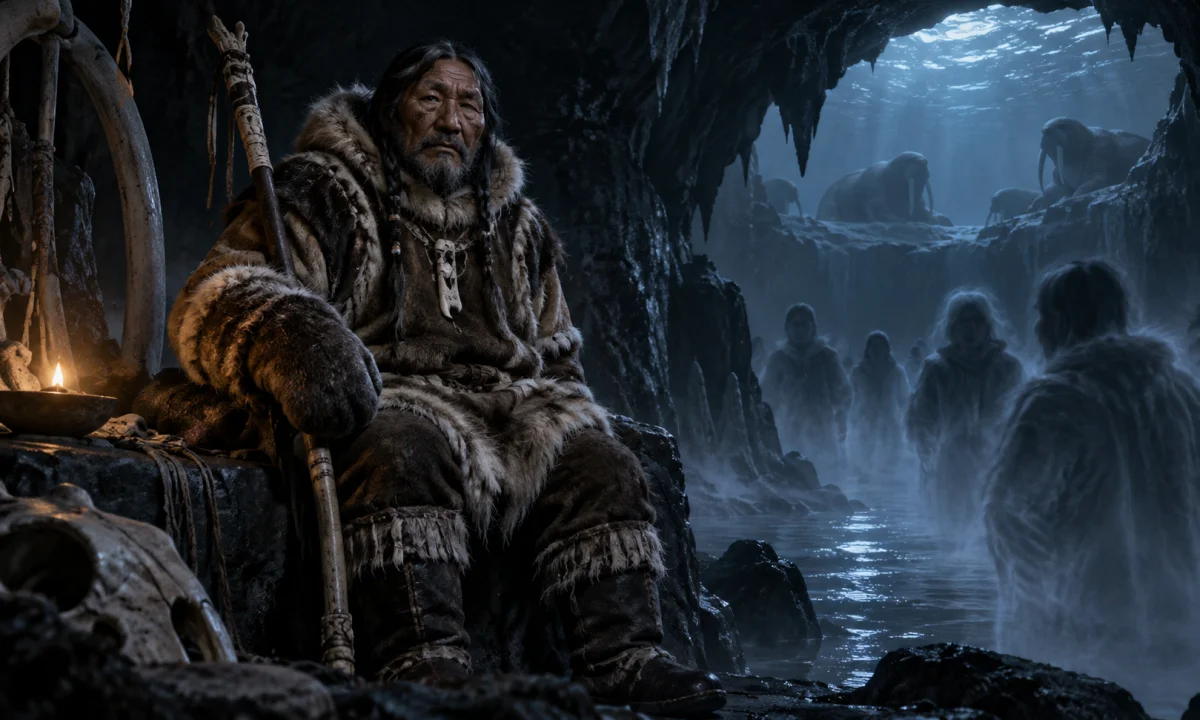
One recurring theme in accounts of angakkuit is the spiritual journey. A specialist may be said to travel beneath the sea, into the sky, across distant regions, or to the realm of the dead. These journeys can be understood as encounters with powers that control animals, weather, illness, or human fate. In stories connected with the sea, an angakok may seek the release of sea animals held back by a powerful woman or another guardian because people have violated ritual rules.
Such narratives are especially prominent in accounts of the sea-mother complex, but there is no single canonical version. In one telling, the angakok must approach a dangerous being and calm her anger. In another, the specialist must untangle or clean the being’s hair, where the animals have become trapped. Elsewhere, the focus is less on a literal journey and more on the community’s need to confess wrongdoing and restore respectful relations with the animal world.
The spiritual journey can also express the dangers of the vocation. An angakok is not simply a person who possesses effortless supernatural power. The specialist may face frightening beings, endure symbolic death and renewal, or sacrifice ordinary comfort in order to acquire knowledge. These motifs are found in many descriptions of Arctic ritual specialists, but their details belong to particular traditions and should not be treated as a universal biography.
Taboos, illness, and restoring balance
In many Inuit traditions, illness could have physical, social, and spiritual dimensions at the same time. A person might be sick because of injury, exposure, infection, hunger, or another bodily cause, while the community might also interpret the illness through a breach of a rule. Some rules were connected with the treatment of animal remains, the separation of foods, mourning, childbirth, menstruation, or the handling of clothing and tools. The exact rules differed among communities and changed over time.
An angakok might investigate whether a taboo had been broken and prescribe an action intended to repair the disturbance. This could involve confession, a public acknowledgment, a ritual restriction, a song, or a change in the way food or objects were handled. Such practices should not be reduced to the idea that Inuit people simply attributed every illness to magic. Traditional healing included observation, accumulated environmental knowledge, care by family members, and practical treatment as well as religious interpretation.
Angakkuit could also be associated with knowledge of harmful spiritual action. In older translations, this aspect is sometimes described with words such as “witchcraft,” “sorcery,” or “black magic.” These labels are imperfect and often carry assumptions from European Christian demonology. A person’s reputation depended on local moral judgments, and accusations of harmful power could arise from conflict, fear, illness, or social tension rather than from a clearly defined universal category.
Sources and historical limitations
Knowledge of angakkuit comes from several kinds of evidence: Inuit oral traditions, remembered teachings, missionary writings, explorers’ reports, colonial records, linguistic research, ethnographic studies, and contemporary Indigenous scholarship. These sources do not all have equal value or the same viewpoint. Missionaries sometimes described Inuit religious practices as “heathen” or demonic. Explorers could misunderstand ceremonies through brief observation. Ethnographers often recorded important information but still interpreted it through the categories of their own era.
Many traditions were transmitted orally and were never intended to form a single written mythology. A story recorded in Greenland cannot automatically be used to explain a practice in western Alaska or the Canadian Arctic. The presence of a similar theme in several regions may indicate broad cultural relationships, but it does not prove that all Inuit communities shared one identical system of gods, spirits, or ritual offices.
Colonial and missionary pressure also affected the survival of religious practices. Conversion to Christianity, restrictions on movement, residential schooling, changing economies, and the disruption of community authority all influenced the public transmission of angakkuq traditions. The historical record may therefore preserve fragments rather than a complete picture. Contemporary Inuit communities and researchers may also choose different terms or emphases from those found in nineteenth-century accounts.
Angakok and similar figures
An angakok should not be confused with a specific deity such as Sedna, Nuliajuk, or another regional sea being. Those figures belong to mythic and religious narratives; an angakok is a human ritual specialist who may communicate with them or with related powers.
The term should also be distinguished from tupilaq. A tupilaq is a separate Greenlandic concept, commonly described in historical accounts as a magically created or summoned being associated with harmful purposes. Its forms and interpretations vary, and it is not another name for an angakok. Nor is an angakok simply equivalent to a “witch doctor,” a phrase that carries colonial stereotypes and does not accurately convey the specialist’s wider religious and social responsibilities.
Finally, Inuit religious specialists should not be merged with practitioners from unrelated Arctic or Indigenous traditions merely because outsiders have called them all “shamans.” Siberian, Sámi, Indigenous North American, and other ritual traditions have their own histories and concepts. Similar practices may reflect comparable human concerns, but they do not erase cultural differences.
Cultural significance
The angakok represents a form of knowledge that joins spiritual responsibility with practical life. The specialist’s authority could involve interpreting dreams, understanding animal behaviour, remembering ritual law, diagnosing social conflict, and maintaining communication with a world understood to be alive and morally responsive. The role also shows that Inuit religion was not limited to stories about supernatural beings. It included relationships, obligations, performances, healing practices, and decisions made in circumstances of real environmental danger.
Descriptions of angakkuit are most meaningful when they preserve the distinction between religious tradition and later outsider interpretation. The angakok was neither a fictional wizard nor a single standardized character. The term points to a varied class of Inuit specialists whose roles were shaped by language, region, community history, and changing religious circumstances.
Later representations
Modern popular culture occasionally uses “angakok” or “angakkuq” as a label for an Arctic wizard, healer, or magical character. Such representations may borrow the ideas of spirit journeys, animal helpers, drums, or encounters with sea beings, but they often combine material from several Inuit regions and from unrelated fantasy traditions. A fictional character using the name does not necessarily reflect a particular Inuit teaching.
More responsible modern discussions retain the original distinction between a human religious specialist and the supernatural beings encountered in Inuit stories. They also acknowledge regional variation and the continuing importance of Inuit voices in interpreting their own religious heritage.