WORLD
WORLD
Alignak
Alignak is a name commonly used in modern English-language accounts for an Inuit moon spirit or moon deity. He is often described as a male power associated with the Moon, tides, weather, hunting, and the movement of souls. The name and the detailed profile attached to it, however, require caution. Inuit peoples have many distinct regional traditions, and the figure called Alignak in popular reference material does not appear to represent one uniformly documented deity shared by all Inuit communities.
Origins and cultural setting
“Inuit” is a collective term for several related peoples of the Arctic, including Inuit communities in Kalaallit Nunaat (Greenland), Canada, and Alaska, as well as closely related Yupik-speaking peoples. Their religious traditions were never a single standardized system. Stories, ritual practices, names, and descriptions of spiritual beings varied between regions, languages, families, and historical periods.
Traditional Inuit religious life generally recognized a world inhabited by human beings, animals, the dead, helping spirits, dangerous beings, and powerful figures connected with natural phenomena. The boundaries between “god,” “spirit,” “personified force,” and “supernatural being” do not always correspond neatly to categories used in English-language mythology. A being associated with the Moon might be treated as a powerful person, an ancestral figure, a spirit, or a celestial presence, depending on the tradition in which the story is recorded.
Knowledge of Inuit mythology comes from oral transmission, observation by community members, accounts collected by missionaries and explorers, and later work by ethnographers and Indigenous scholars. Many early written records use inconsistent spellings and sometimes impose European categories on Inuit beliefs. As a result, a name appearing in a modern mythology list may not be enough to establish that it was a universally recognized deity in traditional Inuit religion.
The name Alignak
Alignak is widely presented online as an Inuit name for a moon god. Some modern sources give him a broad collection of responsibilities, including the Moon, tides, weather, fertility, earthquakes, hunting, and the realm of the dead. These descriptions are not equally well supported, and they should not automatically be treated as evidence of a single traditional figure.
The spelling may reflect transcription into English rather than a single standardized Inuit form. Inuit languages use different writing systems and dialects, and the same word or name can appear in several spellings when transferred into English. It is also possible for similar-sounding names from different regions to be combined by later writers. The identity of Alignak is therefore uncertain and regionally variable in modern accounts.
A closely related and better-attested lunar figure in traditions from Greenland is known in forms such as Anningan or Aningan. In those stories, he is commonly identified as a male Moon spirit whose female sibling is associated with the Sun, often under the name Malina. Some modern writers use Alignak as though it were simply another name for this figure. That equation may be convenient, but it should not be assumed in every context. The names may represent regional or transcriptional variants, later reinterpretations, or separate traditions that have been brought together in secondary accounts.
Alignak as a lunar figure
Where Alignak is described as a traditional Inuit moon spirit, his principal association is the Moon. The lunar cycle has practical importance in the Arctic, where changing light affects travel, hunting, seasonal activity, and the timing of work. A celestial body that moves regularly through darkness and light naturally becomes part of stories about time, pursuit, danger, sexuality, death, and renewal.
Some modern descriptions portray Alignak as controlling the phases of the Moon. Others say that his changing appearance reflects his strength, hunger, or movement through the sky. These interpretations should be distinguished from specific traditional narratives. The general association between a moon spirit and lunar phases is plausible within Arctic storytelling, but the elaborate lists of powers often repeated in popular summaries are not necessarily drawn from one recorded Inuit account.
In accounts that identify the lunar figure with Anningan or Aningan, the Moon is not merely an abstract astronomical object. He is an active being who travels through the sky and participates in relationships with other supernatural or celestial persons. His movement can be understood through human actions: following, fleeing, quarrelling, desiring, hunting, or becoming exhausted. Such stories make the regular but mysterious behavior of the heavens intelligible in social and emotional terms.
The Moon and the Sun
One of the best-known stories associated with the male lunar figure in parts of Greenland concerns his relationship with a female Sun figure, often called Malina. The details differ between versions, and the names should not automatically be assigned to every Inuit community.
In a commonly circulated form, the two are siblings who quarrel after an upsetting or improper encounter. The Sun flees, while the Moon follows her into the sky. Their pursuit explains why the Sun and Moon travel on separate paths and why they are rarely seen together. In some versions, the Moon’s pursuit is continuous, while the Sun repeatedly escapes him. Other versions focus less on the personal relationship and more on the alternating presence of daylight and darkness.
Because the story involves family relationships and sexual violence or sexual transgression in some tellings, it should not be reduced to a simple romantic myth. The narrative belongs to a wider pattern in which celestial movements are explained through conflict, separation, taboo, and pursuit. Different tellers and collectors recorded different emphases, and no single version should be treated as the definitive Inuit account.
When Alignak is identified with the male Moon of this story, he is therefore presented as Malina’s pursuing brother. When the name is used more generally in modern sources, however, that relationship may be added without clear evidence that the original tradition used the name Alignak. The distinction matters because Inuit mythology is regional rather than a single pan-Arctic canon.
Tides, weather, and the natural world
Modern descriptions often call Alignak a ruler of the tides. The Moon’s connection with tides is a reasonable interpretation from an astronomical perspective, and lunar spirits in many cultures are associated with water. Yet the title “god of the tides” may be a modern systematization rather than a direct translation of a traditional Inuit role.
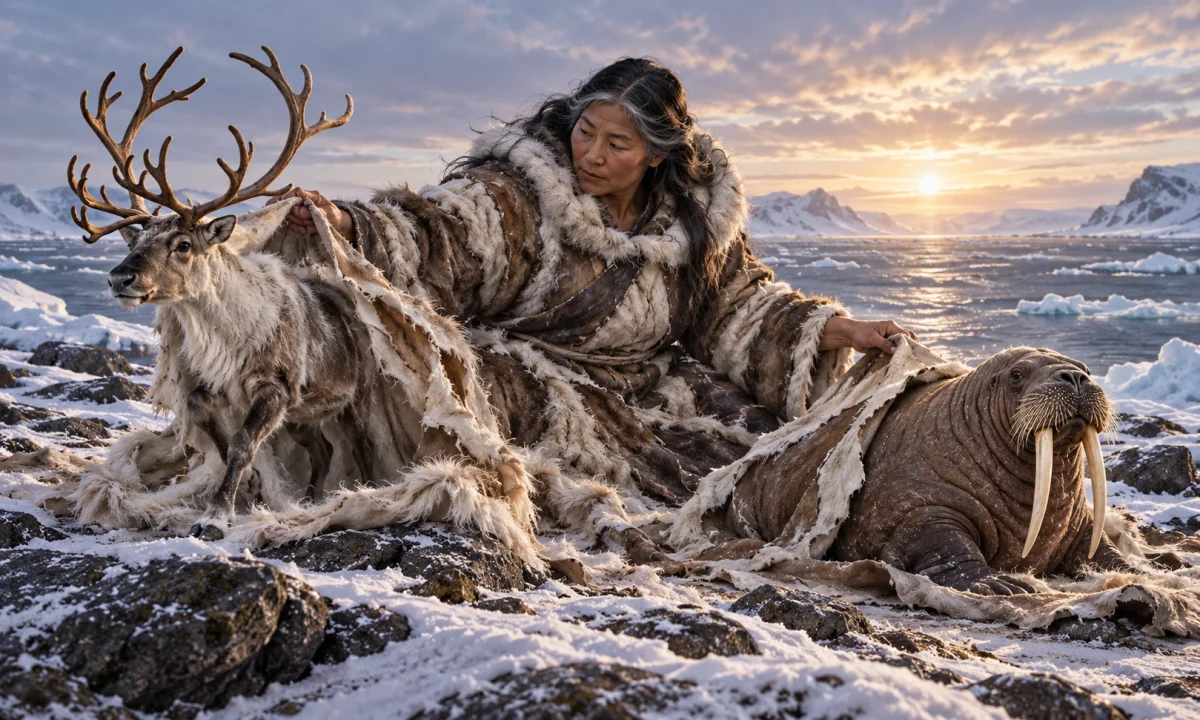
Weather is also frequently included among Alignak’s supposed powers. Arctic communities depend closely on wind, snow, temperature, sea ice, and visibility, so weather has obvious spiritual and practical importance. Inuit traditions include many explanations for dangerous weather and environmental change, but responsibility for these forces was not necessarily concentrated in one universal deity. Local spirits, animal powers, ritual specialists, taboo violations, and other supernatural beings could all be involved in explanations of misfortune.
It is similarly misleading to describe Alignak simply as an Inuit equivalent of a storm god or a sea god. Such comparisons can make unfamiliar traditions easier to approach, but they may obscure the specific cultural setting of Inuit ideas about animals, the sea, the sky, the dead, and human obligations.
Hunting, fertility, and the dead
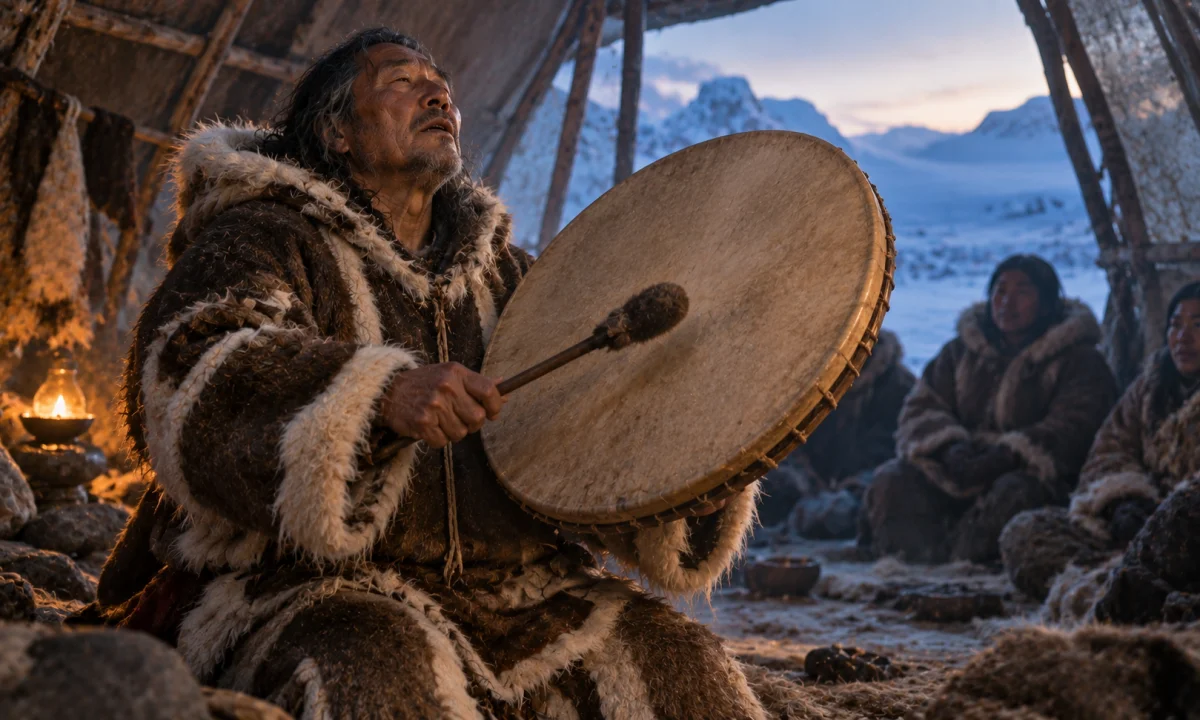
Some popular accounts call Alignak a patron of hunting or fertility. These claims may arise from the broad importance of the Moon’s cycle to seasonal life, or from attempts to assemble a complete list of divine functions. Traditional Inuit spiritual practice did involve concerns with successful hunting, childbirth, illness, reproduction, and the proper treatment of animals. Those concerns were addressed through rules, rituals, personal relationships with helping spirits, and regional religious specialists often known in English by the Greenlandic term angakkuq.
That context does not establish Alignak as a universal god of fertility or hunting. The spiritual life of Inuit communities was not organized around a small fixed pantheon in the manner of many classical mythology textbooks. A single named figure could have important responsibilities in one tradition while being absent or differently understood in another.
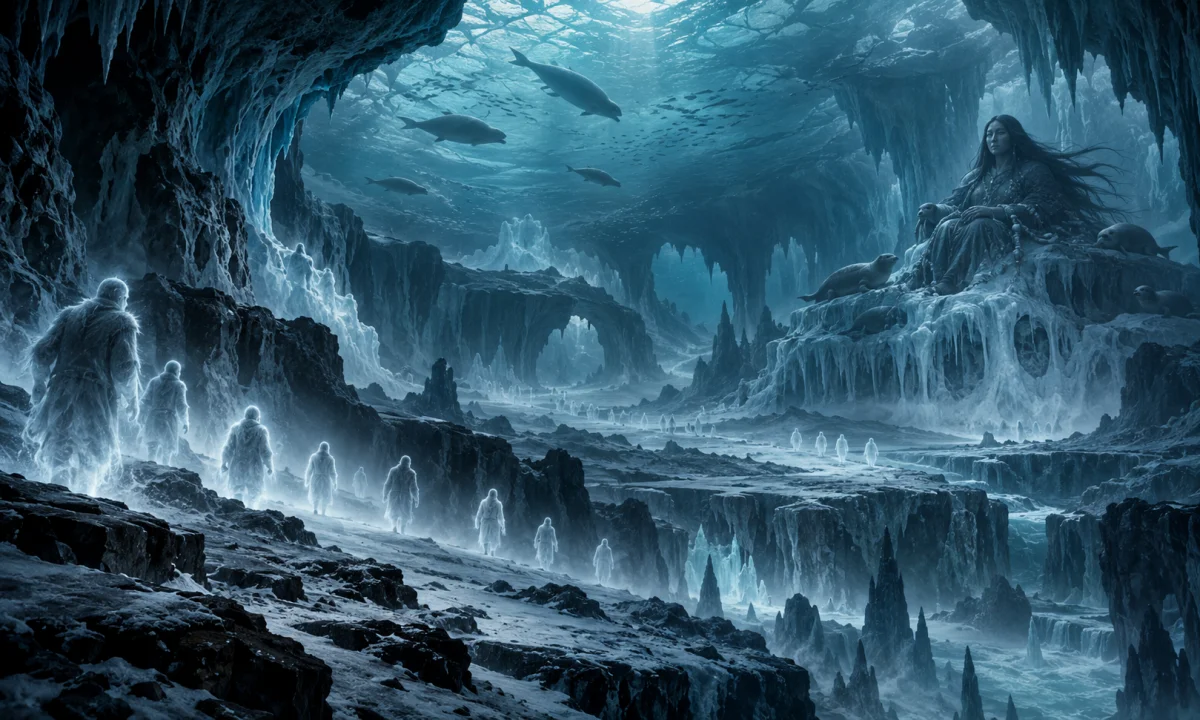
Alignak is also sometimes described as a ruler or guardian of the dead. Death and the afterlife are important subjects in Inuit traditions, but ideas about the destinations of the dead varied. Some accounts distinguish different realms connected with the sea, the sky, or the underworld; others describe the dead continuing in altered forms or remaining connected to the living. A single “Inuit underworld” governed by Alignak is an oversimplification and should not be presented as a general belief.
Appearance and character
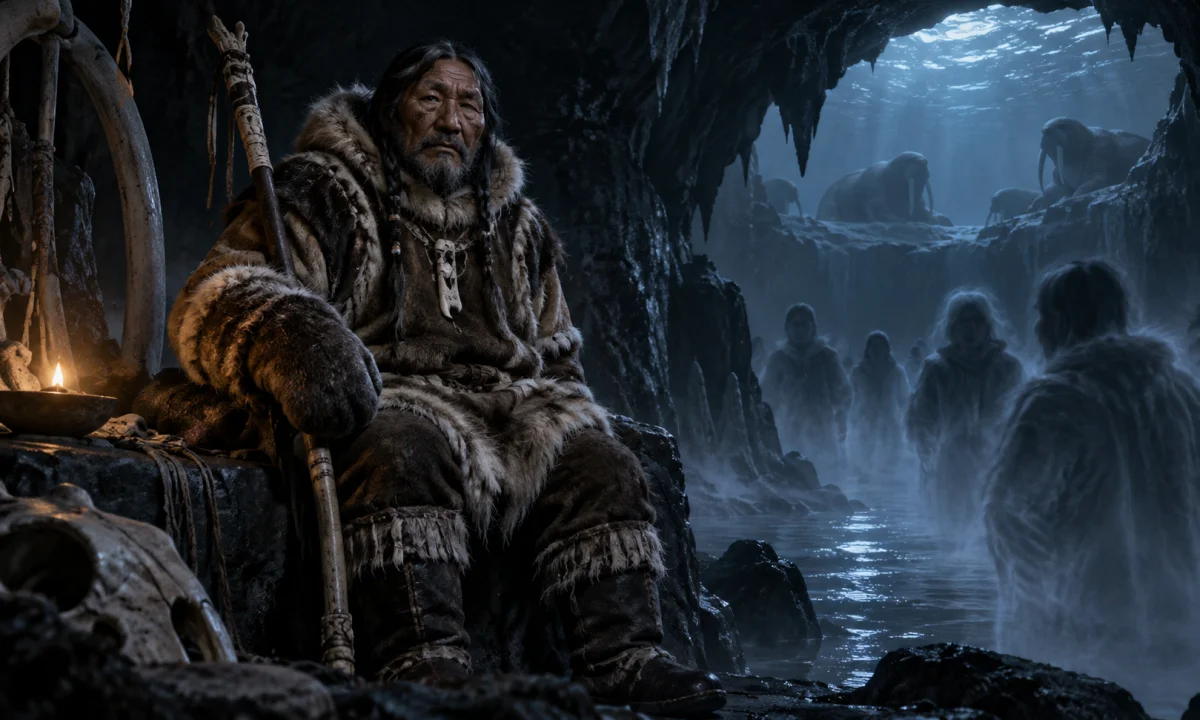
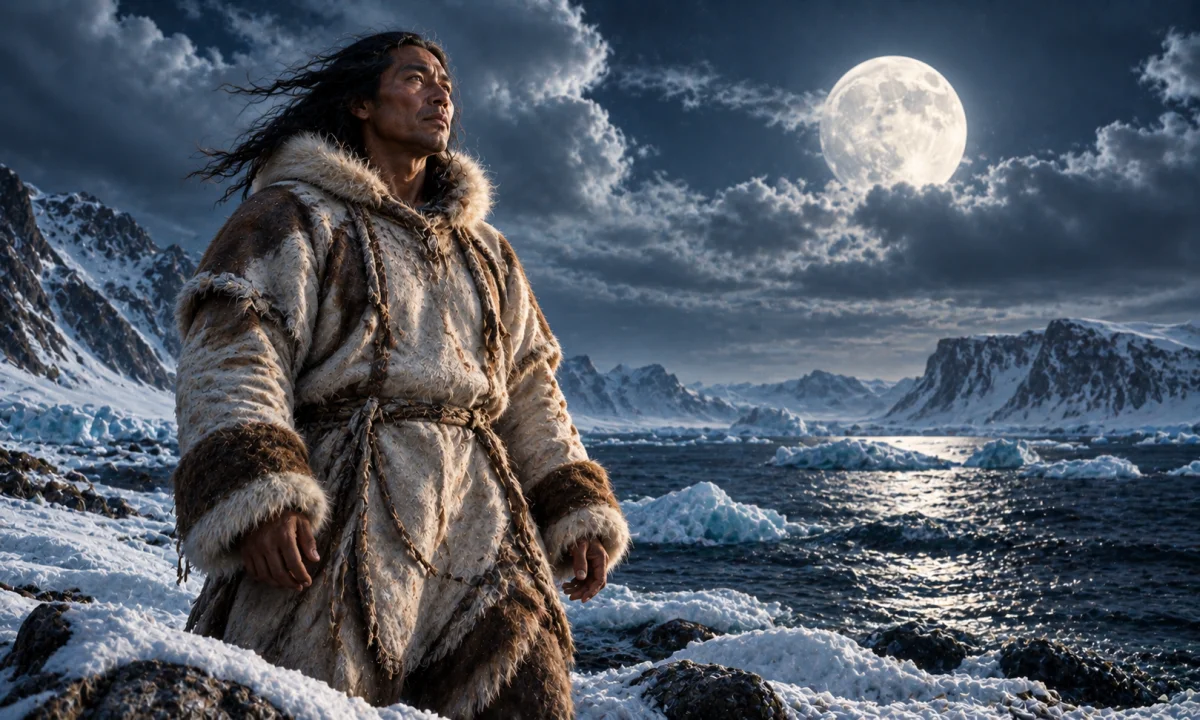
There is no widely established traditional portrait of Alignak comparable to the standardized images created for Greek or Roman gods. Illustrations showing him as a bearded man, a powerful shaman, or a crowned lunar ruler are modern artistic interpretations. Inuit art has its own regional histories and conventions, but an image made for a mythology website or fantasy publication should not be mistaken for an inherited sacred representation.
Descriptions of the lunar figure’s character also vary. In some retellings, he is jealous, obsessive, or violent because of his pursuit of the Sun. In others, he is simply a celestial person whose movement explains the night sky. A modern label such as “cruel moon god” may reflect a particular retelling rather than a stable traditional attribute.
It is more accurate to describe the figure as ambiguous and relational. His meaning emerges through his connection with the Sun, the changing sky, human observation, and regional ideas about spiritual power. He should not automatically be classified as benevolent, evil, or morally perfect.
Alignak and other Inuit spiritual beings
Alignak should not be confused with Sedna, one of the best-known figures in Inuit mythology. Sedna is associated in many traditions with marine animals, the sea, and the conditions governing successful hunting. Her name and story also vary by region, and she is known by other names, including Nuliajuk in some Canadian Inuit traditions. She is not simply another name for a Moon spirit.
Nor should Alignak be merged with Anningan or Aningan without qualification. Those names are strongly associated with the male Moon in Greenlandic accounts, and they may be the source of some descriptions later attached to Alignak. Nevertheless, spelling variation and regional transmission make it unsafe to declare that every use of Alignak refers to exactly the same being.
Inuit religious traditions also include numerous local spirits, animal masters, helping beings, and dangerous entities. Figures connected with weather, hunting, childbirth, illness, or the dead may have distinct identities rather than being subordinate aspects of one pantheon. Treating every important supernatural force as a “god” can hide the structure of the original belief system.
Interpretation and cultural significance
The importance of the lunar figure lies partly in the way Inuit stories connect the visible heavens with human conduct. The Moon is constant but changing, familiar but difficult to explain, and closely tied to the rhythms of Arctic life. A story about a moon person following the Sun turns an astronomical pattern into a drama of kinship, conflict, separation, and persistence.
These traditions also show why mythology should not be separated completely from environment. Darkness, daylight, seasonal change, ice, animals, and celestial navigation were not remote subjects. They affected survival and social organization. Stories about the sky could therefore carry observations about the world as well as ideas about proper behavior, danger, taboo, and the consequences of disorder.
At the same time, the name Alignak illustrates the problems created when oral traditions are compressed into short mythology entries. A modern list may turn a regional lunar spirit into a single “Inuit god” with a fixed biography and a long catalogue of powers. Such presentations can preserve a useful point of recognition, but they may also erase dialect differences, uncertainty in the evidence, and the authority of the communities whose traditions are being described.
Later reception
Alignak has appeared mainly in modern mythology websites, encyclopedic lists, fantasy settings, games, and other popular treatments of supernatural figures. In these contexts he may be given a dramatic appearance, a complete divine hierarchy, or powers over the Moon, oceans, storms, fertility, and death. Those additions belong to modern adaptation unless they can be traced to a specific traditional account.
Contemporary references are most responsible when they identify Alignak as a name used in secondary accounts for an Inuit lunar figure, explain the connection with Anningan or Aningan where relevant, and acknowledge that the evidence is regional and uncertain. The figure is best approached not as a universally standardized “Inuit moon god,” but as part of a broader and diverse set of Inuit traditions concerning the Moon, the Sun, and the spiritual forces of the Arctic world.