WORLD
WORLD
Nanook
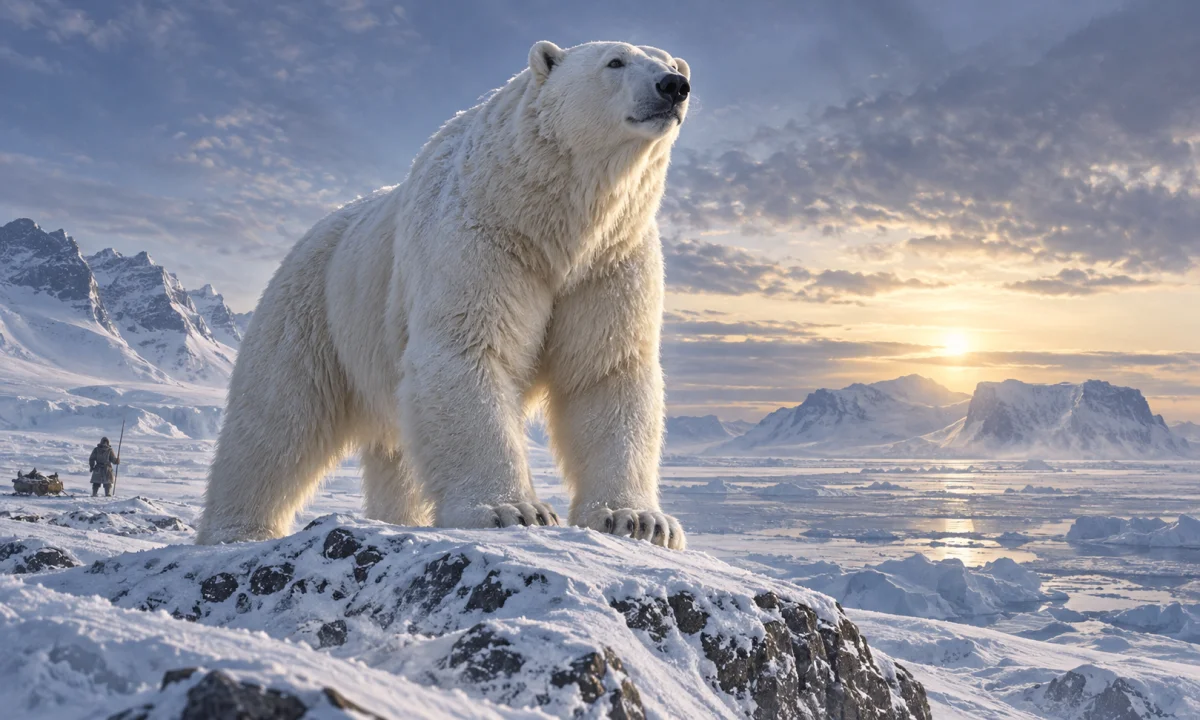
Nanook, more accurately written Nanuq in many Inuit-language contexts, is the polar bear as a powerful being in Inuit religious traditions and oral histories. The name can refer both to the animal itself and to the spiritually significant presence associated with polar bears. In some traditions, Nanuq is understood as a master or guardian of polar bears, able to influence whether hunters encounter them and whether a hunt is conducted correctly.
Nanook is not a single, universally defined god with one canonical biography. Inuit communities have lived across a vast Arctic region, including parts of Alaska, Canada and Greenland, and their languages, ritual practices and oral traditions differ. Stories about polar bears therefore vary from one community to another. Some describe the bear as an unusually powerful animal with human-like qualities; others emphasize the spirit or “owner” of the species. Treating every account as one standard mythology can obscure important regional differences.
The name Nanuq
Nanuq is a common Inuit-language term for a polar bear, although spelling and pronunciation vary between languages and dialects. Nanook is a widely used English spelling, influenced especially by Inuktitut and by earlier written transcriptions. Greenlandic has the related form nanoq, while other Arctic languages use forms that may look or sound different.
The word does not necessarily identify a separate supernatural character in every context. A speaker may use it simply to mean a polar bear, while a traditional story may present the polar bear as a being with intentions, knowledge and spiritual power. This flexibility reflects an important feature of Inuit religious thought: the boundary between an ordinary animal and a spiritually powerful animal is not always expressed in the same way as the boundary between a human deity and a natural creature in European mythology.
Some discussions describe Nanuq as an inua, a term often translated in relation to a person, spirit, owner or indwelling presence. Such translations are approximate. Inuit concepts of personhood and spiritual agency cannot be reduced neatly to the idea of a god living inside an animal. The polar bear may be regarded as a person in its own right, as the representative of a larger species community, or as a being under the authority of a powerful master.
Arctic cultural setting
Polar bears have long been important to the peoples of the Arctic. They are formidable predators, dangerous to approach and highly valued for their meat, hide, fat and bones. A successful polar-bear hunt required courage, specialized knowledge and careful attention to weather, sea ice and animal behaviour. The bear was not simply a resource. Its strength, intelligence and apparent awareness made it an especially significant participant in the moral and spiritual relationship between humans and animals.
In many Inuit traditions, animals are not viewed as spiritually empty objects. They may possess an identity, a soul or a relationship with a master of the species. Hunting is consequently accompanied by obligations. A hunter is expected to show respect, observe appropriate conduct and avoid behaviour that could offend the animal or the being responsible for it. The exact rules differed among communities and periods, but they commonly express reciprocity rather than unlimited human control.
Oral tradition was central to the preservation of these ideas. Knowledge was transmitted through stories, personal instruction, ritual practice and experience on the land and sea. Written descriptions were later produced by missionaries, explorers, anthropologists and other outsiders. Those records are useful, but they were shaped by the observers’ own languages and assumptions. They sometimes grouped diverse beliefs under broad labels such as “Inuit mythology” or interpreted a powerful animal as though it were equivalent to a European-style deity.
Nanuq as animal and spiritual being
Traditional stories often give polar bears a striking dual character. They are recognizably animals, subject to hunger, injury and the conditions of the Arctic, yet they may also behave like people. In some narratives, bears have their own settlements, social life or ceremonial behaviour away from human observation. A bear may remove its skin and reveal a human-like form, or may understand human speech even when people do not realize they are being watched.
These motifs do not mean that every Inuit tradition teaches that polar bears are literally disguised humans. They express the idea that animals possess a life and viewpoint that humans cannot fully see. A bear encountered on the sea ice may be both a physical animal and a morally significant person. Its apparent otherness is precisely what makes it powerful.
Nanuq is also associated with the danger and majesty of the polar bear. The being is not usually a gentle protector in the modern sentimental sense. A polar bear can kill a person, and traditional accounts do not remove that danger. Respect may include fear, caution and restraint. The animal’s power demands proper conduct from hunters rather than emotional affection alone.
The master of polar bears
One recurring interpretation presents Nanuq as the master of polar bears or as the chief spiritual power connected with the species. In this understanding, a hunter’s success depends partly on maintaining the right relationship with Nanuq. The master may allow a bear to be found, make the animal available to a worthy hunter or withhold it when people have violated important rules.
“Master of animals” is a convenient translation for a widespread Arctic religious pattern, but it should not be treated as a single institution with identical rules everywhere. Different communities recognized different powerful beings connected with animals, hunting and the sea. In some traditions, the being who governs polar bears may be closely identified with the polar bear itself; in others, Nanuq is the species name while a separate spirit or animal master controls its abundance.
The idea links hunting success with ethical behaviour. A hunter who is boastful, careless, ritually unclean or disrespectful may be thought to endanger future hunts. Conversely, correct treatment of the animal can help preserve the relationship between human beings and the species. This is not simply a system of “reward and punishment” imposed by a distant god. It is a way of explaining the obligations built into hunting and the uncertainty of life in an Arctic environment.
Stories and ritual themes
There is no single canonical Nanook story comparable to a fixed epic with one accepted sequence of events. Instead, Nanuq appears through a range of stories and practices. A common theme is the encounter between a hunter and a polar bear in which the animal is more perceptive, more powerful or more spiritually aware than expected.
Some traditional narratives describe bears as observing human behaviour. A bear may know whether a hunter has followed the proper rules, whether the killing is necessary and whether the hunter will treat the body respectfully. The story may end with a successful hunt, a warning, an escape or the hunter’s death. Such outcomes emphasize that the bear is not merely passive prey.
Another important theme concerns the treatment of the animal after the kill. Accounts from different Arctic regions describe respectful handling of the hide, skull and other parts of a hunted animal. Some describe placing a polar-bear skull in a particular location or orientation, sometimes in relation to the sea. These practices were not uniform, and they should not be presented as a universal Inuit ritual. Their underlying significance, however, is often connected with returning the animal properly, acknowledging its personhood or encouraging its return in the future.
Bear stories may also explain why polar bears possess unusual abilities. Their capacity to move between sea ice and land, swim great distances and survive the Arctic winter contributes to their status as beings that cross ordinary boundaries. A polar bear can appear at the edge of human settlement, travel through a world beneath the ice and vanish into a landscape where humans cannot easily follow.
Appearance and powers
In visual terms, Nanuq has the body of a polar bear: white or yellowish fur, massive limbs, powerful jaws and a size that varies according to the story. Traditional narratives may portray an especially large or extraordinary bear, but there is no universally established iconography for Nanuq. It is misleading to assign the figure a standard costume, weapon or human form.
The most important powers associated with Nanuq are knowledge, strength and control over access to polar bears. Depending on the tradition, Nanuq may:
- know the intentions and conduct of hunters;
- decide whether a polar bear will reveal itself or become available to a hunter;
- move between animal and human-like states;
- understand human speech or maintain a society beyond human sight;
- punish disrespectful treatment of the bear or its remains; and
- represent the collective spiritual power of polar bears.
These qualities are not attributes of a single standardized character in all Inuit communities. They are recurring elements in stories about polar bears and in wider Inuit ideas about animal personhood, hunting and spiritual reciprocity.
Relationship with other spiritual beings
Nanuq should not automatically be identified with other major beings in Inuit religious traditions. The best-known figure connected with marine animals is often called Sedna in English-language accounts, although she has different names and forms in different regions. Sedna is associated especially with sea animals and the conditions governing their availability. In some traditions, a hunter’s failure may ultimately involve the sea woman or another powerful being who controls marine life. That does not make Sedna and Nanuq the same figure.
The relationship between them depends on regional tradition. A polar bear lives on sea ice and hunts marine animals, so it may occupy a position between land and sea in a story. Nevertheless, Nanuq generally refers to the polar bear or its associated power, whereas Sedna belongs to a different set of narratives and religious relationships. Inuit cosmologies can include several beings with authority over animals without reducing them to one hierarchy shared everywhere.
Nanuq is also distinct from Nanabozho, a major culture hero in several Anishinaabe traditions. The names may look similar in English, but the figures come from different Indigenous cultural and linguistic traditions. Nanuq is not a variant of Nanabozho, and neither should be used as a translation of the other.
Cultural significance
The spiritual importance of Nanuq reflects the central place of hunting knowledge and environmental relationships in Arctic life. The polar bear’s status is not based only on its physical size. It is an animal capable of travelling through a difficult and changing environment, and its behaviour can have immediate consequences for human survival. Stories about Nanuq teach attentiveness, humility and respect for a powerful nonhuman being.
These traditions also challenge a simple division between “nature” and “religion.” A hunt is an economic activity, a practical skill and a spiritual encounter at the same time. The hunter must read tracks, ice, wind and animal movement, but must also understand obligations that cannot be measured solely in physical terms. Nanuq represents the idea that successful coexistence requires more than technical ability.
Modern discussions sometimes portray Nanuq as an environmental symbol or as a personification of the threatened polar bear. That interpretation can draw attention to climate change, shrinking sea ice and the effects of industrial activity in the Arctic. It is a contemporary use of the figure, however, and should not replace the older religious and cultural meanings. For Inuit communities, the polar bear remains connected to living relationships with land, sea ice, hunting and language, not merely to an abstract emblem of wilderness.
Nanook in modern culture
The spelling Nanook became familiar to many non-Inuit audiences through the title Nanook of the North, a 1922 film about an Inuk family and their life in the Arctic. The title uses an Inuit name, but the film was made by a non-Inuit filmmaker and presents a shaped, partly staged representation rather than a transparent record of Inuit life. Its popularity helped spread “Nanook” internationally, while also encouraging outsiders to treat the name as a picturesque label for the Arctic.
In modern English, Nanook is also used as a personal name, a name for fictional polar bears and a general symbol of the North. These uses may be respectful, commercial, artistic or reductive depending on context. They should not be confused with the varied traditional meanings of Nanuq. In particular, a cartoon polar bear named Nanook may borrow the name without representing Inuit religious tradition.
The most accurate understanding of Nanook begins with the word’s living linguistic and cultural setting. Nanuq is a polar bear, but in Inuit tradition the polar bear may also be a person-like being, a dangerous spiritual presence and the representative of a relationship governed by respect. The meaning changes across communities and contexts, yet the central theme remains the recognition that the animal is not merely an object for human use.