WORLD
WORLD
Momo

Momo is a name sometimes presented in modern reference material as belonging to Hopi mythology, but it does not identify a single, consistently documented figure across the best-known accounts of Hopi religious tradition. The spelling, pronunciation, identity and supposed role vary considerably. In some descriptions, Momo is treated as a katsina—a sacred being represented in ceremonial dances—while other accounts give the name to a frightening or clown-like figure. Because of this uncertainty, Momo should not be described as a universally recognized Hopi god or as a figure with one fixed appearance and biography.
Hopi religious and cultural setting
The Hopi are a Pueblo people whose traditional homeland is in what is now northeastern Arizona. Hopi religious life includes ceremonies connected with rainfall, agriculture, seasonal change, social responsibilities and the well-being of the community. Many ceremonies involve katsinam, the plural form commonly used for sacred beings known in English as katsinas or kachinas.
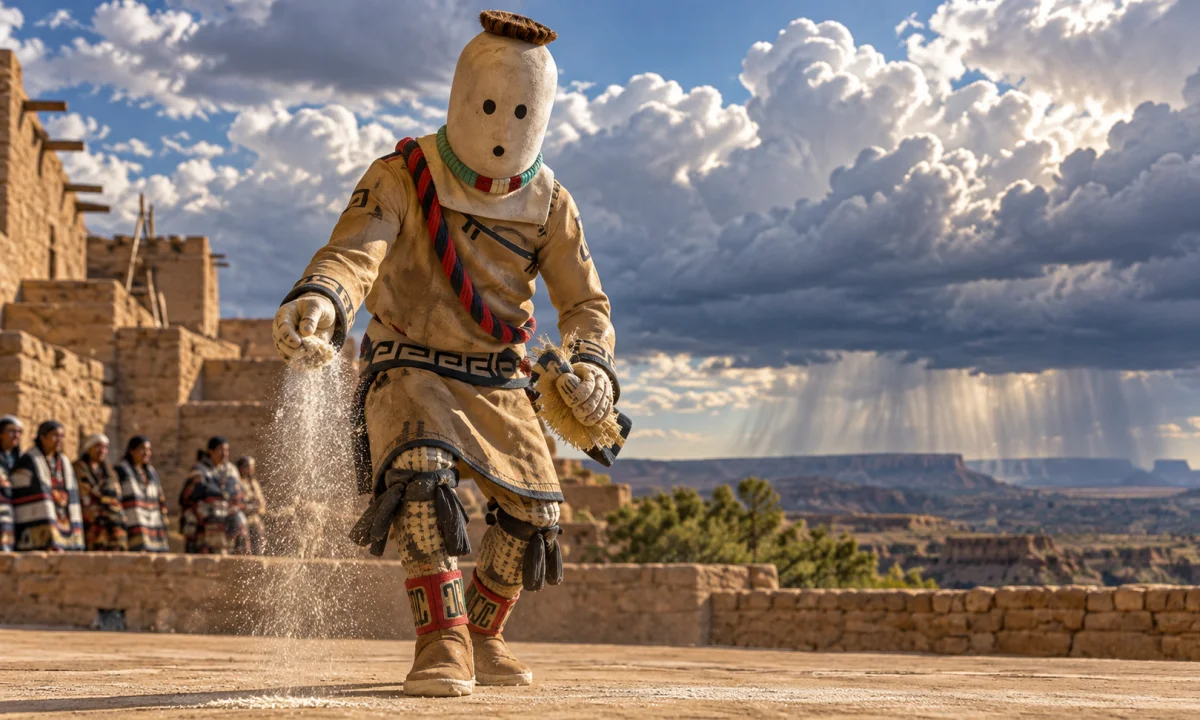
A katsina is not simply a “mythological creature” in the modern fantasy sense. In Hopi understanding, katsinam are part of a sacred order of beings associated with the natural world, the ancestors, the weather, places and other powers that affect human life. During appropriate ceremonies, initiated dancers represent particular katsinam by wearing masks, clothing and other ritual equipment. The dancer is not merely acting out a fictional character; the performance has religious and communal significance.
Hopi traditions have been transmitted through ceremony, oral teaching, family knowledge and community practice. They were not originally organized as a single written mythology with a definitive list of characters. Accounts recorded by outsiders can therefore differ because they were collected in different villages, at different periods and from people with different responsibilities and levels of authority. Some sacred information is also not intended for unrestricted publication.
What does the name Momo mean?
The name Momo is difficult to interpret with confidence. English-language sources sometimes use it as though it were the established name of one Hopi supernatural being, but they do not agree about the figure’s category or characteristics. A name may also be written differently when an unfamiliar Hopi sound is approximated in English. Diacritical marks, glottal stops and distinctions between vowel sounds can be lost in transcription.
For that reason, an English spelling such as “Momo” does not by itself prove that all references concern the same being. A word recorded by an early researcher, a name used for a ceremonial mask, a nickname applied to a dance character and a modern internet description may all be treated as identical even when they are not.
There is no reliable basis for presenting Momo as one of the universally central figures of Hopi tradition in the way that widely documented beings such as Spider Woman, the culture hero Maasaw or prominent katsinam are discussed. Nor is there a secure basis for assigning Momo a single genealogy, domain or standard appearance.
Momo and the katsina tradition
Some modern catalogues and popular accounts classify Momo as a katsina. This classification may reflect a local ceremonial usage, a historical record of a particular dance or an interpretation by a collector. It should not automatically be generalized to every Hopi community.
If Momo is used as the name of a katsina in a particular tradition, the important point is that the figure belongs to a living ceremonial system rather than to a detached collection of legends. Katsina dances can teach values, dramatize relationships between humans and the non-human world, encourage proper conduct and mark the agricultural and ceremonial calendar. Their meanings may include humor, warning, discipline, abundance, rain or social criticism, depending on the being and the occasion.
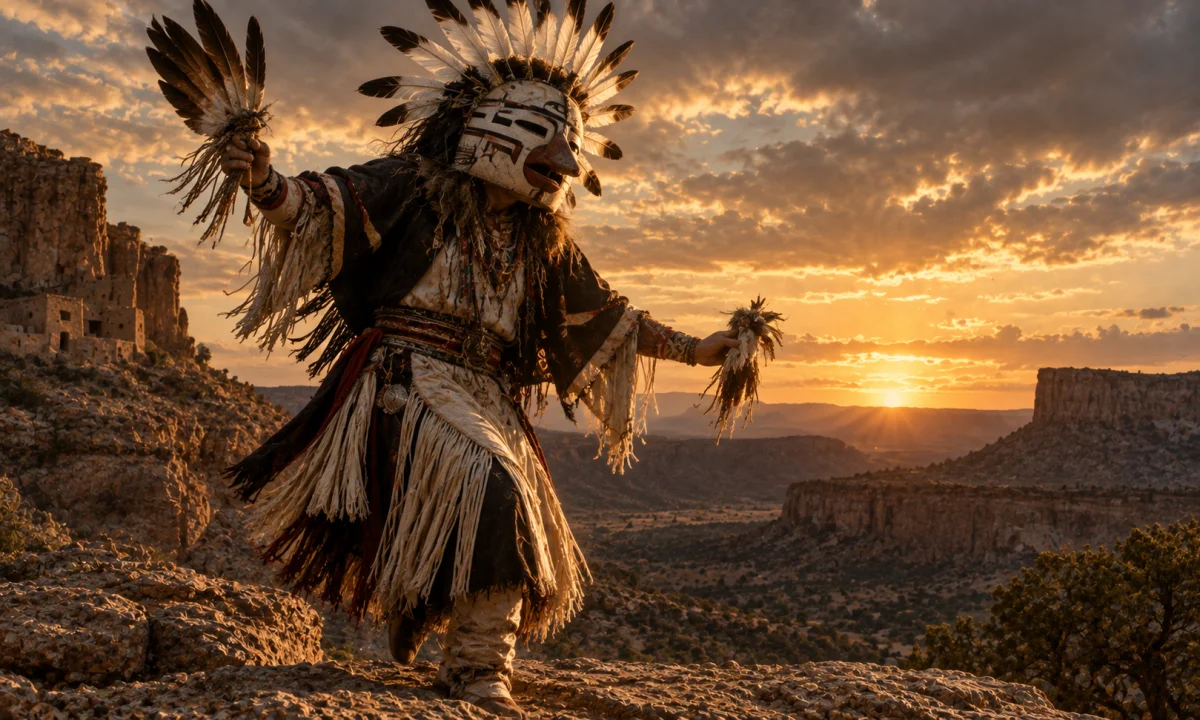
Hopi ceremonial characters can also be deliberately ambiguous. A dancer may appear comic, frightening or grotesque while performing a serious religious and social function. Exaggerated masks and movements may attract attention, expose improper behavior or remind spectators that the sacred world is not limited to familiar human appearances. Consequently, a description of Momo as “a monster,” “a clown” or “a spirit” may be an outsider’s shorthand rather than an adequate account of the figure’s meaning.
Reported characteristics and uncertainty
Descriptions attached to the name Momo in popular sources often mention an unusual, frightening or comic appearance. Some portrayals give the figure exaggerated facial features, a large mouth, prominent eyes or a generally grotesque body. Other references treat Momo as a mischievous character. These descriptions are not consistent enough to establish a standard traditional form.
There is also no dependable, broadly accepted evidence that Momo possesses a fixed set of powers. Claims that Momo controls a particular element, causes a specific disease, guards a named place or plays a defined role in the creation of the world should be treated cautiously unless they can be tied to a clearly identified Hopi tradition. The same caution applies to claims that Momo is a cannibal, child-stealer, demon or ruler of the dead.
Terms such as “monster” and “demon” can distort Pueblo religious concepts. They are sometimes used by English-language writers for beings who frighten people or punish violations, but they may imply a Christian or European system of evil that does not correspond to Hopi thought. A dangerous being may have a role within a larger sacred order, and a frightening ceremonial appearance does not necessarily indicate absolute moral evil.
Why accounts differ
Several factors contribute to the uncertain identity of Momo:
- Regional variation: Hopi villages and communities may preserve different ceremonial practices, names and interpretations.
- Transcription: Hopi words recorded in older English sources may be spelled inconsistently, especially when sounds have no exact English equivalent.
- Restricted knowledge: Not every ceremonial meaning or name is intended for public explanation.
- Collector influence: Museum labels and commercial descriptions have sometimes simplified complex religious figures into easily recognizable “characters.”
- Internet repetition: An unsupported description can be copied across websites until it appears to be an established fact.
These problems are especially significant for figures that are less widely documented than major katsinam. A short reference entry may omit the village, speaker, date and ceremonial context in which a name was recorded. Without that information, it is difficult to determine whether two references describe the same being.
Relationship to better-known Hopi figures
Momo should not be automatically identified with Koshare, one of the best-known Hopi clown figures. Koshare dancers are associated with black-and-white body patterns and comic or disruptive behavior, but their humor can serve serious social and ceremonial purposes. Because popular descriptions often call any grotesque or comic katsina a “clown,” Momo may be confused with Koshare or with another clown figure. Similarity in appearance is not proof of identity.
Momo should also be distinguished from Hahai-i Wuhti and Soyok Wuhti, names associated in published discussions with frightening female or ogre-like ceremonial figures. These beings have their own traditions and should not be merged with an uncertain figure simply because all may be described in English as monsters or bogey figures.
Nor should Momo be confused with Maasaw, a major Hopi cultural and religious figure linked in different accounts with the earth, mortality, the world order and the granting of land. Maasaw’s name and role are much more securely attested in discussions of Hopi tradition. Calling Momo a variant of Maasaw would be unsupported.
Possible confusion with unrelated “Momo” figures
The name Momo occurs in many unrelated cultural and modern contexts. A well-known example is Momo in Greek mythology, the personification of blame and ridicule. Greek Momo has no established connection with Hopi tradition.
There is also a Japanese figure and name written Momo in different contexts, along with modern fictional characters and internet images using the same word. The frightening “Momo” image that circulated widely online in the late 2010s was a modern media phenomenon, not evidence of a Hopi spirit. It was frequently linked in misleading ways to an alleged “Hopi demon,” but such claims do not establish a traditional Hopi origin.
These associations can create a false impression that Momo is a famous pan-cultural monster. Names shared across languages do not demonstrate a historical relationship. A responsible account must keep the uncertain Hopi references separate from Greek mythology, Japanese folklore and contemporary internet culture.
Cultural significance
The most important cultural point is not a sensational description of Momo’s supposed appearance, but the need to treat Hopi religious figures within their own ceremonial setting. Hopi traditions connect spiritual life with obligations to the community, respect for the land, agricultural work, rainfall and the continuation of ceremonial knowledge. A figure represented in a dance may therefore communicate social and religious ideas that are lost when it is reduced to a “scary creature.”
Hopi katsina traditions have also been affected by outside interpretation. Non-Hopi observers have often collected masks, photographed ceremonies or described dances without fully understanding their significance. Commercial trade in katsina carvings has encouraged the use of standardized names and simplified categories, even though a carving made for sale is not identical to a sacred mask used in ceremony. The English word “kachina” is itself used broadly and can conceal important distinctions between sacred beings, dancers, masks and carved representations.
For Momo in particular, the evidence supports caution rather than a detailed invented biography. The name may refer to a locally recognized ceremonial figure or to a form preserved in a limited record, but available popular descriptions do not justify a universal account of Momo’s origin, powers, relationships or appearance. The absence of a stable public profile is not evidence that the figure is unimportant; it may reflect local variation, restricted knowledge or the weaknesses of outside documentation.
How Momo is best described
Momo is best presented as an uncertain or variably identified name associated in some modern sources with Hopi ceremonial tradition, rather than as a universally recognized Hopi deity. Where a specific source or community tradition identifies Momo as a katsina, that context should be stated. Where the name is used for a frightening or comic being, the description should be treated as local or secondary unless stronger evidence is available.
This careful approach respects both the diversity of Hopi traditions and the limits of the surviving public record. It also prevents unrelated figures, commercial labels and modern inventions from being combined into a single imaginary character.