WORLD
WORLD
Koshare
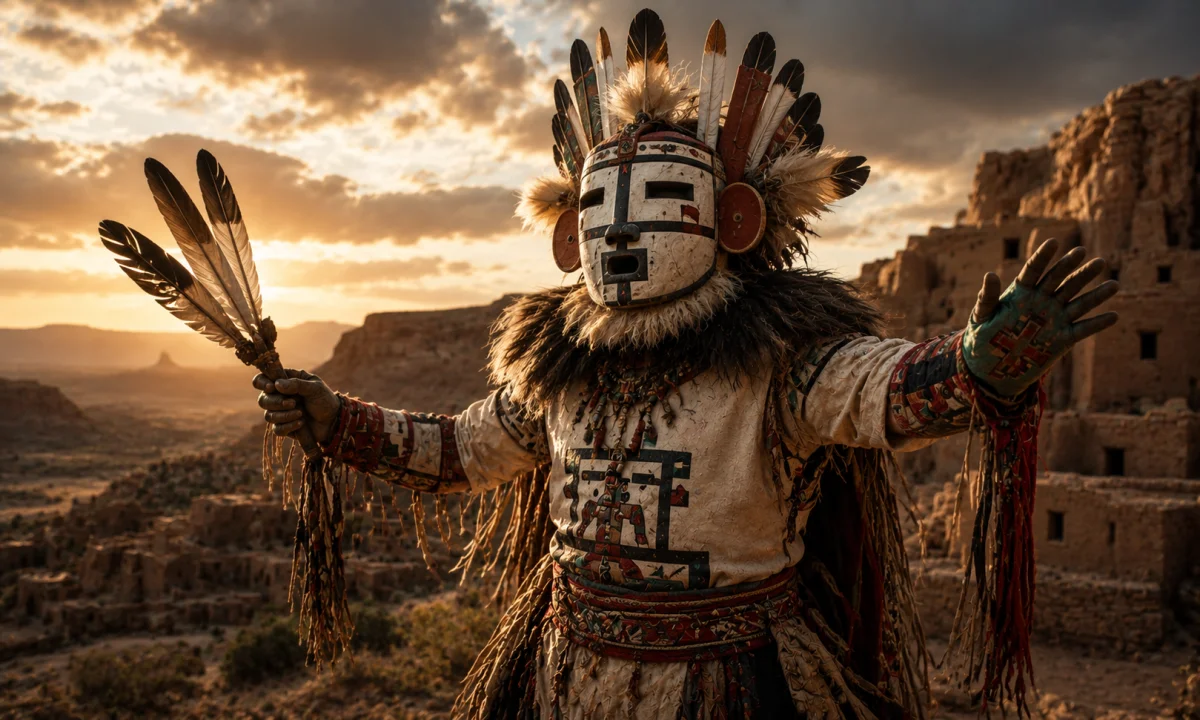
Koshare is a sacred clown figure associated with Hopi ceremonial life in northern Arizona. The name is often applied to a clown character or to ritual performers who appear in certain Hopi dances and public ceremonies. Koshare is not simply a comic entertainer or a fictional “trickster” in the modern sense. Within its traditional setting, clowning can carry religious, educational and social responsibilities: it creates permitted disorder, exposes foolish or antisocial behaviour, and reminds the community of the consequences of breaking accepted rules.
Hopi cultural setting
The Hopi are an Indigenous Pueblo people whose villages are located on mesas in what is now northeastern Arizona. Hopi religious life includes ceremonies connected with rain, agriculture, seasonal change, ancestral relations and the well-being of the community. A major part of this ceremonial world is formed by the katsinam, often rendered in English as kachinas.
Katsinam are understood in different but related ways: they may be regarded as spirit beings, sacred presences, ancestral powers or representatives of forces that sustain the world. During ceremonies, masked and costumed dancers ritually embody particular katsinam. The word may also refer to the carved figures traditionally made for children, although a carved figure is not itself identical to the sacred being it represents.
Koshare belongs to this wider ceremonial environment, but its role is distinctive. The Koshare figure is associated with humour, parody and deliberate disruption. The performer may behave in ways that would be unacceptable in ordinary circumstances, yet the performance is made possible by a ritual framework. This does not make the ceremony meaningless or merely playful. Laughter and disorder can serve serious purposes, including instruction, correction and the restoration of social balance.
Origins and surviving traditions
There is no single, universally published Hopi creation story that provides a complete origin for Koshare. Hopi religious knowledge has been preserved through oral teaching, ceremonial practice, community participation and relationships between ritual societies. Different villages, societies and knowledgeable individuals may emphasize different aspects of a sacred figure. Some teachings are not intended for unrestricted publication.
For that reason, descriptions of Koshare should not be treated as though they were a character biography from one canonical written mythology. Much of what is known outside Hopi communities comes from observations of dances, photographs, museum collections, recorded interviews and ethnographic writing. Such material can help describe appearance and public behaviour, but it does not necessarily communicate the full religious meaning of a ceremony. Older outside accounts also frequently interpreted Pueblo traditions through European categories such as “god,” “spirit,” “devil” or “clown,” categories that do not always correspond neatly to Hopi understandings.
Koshare traditions have continued despite the pressures placed on Pueblo ceremonial life by colonial authorities, missionary activity and later government institutions. Public performances and representations may reveal some features of the tradition, while other knowledge remains within Hopi ceremonial communities. The absence of a detailed public account should not be taken as evidence that the tradition lacks depth or history.
Name and classification
The spelling Koshare is common in English-language descriptions, but Koshari and other forms also occur. Differences may reflect attempts to represent Hopi pronunciation in English, variation between sources or the use of a related form for a group of clowns rather than one individual. The exact grammatical and ceremonial use of these forms is not uniform in popular reference works.
English writers sometimes describe Koshare as a “kachina” or “kachina clown.” This can be useful as a broad explanation, but it can also be misleading if it suggests that Koshare is merely one standardized character in a fixed catalogue. Hopi ceremonial categories are more complex than a simple list of mythological creatures. In some contexts, Koshare refers to a particular clown katsina; in others, the name is used for performers who take on the clown role. The identity is therefore best understood through ceremony and community practice rather than through a single universal definition.
The term katsina is generally preferred in contemporary discussions of Hopi traditions because it is closer to Hopi usage than the widely popularized spelling kachina. The latter remains common in museum descriptions, older publications and discussions of carved figures. Neither term, however, removes the need to distinguish a sacred being, a ceremonial performer and a carved representation.
Appearance and performance
Koshare is especially recognizable for a body painted in contrasting black-and-white stripes. The precise design, clothing and accessories may vary according to the ceremony and the community. In artistic representations, Koshare is often given an exaggerated body, broad gestures and a conspicuous belly. These features emphasize physical comedy and the deliberate transformation of ordinary human appearance.
The performer’s appearance is not intended merely to identify a theatrical character. Paint, costume, movement and ritual context help establish a temporary sacred identity. A person who performs a katsina role is not simply pretending in the casual sense. During the ceremony, the dancer acts within a system in which the represented presence has religious significance.
Koshare performances may include exaggerated walking, falls, mock arguments, comic imitation, feigned hunger and other forms of physical humour. The clown may interrupt a more formal atmosphere or imitate the habits of spectators and community members. In some public descriptions, Koshare figures are shown teasing people, demanding food or creating staged confusion. Such actions should not be generalized into a fixed script, because the details of a performance can change according to the occasion and the community.
The humour is often based on reversal. A person who should be dignified becomes ridiculous; a supposedly orderly event is disrupted; the clown behaves badly so that ordinary standards of conduct become more visible. The performer may display greed, laziness, gluttony, vanity or incompetence in exaggerated form. The audience laughs, but the joke can also function as a lesson about behaviour that threatens communal life.
The social and religious work of the clown
One important function associated with Koshare is the public correction of improper conduct. Sacred clowns can mock people who ignore ceremonial expectations, behave selfishly or fail to respect community standards. Because the criticism appears through ritual humour, it can address tensions that might be difficult to confront directly. The clown’s apparent foolishness gives the performance permission to say what ordinary speakers might not say.
This role does not mean that Koshare is simply a moral lecturer. The clown is effective precisely because the performance combines entertainment, embarrassment, unpredictability and sacred authority. A lesson delivered through laughter may be remembered more sharply than a formal instruction. Children and adults can both be reminded that social life depends on cooperation, restraint and respect.
Clowning may also create a controlled space for inversion. For a limited time, familiar rules of appearance, speech and behaviour are turned upside down. The disruption is not necessarily a rejection of the community. On the contrary, it can help reaffirm the value of the rules by showing what happens when they are ignored. Once the ceremonial interval ends, ordinary order can be restored with a renewed awareness of its importance.
Some interpretations connect clown figures generally with fertility, rain or the renewal of life, because they appear within ceremonies concerned with the agricultural and spiritual welfare of the community. It is safer, however, not to assign every such meaning specifically to Koshare without knowing the ceremony and local explanation. Symbolic meanings can overlap, and a clown’s role in one event need not be identical to its role in another.
Stories, relationships and variation
Koshare is not known primarily through a long cycle of individual adventures comparable to the stories of Heracles or Coyote. Its significance lies more in a recurring ritual role than in a universally recognized narrative biography. Publicly available descriptions therefore tend to focus on performance, appearance and social purpose rather than on a sequence of stories about Koshare’s birth, family or travels.
Hopi traditions include many katsinam with different identities, powers and ceremonial functions. Koshare participates in this larger sacred system, but it should not be treated as interchangeable with every other comic or disruptive figure. The fact that several katsinam may use humour does not make them versions of Koshare. Nor does every masked dancer who behaves playfully represent the same being.
Details can vary between Hopi communities and between ceremonial occasions. A public dance may present the clown in a form that outsiders can observe, while other aspects of the role may be explained only within a ritual society. Accounts that claim one fixed costume, one unchanging set of jokes or one complete symbolic meaning are likely simplifying a tradition that is both living and locally grounded.
Koshare and other Pueblo clowns
Confusion often arises because sacred clowning is found in more than one Pueblo tradition. The Zuni, for example, are well known for the Koyemshi, commonly called the Mudheads in English. Koyemshi are not simply another name for Koshare. They belong to Zuni ceremonial life and have their own history, appearance and religious context.
Other Pueblo communities also have clown societies or comic ritual figures, sometimes with names that have been transcribed in similar ways. These traditions may share broad features, such as painted bodies, mock disorder, social criticism and participation in agricultural or seasonal ceremonies. Similarity does not prove that the figures are identical or that one tradition was copied directly from another. Pueblo peoples have long maintained distinct languages, histories and ceremonial systems, even where neighbouring communities have influenced one another.
Koshare should also be distinguished from the general idea of a “trickster.” In comparative mythology, tricksters are often characters who use deception, shape-shifting or rule-breaking to move through a series of stories. Koshare’s defining setting is instead a sacred performance carried out within a community’s ceremonial order. The role can be mischievous, but it is not automatically equivalent to figures such as Coyote, Raven or the European court fool.
Cultural significance
Koshare demonstrates that humour can be a form of religious action. In many modern settings, comedy is treated as entertainment separate from worship. In Pueblo ceremonial life, however, laughter may coexist with solemnity and may contribute to the community’s spiritual and social health. The clown’s behaviour can expose pride, greed and disorder while also giving people a shared experience of release.
The figure also challenges narrow ideas about what a sacred being should look like. Koshare is not necessarily dignified in the conventional sense. The striped body, grotesque exaggeration and unruly conduct may appear disrespectful when removed from their ceremonial context. Within the tradition, that very lack of conventional dignity can be meaningful. Koshare reveals that wisdom, correction and sacred power are not always expressed through solemn speech or majestic appearance.
At the same time, the comic role should not be romanticized as unrestricted freedom. The performer acts under ceremonial responsibilities and within limits established by the community. Sacred clowning is not a license for outsiders to imitate the costume, copy the behaviour or reproduce the ceremony as entertainment. Its meaning depends on relationships, permissions and knowledge that cannot be separated from Hopi religious life.
Later representations and popular culture
Koshare has appeared in ethnographic photographs, museum displays, educational writing and images of Hopi katsina carvings. These representations have helped make the figure recognizable beyond Hopi communities, especially through the distinctive striped design. They can also reduce a living ceremonial role to a colourful character or collectible object.
Commercial art and tourist descriptions sometimes use “Koshare” loosely for any Pueblo clown or for a generic comic katsina. Such usage can erase distinctions between Hopi and other Pueblo traditions. A carved figure labelled Koshare may preserve an important artistic and cultural association, but it should not be assumed to provide a complete explanation of the being or the ceremonies in which the role appears.
Outside popular culture, Koshare remains most meaningful as part of Hopi ceremonial tradition: a sacred clown whose humour, exaggeration and apparent disorder can teach, criticize and help maintain communal balance. Its identity cannot be separated from the living religious context in which the performance is authorized and understood.