WORLD
WORLD
Mexitl
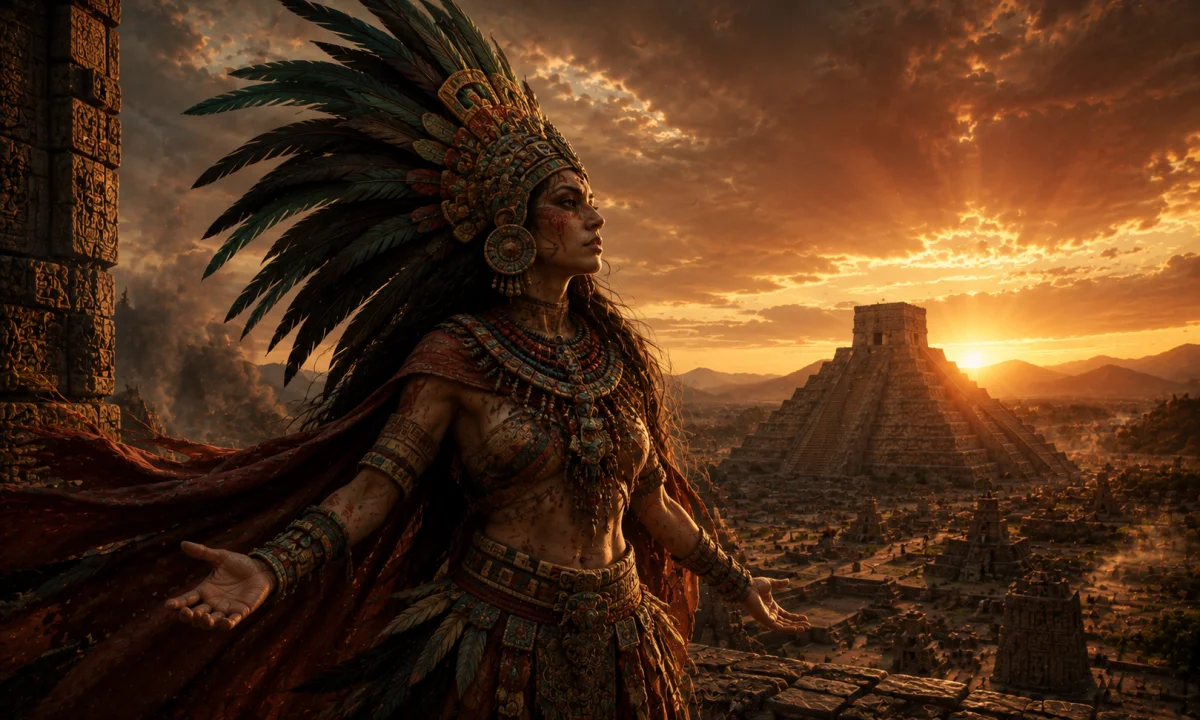
Mexitl is a name associated in colonial-era Nahuatl traditions with Huitzilopochtli, the patron deity of the Mexica and one of the most important gods of the Aztec Empire. The name also appears in accounts of the Mexica migration, where it may function as a divine name, an ancestral designation, or an eponym explaining the people’s name. Because the surviving evidence was recorded after the Spanish conquest and varies between sources, Mexitl should not always be treated as a completely separate god from Huitzilopochtli.
Origins and cultural setting
Mexitl belongs to the religious world of the Mexica, the Nahuatl-speaking people who established Tenochtitlan and built the empire commonly called the Aztec Empire. Their traditions developed within the wider cultural environment of central Mesoamerica, where gods were connected with warfare, agriculture, rulership, celestial cycles, sacred places and the origins of particular communities.
The Mexica preserved their history through oral transmission, ritual performance, painted manuscripts and priestly knowledge. Much of what is now known about their religion comes from sources produced during the sixteenth century, after the conquest of Mexico. These include alphabetic texts written in Nahuatl or Spanish, accounts by Indigenous informants, colonial historians and painted manuscripts. Such sources are invaluable, but they do not provide a single, consistent account of every deity or migration tradition.
Spanish missionaries and Indigenous writers often recorded native religious names according to Christian or European ideas of what a “god,” “ancestor” or “idol” should be. They also sometimes combined different versions of a tradition, interpreted unfamiliar names, or preserved alternative spellings. As a result, Mexitl’s identity is best understood through comparison rather than through one definitive description.
The name Mexitl
The spelling Mexitl reflects the way the name was written in colonial sources using the Latin alphabet. Other forms, including Mexi and Mexic, may occur in discussions of the same tradition. The exact meaning of the name is uncertain. It has sometimes been connected with the name Mexica, the community that founded Tenochtitlan, but the relationship between the two terms is interpreted differently by scholars and by the historical sources themselves.
Some colonial accounts state that the Mexica were named after Mexitl, who is identified with Huitzilopochtli. In this interpretation, Mexitl was the deity whose name became the name of his chosen people. Other traditions present a figure called Mexi or Mexitl in a way that resembles an ancestral leader or founding person. These differences may reflect distinct versions of the migration story rather than a simple disagreement about one individual.
The etymology should therefore be treated cautiously. Popular explanations sometimes claim that Mexitl straightforwardly means “the one from the maguey” or derive it from a single Nahuatl word. Such explanations are not universally accepted, and the surviving sources do not establish one certain translation. The connection between Mexitl, Mexica and Huitzilopochtli is much better attested than any single proposed literal meaning.
Mexitl and Huitzilopochtli
In the most common interpretation, Mexitl is an alternative or earlier name of Huitzilopochtli. Huitzilopochtli was the Mexica’s principal patron deity, a god of warfare, rulership, the sun and the Mexica community itself. His name is usually translated as “Hummingbird of the Left” or understood through a more complex set of associations involving hummingbirds, the south and the left side of the cosmic order.
The identification of Mexitl with Huitzilopochtli is especially important because it places Mexitl within the central foundation narrative of the Mexica. Huitzilopochtli was not merely one god among many. He was the divine power who guided the Mexica during their migration and directed them toward the place where they would establish their capital.
Nevertheless, the names are not identical in every surviving account. Some texts use Mexitl in explanations of the Mexica name without giving a full account of a separate mythology for him. Other traditions emphasize Huitzilopochtli’s better-known name and do not mention Mexitl at all. It is therefore safer to describe Mexitl as a name or aspect associated with Huitzilopochtli in certain traditions, rather than to claim that every Mexica community worshipped a distinct deity called Mexitl.
Role in Mexica origins
The Mexica migration traditions describe a long movement from a place called Aztlan or from a related homeland remembered through several names. During this journey, the people were guided by their patron deity. Different narratives give different details, but Huitzilopochtli commonly communicates through priests, sacred objects, dreams or signs and instructs the migrants where to travel and when to move.
When Mexitl appears in this context, the name helps explain the people’s relationship with their divine patron. The Mexica were not simply a population carrying the name of a human founder. They understood their collective identity as rooted in a covenant-like relationship with a god who had selected, protected and directed them. Their migration was therefore both a political history and a sacred narrative.
The best-known destination sign was an eagle perched on a cactus, often holding or associated with a serpent. The sign appeared at the place where the Mexica founded Tenochtitlan on an island in Lake Texcoco. The precise form and meaning of the image vary among manuscripts and later retellings, and the familiar national emblem of modern Mexico is not identical to every pre-Hispanic version. In the broader foundation tradition, however, the sign confirms the divine destination of the Mexica.
Some accounts place the deity’s commands in the mouth of a priest or leader, while others describe him as a more directly speaking supernatural presence. This variation illustrates how migration traditions could connect divine revelation with human leadership. A founding ruler, priest or ancestor might carry out the god’s instructions while remaining distinct from the god himself.
Attributes and religious significance
Because Mexitl is generally linked with Huitzilopochtli, the attributes most often associated with the name are those of the Mexica patron deity. Huitzilopochtli was represented as a warrior armed with a spear-thrower, shield and other martial equipment. He could also be shown with a hummingbird helmet or hummingbird imagery. The hummingbird was connected with warfare, vitality and the souls or spiritual force of fallen warriors in Mexica thought.
Huitzilopochtli’s religious role cannot be reduced to that of a generic war god. He embodied the power and destiny of the Mexica state. War supplied captives for sacrifice, expanded imperial authority and maintained the political order that supported the capital and its temples. The deity’s cult thus joined military success, royal legitimacy, community identity and cosmic renewal.
The great temple of Tenochtitlan, the Templo Mayor, was dedicated principally to Huitzilopochtli and Tlaloc. This pairing brought together the Mexica war patron and the rain deity whose power was essential to agriculture. The temple’s dual arrangement expressed the interdependence of military power, fertility and food production. Mexitl is not usually named as a separate temple occupant in the surviving descriptions of the Templo Mayor; his significance rests chiefly in the identification with Huitzilopochtli and in traditions of Mexica origin.
Huitzilopochtli’s major festival, Panquetzaliztli, was held during the period corresponding broadly to November and December in the colonial calendar. The festival included ritual processions, offerings, music, dancing and ceremonies connected with the deity’s birth and victory. Accounts of the festival also describe the making and treatment of a large image formed from edible materials, which was later divided and consumed. These rites belonged to Huitzilopochtli’s established cult and should not automatically be attributed to a separate cult of Mexitl.
Myths connected with the Mexica patron
The most important myth associated with Huitzilopochtli concerns his birth and his conflict with his sister Coyolxauhqui and the four hundred Centzon Huitznahua. According to the tradition recorded by colonial-era sources, the goddess Coatlicue became pregnant after a ball of feathers entered her clothing. Her children were alarmed by the pregnancy, and Coyolxauhqui encouraged an attack on their mother.
Huitzilopochtli emerged fully armed from Coatlicue’s womb and defeated the attackers. He struck down Coyolxauhqui and pursued the Centzon Huitznahua. This story is represented dramatically in the great stone disk of Coyolxauhqui discovered near the Templo Mayor. The sculpture shows the dismembered goddess and has been interpreted in connection with the temple’s ritual architecture and the deity’s cosmic warfare.
The myth is often interpreted as a symbolic account of the sun’s victory over darkness, although the symbolism is more complex than a simple solar allegory. It also expresses the triumph of the Mexica’s patron over rival forces and helps explain the ritual importance of the Templo Mayor. The myth is associated primarily with Huitzilopochtli by name, but it becomes relevant to Mexitl when Mexitl is understood as an alternative designation for the same divine power.
Another important narrative concerns the founding of Tenochtitlan. The Mexica wander until their patron signals the correct place for settlement. The eagle, cactus and island setting become signs that the wandering community has reached its promised destination. In later retellings, the story may appear as a straightforward national foundation legend, but within its original religious context it also affirmed the authority of the deity, the sacred status of the capital and the special identity of the Mexica people.
Ancestor, god or title?
The uncertainty surrounding Mexitl partly results from the different functions a name can have in Indigenous historical traditions. A name may designate a god, an ancestral figure, a title used by a priestly representative, or a name by which a community explains its own origin. The categories are not always mutually exclusive in Mesoamerican traditions.
Some modern descriptions call Mexitl a legendary ancestor or first leader of the Mexica. This reflects passages in which Mexi or a similar name appears in an origin narrative as though referring to a person. Other interpretations treat the figure as entirely divine because the name is equated with Huitzilopochtli. Neither formulation should be imposed on all sources. The evidence supports a close association with the Mexica patron deity, while leaving open the possibility that particular traditions recast the name in ancestral or historical terms.
This ambiguity is not necessarily evidence of confusion on the part of the Mexica. Religious traditions often preserve multiple layers of history. A community may describe its god as the guide of its ancestors, remember a priest as the god’s representative, and use the deity’s name as an explanation for the community’s own name. Colonial recording practices could make these relationships appear more sharply divided than they were in lived tradition.
Distinction from similar names
Mexitl should not be confused with Mixcoatl, another important deity in central Mexican religion. Mixcoatl was associated with hunting, the Milky Way, ancestral peoples and several regional traditions. He was especially important among groups whose origin stories differed from the Mexica account. Although both names appear in migration narratives and both gods could be connected with warfare or ancestral identity, Mexitl is chiefly associated with Huitzilopochtli and the Mexica patron tradition.
Mexitl is also not simply another spelling of Mexica. The Mexica were a people and political community, while Mexitl is a name associated with a divine or ancestral figure. The two names may be historically and linguistically related in some traditions, but they do not refer to the same category of being.
Nor should Mexitl be treated as a universal “Aztec god” worshipped throughout Mesoamerica. The term Aztec is a modern umbrella label commonly applied to the Nahua-speaking peoples and political traditions of central Mexico, while Mexica refers more specifically to the people of Tenochtitlan and related communities. Mexitl’s importance belongs primarily to Mexica identity and to traditions surrounding their patron deity.
Sources and historical interpretation
No known pre-conquest alphabetic text provides a complete biography of Mexitl. Knowledge of the name comes through colonial-era records, painted manuscripts and traditions preserved by Indigenous and Spanish authors. The Codex Aubin, the works associated with Bernardino de Sahagún, the histories of Diego Durán and other colonial sources preserve overlapping but non-identical accounts of Mexica origins and Huitzilopochtli’s cult.
These records must be read with attention to language and context. Nahuatl terms were sometimes translated inconsistently, and Spanish writers could use “god,” “devil,” “idol,” “captain” or “ancestor” for figures who did not fit neatly into European categories. In addition, the Mexica state had political reasons to emphasize the special authority of Huitzilopochtli and the sacred legitimacy of Tenochtitlan.
For these reasons, scholars generally distinguish between what is strongly supported and what remains uncertain. The strong association of Mexitl with the name of the Mexica people and with Huitzilopochtli is widely recognized. A separate mythology, fixed appearance or independent temple cult for Mexitl is not securely established. Claims that Mexitl was definitively an agave deity, a historical king or a completely separate war god go beyond what the varied evidence can safely demonstrate.
Later reception
Mexitl is less familiar in modern popular culture than Huitzilopochtli, Quetzalcoatl or Tezcatlipoca. When the name appears today, it is usually in discussions of Mexica origins, the etymology of “Mexico” or alternative names for Huitzilopochtli. Modern writers sometimes present Mexitl as a distinct god because short summaries simplify the differences between colonial sources. That treatment should be regarded as an interpretation rather than an undisputed feature of ancient religion.
The most historically responsible understanding is that Mexitl is a contested and context-dependent name closely tied to Huitzilopochtli and to the sacred identity of the Mexica. It may preserve an older divine name, an epithet, or a tradition in which a divine patron was remembered through the language of ancestry and migration. Its importance lies less in a separate catalogue of powers than in the relationship among deity, people, homeland and imperial destiny.