WORLD
WORLD
Mixcoatl
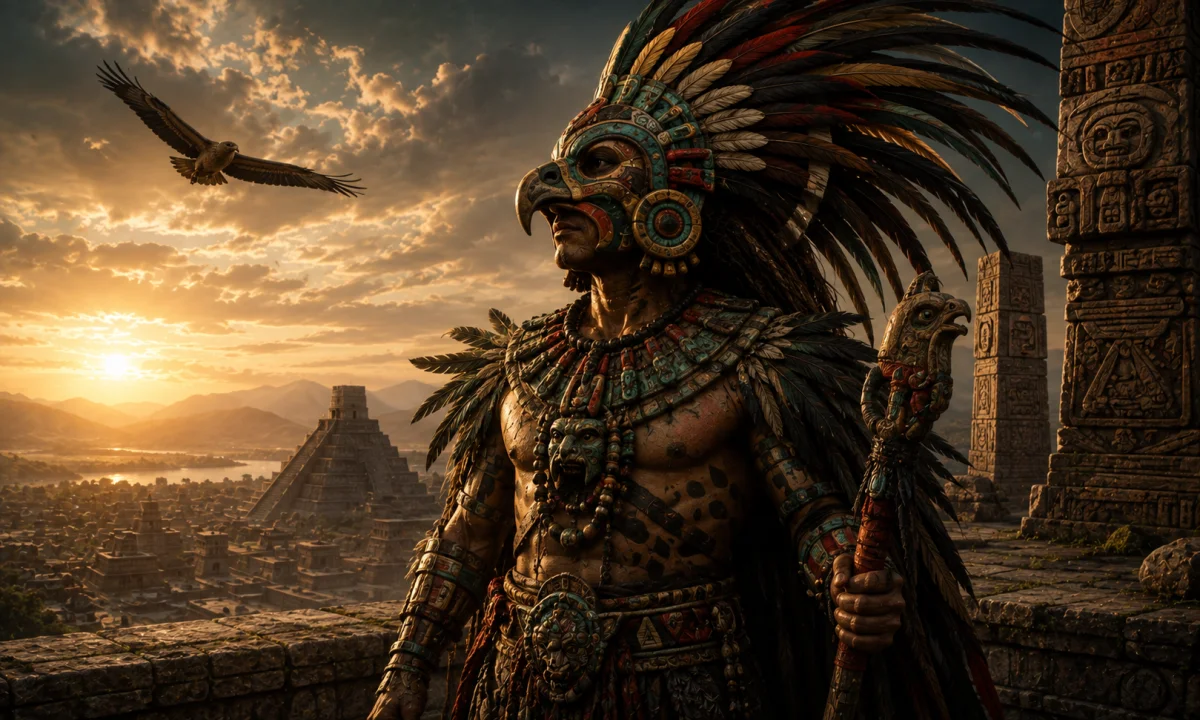
Mixcoatl is a deity of Nahua, especially central Mexican, religious tradition whose name is commonly translated as “Cloud Serpent.” In Aztec mythology he is associated with hunting, warfare, ancestral peoples, the night sky and the stars. His identity is not entirely uniform: surviving colonial sources describe Mixcoatl both as a distinct god and as a name connected with related regional deities, ancestral figures and groups of star beings. Interpretations therefore need to distinguish the Mexica tradition from other Nahua and Mesoamerican traditions that later writers sometimes treated as equivalent.
Name and identity
The Nahuatl name Mixcoatl is usually analysed as a combination of mixtli, “cloud,” and coatl, “serpent.” “Cloud Serpent” is consequently the standard English translation. The name may evoke a serpent moving through clouds, but its religious meaning is broader than a single animal image. Mixcoatl was linked to the sky, the Milky Way or starry heavens in some interpretations, as well as to hunting and the power of mobile warrior peoples.
The name also appears in forms such as Mixcōātl, reflecting the long-vowel marking used by modern scholars to represent Classical Nahuatl pronunciation. Colonial Spanish writers frequently omitted vowel length and recorded Nahuatl names inconsistently, so spelling variations are common.
Mixcoatl belonged to a religious world in which gods could possess several titles, local forms and overlapping functions. A deity connected with hunting could also be an ancestral leader, a patron of migration or a celestial power. This does not mean that every figure associated with hunting or the stars was simply another name for Mixcoatl. Rather, shared symbols and regional religious relationships produced identities that could overlap without being identical.
Cultural setting
Mixcoatl is best known from the religious traditions of the Nahua peoples of central Mexico, including the Mexica, often called the Aztecs. These traditions developed in a wider Mesoamerican environment in which hunting, warfare, agriculture, rulership and ancestry were closely connected. The Mexica state was agriculturally based, but its sacred histories continued to emphasize the importance of hunting peoples, mobile ancestors and the conquest of difficult landscapes.
In this setting, the hunter was not merely a provider of meat. Hunting required knowledge of forests, mountains and animal behaviour, as well as skill with the bow and other weapons. It could also serve as a model for warfare. Deer, rabbits and other game animals appear in accounts of ritual practice, while hunting imagery helps explain why Mixcoatl could be associated simultaneously with the wilderness, military power and the origins of communities.
Mixcoatl was particularly important in traditions concerning Chichimec ancestors. “Chichimec” was a broad and sometimes negative term used by central Mexican peoples for groups regarded as coming from northern or semi-arid regions. It did not identify one single ethnic group. In migration histories, the name could refer to ancestral hunters whose way of life contrasted with the urban and agricultural culture of central Mexico. Mixcoatl’s association with these ancestors helped connect a deity of the hunt with the remembered origins of ruling peoples.
Surviving sources and their limitations
Knowledge of Mixcoatl comes primarily from sources created or recorded after the Spanish conquest. Important evidence includes the Florentine Codex, compiled in Nahuatl and Spanish under the direction of Bernardino de Sahagún with Indigenous collaborators; the Primeros Memoriales; the Codex Borbonicus; the Codex Borgia and related painted manuscripts; and narrative works such as the Leyenda de los Soles. These sources preserve valuable Indigenous traditions, but they do not form a single, consistent theological system.
Colonial descriptions were shaped by translation, Christian expectations and the interests of Spanish missionaries or Indigenous informants working within a new political order. Painted manuscripts also use visual conventions that are not always explained in accompanying text. As a result, scholars may disagree about whether a particular image represents Mixcoatl, a related deity or a local form of a broader divine complex.
Archaeological evidence can show that hunting, warfare and celestial symbolism were important in central Mexican religion, but identifying a particular image as Mixcoatl is often difficult. There is no universally accepted archaeological portrait of the deity. Written descriptions, calendrical context, iconography and regional comparison must be considered together.
Appearance and attributes
Mixcoatl is generally represented as a hunter or warrior. Common attributes associated with him include a bow, arrows, hunting equipment, body paint and garments made from materials connected with the wilderness. Some depictions show deer-related imagery or other signs of hunting. In painted manuscripts, his body and face may display strong contrasts of red, black and white, though the exact colours and details vary between manuscripts and identifications are not always certain.
Descriptions of Mixcoatl may include a distinctive black facial mask or dark facial marking, along with striped or spotted elements. These features should not be treated as a fixed portrait used in every region. Mesoamerican manuscripts often communicate divine identity through combinations of colour, costume, weaponry and context rather than through a single standard image.
The serpent in his name does not necessarily mean that Mixcoatl was normally portrayed as a giant snake. In Nahua religious thought, animal names and forms could express power, movement or transformation. “Cloud Serpent” may point toward a celestial or storm-related aspect, while his bow, arrows and hunting dress emphasize his role as a hunter and warrior. The combination of sky and wilderness imagery is central to his character.
Some interpretations connect Mixcoatl with the Milky Way or with a band of stars visible in the night sky. This association is plausible in light of his name and celestial relationships, but the evidence does not establish one universally accepted astronomical identification. Statements that he was simply “the Milky Way” are modern simplifications of a more varied religious tradition.
Hunting and the festival of Quecholli
Mixcoatl was especially associated with Quecholli, the fourteenth twenty-day period in the Mexica ritual calendar. The festival included ceremonies involving hunting, archery and the commemoration of Mixcoatl. Accounts describe participants wearing hunting equipment and performing activities that represented the pursuit of game and the skills of the hunter.
Quecholli also had connections with the dead, warfare and the remembrance of ancestors. The festival’s precise practices and meanings are difficult to reconstruct because colonial descriptions combine several events and sometimes explain Indigenous rites through Christian categories. Nevertheless, it clearly presents Mixcoatl as more than a nature spirit. He was connected with human communities, military identity and the ancestral past.
Ritual hunting could symbolically reproduce an older way of life while taking place within the highly organized ceremonial system of the Mexica capital. This created a relationship between the imperial city and the non-urban or “Chichimec” past. Through Mixcoatl, the Mexica could honour hunting traditions even while presenting themselves as a powerful settled state.
Myths of ancestry and creation
Several Nahua narratives make Mixcoatl an ancestor or father of important figures. One widely known tradition identifies him as the father of Quetzalcoatl, whose human or culture-hero form is named Ce Acatl Topiltzin Quetzalcoatl. In these accounts, Mixcoatl is associated with Chimalma, who becomes the mother of Quetzalcoatl. The details differ between sources, and some traditions give other accounts of Quetzalcoatl’s parentage or distinguish the deity Quetzalcoatl from the historical or legendary ruler Topiltzin.
Mixcoatl is also connected with the Mimixcoa, often translated as “those of Mixcoatl” or “the Mixcoas.” These beings are described in some traditions as a group of star-related brothers or warriors. The number four hundred appears in narratives about them, but the exact role of the Mimixcoa changes between versions. They may be portrayed as celestial beings, ancestral hunters or warriors who fail in their obligations and are subsequently defeated.
One story recorded in post-conquest sources tells of the four hundred Mimixcoa and their relationship to Mixcoatl and the earth goddess Itzpapalotl. In the narrative, questions of hunting, sacrifice, disobedience and the proper maintenance of divine order are intertwined. The surviving versions are difficult to harmonize, and scholars do not treat every detail as part of one standardized Mexica myth.
The association with groups of stars is significant because it joins Mixcoatl’s celestial aspect to his role as a progenitor of peoples. The “children” or followers of a deity could be divine beings, stars, warriors or human ancestors depending on the narrative context. This fluidity is characteristic of Mesoamerican mythic traditions and should not be forced into a modern distinction between “god” and “tribal founder.”
Mixcoatl, Camaxtle and regional traditions
A major source of confusion is the relationship between Mixcoatl and Camaxtle. Camaxtle was an important deity among the Tlaxcalans and other central Mexican communities, where he was associated with hunting, warfare and ancestral identity. Colonial writers sometimes equated Camaxtle with Mixcoatl, and the two figures share enough attributes for the comparison to be understandable.
They should not automatically be treated as the same deity. Their importance belonged to different regional political and religious settings, and local traditions gave them distinct names, histories and ritual roles. It is more accurate to say that Camaxtle was sometimes interpreted through the figure of Mixcoatl or identified with him by outside observers. Regional equivalence does not erase local identity.
Similar caution applies to other hunting and star-related figures. The Mimixcoa are not simply a collective name for every follower of Mixcoatl, and they should not be confused with the Centzon Huitznahua, the “Four Hundred Southerners” associated with the myth of Huitzilopochtli. Both groups may be described using the number four hundred, but they belong to different mythic contexts. The numerical expression may carry symbolic meaning rather than indicate a literal count.
Religious significance
Mixcoatl’s importance lies in the way several dimensions of Nahua life meet in his character. He represents the hunter’s expertise, the danger and abundance of the wilderness, the military virtues of speed and accuracy, and the memory of ancestors who came before settled states. His celestial associations extend these themes into the night sky, where stars could be understood as divine beings, ancestors or warriors.
His myths also reflect the political importance of origin stories. A ruling society could claim descent from powerful northern or Chichimec ancestors while simultaneously presenting itself as civilized, urban and agriculturally prosperous. The hunter and the city were not opposites in ritual thought. The city’s ceremonies could incorporate the ancestral wilderness, and imperial identity could be strengthened by honouring figures associated with earlier migrations.
Mixcoatl’s relationship with Quetzalcoatl further illustrates how divine genealogy could support multiple kinds of authority. If Mixcoatl is the father of Ce Acatl Topiltzin Quetzalcoatl, then the later culture hero inherits a connection to both ancestral warrior traditions and sacred rulership. Yet the surviving accounts differ too much to justify a single definitive family tree for all Nahua religion.
Later reception
In modern popular culture, Mixcoatl is often reduced to a simple label such as “Aztec god of hunting” or presented solely as a serpent-shaped sky deity. These descriptions identify genuine elements of his tradition but leave out his connections with Quecholli, Chichimec ancestry, warfare, stars and regional religious variation. Contemporary illustrations may also give him a standardized costume or reptilian body that is not supported by every Indigenous source.
Modern books, games and fantasy settings sometimes combine Mixcoatl with Quetzalcoatl, Camaxtle or other Mesoamerican figures because their names and attributes overlap. Traditional sources do provide relationships among some of these figures, but they do not support treating all feathered serpents, hunting gods or star beings as one interchangeable character. A careful representation preserves the uncertainty and diversity found in the historical traditions.