WORLD
WORLD
Koyemshi
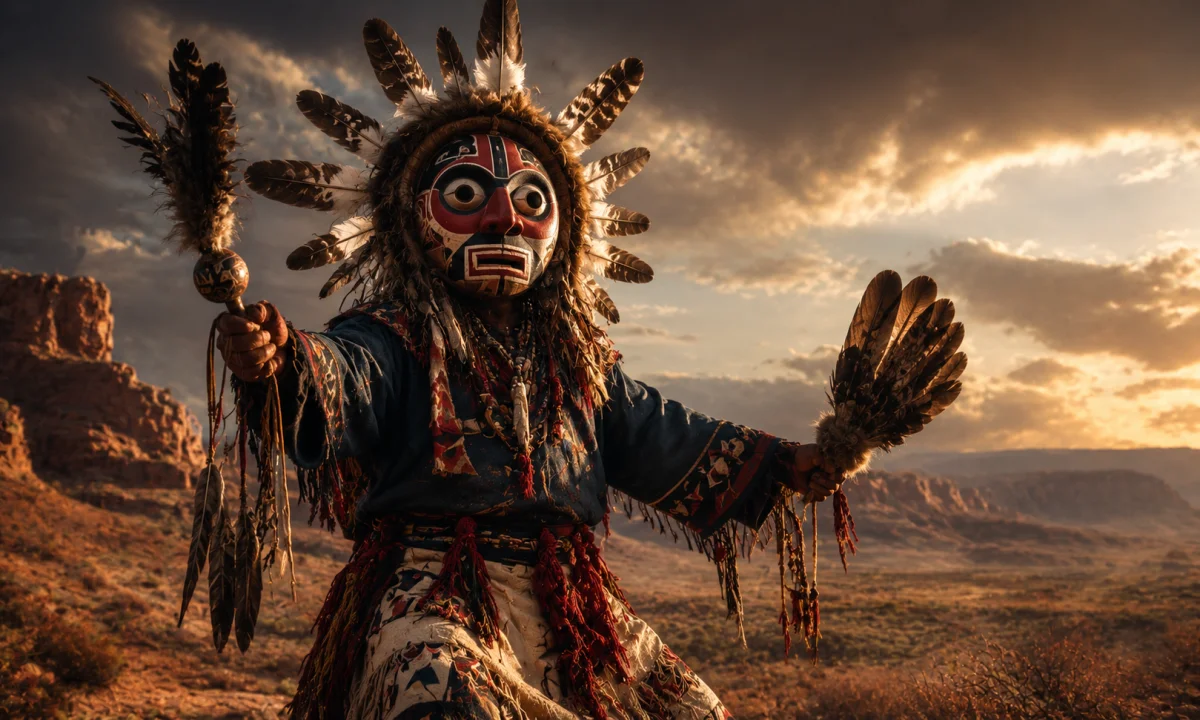
Koyemshi are sacred clown figures associated with Hopi ceremonial life in northern Arizona. They are best known in English as the Mudheads, a name referring to their distinctive clay- or mud-covered masks. Rather than being a single individual with one fixed biography, Koyemshi are a group or type of ceremonial impersonator within the wider Hopi tradition of katsinam—spiritual beings represented by masked dancers during public ceremonies.
Their humor is not merely entertainment. Koyemshi can help organize ceremonies, interact with children and spectators, expose foolish or antisocial behavior, and communicate ideas that would be difficult to express through solemn ritual alone. Their presence combines play, social criticism, religious performance and instruction. Accounts of them vary between Hopi communities and according to how much of a ceremony an observer was permitted to see, so descriptions should not be treated as a single complete or universally authoritative account of Hopi belief.
Hopi ceremonial setting
The Hopi are an Indigenous people whose villages are located on the mesas of northeastern Arizona. Hopi religious life includes seasonal ceremonies connected with rain, agricultural fertility, community well-being and relationships between humans and the spiritual world. Among the most visible ceremonial figures are the katsinam, often written in English as kachinas or kachina spirits.
The word katsina can refer to a spiritual being, while related words may describe a person who impersonates that being in a ceremony or a carved representation given to a child. These meanings are connected but should not be collapsed into one another. A masked dancer is not simply wearing a costume for theatrical display; within the ceremonial context, the dancer represents a spiritual presence and participates in a relationship between the human community and the katsinam.
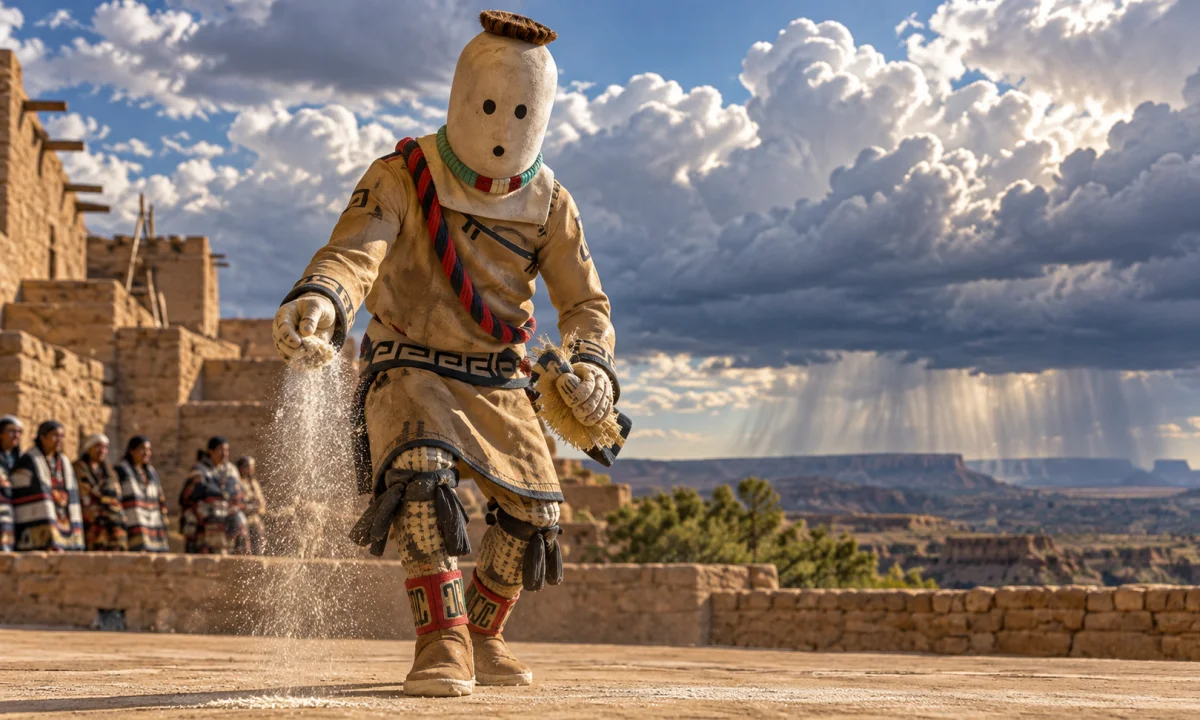
Koyemshi appear within this religious and social system. Their performances commonly occur in public plazas during ceremonies when masked dancers are present. They may move among the dancers and the audience, perform comic actions, address people directly, imitate everyday conduct or create moments of controlled disorder. Their behavior is governed by ceremonial expectations even when it appears spontaneous or irreverent.
The name and the Mudhead identity
The form Koyemshi is one English spelling; Koyemsi and other forms also occur in descriptions of Hopi ceremonial figures. English-language sources frequently translate the name as “Mudheads.” Spellings vary because Hopi words have been represented through different systems of transcription, and because writers have sometimes adapted Hopi terms to English conventions.
The translation “Mudheads” refers primarily to their appearance. Koyemshi performers traditionally wear masks with a rough, rounded or irregular surface associated with mud or clay. The masks may have exaggerated features, including prominent eyes, noses or mouths. Their clothing and specific visual details are not necessarily identical in every community or ceremony. Public photographs and museum objects provide only partial evidence, since an object removed from its ritual setting cannot fully convey the role it has in Hopi religious life.
“Clown” is also a useful but imperfect translation. In modern English, a clown is often understood as a professional entertainer. Koyemshi are not simply Hopi equivalents of circus clowns. Their humor takes place within a sacred ceremonial framework, and their actions may carry moral, communal or religious force. “Sacred clown” is a comparative scholarly term, not a claim that Hopi people understand Koyemshi through the categories of every other culture where sacred clowning has been studied.
Appearance and ceremonial behavior
The most recognizable feature of Koyemshi is the mud-colored mask or head covering. The mask conceals the performer’s ordinary identity and makes the figure appear strange, earthy and socially unconventional. Its exaggerated form supports the comic character of the performance, but it also marks a transformation: the dancer is functioning as a ceremonial figure rather than as a named private individual.
Koyemshi may carry simple objects, use gestures and make sounds that heighten their comic effect. They can act clumsy, greedy, boastful, inattentive or excessively literal. Such behavior allows them to dramatize traits that a community regards as foolish or disruptive. A Koyemshi performer may also pretend not to understand ordinary rules, creating a temporary inversion of expected conduct.
At the same time, Koyemshi are often involved in practical ceremonial work. Public descriptions associate them with helping to maintain order, engaging spectators, announcing or supporting parts of a dance, and receiving or distributing food in particular contexts. The exact duties depend on the ceremony and community. It is therefore safer to describe these as recurring functions reported in accounts of Koyemshi rather than as rules that apply in every Hopi village.
Their comedy may include mock punishment, teasing or the public exposure of undesirable behavior. This does not mean that every performance is intended to humiliate individuals. The comic action can be directed at a general type of conduct, at the audience as a whole or at the performers themselves. Its force comes partly from the fact that the figure stands outside ordinary decorum while still serving the community.
Social criticism and instruction
One important role of Koyemshi is to make social rules visible by breaking them in a controlled way. A person who is selfish, lazy, boastful or disrespectful may be represented through clowning. The audience can laugh at the behavior while recognizing the consequences attached to it. In this sense, Koyemshi performance may teach without taking the form of a formal lecture.
They can also address the difference between appearance and reality. The masked figure looks unfamiliar and behaves absurdly, yet the performance is carefully organized and meaningful. A Koyemshi may pretend to be powerless while controlling attention in the plaza, or act foolishly while helping the ceremony proceed. The contrast encourages spectators to question outward appearances and to recognize that social roles are constructed and maintained.
Children are often an important part of the audience. Koyemshi can frighten, chase, tease or amuse them, depending on the particular event. Such encounters may help introduce children to ceremonial figures and to the boundaries of acceptable behavior. However, public accounts do not justify reducing Koyemshi to children’s entertainment. Their actions address the wider community and take place within religious observances involving adults, families and ceremonial societies.
Mythic identity and variants
Koyemshi are sometimes discussed as if they were characters in a single standard myth, but the available material does not support a simple universal biography. Hopi traditions include accounts of the origins and relationships of katsinam, yet these traditions may be connected to particular ceremonies, communities, ritual specialists or levels of knowledge. Publicly published descriptions often simplify material that is more specific or restricted in its original setting.
Some accounts describe the Koyemshi as an unusual group of beings with an origin distinct from more dignified or powerful katsinam. Other accounts emphasize their relationship to the earth, mud or an earlier stage of human existence. These themes fit their visual character, but the details and interpretation differ among sources. Stories encountered in ethnographic writing, museum catalogues or popular summaries should not automatically be treated as a complete Hopi canon.
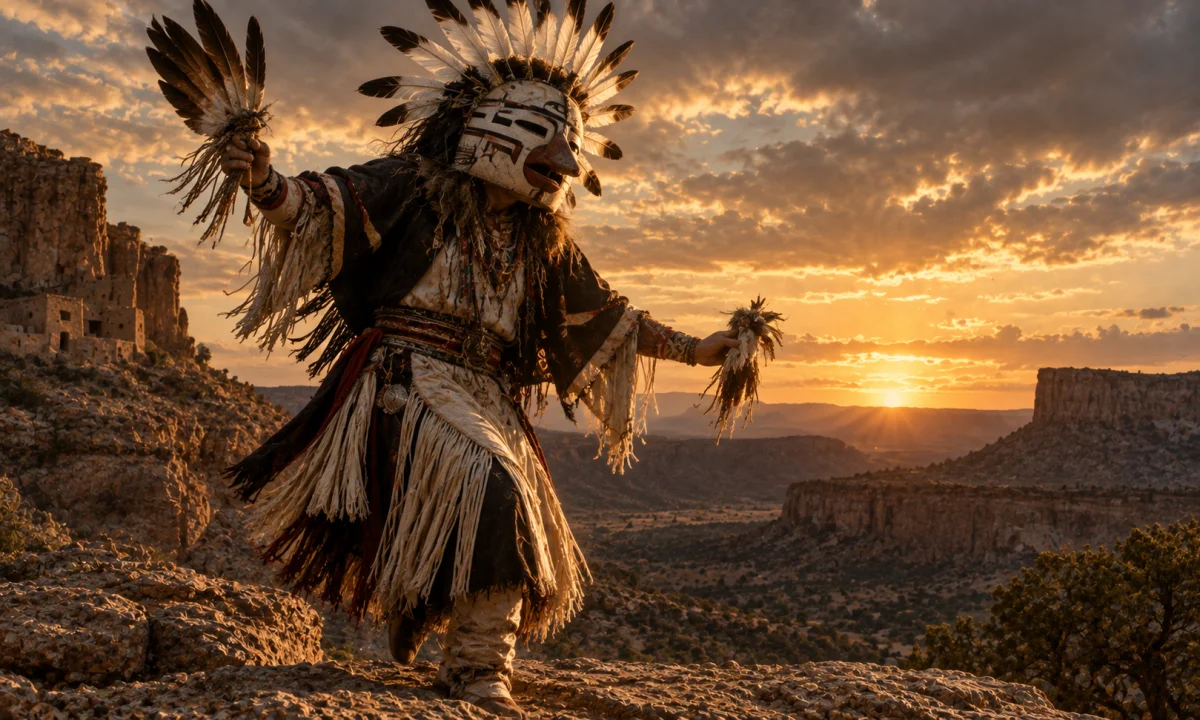
Nor should every comic masked figure in a Hopi ceremony be identified as Koyemshi. Hopi ceremonial traditions include many katsinam and other ritual roles, each with its own name, appearance and associations. A performer’s actions may look clownlike to an outside observer without making that figure a Koyemshi. Identification depends on Hopi terminology and ceremonial context, not solely on a mask’s shape or on whether a dancer behaves humorously.
Relationship to katsinam
Koyemshi are often classified among the katsinam because they appear as masked ceremonial representatives within the katsina cycle. This classification does not mean that they are merely one more ordinary rain or animal spirit. Their distinctive role is precisely their ability to disrupt solemnity and bring comic criticism into a sacred setting.
In Hopi thought, the masked dancer and the spiritual being represented are related but not identical. The performer is a human participant who has taken on a ceremonial identity. The mask, clothing, movement and ritual setting allow the katsina presence to be encountered by the community. This distinction is important when discussing Koyemshi: the “Mudhead” is not simply a fictional character invented for a performance, but neither is the performer understood as literally becoming a supernatural being in the same way a modern actor plays a stage role.
The English word “kachina” can cause additional confusion. It may refer broadly to Hopi spiritual beings, to ceremonial dances or to carved figures made for educational and artistic purposes. A carved Mudhead figure represents a ceremonial identity, but it is not itself the complete ritual presence of a Koyemshi performance. The significance of an object depends on its maker, use, recipient and cultural setting.
Earth, mud and comic disorder
The association with mud gives Koyemshi an earthy and deliberately unrefined appearance. Mud is ordinary, unstable and difficult to keep clean, qualities that contrast with the dignity and precision expected in many ceremonial performances. The Mudhead mask therefore supports the figure’s role as a disruptive presence. It suggests a character who belongs to the material world and to the untidy side of human behavior.
This symbolism should not be turned into a single fixed interpretation. Koyemshi are not simply “earth spirits,” and their mud-covered appearance does not by itself establish a particular creation story or theological meaning. The mask’s significance emerges through the full performance: its movement, jokes, interactions, timing and relationship to the other dancers and the community.
Comic disorder can also restore order. By temporarily violating ordinary expectations, Koyemshi make those expectations noticeable. Their mock foolishness gives the community a way to laugh at pride, greed or carelessness while reaffirming the values that the ceremony is intended to support. Sacred clowning of this kind is often misunderstood when comedy is separated from discipline and religious purpose.
Sources and limits of interpretation
Knowledge of Koyemshi comes from several kinds of evidence, including Hopi oral traditions, observations of ceremonies, ethnographic writing, historical photographs, museum collections and accounts by artists or cultural educators. These sources do not all have the same authority. An outsider’s description may record visible actions accurately while misunderstanding their religious meaning. A museum object may preserve the form of a mask but not the words, relationships or restrictions associated with it.
Hopi ceremonial knowledge is not necessarily public in its entirety. Some practices are reserved for initiated participants or are appropriate only within particular ritual settings. Consequently, a responsible account should distinguish between what is widely described for public education and what remains dependent on Hopi authority and community context. Apparent differences between sources may reflect regional variation, changing historical circumstances or the limits of what the writer was allowed to observe.
Colonial and tourist representations have also influenced the way Koyemshi have been presented to non-Hopi audiences. Photographs and commercial descriptions sometimes isolate the amusing appearance of the Mudheads from the ceremony that gives them meaning. This can turn a sacred figure into a decorative “character” and obscure the fact that Hopi ceremonies are living religious practices rather than performances created primarily for outsiders.
Distinction from other Indigenous clown traditions
Koyemshi are sometimes compared with sacred clown figures from other Indigenous traditions of North America, including Pueblo communities. Such comparisons can be useful when discussing the broad religious phenomenon of ritual humor, but they do not make the traditions interchangeable. Names, masks, origin accounts, ceremonial responsibilities and relationships to religious societies differ from one community to another.
The term “Pueblo clown” is therefore too broad to serve as a synonym for Koyemshi. Hopi Koyemshi belong specifically to Hopi ceremonial life, even though Hopi culture shares historical and regional connections with other Pueblo peoples. Similarities in comic behavior may reflect related social functions, independent developments or outside interpretation; they do not prove that the figures have the same origin or identity.
Modern representation
Koyemshi appear in museum exhibitions, books on Native American art and collections of carved katsina figures. Their unusual masks make them visually recognizable, and modern artists may present them in styles ranging from closely observed ceremonial forms to highly individualized works. Such objects can be important expressions of Hopi artistry, but they should not be confused with generic fantasy creatures or with evidence that the figure belongs to a single pan-Indigenous mythology.
Outside Hopi cultural contexts, the Mudheads are sometimes reduced to comic mascots or treated as examples of an exotic “primitive” clown. That approach removes the religious setting and repeats older stereotypes. A more accurate understanding keeps several dimensions together: Koyemshi are humorous, but not merely comic; masked, but not merely decorative; disruptive, but not without ceremonial responsibility; and publicly visible, but not necessarily fully explained by every public account.