WORLD

Kon
Kon, also written Con in some colonial records, is a deity associated chiefly with the ancient cultures of Peru’s Pacific coast. He is often described as a creator or culture-bearing power connected with the making of human beings, the provision of food, and the control of water and rainfall. Although Kon is commonly placed under the broad label of “Inca mythology,” the surviving accounts suggest that his worship and stories belonged especially to coastal traditions that existed before, or alongside, the Inca Empire.
Origins and cultural setting
The Andes were home to many different religious traditions rather than a single unified mythology. Communities in the highlands, valleys and coastal deserts developed distinct gods, sacred places and origin stories. The Inca state later incorporated a large part of this region, but it did not erase every local religious tradition. As a result, a deity mentioned in an account of “Peruvian” or “Inca” religion may have originated among a particular coastal people rather than in the imperial religion centred on Cusco.
Kon is best understood in this regional context. The Pacific coast of Peru is one of the driest inhabited environments in the world. Rivers descending from the Andes made agriculture possible, while seasonal rains, distant mountain weather and the availability of water determined whether communities could prosper. In such an environment, a deity associated with creation, fertility, drought or the distribution of food could have had deep religious significance.
The traditions concerning Kon were written down after the Spanish conquest, when Christian missionaries, colonial officials and chroniclers recorded Indigenous beliefs through translation and interpretation. These accounts are valuable but incomplete. They do not preserve a single original scripture, and they may combine information from different communities or adapt Indigenous concepts to European ideas about gods, creation and idolatry.
Name and identity
The name appears in different forms, including Kon, Con and occasionally other spellings produced by Spanish writers attempting to represent an Indigenous word. The original pronunciation and meaning are not certain. The spelling “Kon” is now common in modern reference works, but “Con” is frequent in older translations and historical discussions.
Kon is usually classified as a creator deity or a powerful ancestral being. Some accounts present him as a creator of people and animals; others emphasise his role in shaping the land and making its resources available. He is also linked in later interpretations with rain, wind and the difficult balance between abundance and drought.
It is important not to treat these descriptions as a fixed theological profile comparable to the carefully defined roles of gods in some classical pantheons. The available evidence does not establish a universally accepted hierarchy, family tree or official set of attributes for Kon. His identity varies according to the source and according to whether a writer is describing a local tradition, an Inca-era interpretation or a modern scholarly reconstruction.
Kon as creator and provider
One of the most frequently repeated traditions describes Kon as a being who created human beings and other living creatures. He is also said to have supplied people with what they needed to live, including food or fertile resources. In this role, he resembles a creator and provider rather than a narrowly defined god of one natural phenomenon.
The story reflects the importance of agricultural and ecological relationships in coastal Peru. Food production depended on careful irrigation, access to river water and the cultivation of crops in otherwise arid surroundings. A creator who gave people nourishment could therefore also be understood as a power responsible for the basic conditions of human survival.
Some accounts describe Kon as moving over the earth without ordinary physical limitations. He may be portrayed as bodiless, or as lacking bones and joints, and as travelling with extraordinary speed. Such details are difficult to interpret with confidence. They might express the intangible nature of a divine power, evoke the movement of wind across the landscape, or reflect the way a colonial observer understood a supernatural being who did not conform to human anatomy. They should not automatically be treated as evidence that Kon had one standard, universally recognised appearance.
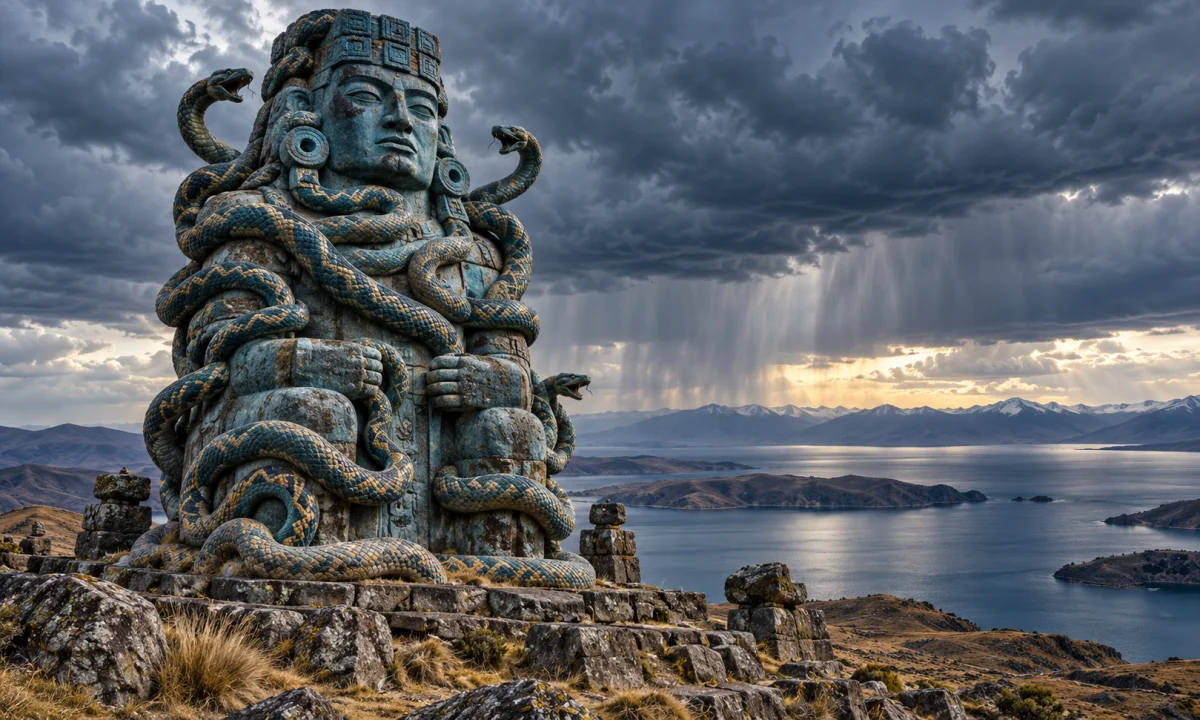
Descriptions of Kon’s form are far less consistent than his association with creation and the environment. Some modern illustrations present him as a human-shaped god, a bird-like figure or a being with feline features, but many such images are artistic reconstructions rather than descriptions securely preserved in an Indigenous source. Archaeological motifs from coastal Peru cannot be assigned to Kon simply because they appear unusual or supernatural.
The conflict with Pachacamac
The best-known narrative involving Kon concerns his defeat by Pachacamac, another major deity associated with the central coast of Peru. In the account most often summarised by modern writers, Kon created human beings and gave them a land rich in resources. The people later failed to honour him properly, and he responded by withdrawing his gifts or making the land dry and barren.
Pachacamac then appeared as a rival power. He defeated or expelled Kon and altered the world that Kon had made. In some retellings, Pachacamac transformed Kon’s followers into animals or otherwise changed the human order. The details vary considerably, and not every surviving account tells the story in the same way.
This narrative should not be reduced to a simple battle between a “good god” and an “evil god.” It can be read as a mythic account of changing religious authority, the unstable relationship between human communities and their environment, or the way one sacred tradition incorporated and subordinated another. Pachacamac was especially important at a famous sanctuary on the central Peruvian coast, while Kon may represent an older or different coastal religious stratum.
The relationship between the two deities is also uncertain. Some sources make Pachacamac a son of the Sun, while other traditions give him different origins and relationships. These genealogies should not be automatically transferred to Kon. There is no consistent evidence that Kon and Pachacamac belonged to one unified pantheon with a single agreed family structure.
Water, drought and the coastal landscape
Kon’s stories are often interpreted through the ecological conditions of the Peruvian coast. Rainfall is scarce there, and the appearance or disappearance of water has an immediate effect on crops, animals and human settlement. A myth in which a creator provides abundance and later removes it can express the dependence of society on divine, natural or ancestral powers.
Some modern accounts call Kon a rain god, while others identify him primarily as a wind deity. Neither label should be regarded as definitive. The surviving narratives connect him with environmental forces, but they do not provide a complete, standardized description of a specialised “god of rain” in the way that modern categories may suggest.
It is possible that different local traditions used similar names or attached related ideas to them. Coastal religious systems often connected fertility, water, the sea, rivers, agricultural land and the movement of storms. A deity who created the world and supplied food could naturally acquire associations with these forces without being limited to one of them.
The stories also reflect a moral dimension. Divine generosity is not necessarily permanent or unconditional. Human neglect, failure to observe ritual obligations or disrespect toward sacred powers may lead to the loss of prosperity. Such themes are common in many religious traditions, but in the coastal Andes they carried particular force because the margin between successful cultivation and scarcity could be extremely narrow.
Kon and the Inca religious world
The Inca Empire expanded across a vast area during the fifteenth and early sixteenth centuries. Its state religion gave prominent places to Inti, the Sun, and to other powers such as Viracocha, the creator figure celebrated in several highland traditions. At the same time, the Inca generally incorporated local sacred places and beings into a larger imperial system rather than replacing every regional cult.
For this reason, calling Kon an “Inca god” can be misleading if it implies that he was one of the principal deities of Cusco. Kon is more accurately described as a deity of ancient Peruvian, especially coastal, tradition whose stories were later recorded in contexts shaped by Inca rule and Spanish colonial observation.
Colonial writers sometimes presented Indigenous religions as if they formed one coherent system. Modern summaries can repeat this pattern by placing every deity mentioned in a colonial account inside a single “Inca pantheon.” The evidence does not support that level of certainty for Kon. His importance may have been substantial in particular regions without making him a central god throughout the Inca Empire.
Sources and limits of the evidence
Knowledge of Kon comes mainly from early colonial descriptions rather than from a surviving Indigenous text devoted to him. Spanish chroniclers recorded oral traditions, statements from Indigenous informants and interpretations of local religious practices. Their writings differ in purpose and reliability. Some sought to describe history, some to explain unfamiliar beliefs, and others to condemn Indigenous religions from a Christian perspective.
Names could be altered in transcription, and concepts could lose meaning when translated into Spanish. A chronicler might use familiar terms such as “creator,” “god,” “son” or “idol” even when an Indigenous concept did not correspond exactly to those categories. The surviving evidence therefore allows a cautious outline of Kon’s significance, but not a complete reconstruction of his original cult.
Archaeology provides important information about the religious worlds of coastal Peru, including monumental temples, ceremonial architecture, burials, textiles, ceramics and carved or painted supernatural figures. Yet an image cannot be identified as Kon merely because it comes from the right region. Without an inscription or a secure connection to a recorded tradition, assigning a particular artefact to Kon remains speculative.
Distinguishing Kon from similar figures
Pachacamac
Pachacamac was a major coastal deity whose sanctuary stood south of present-day Lima. He is sometimes described as a creator or as a powerful oracle, and he plays the role of Kon’s rival in one important narrative. Kon and Pachacamac should not be merged. Their association in a story indicates a relationship between distinct figures, not identical names for one god.
Viracocha
Viracocha, also written Wiraqucha, is a creator figure prominent in several highland and Inca-era traditions. Broad popular accounts sometimes treat every Andean creator god as a version of Viracocha, but this obscures regional differences. Kon may share creator characteristics with Viracocha, yet the two belong to different bodies of tradition and should not be assumed to be the same deity.
Coniraya
Coniraya is a figure known from the Huarochirí traditions recorded in the colonial period. He is often associated with Viracocha and appears in stories involving transformation, deception, sexuality and contests with other supernatural beings. Despite the similar opening syllable, Coniraya is not simply another name for Kon. The two figures come from different narrative contexts.
Inti
Inti was the Inca Sun deity and held a central position in imperial state religion. Some colonial accounts connect various creator beings to the Sun or describe them through solar genealogies. That does not make Kon an alternative name for Inti. Their roles and regional associations are distinct in the surviving evidence.
Religious significance
Kon’s importance lies partly in the tension between creation and withdrawal. He is remembered as a provider of life and abundance, yet also as a power capable of making the world unproductive. This combination presents the natural world as active, morally significant and dependent on reciprocal relations between humans and the sacred.
The story of Kon also preserves a memory of religious change. A deity who is defeated by Pachacamac may represent a local tradition that was later overshadowed by a more influential coastal cult. Alternatively, the narrative may explain why one community’s sacred history gave precedence to another deity. Because the original social setting is not fully known, these interpretations remain possibilities rather than proven facts.
Kon should therefore be approached neither as a fully documented member of a single Inca pantheon nor as a purely invented figure. His name and associated stories occur in colonial records, and they fit the religious concerns of ancient coastal Peru. At the same time, the fragmentary nature of those records requires care about his exact appearance, powers, genealogy and geographical range.
Later reception
Kon appears today in encyclopedias, books on mythology and artistic reconstructions of pre-Columbian Peru. Modern retellings often simplify him into a “creator god,” “rain god” or “wind god,” depending on the emphasis of the writer. These labels can be useful introductions, but they should not conceal the variation in the historical evidence.
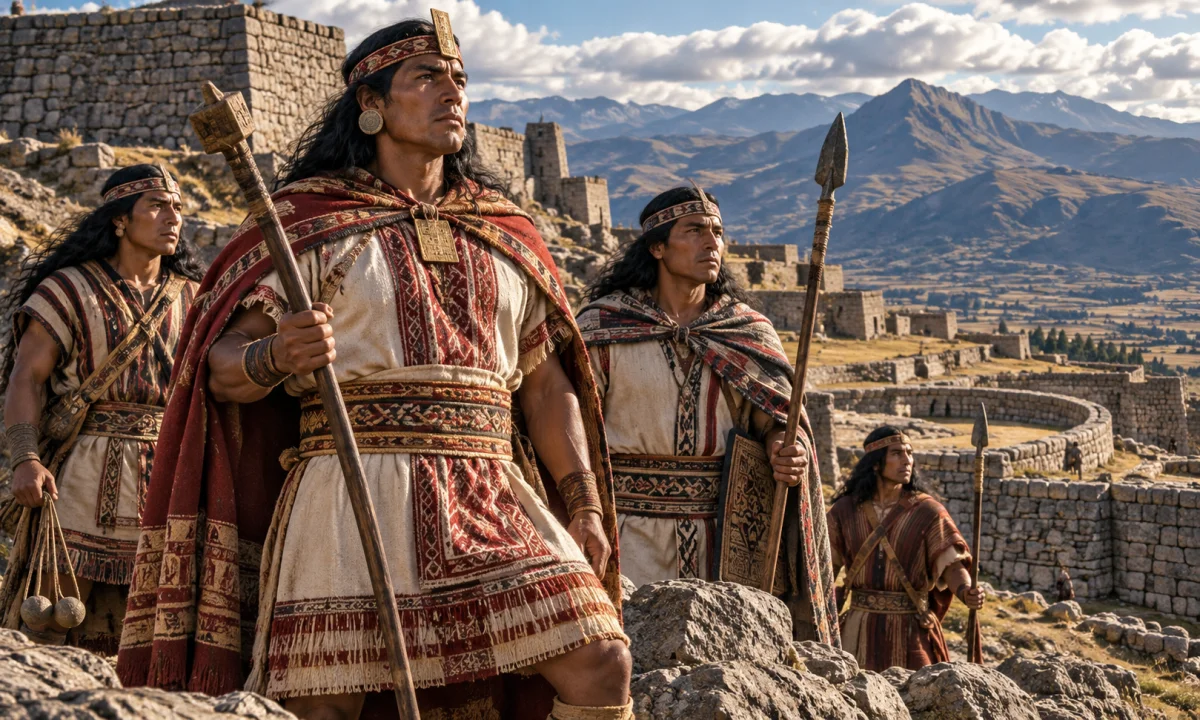
Contemporary images may combine features from several coastal cultures or borrow visual motifs from better-known Andean deities. Such representations belong to modern interpretation unless they are supported by a specific ancient or colonial description. The most responsible presentations retain the uncertainty surrounding Kon while recognising his place in the religious history of Peru’s coastal communities.