WORLD

Coniraya
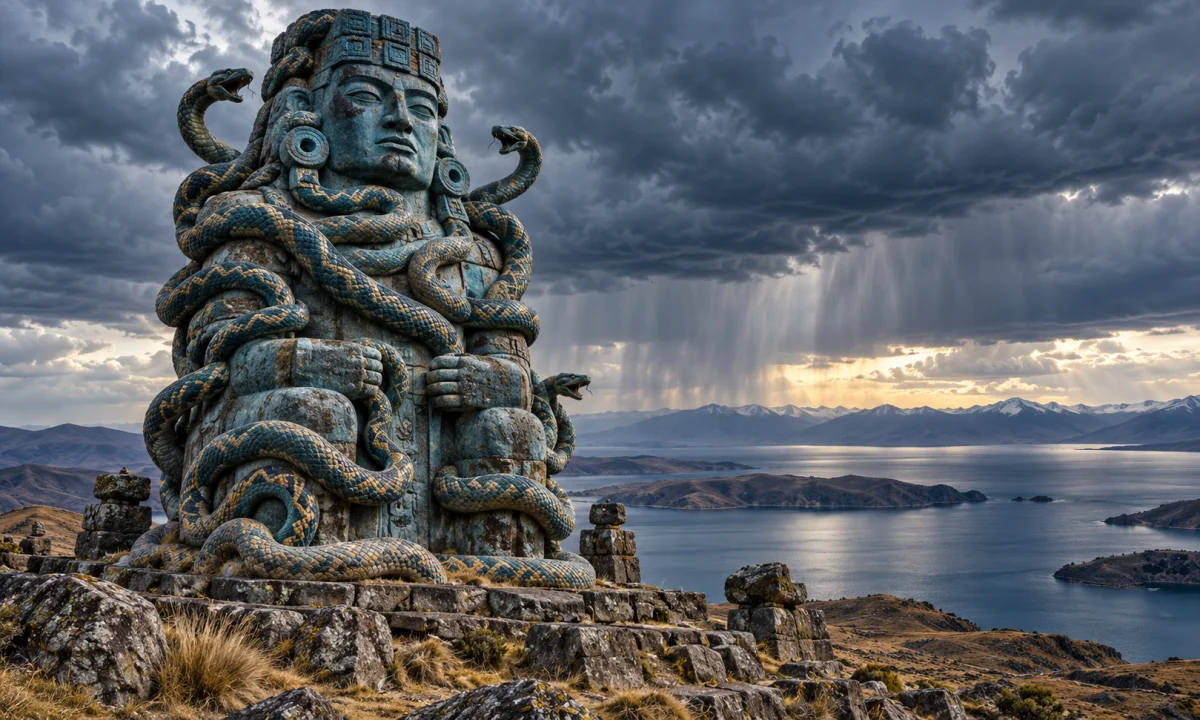
Coniraya is a powerful huaca, creator figure and trickster from the religious traditions of the central Andes. He is best known from the Huarochirí Manuscript, a Quechua account of local myths and sacred traditions recorded during the early colonial period in the region east of present-day Lima, Peru. He is often classified under Inca mythology, but that label requires care: Coniraya belongs specifically to the religious world of Huarochirí and neighbouring Andean communities rather than to a single, standardized Inca pantheon.
Origins and cultural setting
Coniraya appears in traditions concerning huacas, a Quechua term for sacred beings, places, ancestors, objects and forces associated with extraordinary power. A huaca might be a mountain, spring, rock, shrine, ancestor or divine person. These categories did not always correspond to modern distinctions between “god,” “spirit” and “sacred place.” Coniraya is therefore more accurately understood as a powerful sacred being whose influence could extend through the landscape, agriculture, sexuality, weather and human society.
The principal surviving account of Coniraya comes from the Huarochirí Manuscript, a collection of narratives written in Quechua during the early seventeenth century. The work records the beliefs and stories of communities in Huarochirí during a period when Spanish missionaries and officials were attempting to suppress Indigenous religious practices. Its exact authorship and circumstances of composition remain subjects of scholarly discussion. The manuscript appears to preserve older oral traditions, but it is not a pre-Columbian book copied unchanged from Inca times. Its language, organization and presentation were shaped by the colonial setting in which the traditions were recorded.
The manuscript presents a world populated by huacas who compete, travel, transform themselves, establish sacred places and affect the fortunes of human communities. Their stories are not arranged as a single systematic mythology. Different traditions can overlap, vary in emphasis or preserve local explanations for particular mountains, springs, rituals and social relationships. Coniraya’s character must therefore be understood through the narratives in which he appears rather than through a fixed list of attributes.
Name and identity
The name appears in several spellings, including Coniraya, Cuniraya and Quniraya, depending on the language system and translation being used. He is also frequently called Coniraya Huiracocha or Cuniraya Viracocha. The second element creates an important interpretive problem.
Huiracocha, also written Viracocha or Wiraqucha, is associated with the famous creator figure worshipped by the Inca and with a wider Andean religious vocabulary. Colonial writers and translators sometimes used the name in ways that connected different creator traditions. As a result, Coniraya Huiracocha is sometimes treated as a local form of the better-known Inca Viracocha. That identification may reflect genuine historical connections, but it should not be assumed to mean that the two figures were identical in every community or period.
In the Huarochirí tradition, Coniraya is presented as a creator and an immensely powerful being, but he is also distinctly local and personal. He interacts with named huacas, animals and communities, travels through recognizable landscapes and behaves in ways that are comic, deceptive, generous, arrogant or sexually forceful. He does not resemble a distant creator who acts only at the beginning of time. His power remains active in the world inhabited by people.
Appearance and character
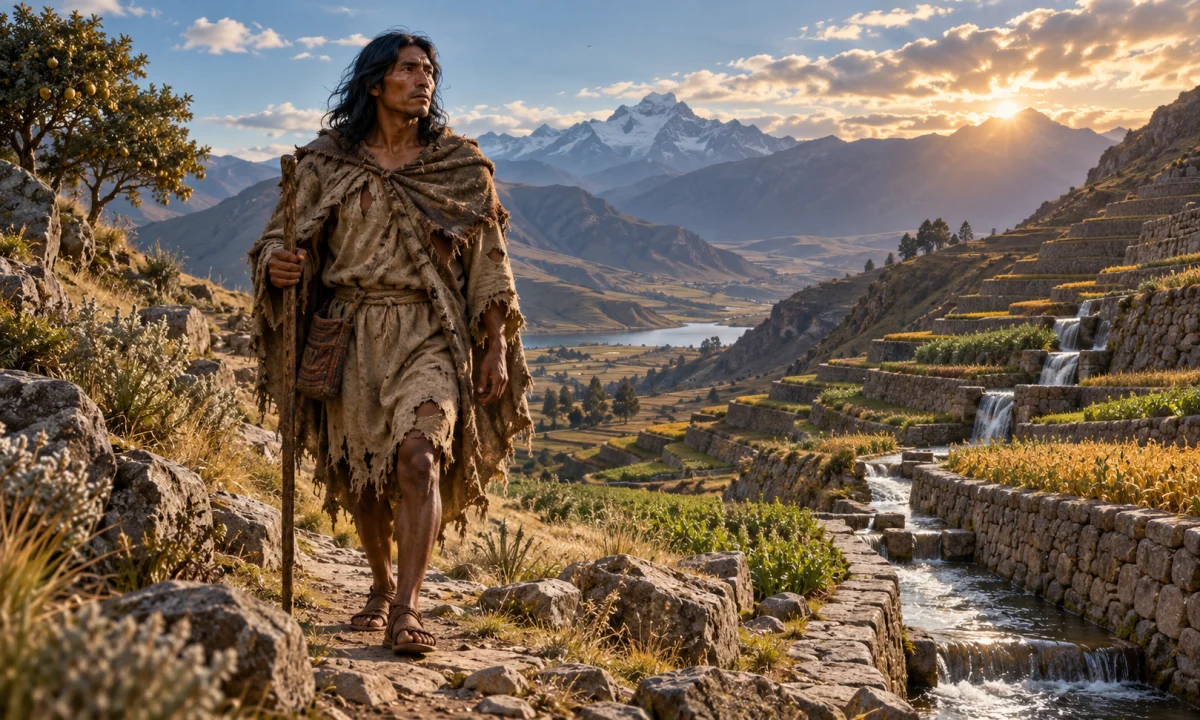
One of Coniraya’s most striking characteristics is the contrast between his appearance and his true nature. He often travels disguised as a poor, ragged or unimpressive man. Other huacas and people may look down on him because of his clothing and apparent social status. They fail to recognize that the apparently insignificant stranger is one of the most powerful beings in the sacred world.
This disguise creates a recurring pattern of reversed appearances. A being who seems poor may be divine; a person who appears beautiful or prestigious may be vain; a respected figure may be vulnerable to mockery or deception. Coniraya’s stories use these reversals to challenge ordinary assumptions about rank and power. His rags do not indicate weakness. They conceal it from those who judge by outward appearance.
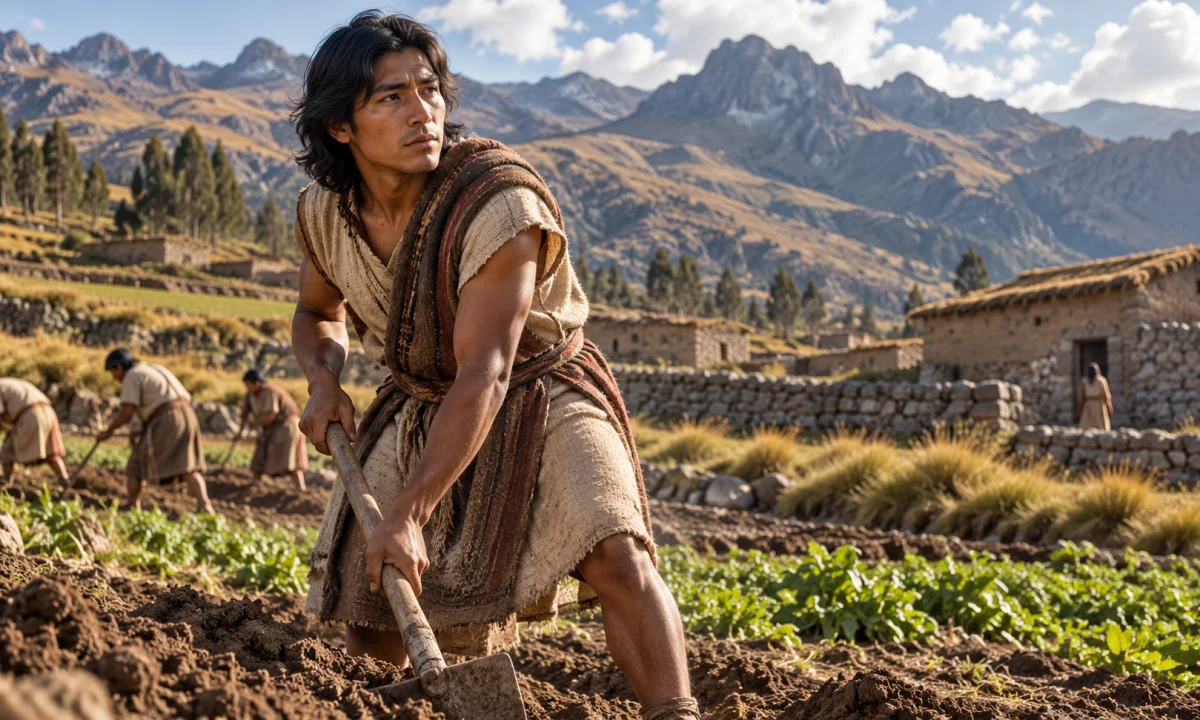
Coniraya is also associated with the creation and transformation of the cultivated landscape. Translations and interpretations of the Huarochirí traditions connect him with fields, irrigation and the organization of land, although the precise details and wording vary between versions. Such associations place him within a world where sacred power is inseparable from agriculture. Water channels, terraces, fertile soil and productive fields were not merely practical achievements; they were part of the relationships between humans, ancestors, huacas and the forces that sustained life.
He is not an entirely benevolent creator. Coniraya deceives, pursues and humiliates others, and his sexual conduct in the stories can be coercive by modern standards. He rewards animals that help him and curses or diminishes those that obstruct or mock him. His character combines creative and destructive possibilities rather than conforming to a simple division between good and evil.
The story of Coniraya and Cahuillaca
The most famous narrative involving Coniraya concerns the beautiful huaca Cahuillaca, whose name also appears in variant spellings such as Cavillaca. She is described as proud of her beauty and independence. Coniraya desires her, but she would not willingly accept him, particularly because she sees him as a shabby and unworthy man.
Coniraya therefore uses a transformation and a deception. While Cahuillaca is weaving beneath a lúcuma tree, he places his semen inside a lúcuma fruit. He causes the fruit to fall near her, and she eats it without knowing what it contains. As a result, she becomes pregnant. The episode is presented through the symbolic language of myth, connecting sexual generation with fruit, fertility and the productive landscape. It is also a story of deception and unequal power, not a romantic courtship.
Cahuillaca later gives birth to a child. After the child has grown for about a year, she calls together the local huacas and asks them to identify its father. The gathering brings together beings who arrive dressed according to their status and importance. Coniraya comes in the guise of a poor man, wearing ragged clothing. Cahuillaca assumes that the father must be one of the impressive huacas gathered around her and does not recognize Coniraya as a powerful figure.
The child is placed on the ground and allowed to approach its father. Rather than crawling toward the richly dressed huacas, the child goes directly to Coniraya. The child’s action reveals the truth. Cahuillaca is horrified or ashamed that she has had a child by someone she considers inferior. She takes up the child and runs away toward the sea.
Coniraya follows her. During the pursuit, he asks various animals whether they have seen Cahuillaca and her child. The animals respond differently. Those that give helpful answers receive rewards or blessings, while those that mock him, lie or provide unhelpful information are punished. These exchanges explain why some animals are favoured and why others are associated with negative qualities in the traditional moral order. They also display Coniraya’s ability to establish relationships between divine power and the natural world.
Cahuillaca eventually reaches the coast near the sacred region associated with Pachacamac. She and her child enter the sea and become stones or rocky forms. Details differ among translations and retellings, including the precise location and nature of the transformed figures. The transformation gives the story a lasting geographical dimension: the fate of the characters is represented in the coastal landscape rather than ending only as a human family dispute.
The story has several intertwined meanings. It explains the origin or sacred significance of particular coastal features, dramatizes the limits of social judgment and portrays Coniraya as a being whose hidden identity can overturn the expectations of everyone around him. It also connects sexuality, food, fertility, childbirth, shame and landscape transformation within a single mythic sequence.
Coniraya as creator and trickster
Coniraya does not fit neatly into the modern category of either creator god or trickster. He has creative powers and is sometimes described as having made the world, the huacas or important features of the land. At the same time, he relies on disguise, deception and sudden reversals. His actions may establish order in one context and cause fear or humiliation in another.
His trickster qualities should not be confused with the idea that he is merely comic or dishonest. In many traditional mythologies, a trickster is a boundary-crossing figure who exposes weaknesses in social rules and reveals that established hierarchies are unstable. Coniraya moves between the divine and human worlds, between poverty and sacred authority, and between civilization and the wild landscape. His ability to change status and appearance gives him access to knowledge that more self-important figures lack.
The contrast between Coniraya and Cahuillaca also reflects a wider Andean interest in the relationship between social appearance and actual power. Clothing, wealth and public reputation matter to the characters, but they do not reliably identify who possesses sacred authority. The myth does not simply praise humility in a general moral sense. Instead, it presents a dangerous world in which failure to recognize hidden power can lead to humiliation, flight and irreversible transformation.
Religious and cultural significance
Coniraya’s importance lies partly in the way his narratives join people to specific places. Huarochirí traditions frequently explain mountains, rocks, springs, roads, fields and shrines through the actions of huacas. The landscape is not a passive background. It is a record of encounters among sacred beings and a continuing participant in religious life.
His connection with agriculture is especially significant. In the Andes, successful cultivation depended on carefully managed water, altitude-specific crops, communal labour and relationships with powerful places and ancestors. A sacred being associated with fields or irrigation represented more than fertility in the abstract. Such a being could embody the continuing forces that made cultivation possible and the obligations required to maintain balance with them.
Coniraya’s sexual imagery likewise belongs to a broader religious world in which fertility could be expressed through human reproduction, plants, water and the renewal of the land. The episode with the lúcuma fruit does not turn him into a fertility god in the narrow sense, nor does it make the encounter harmless or consensual. It demonstrates how myth can combine generative power with coercion, humour, danger and social criticism.
Distinction from Viracocha and other Andean figures
Coniraya should not automatically be equated with Viracocha, the major creator figure associated with Inca imperial religion and with several Andean creation traditions. The names are connected in some colonial records and translations, and “Coniraya Huiracocha” may indicate a title, an identification or an attempt to relate local theology to a better-known sacred figure. Nevertheless, the Huarochirí narratives give Coniraya a distinctive personality, local setting and cycle of stories.
He should also be distinguished from Pachacamac. Pachacamac was a major coastal deity and the centre of an important sanctuary south of present-day Lima. Coniraya’s pursuit of Cahuillaca takes him toward the region associated with Pachacamac, but this does not make the two beings identical. Nor should Cahuillaca be merged with other Andean female deities simply because she is connected with fertility, beauty or a transformed landscape.
Modern summaries sometimes combine figures from different Andean communities into one broad “Inca mythology.” That approach can make the material easier to catalogue, but it can also conceal regional distinctions. Coniraya is most securely understood through the Huarochirí tradition and its particular network of huacas, places and stories.
Later reception
Coniraya is not a major figure in globally familiar popular culture, and there is no single modern version that has replaced the traditional accounts. He is, however, important in scholarship on Andean religion, colonial Indigenous literature and the survival of local sacred traditions. Contemporary retellings often emphasize his disguise, his role as a creator and trickster, and the transformation of Cahuillaca and her child.
Such retellings can make the narrative accessible, but they may simplify its religious setting by presenting Coniraya as a “god” in the same sense as figures from classical European mythology. The original tradition is more relational and place-based. Coniraya is a huaca whose identity is expressed through encounters with other sacred beings, human communities, animals and the living Andean landscape.