WORLD
WORLD
Ixtlilton
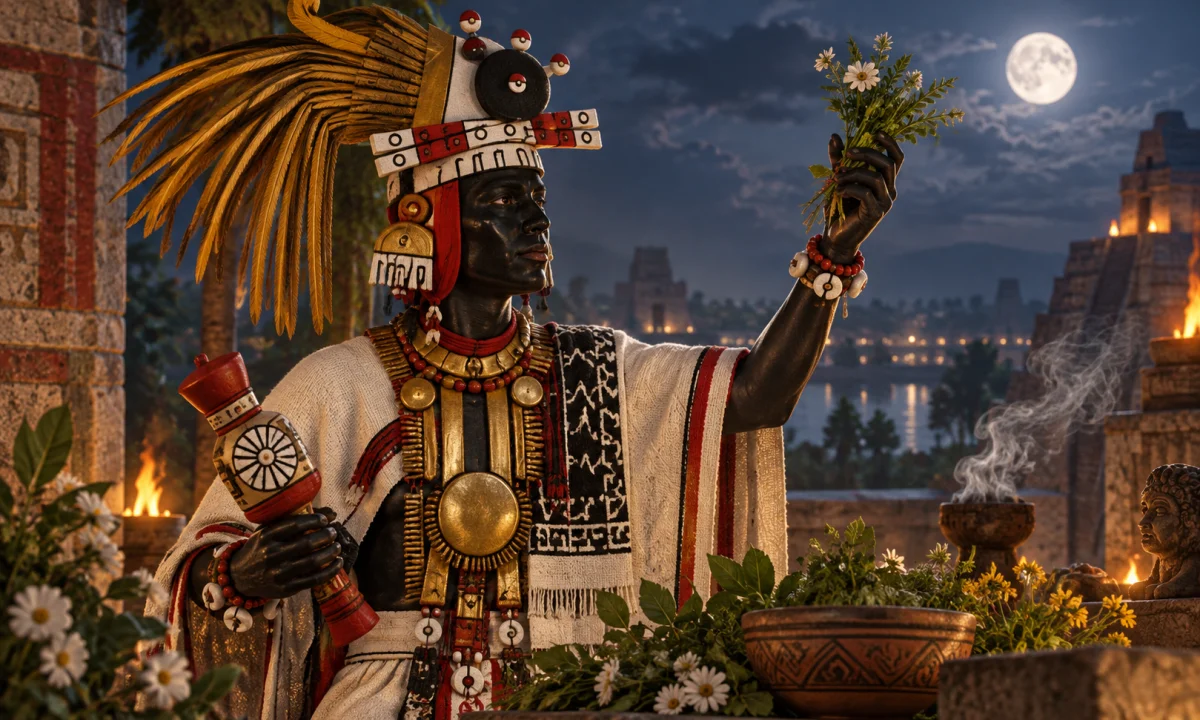
Ixtlilton was a deity of the Nahua peoples of central Mexico, especially associated with health, healing, childhood, music, dancing and joyful recreation. He is commonly described as an Aztec god because he appears in sources concerning the Mexica and other Nahua communities of the central Mexican highlands. His name is usually translated as “Little Black Face” or “Little Black One,” although the exact implications of the name and the full range of his identity remain subjects of interpretation.
Ixtlilton is known mainly through early colonial descriptions written after the Spanish conquest. These accounts preserve valuable information about Nahua religious life, but they were recorded through translation, Christian scrutiny and European assumptions about indigenous gods. As a result, Ixtlilton should not be treated as a perfectly defined figure with one universally accepted biography. The surviving evidence presents him as a powerful but unusually intimate deity: a god approached in domestic settings, especially on behalf of children who needed health, protection or recovery.
Origins and religious setting
Ixtlilton belonged to the religious world of central Mexico before and during the sixteenth-century Spanish invasion. Nahua religion did not consist of a single uniform system. Different cities, communities and temples could emphasize particular gods, ceremonies and local traditions. The Mexica of Tenochtitlan shared many deities and ritual concepts with neighbouring Nahua-speaking peoples, but the prominence and interpretation of a god could vary from one community to another.
The information about Ixtlilton comes primarily from colonial-era records based on Nahua testimony. The most important evidence is associated with the work of Bernardino de Sahagún and his Indigenous collaborators, especially the material now known as the Florentine Codex. Other early manuscripts and descriptions also preserve references to Nahua gods, ceremonies and images. These records are not neutral transcripts of pre-Hispanic religion. They were produced in a period of missionary activity, and Christian writers sometimes classified unfamiliar deities according to categories such as “idol,” “devil” or “false god.” Nevertheless, the Nahuatl-language passages and Indigenous descriptions offer important evidence for reconstructing Ixtlilton’s cult.
Like other Mesoamerican deities, Ixtlilton was not necessarily limited to one modern category such as “medicine” or “childhood.” Nahua religious thought often connected physical health with ritual order, emotional well-being, social relationships, music and the correct performance of ceremonies. A deity who protected health could therefore also be connected with dancing, celebration and the care of children without those associations being contradictory.
The meaning of the name
The name Ixtlilton is generally analysed as a Nahuatl expression related to ix-tli, “face” or “countenance,” and tlil-li, “black” or “ink-black,” with a diminutive element. For that reason, translations such as “Little Black Face,” “Little Black One” and “Little Dark-Faced One” are common. The name may refer to the appearance of the deity’s image, to ritual painting or to a symbolic quality associated with darkness and sacred power.
Translations of Nahuatl divine names are not always exact equivalents. A name could contain wordplay, a ritual reference or a description whose meaning was understood differently by speakers in different places. “Little” should not automatically be taken to mean that Ixtlilton was merely a minor or childlike god. The diminutive may express affection, familiarity or a particular naming convention rather than physical size or low rank.
Healing and protection
Ixtlilton’s best-attested role is connected with health and healing. Families could appeal to him when a child was ill, and ceremonies connected with his worship appear to have involved requests for recovery and well-being. His religious importance was therefore not restricted to a state temple or a royal ceremony. He could be part of family concerns, particularly the vulnerable early years of life.
The surviving accounts describe an image of Ixtlilton made from wood. The image was associated with a house or ritual location and could be visited by people seeking help. Colonial descriptions emphasize the image’s dark or black-painted appearance, which helps explain the interpretation of his name. Details differ between accounts, and it is difficult to know how much these descriptions reflect a single standard image and how much they represent local variations.
Healing in Nahua tradition involved more than the treatment of symptoms in the modern medical sense. Specialists used knowledge of plants, bodily conditions, ritual procedures and divination. Religious ceremonies could accompany practical remedies. An appeal to Ixtlilton may therefore have formed part of a broader process involving offerings, prayers, cleansing, music or communal participation. The available records do not justify reducing his worship to a simple equivalent of a modern physician or hospital patron.
Some descriptions connect Ixtlilton with vessels or containers used in ritual observances. Accounts associated with his ceremonies mention prepared drinks or liquids and the participation of children. Because colonial texts often compress unfamiliar practices into short explanations, the precise purpose of every vessel and offering is not always clear. What does emerge is an image of a deity whose ceremonies involved hospitality, performance and the restoration of bodily or social vitality.
Children, music and dancing
Ixtlilton is frequently associated with children. This connection may reflect his role as a healer and protector, but it also appears in descriptions of festivals and household observances in which children took part. Children could be brought before the deity, and dancing, music or festive activity formed part of the ritual environment. These associations make Ixtlilton distinctive among the better-known Nahua gods, whose surviving descriptions often focus on warfare, rulership, agriculture, rain or cosmic conflict.
His relationship with music and dancing should not be understood as a merely recreational addition to an otherwise medical cult. In Nahua society, song and dance were important forms of education, worship and social organization. Public performances could honour gods, mark festivals, praise rulers and teach communal values. Joyful activity could also express the restoration of health. A child who recovered from illness, or a household seeking divine assistance, might participate in a ceremony in which music and movement helped establish a renewed relationship with the deity.
The association with pleasure and performance has led some modern writers to place Ixtlilton close to deities such as Xochipilli or Macuilxochitl. These figures share connections with music, flowers, dance, games or pleasure in certain interpretations, but they should not simply be identified with one another. The evidence for their relationships is not consistent enough to treat them as interchangeable names. Ixtlilton had his own name, image and ritual associations, especially those involving health and children.
Appearance and sacred image
The most distinctive visual feature attributed to Ixtlilton is a dark or black-painted face. This feature is especially significant because it corresponds to the usual interpretation of his name. The image was wooden, and the descriptions suggest that it was treated as a living sacred presence rather than as a decorative statue. People could address it, present offerings to it and bring requests before it.
Early colonial accounts sometimes describe Indigenous images in language that reflects European expectations about statues and idols. They may also record the image’s clothing, headdress, paints or ornaments unevenly. It is therefore unsafe to reconstruct a single definitive appearance from later illustrations or modern drawings. Images of Ixtlilton found in popular books and online collections often combine details from different manuscripts or rely on artistic reconstruction rather than on a securely preserved pre-conquest sculpture.
The colour black had no single meaning in Nahua religion. It could be associated with night, darkness, potency, concealment, sacred knowledge, dried blood, earth or ritual transformation, depending on the context. The dark face of Ixtlilton should not automatically be interpreted through later European ideas about evil. Nor does it provide evidence that the deity was a demon in the Christian sense. The colonial designation of indigenous gods as devils reflects missionary theology, not an indigenous classification of Ixtlilton.
Ritual life and household worship
Descriptions of Ixtlilton suggest a form of worship that connected public religion with the household. A family could maintain an image, prepare offerings and seek the god’s attention for a child’s welfare. This is important because discussions of Aztec religion often concentrate on major temples, state ceremonies and sacrificial rites. The evidence for Ixtlilton points toward another dimension of religious life: domestic devotion shaped by illness, care and family hopes.
Such worship did not necessarily stand apart from larger institutions. Priests, ritual specialists and local temples could still be involved, and family observances may have followed recognised ceremonial patterns. The distinction between “private” and “public” religion was not the same in pre-Hispanic central Mexico as it is in many modern societies. A household’s request for healing could have social and religious significance beyond the immediate family.
The ceremonial role of drink, song and movement also suggests that healing could be communal. A child’s illness affected parents, relatives and the wider community. Ritual participation gave the illness a religious setting and allowed people to make promises, present gifts or express gratitude. The surviving descriptions do not provide enough information to reconstruct every stage of these ceremonies, but they do indicate that Ixtlilton was approached through active ritual rather than through passive belief alone.
Interpretations of Ixtlilton
Modern scholars and interpreters have described Ixtlilton in several overlapping ways: a god of health, a healing deity, a patron of children, a god of dance and music, or a figure connected with games and pleasure. These descriptions are not necessarily mutually exclusive. They reflect different emphases in the colonial evidence and different attempts to translate Nahua religious categories into modern terms.
It is also useful to avoid assuming that Ixtlilton represented childhood in the abstract. The evidence more securely connects him with children as recipients of care and with activities in which children participated. His “child” associations may arise from his protective and healing functions rather than from an independent myth in which he is literally a divine child.
Nor should Ixtlilton be presented as a simple equivalent of a god of medicine in another culture. Nahua concepts of illness included physical, spiritual, social and ritual dimensions. Health involved balance and proper relations among people, forces and places. Ixtlilton’s connection with dancing and celebration may therefore express a wider idea of restored vitality rather than a separate entertainment-related portfolio.
Distinction from similar figures
Ixtlilton is sometimes confused with other Nahua gods because several figures are associated with pleasure, flowers, music or healing. The closest comparisons often involve Xochipilli and Macuilxochitl, both of whom are linked in various sources with music, dance, games and pleasurable activities. These similarities are real, but the names refer to distinct figures in the surviving traditions. A shared attribute does not prove that they were merely alternate forms of Ixtlilton.
He should also be distinguished from Quetzalcoatl in his aspect as a culture hero or healer, from Toci and related maternal or earth-associated figures, and from deities connected with childbirth, midwifery or temazcal bathing. Nahua religion contained several overlapping healing traditions, and the presence of a medical or protective function does not establish identity. Comparisons can clarify the religious landscape, but they should not erase the differences among the gods.
The term “Aztec god” itself can conceal regional variation. Ixtlilton was part of a broader Nahua religious world, not necessarily a figure whose worship was identical in every city. The surviving evidence is strongest for central Mexican traditions recorded in the early colonial period, while the details of earlier practice and local variations remain difficult to recover.
Later reception
Ixtlilton has received less attention in modern popular culture than figures such as Quetzalcoatl, Huitzilopochtli, Tezcatlipoca or Mictlantecuhtli. When he does appear in contemporary books, games, artwork or online mythology collections, he is often presented as a neatly defined “Aztec god of medicine” or “god of children.” Such labels can be useful introductions, but they simplify a complex and fragmentary tradition.
Modern illustrations may also give Ixtlilton a standardized costume, magical abilities or family relationships that are not securely documented in the early sources. These creative additions belong to modern interpretation rather than to established pre-Hispanic tradition. The most historically grounded image of Ixtlilton remains that of a dark-faced wooden deity approached through ritual, song and offering, especially in matters involving children’s health and the renewal of well-being.