WORLD
WORLD
Huruing Wuhti
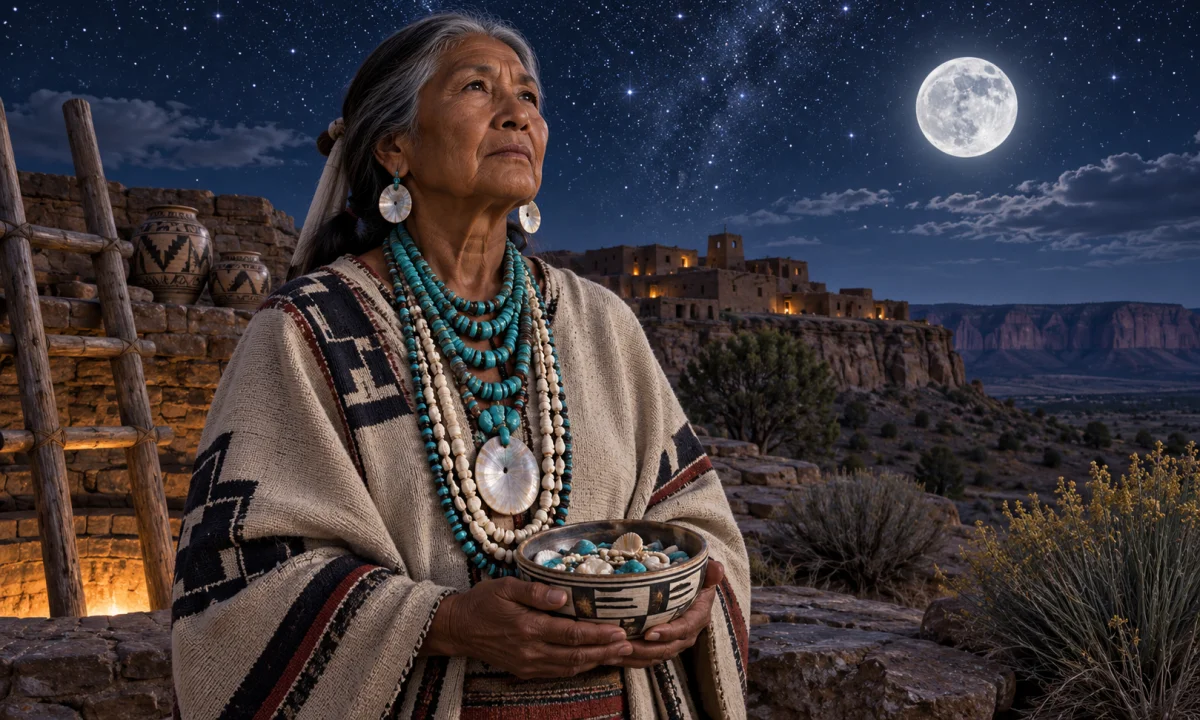
Huruing Wuhti is a female spiritual being associated with Hopi mythology, although descriptions of her identity and role vary considerably between published accounts. Her name is also written in forms such as Huruing Wuh-ti, and English-language sources have translated it in different ways, including “Hard Being Woman” and “Hard Woman.” These translations should be treated cautiously: Hopi religious concepts and names do not always fit neatly into English categories such as “goddess,” “deity” or “earth mother.”
In broad summaries of Hopi cosmology, Huruing Wuhti is presented as an ancient female power connected with the formation, ordering or endurance of the world. Some accounts associate her with the earth and with the generative forces that sustain life. Other accounts give her a more limited or different role, sometimes placing her among the powerful beings involved in the earliest stages of creation. There is no single, universally authoritative version of her mythology available in English.
Hopi religious and cultural setting
The Hopi are an Indigenous people whose villages are located in the high-desert region of northeastern Arizona. Hopi religious life is expressed through ceremonies, prayers, agricultural practice, clan traditions, sacred places and relationships with spiritual beings. Mythic narratives are not merely stories about a distant pantheon. They may explain the origins of the world, establish obligations toward the land, and provide a framework for ceremonial knowledge and moral conduct.
Hopi traditions include accounts of successive worlds, emergence, the actions of powerful spirit beings, and the movement of humanity toward its present condition. These traditions have been recorded in English by outsiders and by Hopi collaborators, but the written record does not represent the whole of Hopi religious knowledge. Some teachings are connected with particular clans, societies or ceremonies, and may not be intended for unrestricted publication. As a result, an encyclopedia-style description can only present a limited outline.
Hopi mythology is also not a fixed canon comparable to a single sacred book. Narratives may differ according to village, family, ceremonial context, speaker and the purpose for which a story is being told. Differences in translation and transcription further complicate the picture. A name preserved in an English-language book may reflect an individual interpreter’s spelling rather than a standard form used by all Hopi speakers.
Name and identity
The element Wuhti is commonly understood in English-language discussions as referring to a woman or female being. The first part of the name has often been translated as “hard,” producing the familiar rendering “Hard Being Woman.” That translation has led some writers to interpret Huruing Wuhti as a personification of the solid or enduring earth. Such an interpretation is possible, but it should not be presented as an uncontested definition.
Different sources sometimes use the name for somewhat different kinds of figure. In one account she may appear as a primordial female being; in another she may be treated as an old woman with supernatural authority; in still another she may be classified broadly as a goddess. These differences do not necessarily mean that every source is describing a completely separate being. They may reflect the flexibility of oral tradition, the use of different narrative contexts, or the tendency of non-Hopi writers to combine material that was originally more specifically situated.
The title “goddess” is therefore convenient but imperfect. Huruing Wuhti is better described as a powerful female being within particular Hopi traditions. Her significance lies less in belonging to a neatly organized pantheon than in her place within relationships among the creator, the worlds, humanity, the earth and other spiritual powers.
Role in creation traditions
Hopi accounts of creation commonly begin with Taiowa, the supreme or originating spiritual principle, and Sotuknang, a powerful being who carries out creative and ordering work. The details differ among accounts, but Sotuknang is often described as organizing the universe and preparing the worlds in which life will exist.
Huruing Wuhti is sometimes placed within this early cosmic setting. In these presentations, she belongs to the group of primordial beings whose existence precedes ordinary human history. Her association with the earth or with physical solidity makes her a natural figure for discussing the material world: the ground on which people live, the substance from which bodies are formed, and the enduring environment that supports human communities.
It is important not to assign her every role found in generalized descriptions of Hopi creation. Popular summaries sometimes combine her with Spider Woman, Spider Grandmother, or other female figures and then attribute to Huruing Wuhti the full set of their creative acts. That is not a reliable method. In many well-known creation narratives, Spider Woman or a related spider being has distinctive responsibilities involving the making of living creatures, the preparation of humanity and guidance through the worlds. Those functions should not automatically be transferred to Huruing Wuhti.
Likewise, accounts that call Huruing Wuhti an “earth goddess” may be emphasizing her connection with the physical world rather than reporting a detailed story in which she personally creates the earth. The difference between these two claims matters. One is an interpretive description of symbolism; the other is a specific mythic action.
Attributes and symbolism
Descriptions of Huruing Wuhti often emphasize age, strength and endurance rather than a standardized appearance. She may be represented in broad terms as an old woman or as a woman of formidable spiritual power. There is no widely established canonical portrait comparable to the fixed visual forms associated with some figures in classical mythology.
The translation “Hard Being Woman” has encouraged interpretations centered on firmness and permanence. In this reading, “hardness” can suggest the solid earth in contrast to air, water or the changing surface of human life. It may also imply resilience: the capacity to withstand destruction and to remain present through successive phases of cosmic history. These interpretations are scholarly or popular explanations, not necessarily a complete account of what Hopi people mean by the name.
Her feminine identity is also significant in discussions of Hopi cosmology, which includes several important female spiritual figures. Female beings may be associated with creation, fertility, instruction, protection, emergence and the continuity of life. It would be misleading, however, to assume that all such figures are versions of one universal “mother goddess.” Their names, relationships and ceremonial contexts are distinct.
Where Huruing Wuhti is connected with the earth, the association should not be reduced to agricultural fertility alone. Hopi life has historically depended on careful cultivation in an arid environment, especially the growing of corn. The earth is consequently not just a symbolic female body but a living context of responsibility, reciprocity and survival. Spiritual power may be expressed through proper conduct toward land, water, plants, animals and community.
Relationships with other Hopi beings
Sotuknang
Some English-language accounts describe Huruing Wuhti as connected with Sotuknang, and a few present her as his female counterpart or companion. These descriptions should be qualified because the relationship is not consistent across all published versions. The prominent place of Sotuknang in creation narratives can make him a natural point of comparison, but the existence of a relationship in one retelling does not establish a universal Hopi doctrine.
Sotuknang is generally associated with cosmic organization and with the work of bringing the worlds into order under Taiowa’s authority. Huruing Wuhti, when discussed alongside him, is often interpreted as representing a complementary aspect of the created world—its substantial, enduring or terrestrial dimension. This is an interpretive pattern rather than a complete mythological genealogy.
Spider Woman and Spider Grandmother
Huruing Wuhti is especially likely to be confused with Spider Woman or Spider Grandmother, commonly known by the Hopi name Kokyangwuti. Spider Woman has an important place in several accounts of creation and emergence. She is frequently described as a helper, creator, teacher or guide, although the details vary. In some narratives she works with Sotuknang or helps prepare beings for life in the worlds.
The similarity between the figures is mainly that both are female spiritual powers connected in some sources with primordial events. Their names and narrative identities are not interchangeable. A story about Spider Woman’s creation of living beings, instruction of people or assistance during emergence should not be attributed to Huruing Wuhti unless the particular source explicitly does so.
Other female spiritual figures
Hopi traditions contain additional female figures associated with corn, fertility, ritual instruction, clouds, rain, death, emergence and the kachina world. English-language writers have sometimes grouped these figures under broad labels such as “earth mother” or “fertility goddess.” Such labels can conceal meaningful distinctions. Huruing Wuhti should not be merged with a Corn Mother, a rain being, a kachina or a clan-specific ancestor simply because all may be associated with life or the earth.
Stories and narrative variation
Huruing Wuhti is not represented in English by one universally recognized cycle of myths. Instead, references to her tend to occur in summaries of Hopi cosmology, comparative discussions of Indigenous creation traditions, and accounts that list important Hopi spiritual beings. The brief nature of these references may give the impression that she is a minor figure, but that conclusion would also be uncertain. A figure can be important within a particular religious context without appearing extensively in material intended for public publication.
Some accounts place her among the ancient beings connected with the origin of the earth or the establishment of the first world. Others stress her identity as a powerful old woman rather than describing a sequence of creative acts. Still others use her name in ways that appear influenced by the author’s own classification system. These variants should be preserved rather than forced into a single artificial biography.
Hopi narratives about successive worlds often emphasize that human behavior affects the condition of the world. Worlds may be destroyed or abandoned when people become disorderly, violent, disrespectful or forgetful of their obligations. When Huruing Wuhti is interpreted as a figure of terrestrial endurance, she can be understood within this wider concern for the stability of the created order. Such an interpretation does not mean that she is personally responsible for every destruction or emergence episode found in Hopi mythology.
Cultural significance
Huruing Wuhti is significant partly because she illustrates the difficulty of translating Indigenous religious traditions into the categories of comparative mythology. Calling her an “earth goddess” can communicate something useful to readers, but it may also suggest a formal pantheon, a fixed mythology and a universal mother-earth role that do not accurately describe Hopi religious life.
Her identification with hardness or solidity invites reflection on the earth as a condition of life rather than a passive object. In a desert environment, the survival of a community depends on knowledge of seasons, water, soil, planting and cooperation. Spiritual narratives provide ways of understanding those relationships, while ceremonies and social responsibilities keep them active in the present.
The figure also demonstrates why oral tradition should not be judged by the standards of a single definitive text. Variation can be a feature of transmission rather than evidence of error. A narrative may be adapted to its audience, linked to a particular ceremonial purpose, or preserved differently by different communities. Published English versions are therefore records of encounters with Hopi tradition, not substitutes for the living tradition itself.
Huruing Wuhti in modern reference works
Modern websites and mythology dictionaries often present Huruing Wuhti as a fully defined “Hopi earth goddess,” sometimes adding a spouse, family relationships, powers or a detailed biography without indicating the source of those claims. Such presentations can make uncertain material appear more established than it is. The safest description recognizes her as a female spiritual figure whose name and associations vary in English-language accounts.
She has not become a major figure in mainstream film, television or widely distributed fantasy fiction. When she appears in modern popular culture, it is more often through generalized lists of Indigenous deities or simplified treatments of Native American mythology. These adaptations may detach her from Hopi language, ceremonial context and cultural boundaries. They should not be treated as evidence for traditional belief.
Careful discussion of Huruing Wuhti therefore requires two forms of distinction: between Hopi tradition and later popular summaries, and between Huruing Wuhti and other female beings who have been placed beside her. Her importance is best approached through the specific traditions in which her name occurs, with attention to uncertainty, translation and the continuing character of Hopi religious life.