WORLD
WORLD
Hoso-no-kami
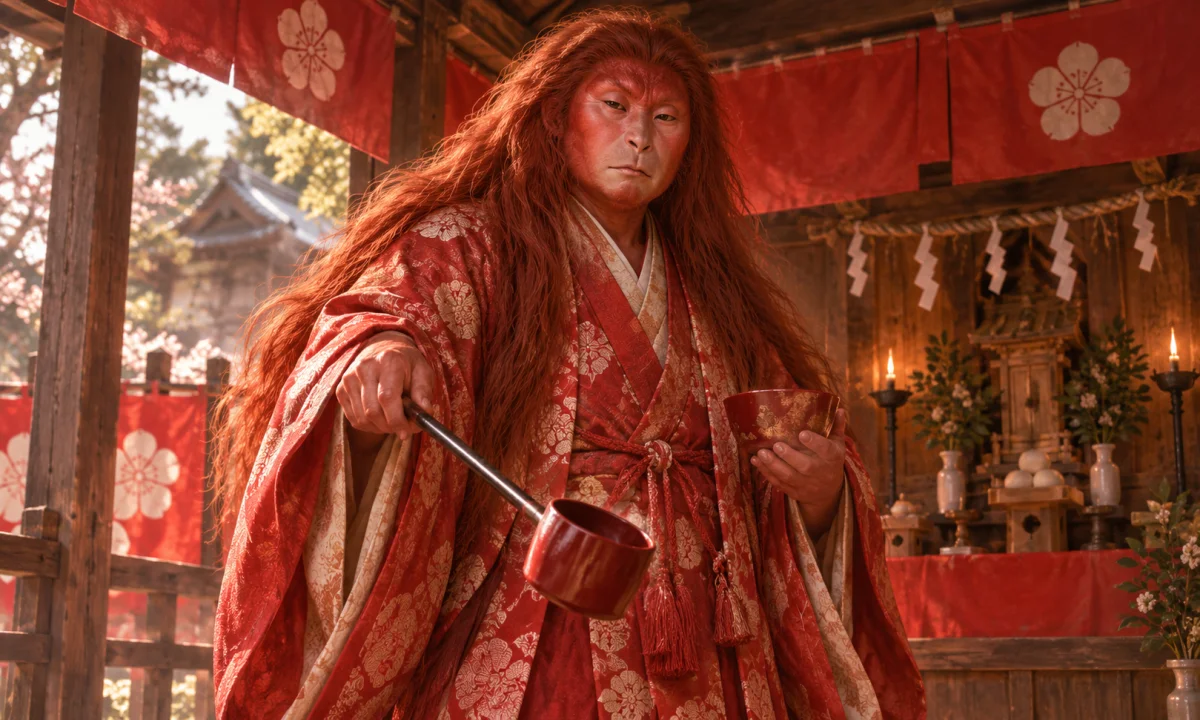
Hōsō-no-kami (also written Hoso-no-kami or Hōsōgami) is the Japanese personification of smallpox. The name is formed from hōsō, meaning smallpox, and kami, a deity, spirit, or sacred power. Rather than a single god with a fixed genealogy and a standard mythology, Hōsō-no-kami belongs primarily to Japanese folk religion and the religious interpretation of epidemic disease.
Smallpox was one of the most feared illnesses in Japan before modern vaccination. It could kill infants and adults, leave survivors permanently scarred, and spread rapidly through communities. In response, people developed rituals, images, protective objects, prayers, and rules of behaviour associated with the spirit believed to cause or govern the disease. Hōsō-no-kami therefore represents an attempt to give a dangerous and unpredictable illness a recognisable supernatural identity.
Name and identity
The Japanese term is commonly written 疱瘡神. The first element, hōsō, referred historically to smallpox, while the final element, kami, can refer to a god, spirit, or powerful presence. English-language writing may use Hōsōgami, Hōsō-shin, or Hōsō-no-kami. These forms generally refer to the same broad religious idea, although historical sources do not always use the terms with complete consistency.
Hōsō-no-kami should not be understood as a universally defined member of the Japanese pantheon. There is no single canonical account comparable to the myths of Amaterasu, Susanoo, or Inari. The figure appears instead in regional beliefs, medical and religious practices, popular literature, protective images, and early modern visual culture. In some contexts the spirit is treated as the cause of smallpox; in others it is a being whose anger, presence, or favour determines the course of the illness.
This distinction is important. Japanese traditions often described illness through several overlapping systems at once. A person might understand smallpox in terms of bodily imbalance, inherited medical learning, pollution, Buddhist ideas about suffering, local spirit beliefs, and the action of a disease deity. Hōsō-no-kami was not necessarily regarded as the only explanation for smallpox, nor did belief in the spirit exclude practical forms of care.
Historical and religious setting
Smallpox was present in Japan for many centuries, although the timing and routes of its earliest introduction remain matters for historical study. By the medieval and early modern periods, it was a familiar epidemic disease. The illness was especially dreaded because it often affected children and could move through households, villages, towns, and military or trading networks.
Before the development and widespread adoption of modern vaccination, supernatural interpretations offered a way to understand why one person became ill while another did not, why an outbreak arrived at a particular time, and why the illness sometimes became fatal. Disease spirits were not unique to Japan. Across East Asia, epidemic illnesses could be personified as powerful beings that entered human communities, travelled from place to place, or responded to ritual treatment.
Japanese beliefs about Hōsō-no-kami developed within a religious landscape that combined local kami traditions with Buddhist institutions, Chinese-derived medical ideas, and popular protective practices. The boundary between a kami, an oni-like demon, a disease spirit, and a dangerous ghost was not always sharply drawn in everyday religious life. A being might be feared as a destructive force and addressed as a power capable of negotiation.
Surviving evidence for Hōsō-no-kami is particularly abundant from the Edo period, when commercial printing, urban publishing, and the circulation of popular religious objects expanded. Records, illustrated books, amulets, and smallpox pictures reveal how communities imagined the disease and sought protection from it. These materials are valuable historical evidence, but they do not establish one official version of the deity. They show variation in local practice, artistic representation, and interpretation.
Appearance and visual symbolism
Hōsō-no-kami has no universally fixed appearance. In popular imagery, the spirit may appear as a supernatural humanoid figure, a demon-like being, or a figure associated with the visual signs of smallpox. Some images are threatening, while others are comparatively plain, comic, or even deliberately approachable. The purpose of an image could be protective, explanatory, ritual, or satirical.
Red is the colour most strongly associated with Japanese smallpox traditions. Red clothing, red furnishings, red objects, and red pigments were used in a variety of protective and therapeutic customs. The meaning of red was not always the same. It could be understood as a colour that repelled malign forces, displayed vitality, or attracted and appeased the smallpox spirit. These interpretations sometimes existed side by side.
Red was also linked more broadly with protection from harmful supernatural influences. Its use in smallpox customs therefore belonged to a larger Japanese and East Asian symbolic world rather than to Hōsō-no-kami alone. The colour appeared in household decorations, children’s garments, amulets, dolls, and printed images. In some cases, the use of red may also have helped distinguish the illness and its ritual environment from ordinary domestic life.
Dogs occur in some smallpox-related customs and images. In Japanese popular belief, dogs could be associated with easy childbirth, health, or resistance to certain dangers, and dog motifs appear in protective objects for children. Their presence in a smallpox context does not mean that the dog was Hōsō-no-kami’s companion in a fixed myth. It is better understood as part of a wider protective symbolism that varied by period and locality.
Other images connected with smallpox use figures such as Shōki, the famous demon-queller, or employ auspicious objects and written charms. Shōki is not Hōsō-no-kami. He was a separate protective figure whose image could be used against illness, demons, and other threats. His appearance in a smallpox print reflects the purpose of the object, not an identity between the two beings.
Hōsō-e: protective smallpox pictures
One of the most distinctive forms of evidence for Hōsō-no-kami is the hōsō-e, or smallpox picture. These were printed images produced especially in the early modern period and associated with protection from smallpox or recovery from it. They were not simply illustrations in the modern artistic sense. Many were treated as amulets or as objects with practical ritual value.
Hōsō-e could include depictions of the smallpox spirit, protective deities, auspicious symbols, animals, poems, or instructions. Their appearance changed according to local custom, the intended audience, and the commercial choices of publishers. Some prints sought to frighten away the disease; others tried to control, humour, deceive, or placate the spirit. The mixture of religious belief and popular entertainment is characteristic of much Edo-period print culture.
Families might place such images near a sick person or keep them in the household. In some traditions, a print was destroyed, discarded, or otherwise removed after recovery, symbolically sending away the illness. Such practices were not universal, and surviving evidence does not support one standard ritual sequence for all communities.
The images also show that people did not necessarily imagine the disease spirit as an abstract theological principle. Hōsō-no-kami could be visualised as an active visitor, a dangerous presence, or a being whose attention had to be managed. Giving the illness a face made it possible to address it through prayer, ritual speech, offerings, protective display, and symbolic action.
Stories, behaviour, and ritual relationships
Unlike major mythological gods, Hōsō-no-kami does not possess a stable cycle of famous stories. The traditions surrounding the figure are usually situational. The spirit arrives with an outbreak, enters a household, causes the characteristic disease, or determines whether the patient survives. Protective practices aim either to prevent its approach, make it leave, or persuade it to treat the patient favourably.
In some accounts and customs, the smallpox spirit is imagined as travelling from one place to another. This reflects the observed movement of epidemics, even though the supernatural explanation differs from the modern understanding of viral transmission. Other traditions focus on the household: the spirit is thought to be present in the sickroom, and the family alters clothing, decoration, speech, or daily activity in response.
These actions should not be reduced to a single idea of “worship.” A family might fear the spirit, offer it symbolic respect, display a protective image against it, and seek assistance from Buddhist or Shinto religious specialists at the same time. Ritual practice was often pragmatic. People used whatever prayers, charms, medicines, restrictions, and household customs seemed appropriate.
Hōsō-no-kami was sometimes understood in relation to the broader category of yakubyōgami, or disease and epidemic deities. The term yakubyōgami can refer generally to supernatural beings associated with pestilence, not to one precise individual. Hōsō-no-kami is therefore best described as a smallpox-specific disease spirit within a wider family of Japanese beliefs about illness.
Medical belief and historical interpretation
Traditional explanations of smallpox should be distinguished from modern medical knowledge. Smallpox was caused by variola virus and spread primarily through close contact and infectious materials. Red clothing, images, charms, and rituals did not prevent viral infection in the biomedical sense. Their historical importance lies in the meanings and social actions attached to disease, not in evidence of supernatural control over the virus.
At the same time, it would be misleading to portray premodern communities as guided only by superstition. Japanese physicians and healers possessed substantial medical knowledge within the frameworks available to them. They observed symptoms, tracked the progress of illness, advised on diet and care, and used pharmaceutical preparations. Religious and medical explanations could coexist in the same household.
Smallpox prevention changed as inoculation and, later, vaccination became known in Japan. Methods of deliberate exposure had circulated in East Asia before the adoption of modern vaccination, though their use and availability varied. Vaccination based on the work of Edward Jenner reached Japan through international contacts in the nineteenth century and gradually gained importance. As biomedical prevention became more influential, the practical role of Hōsō-no-kami and smallpox amulets declined.
The global eradication of smallpox in the twentieth century transformed the status of the figure. Hōsō-no-kami is now primarily a subject of folklore, religious history, art history, and the study of medicine and society. The traditions remain valuable because they record how Japanese communities experienced childhood illness, epidemic fear, family care, commercial printing, and religious practice.
Distinguishing Hōsō-no-kami from similar figures
- Yakubyōgami: a broad term for spirits associated with disease or epidemics. Hōsō-no-kami is a smallpox-specific figure, not necessarily a synonym for every disease deity.
- Shōki: a protective demon-queller whose image was used against illness and evil. Shōki and Hōsō-no-kami may appear in the same protective context, but they are different figures.
- Yakushi Nyorai: the Buddhist Medicine Buddha, associated with healing and relief from suffering. Yakushi Nyorai is a benevolent Buddhist figure, not the spirit personifying smallpox.
- Otafuku and other auspicious figures: popular protective or lucky figures could appear in disease-related prints, but their presence does not make them forms of Hōsō-no-kami.
- Oni and malicious spirits: smallpox images may use demon-like visual language, yet not every oni shown in an illness context is the smallpox deity.
Cultural significance
Hōsō-no-kami reveals how Japanese religious culture could personify an illness without placing it inside a rigid theological system. The figure stands at the intersection of folklore, medicine, family religion, visual culture, and the history of epidemics. Its traditions express fear of contagion, concern for children, hope for recovery, and the desire to make an invisible danger understandable.
The history of Hōsō-no-kami also demonstrates the flexibility of the word kami. A kami need not always be an idealised creator, ancestor, or guardian. It can denote a force that is dangerous, powerful, and worthy of ritual attention. Such a being may be confronted, honoured, deceived, or appeased rather than simply loved or obeyed.
In modern Japan, the figure is not a major character in mainstream popular culture, and there is no single contemporary version that has replaced the older traditions. Hōsō-no-kami is more often encountered through museum collections, exhibitions of Edo-period prints, folklore studies, and discussions of historical disease. The surviving images continue to offer a vivid record of the social and religious world that surrounded smallpox before vaccination and eradication changed its place in human life.