WORLD
WORLD
Elusu
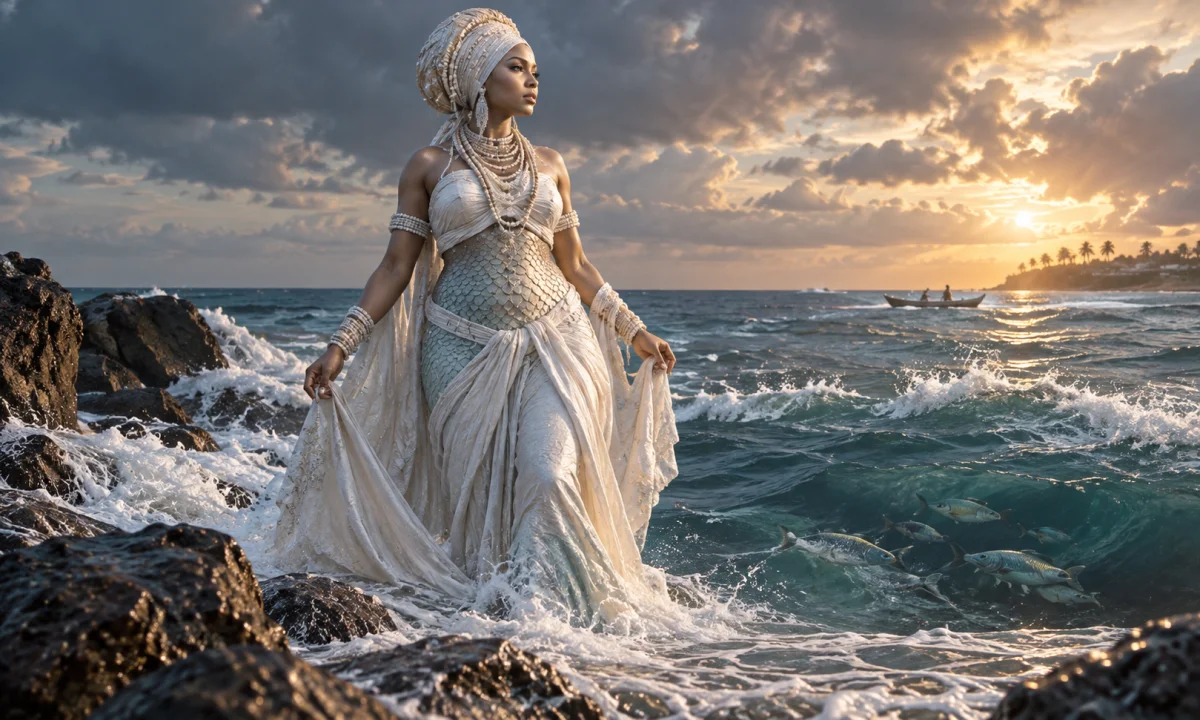
Elusu is a little-documented figure associated with Yoruba religious tradition and with the watery realm governed by Olokun. Information about Elusu is considerably less abundant than material about major orishas such as Èṣù, Ọ̀ṣun, Ọ̀ya, Ògún, or Ṣàngó. As a result, descriptions of Elusu vary between reference works, oral accounts, and modern summaries. Some identify Elusu as a female spirit or divinity of the sea; others connect the name more specifically with the shore, sand, or coastal waters. These differences should be acknowledged rather than treated as a single universally fixed biography.
Yoruba religious setting
Yoruba religious tradition developed among Yoruba-speaking peoples of West Africa, especially in present-day Nigeria and neighbouring regions of Benin and Togo. It is not based on one canonical book or a single standardized mythology. Religious knowledge has been transmitted through ritual practice, praise poetry, divination verses, family traditions, shrine traditions, oral narratives, and the teachings of priests and elders.
The central creator is commonly called Olódùmarè, Ọlọ́run, or by related names, depending on context and regional usage. The òrìṣà are sacred powers and divine personalities associated with natural forces, human activities, places, moral relationships, and particular communities. Their identities are not always equivalent to the fixed “gods” of a literary pantheon. An òrìṣà may be understood as a primordial power, an ancestor who became sacred, a divinized force of nature, or a combination of these dimensions.
Water occupies an especially important place in Yoruba thought. Rivers, lagoons, springs, marshes, and the sea are not merely physical environments. They may be inhabited or governed by spiritual powers and may provide fertility, wealth, healing, protection, or danger. The sea in particular is associated with Olokun, a powerful and wealthy divinity whose gender and characteristics may vary between Yoruba communities and later religious traditions. It is within this broad aquatic setting that references to Elusu are generally placed.
Name and identity
The spelling Elusu is not as consistently documented as the names of better-known Yoruba divinities. English-language sources may preserve different spellings or may provide little information beyond a brief identification. Yoruba is a tonal language, and tones are important to meaning, but many English publications omit tone marks. Consequently, a spelling without diacritics does not by itself establish a single definitive pronunciation or etymology.
Some modern descriptions call Elusu a sea goddess, while others use broader terms such as water spirit, coastal divinity, or female companion of Olokun. These labels may reflect different local traditions, different translations, or the tendency of modern writers to fit complex Yoruba religious categories into familiar European classifications. There is no reliable basis for presenting one simplified description as accepted across all Yoruba communities.
Elusu should therefore be treated as a regional or comparatively obscure aquatic figure, not as one of the universally prominent members of the Yoruba religious system. The limited surviving documentation makes it difficult to reconstruct a complete mythology, a standard genealogy, or a single set of ritual attributes.
Association with Olokun and the sea
The most frequent broad association made for Elusu is with Olokun, the power of the deep sea. Olokun is connected with the immense, concealed, and wealthy dimensions of the ocean. In many traditions, the sea signifies both abundance and uncertainty: it can carry trade and provide food, yet it can also drown, conceal, and remove people from the visible world.
When Elusu is described as a companion, subordinate, or associated spirit of Olokun, the relationship should not automatically be understood as a universally established family relationship. Some summaries may present the figures as related, while others simply place them within the same sacred sphere. The available evidence does not justify confidently assigning Elusu a single genealogy, marriage, or parentage.
Several descriptions also connect Elusu with the meeting place between land and water. This may explain references to sand, beaches, or coastal margins in accounts of the figure. Such associations are plausible within the symbolism of an aquatic spirit, but they should not be expanded into detailed stories unless a particular oral or written tradition clearly supports them.
Attributes and symbolism
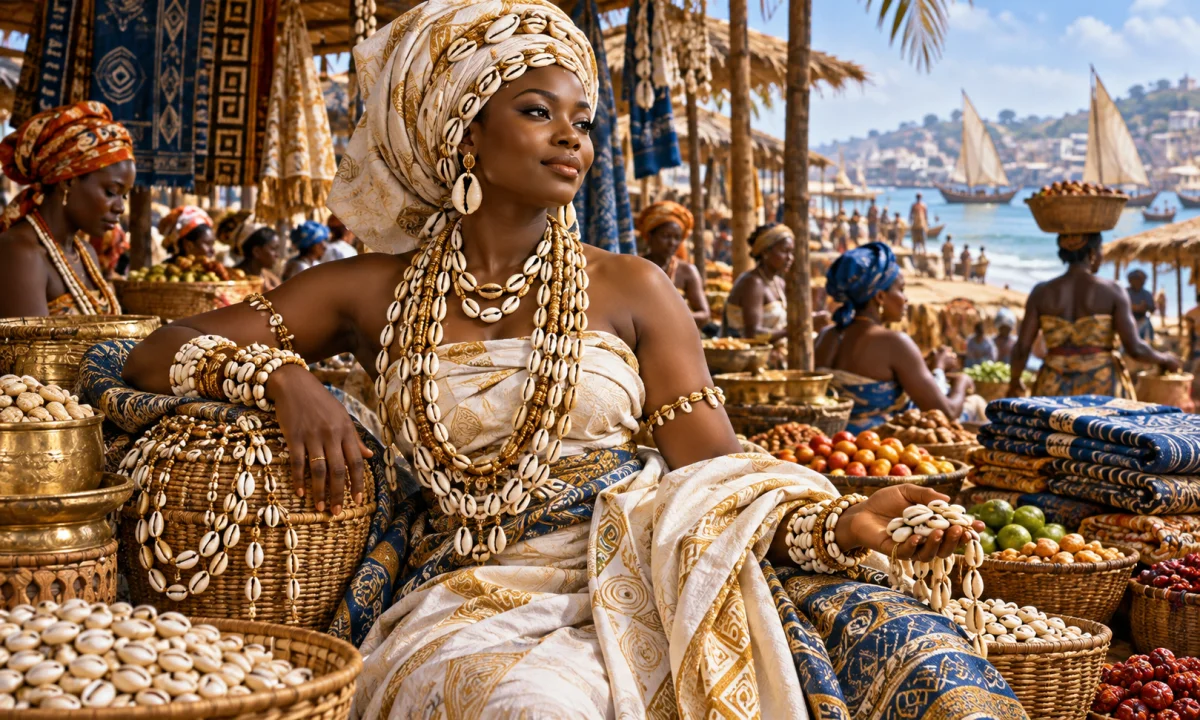
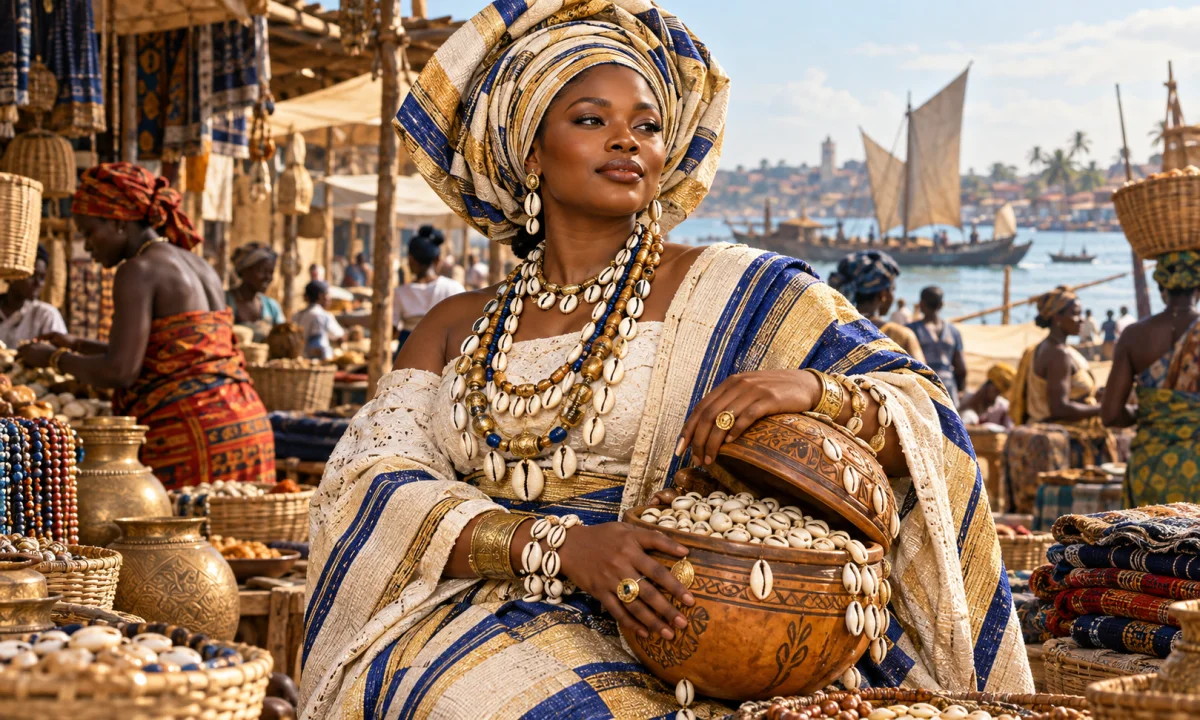
No broadly standardized physical appearance for Elusu is securely established. Images circulated in modern encyclopedias, fantasy art, and online mythology collections should not be mistaken for traditional Yoruba iconography. A depiction of a woman emerging from the sea, a figure covered in shells, or a mermaid-like being may communicate a general aquatic theme, but it does not necessarily represent a historically documented image of Elusu.
The symbolic associations attributed to Elusu usually arise from the sacred significance of water and the coast:
- Water and depth: Elusu may represent the hidden or unpredictable qualities of aquatic realms.
- Coastal boundaries: Where the figure is linked with sand or shorelines, Elusu can be interpreted as belonging to a threshold between land and sea.
- Abundance: Like other water powers, an aquatic divinity may be associated with fertility, nourishment, trade, prosperity, or the wealth believed to lie beneath the water.
- Danger and respect: The sea is not only generous. Its power demands caution, correct conduct, and appropriate ritual respect.
- Transformation: Water frequently functions as a medium of passage, cleansing, concealment, and change in Yoruba religious symbolism.
These themes describe the religious environment in which Elusu is interpreted; they do not constitute a fixed list of powers or commandments belonging to the figure. Yoruba traditions commonly understand divine powers through relationships with places, communities, ritual specialists, and particular forms of worship rather than through a standardized catalogue of abilities.
Stories and surviving traditions
There is no widely recognized cycle of elaborate myths about Elusu comparable to the many narratives associated with Ọ̀ṣun, Ṣàngó, Ọ̀ya, or Èṣù. Nor is Elusu a central figure in the best-known discussions of Ifá, the Yoruba divination system, where sacred verses preserve extensive accounts of divine beings, ancestors, human conduct, and cosmic events. This does not prove that no local stories or ritual references exist. It means that a complete, pan-Yoruba mythology of Elusu cannot responsibly be reconstructed from the limited material commonly available in English.
Oral tradition is also not static. A name may be preserved in one locality but absent from another. A spirit may be important at a particular shrine without appearing in general accounts of Yoruba religion. The same sacred being may be described differently by priests, worshippers, researchers, translators, or writers working outside the community. These factors are especially significant for lesser-known names that have been removed from their original ritual context and repeated in short reference lists.
Some modern accounts assign Elusu a close relationship to Olosa, another name associated in certain sources with lagoons or coastal waters. The relationship between Elusu and Olosa is not consistently documented, however. They should not automatically be treated as sisters, twins, or interchangeable forms of one being. Where a particular tradition presents them as related, that claim belongs to that tradition rather than to Yoruba mythology as a whole.
Elusu and the problem of classification
Calling Elusu a “goddess” can be convenient in English, but it may conceal important distinctions. The Yoruba term òrìṣà does not map perfectly onto the categories “god,” “goddess,” “spirit,” or “demon.” A sacred power may have a human-like personality while also being inseparable from a river, a forest, a storm, the sea, or a particular ritual institution.
Likewise, the English term “mythology” can suggest a collection of ancient stories separated from living religion. Yoruba religious traditions continue to be practiced, adapted, and interpreted in West Africa and throughout the African diaspora. A reference to Elusu should therefore be approached with the same care given to any religious figure: descriptions may concern living beliefs rather than merely literary characters.
The lack of extensive documentation should not be used to dismiss Elusu as unimportant. Religious importance is not measured only by how often a name appears in international reference books. A localized spirit can have significance for a community, a shrine, a lineage, or a particular relationship with the sea even when that significance is not visible in general surveys.
Distinction from Èṣù
Elusu is sometimes confused with Èṣù because the names look similar in unmarked English spelling. They are not the same figure. Èṣù is one of the most important òrìṣà in Yoruba religion, associated with communication, crossroads, choice, consequence, mediation, and the dynamic transmission of ritual power. He is also central to the proper functioning of sacrifice and divination.
The similarity between “Elusu” and “Èṣù” is a spelling issue, not evidence of shared identity. Èṣù is not a sea goddess, and Elusu should not be described as a feminine form of Èṣù. Confusion has sometimes been encouraged by older translations and by the difficulty of representing Yoruba sounds and tones in English. Careful writing should preserve the distinction.
Relationship to African-diaspora traditions
Yoruba religious concepts travelled across the Atlantic through forced migration, especially during the era of the transatlantic slave trade. They contributed to traditions including Candomblé in Brazil, Santería or Regla de Ocha in Cuba, and related practices in the Caribbean and the Americas. In these settings, Yoruba names and identities were sometimes translated, combined with local traditions, or associated with Catholic saints through processes commonly called syncretism.
Olokun is known in several African-diaspora religions, where the figure may have a more clearly defined ritual identity than in some general descriptions of Yoruba religion. This does not automatically establish a corresponding place for Elusu in every diaspora tradition. A name appearing in a modern list of African or Afro-Caribbean spirits may represent a local adaptation, a later classification, or a mistaken transfer from one source to another.
For the same reason, Elusu should not be casually identified with a mermaid, siren, water nymph, or another European or Caribbean being. Aquatic female spirits occur in many cultures, and visual similarities do not demonstrate historical identity. African-diaspora traditions may contain powerful water beings with their own histories, but those figures should be studied within their respective religious contexts.
Modern representation
Elusu has little established presence in widely known novels, films, games, or other major forms of popular culture. When the name appears online, it is more often in short mythology databases, lists of African deities, or generalized discussions of Yoruba water spirits than in works with a substantial traditional or literary treatment.
Modern illustrations may give Elusu a standardized appearance, a detailed personality, or a dramatic set of supernatural powers. Such portrayals can be creative reinterpretations, but they should be labelled as modern invention or adaptation rather than presented as ancient Yoruba teaching. The strongest responsible description remains a modest one: Elusu is a sparsely documented name associated in some accounts with Yoruba aquatic powers, especially the sea and the sphere of Olokun, while her exact identity and attributes vary by source.