WORLD
WORLD
Eithinoha

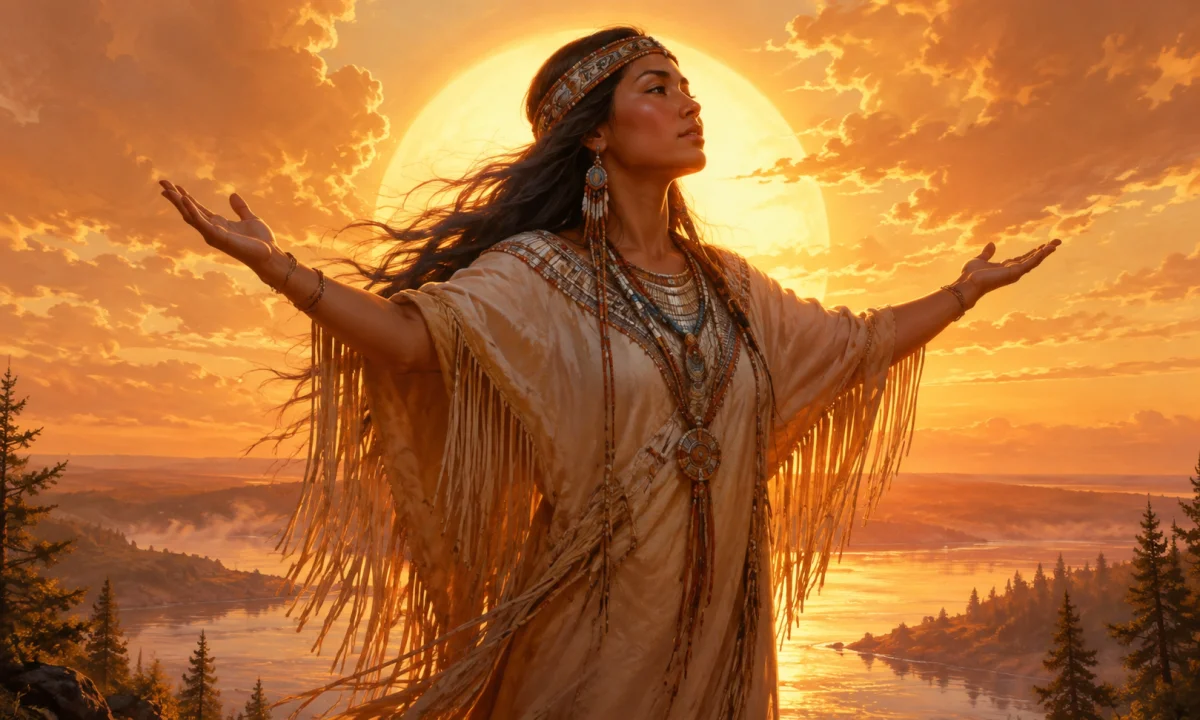
Eithinoha is a figure associated with Iroquois, or Haudenosaunee, mythology. In English-language mythological references, she is usually described as an earth mother whose death during childbirth makes possible the ordering of the world. She is commonly presented as the mother of opposing twin beings, often called Hahgwehdiyu and Hahgwehdaetgah, although names and details differ among sources and traditions.
Cultural setting
“Iroquois” is a historical English term for the Haudenosaunee Confederacy, whose original member nations are the Mohawk, Oneida, Onondaga, Cayuga and Seneca. The Tuscarora later joined the confederacy. Haudenosaunee traditions are not a single, uniform mythology: stories, names, pronunciations and ritual meanings can vary between nations, communities and individual tellers.
The traditions were preserved primarily through oral transmission. Some were later written down by missionaries, ethnographers, Indigenous scholars and other observers, often using inconsistent spelling systems. As a result, a name found in one English-language reference may not represent a universally recognized form in every Haudenosaunee community. Eithinoha is one of the figures whose identity is especially dependent on the source and its method of transcription.
Haudenosaunee creation narratives frequently connect the formation of the world with births, deaths, transformations and relationships between generations. The natural world is not merely a setting for divine events. It is formed through them and remains bound to their consequences. Animals, plants, celestial beings, human communities and spiritual powers belong to an interconnected order rather than to separate mythological compartments.
Name and identity
The spelling Eithinoha appears mainly in English-language mythological compilations and summaries. The name may be spelled differently in other sources, and its pronunciation is not reliably recoverable from the English spelling alone. A definitive translation is also uncertain. It should not automatically be treated as a direct equivalent of “Earth” or “Mother Earth” in a specific Haudenosaunee language.
In the sources that identify her, Eithinoha is generally classified as an earth-associated mother figure. She is sometimes called an earth goddess, but that label can impose a European category on traditions that do not necessarily organize spiritual beings according to the same divisions as classical mythology. “Earth mother” is therefore often a more cautious description than “goddess,” especially when discussing the figure across several versions of the story.
Her story is frequently placed within a broader cycle involving the Sun, a mother who gives birth to twins, and the transformation of her body after death. Some summaries describe her as the daughter of the Sun. Other accounts of related Haudenosaunee narratives use different genealogies or do not emphasize the same relationship. The connection with the Sun should consequently be identified as a recurring feature of some accounts, not as an uncontested element of all Iroquois tradition.
The story of the twins
The most familiar account of Eithinoha presents her as the mother of two powerful twins. Their names appear in several forms, including Hahgwehdiyu and Hahgwehdaetgah. English retellings have sometimes translated or interpreted them as the Good Mind and the Evil Mind, or as benevolent and destructive powers.
In this narrative pattern, the twins are opposed from the beginning. Their conflict begins before or during birth, and Eithinoha dies as a result of the difficult delivery. The death of the mother is not an incidental tragedy. It becomes one of the central creative events in the myth, because the world is made from, or organized through, what remains of her body.
The twin identified with constructive or ordering power uses the maternal body to establish important features of the world. Depending on the version, these may include the earth itself, plants, animals, celestial bodies or other elements of the natural order. The opposing twin resists or damages these arrangements, introducing irregularity, danger, darkness or other conditions that make life difficult.
Popular summaries often describe the twins as absolute embodiments of good and evil. That wording can be misleading. The stories are more concerned with opposing forces and their effects than with a simple philosophical division between morally perfect and morally wicked beings. The destructive twin is associated with harmful conditions, but the narrative also explains why the world contains conflict, obstacles, death and unpredictability. The opposition helps account for the mixed character of lived existence.
In some versions of the broader twin cycle, the conflict continues after the world has been formed. The ordering twin is connected with daylight, growth, useful animals or beneficial natural processes, while the rival is linked with night, dangerous creatures, destructive plants or other threatening features. These associations vary considerably, and no single list of creations should be treated as definitive for every Haudenosaunee nation.
Eithinoha and the earth
Eithinoha’s importance lies less in a catalogue of personal powers than in her place at the foundation of the world. Her body becomes a source of terrestrial life and structure. In this respect, she resembles earth-mother figures found in many mythologies, but her story has its own Haudenosaunee context: creation emerges through kinship, childbirth, loss and the struggle between powerful relatives.
The association with the earth also gives her death a generative meaning. Death does not simply mark the end of Eithinoha’s existence. It changes her status and extends her presence through the world that follows. Soil, vegetation and the material conditions of life may be understood through the image of a mother whose body nourishes future generations.
This theme should not be reduced to a generic fertility symbol. Haudenosaunee cultural life places strong emphasis on relationships, responsibilities and the continuity of generations. The mother in the creation narrative is part of a network that includes celestial powers, twins, human beings, animals and the land. Her role can therefore be understood in social and cosmological terms at the same time.
The story also gives a mythic explanation for the world’s dual character. The earth sustains life, but it also contains hazards. Birth is connected with death, abundance with hardship, and order with opposition. Eithinoha’s narrative provides a framework for understanding these tensions without presenting the world as either wholly benevolent or wholly hostile.
Relationship to other creation figures
Eithinoha should not automatically be merged with Sky Woman, also known in some retellings as Ataensic or by other names. Sky Woman belongs to a major Haudenosaunee creation tradition in which she falls from the sky world and is supported by aquatic animals on the back of a great turtle. She gives birth to or is associated with important generations of beings, and her story is central in many accounts of the world’s formation.
Some English-language retellings combine elements from the Sky Woman narrative with the story of the rival twins. This can create the impression that Eithinoha and Sky Woman are always the same person. They are not securely identical across the evidence. In some traditions or summaries, the maternal figure in the twin story may be related to the broader creation cycle; in others, the names and episodes are kept distinct.
Nor should Eithinoha be confused with the twins themselves. Hahgwehdiyu and Hahgwehdaetgah are usually described as her sons, not alternative names for her. Their conflict belongs to a later stage of the story, even when their struggle begins before birth.
There is also a risk in treating “Iroquois mythology” as though it were a fixed canon comparable to the mythology of ancient Greece. Haudenosaunee narratives have been transmitted in living communities and in ceremonial contexts, not merely preserved as a closed collection of written stories. A name may therefore be prominent in a nineteenth- or twentieth-century compilation while being less familiar, differently understood or absent in another community’s tradition.
Variants in the twin tradition
The names of the twins are among the most variable parts of the narrative. Hahgwehdiyu may appear with different spellings, and Hahgwehdaetgah has several English transcriptions. Other versions use names that are not obviously related in spelling. Translators have also used descriptive titles such as Good Mind, Right-Minded One, Evil Mind or Flint.
The name Flint is especially important in some versions because the hostile twin is associated with hard, jagged or resistant material. Retellings sometimes explain the presence of rough stones, difficult terrain or destructive natural features through this association. However, the use of “Flint” in one version does not prove that every story concerning an opposing twin belongs to exactly the same narrative form.
Some accounts present the twins as moral opposites, while others emphasize their different dispositions, powers or effects on the world. The constructive twin may shape a habitable environment, whereas the rival introduces dangers and limitations. The conflict is often resolved through a contest or separation rather than through the complete elimination of one side. This reflects the continuing presence of opposing conditions in the world.
Because the stories were recorded through translation, words such as “good,” “evil,” “light” and “darkness” may simplify concepts that carried more specific meanings in the original languages. A careful interpretation distinguishes the wording of an English retelling from the full religious and cultural significance of the traditional narrative.
Religious and cultural significance
Stories associated with Eithinoha can be read as accounts of origins, but they also express principles about life in the world. They link human existence to the land and present the natural environment as the result of ancestral and spiritual events. The earth is not an inert object created for human use; it is connected to a maternal body and to relationships that impose obligations.
The maternal dimension is also consistent with the importance of kinship and clan relationships in Haudenosaunee society. Haudenosaunee nations have traditionally maintained matrilineal clan systems, in which clan identity is inherited through the mother. That social fact should not be treated as a simple explanation of Eithinoha’s myth, but it helps show why maternal ancestry and the continuity of generations carry considerable cultural weight.
The twin conflict can likewise be understood as a narrative about balance and responsibility rather than as an abstract battle between two supernatural personalities. People live amid forces that sustain and threaten life. Cultivation, hunting, family obligations, ceremony and communal law all take place within that world of mixed conditions. The mythic struggle provides one way of explaining why skill, caution, gratitude and cooperation are necessary.
It is important not to assume that every Haudenosaunee person interprets Eithinoha in the same way or regards the figure as part of a standardized pantheon. The word “pantheon” suggests a system of neatly ranked gods, while Haudenosaunee religious traditions are better approached through particular stories, practices, relationships and responsibilities. Eithinoha’s significance depends on the narrative context in which her name appears.
Later reception
Eithinoha has had limited visibility in modern popular culture compared with figures such as Sky Woman or the Great Turtle. The name is most often encountered in mythology dictionaries, lists of Indigenous deities, educational websites and generalized retellings of Iroquois creation stories. These presentations can preserve an important element of the tradition, but they may also compress regional differences and turn a complex narrative into a short genealogy.
Modern writers should therefore distinguish between a traditional Haudenosaunee story, an early written record, a later scholarly interpretation and a popular fantasy adaptation. An author who presents Eithinoha as a universal “Iroquois earth goddess,” gives her a fixed appearance, or assigns her a large set of unrelated powers may be drawing on modern reconstruction rather than on a consistently attested tradition.
The most responsible description is a qualified one: Eithinoha is a name used in some accounts of Iroquois or Haudenosaunee mythology for an earth-associated mother connected with the birth of rival twins and the formation of the world. Her genealogy, name, attributes and relationship to other creation figures vary, and those variations are part of the evidence rather than errors to be silently corrected.