WORLD
WORLD
Adekagagwaa

Adekagagwaa is a figure identified in some accounts of Iroquois mythology with summer and the warm, life-supporting part of the yearly cycle. He is commonly presented as the opponent or counterpart of Okwirase, a figure associated with winter. The best-known version of their relationship describes an ongoing struggle between warmth and cold, growth and dormancy, or the forces that make the land productive and those that restrict it.
The name and story require some care. “Iroquois mythology” is a broad modern label for traditions belonging to several related nations, especially the Haudenosaunee, or Iroquois Confederacy. These nations have distinct languages, communities and bodies of oral tradition. Adekagagwaa is not equally prominent in every Haudenosaunee tradition, and the surviving written references are limited and variable. As a result, descriptions of him as a fully defined “god of summer” often come from condensed reference works or comparative retellings rather than from a single, universally accepted traditional narrative.
Cultural setting
The Iroquois Confederacy traditionally includes the Mohawk, Oneida, Onondaga, Cayuga and Seneca nations; the Tuscarora later joined the confederacy. In many contexts, “Haudenosaunee” is preferred to “Iroquois,” although “Iroquois mythology” remains a common category in English-language reference writing. Haudenosaunee traditions include creation narratives, accounts of culture heroes, teachings about ceremonial responsibilities, stories of powerful beings and explanations of the natural world.
These traditions were preserved primarily through oral transmission. Knowledge was carried in speeches, ceremonies, songs, personal names, seasonal observances and narratives told in particular cultural settings. Early European observers recorded some stories, but their spelling systems, translations and assumptions often differed from the languages and concepts they encountered. Later writers sometimes combined material from different nations or reduced complex spiritual traditions to lists of named “gods.”
That background is important when considering Adekagagwaa. The available descriptions do not establish a single detailed biography, fixed appearance or complete cycle of myths. The figure is most securely associated, in secondary accounts, with the symbolic force of summer and with a seasonal opposition to winter. Details beyond that core should be treated as interpretive or source-dependent rather than as universally Haudenosaunee.
Name and identity
The spelling Adekagagwaa is one of several forms used in English-language discussions. Variations may result from differences in transcription, pronunciation, translation and the use of different Indigenous languages. An English spelling should not automatically be treated as a standardized traditional form. The pronunciation of the name cannot be established reliably from its spelling alone.
Adekagagwaa is often classified as a deity, spirit or personification of summer. These classifications reflect the vocabulary of English-speaking writers. Indigenous concepts of spiritual power do not always fit neatly into the categories “god,” “spirit,” “person,” or “natural force.” Calling him a “summer god” can be a useful shorthand, but it may suggest a sharply bounded divine figure in a pantheon in a way that does not represent every Haudenosaunee understanding.
In the accounts where he appears, Adekagagwaa is generally paired with Okwirase. Okwirase is described as the force or being of winter, making the two figures an example of seasonal complementarity and conflict. Their opposition is sometimes presented as a literal contest and sometimes as a mythic explanation for the alternating seasons. The sources do not provide a consistent account of their genealogy, and claims that they are brothers or members of a larger divine family should be regarded as dependent on particular retellings.
Association with summer
Adekagagwaa’s central attribute is the power of summer. Summer brings warmth, longer days, plant growth and conditions favourable to agriculture. For communities whose traditional economies included farming, hunting and gathering, seasonal change was not merely an abstract natural process. It affected planting, ripening, travel, food storage, hunting patterns and the timing of communal activities.
In this context, a summer figure can represent the conditions that allow life to flourish. His sphere may be understood symbolically through sunlight, warmth, fertility and abundance, although not every one of these attributes is explicitly recorded for Adekagagwaa in surviving accounts. It is safer to say that these are reasonable interpretive associations of the summer role than to describe them as fixed personal powers.
Seasonal power is also limited power. Summer cannot simply erase winter; it arrives, reaches its strength and eventually gives way. Adekagagwaa therefore works well as a figure of recurring renewal rather than as an embodiment of permanent victory. The seasonal cycle implies an order larger than either opponent. Neither summer nor winter can dominate forever without disrupting the rhythm on which the living world depends.
The struggle with winter
The most frequently repeated story pattern involving Adekagagwaa is his conflict with Okwirase. In simplified retellings, the two forces contend each year, and their struggle produces the changing seasons. When Adekagagwaa prevails, warmth returns and the earth becomes productive. When Okwirase gains strength, cold spreads, vegetation becomes dormant and winter conditions take hold.
This should not be confused with a single canonical epic preserved in an agreed written form. Accounts vary in how much narrative they give to the contest. Some offer only the names and their opposing seasonal roles. Others turn the relationship into a more dramatic battle, with the progress of the year treated as the outcome of supernatural combat. The dramatic version may help modern readers visualize the seasonal cycle, but it should not be assumed to preserve one original wording or a complete traditional story.
The conflict is also not necessarily a simple moral opposition between good and evil. Summer may be welcomed because it supports crops and human activity, while winter may be feared for its hardship, yet winter is part of the natural order. Cold, rest and seasonal limitation have their own place. The opposition is therefore better understood as a recurring tension between complementary conditions than as a final war in which one side ought to destroy the other.
Attributes and representation
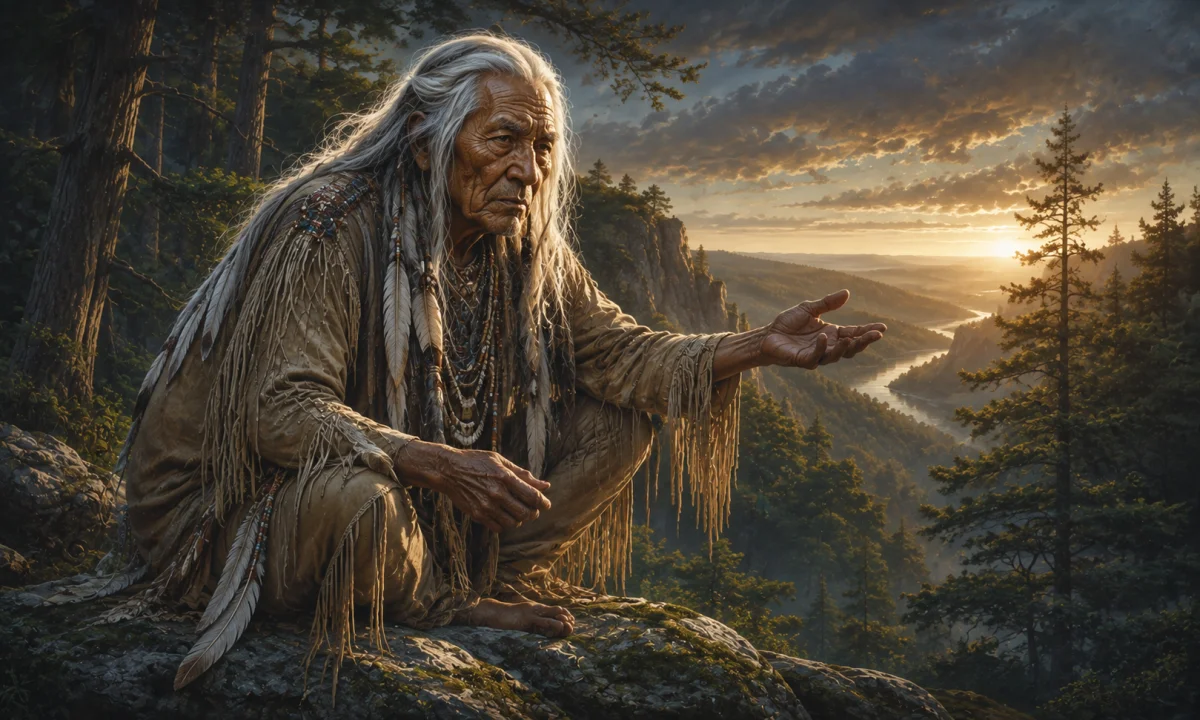
There is no well-established traditional description of Adekagagwaa’s physical appearance. Images showing him as a young man, a warrior, a crowned deity or a person surrounded by flames or flowers belong to artistic interpretation unless tied to a specific documented tradition. The same caution applies to claims about weapons, clothing, animals, sacred objects or a permanent dwelling.
His principal “attribute” is functional rather than visual: he brings or represents the warm season. In mythic terms, that role can be expressed through the return of light, the strengthening of vegetation and the restoration of conditions needed for human subsistence. Yet these associations should not be expanded into an invented catalogue of powers. The surviving information does not securely identify Adekagagwaa as a sun deity, thunder deity, creator or ruler of all weather.
Nor should the seasonal figure be automatically identified with every benevolent being in Haudenosaunee tradition. Haudenosaunee cosmology includes many important beings and narrative figures whose roles differ by nation and story. Adekagagwaa’s association with summer does not make him a general agricultural god, a creator of humanity or a universal guardian of nature.
Relationship to Haudenosaunee seasonal life
The significance of a summer figure becomes clearer when seasonal change is considered within the wider life of Haudenosaunee communities. Agriculture traditionally depended on the timing of planting, cultivation and harvest. Corn, beans and squash were central crops in many Haudenosaunee communities, and the yearly cycle shaped labour, foodways and ceremony. Hunting and gathering also required close attention to the behaviour of animals and the availability of plants.
It would be misleading to claim that every seasonal activity was directed toward Adekagagwaa. The evidence does not establish a universally observed cult, festival or prayer cycle devoted specifically to him. Haudenosaunee ceremonial life is diverse and has its own established structures, including thanksgiving practices and ceremonies connected with crops, the natural world and community responsibilities. Adekagagwaa should therefore be discussed as a mythological or interpretive figure associated with summer, not automatically as the centre of a separate historical religion.
The seasonal pairing attributed to Adekagagwaa and Okwirase can nevertheless express an important idea: the world is sustained through relationships and cycles. Warmth has meaning in relation to cold, growth in relation to dormancy, and abundance in relation to scarcity. The story pattern provides a way of imagining natural processes as active and relational rather than as impersonal changes detached from human life.
Sources and uncertainty
Information about Adekagagwaa is difficult to separate from the history of European and later popular writing about Indigenous religions. Missionaries, travellers, antiquarians and folklorists often translated Indigenous beings into familiar European categories such as gods, devils, giants or nature spirits. They could also record a story in one community and present it as representative of an entire people.
Modern encyclopedic entries may repeat a short description without identifying the nation, language or storyteller from which it came. When a name appears chiefly in such compressed summaries, it is not possible to infer a large body of traditional material from the entry alone. Adekagagwaa’s limited profile is therefore meaningful: it suggests that he has been recognized in some compilations as a summer figure, but it does not justify a detailed invented mythology.
Spelling variation creates an additional problem. Indigenous names were often written by outsiders using European alphabets that did not represent every sound in the original language. Different writers could produce different forms of the same name, while similar-looking forms could also refer to different figures. Without a documented linguistic analysis, it is unwise to derive a precise translation of Adekagagwaa or to assign a definite pronunciation.
Distinction from other figures
Adekagagwaa should not be confused with the Haudenosaunee Thunderer or thunder beings. Thunder and lightning have important places in many Indigenous traditions of northeastern North America, but a summer association by itself does not establish an identity with a thunder deity. Adekagagwaa is also distinct from major creation and culture-hero figures whose stories explain the formation of the world, the origin of human communities or the acquisition of important cultural practices.
He should likewise be kept separate from the broader concept of the sun. Summer depends on sunlight, but the sources that name Adekagagwaa do not securely identify him as the sun itself or as the ruler of the sun. Treating every warm-season being as a solar god is a common result of comparing different mythologies through overly general categories.
Okwirase is his closest named counterpart in the usual accounts. Even here, the relationship should not be expanded beyond what the particular version supports. The pair represents seasonal opposition, but there is insufficient consistent evidence to provide a detailed family tree, fixed set of battles or final resolution.
Interpretation
Adekagagwaa can be interpreted as a personification of the returning, productive season. His importance lies less in a collection of independent adventures than in the relationship between seasonal forces. The contest with winter makes the passage of time visible as a struggle, while the repeated alternation of the two figures reflects the persistence of natural cycles.
The figure also demonstrates why mythological categories need to be used carefully. “God of summer” is concise and memorable, but it can conceal the difference between an Indigenous oral tradition and a modern list of deities. A respectful interpretation preserves the uncertainty: Adekagagwaa is associated with summer in some accounts, often paired with Okwirase, but the evidence does not support a single exhaustive portrait shared by all Haudenosaunee nations.
There is no major, widely recognized modern popular-culture tradition centred on Adekagagwaa. He may appear in mythology databases, fantasy-themed lists or derivative illustrations, where his role is sometimes enlarged into that of a warrior or elemental lord. Such portrayals are modern adaptations rather than secure evidence about Haudenosaunee tradition. The traditional significance of the name remains tied to the limited but evocative idea of summer’s power and its recurring contest with winter.