WORLD
WORLD
Dawn
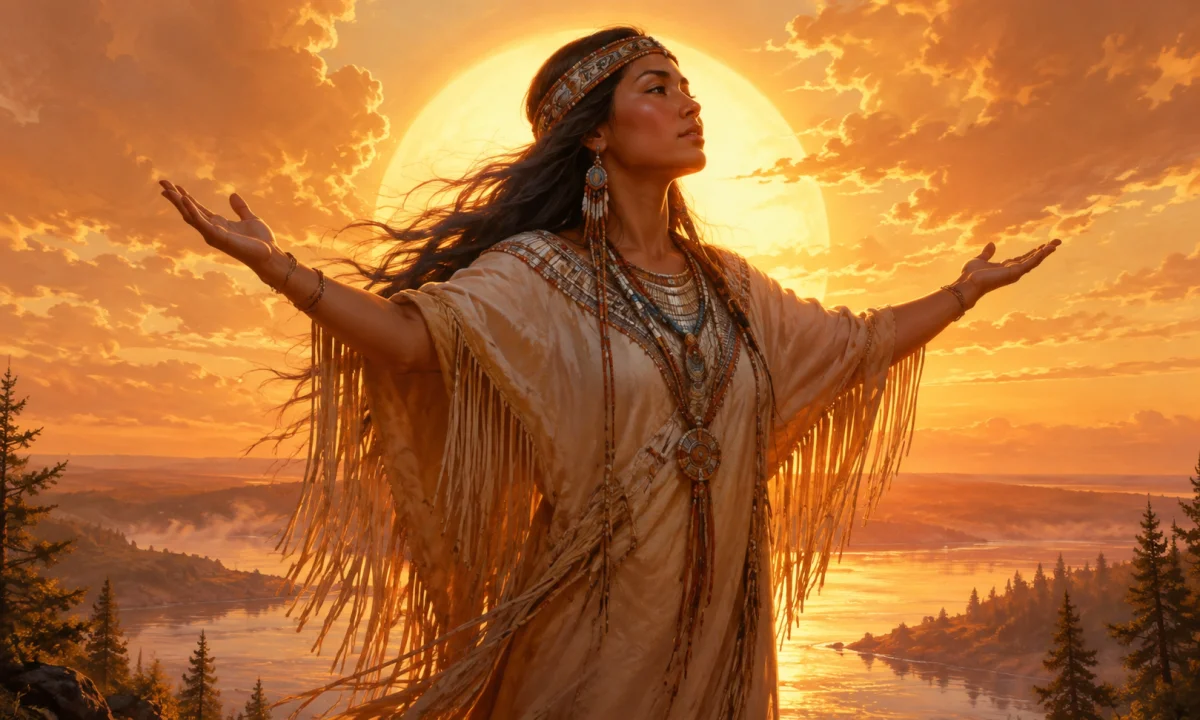
Dawn is not securely documented as a single, pan-Iroquois goddess or named supernatural being. In discussions of Iroquois mythology, the word usually refers to the daily return of light, to the eastern horizon, or to a symbolic transition between darkness and day. Some modern summaries personify Dawn as a female spirit or deity, but that identification is difficult to support as a common tradition shared by all the Haudenosaunee nations. The surviving evidence instead points to a rich set of teachings about light, the sun, the moon, the ordering of the world and the renewal of life.
Cultural setting
The term Iroquois is often used for the Haudenosaunee, the Confederacy traditionally composed of the Mohawk, Oneida, Onondaga, Cayuga and Seneca, with the Tuscarora joining later. These nations have distinct languages, communities and narrative traditions, even though they share important political and cultural relationships. A story recorded among one nation should not automatically be treated as a belief held identically by all the others.
Haudenosaunee religious knowledge has traditionally been transmitted through spoken narratives, ceremonies, personal teachings and community practice. It was not organized as a single written mythology with a fixed list of gods. Early European and colonial writers recorded stories through translation and often forced Indigenous beings into categories such as “god,” “goddess,” “spirit” or “devil.” Those labels can obscure important differences between a creator, a personified natural force, a ritual power and a character in a traditional narrative.
This background is especially important for Dawn. In English, “dawn” is both a time of day and an abstract idea. A translator or later writer may turn that idea into a named figure even when the original tradition speaks about the coming of light without presenting Dawn as an independent person. The absence of a well-established pan-Iroquois Dawn does not make the subject meaningless; it means that the subject should be treated as a theme or symbolic force unless a particular nation, language and source provide a more precise identity.
Dawn and the ordering of the world
Haudenosaunee creation traditions commonly describe a world that is brought into order through a sequence of powerful events. One widely known group of narratives begins with the Sky World and the woman often called Sky Woman in English. She falls or descends from that upper realm and is received by water animals. With their help, earth is brought up from beneath the water and placed upon the back of a great turtle. This is the foundation of the image often called Turtle Island.
Different versions then describe the emergence of human beings, plants, animals, the heavenly bodies and the powers that shape earthly life. The details vary considerably. Some narratives focus on the conflict or contrast between beneficent and destructive forces, frequently represented by the twins commonly rendered in English as Good Mind and Flint. Other accounts use different names, emphases or sequences. These stories are not simply explanations of physical processes. They describe how life became inhabitable, why the world contains both nourishment and danger, and why human beings have responsibilities within a living order.
Within such a worldview, dawn can be understood as one of the recurring signs that the world remains ordered and alive. Night does not permanently overcome day, and darkness is followed by the return of light. The event is therefore associated with renewal, continuity and the restoration of visibility. Yet this symbolic interpretation should not be mistaken for evidence that Dawn was always imagined as a separate goddess with a personal biography.
Light, the sun and the east
The sun holds major importance in Haudenosaunee thought, as it does in many Indigenous traditions of North America. Sunlight makes growth possible, marks the passage of time and supports the seasonal rhythm on which food, travel and ceremony depend. The first light of morning is consequently connected with the sun’s wider powers, even when it is not given an independent name.
The east is the direction from which the sun appears. In many Indigenous North American traditions, directions carry ceremonial and ethical associations, but these associations are not identical from nation to nation. Haudenosaunee teachings may connect the east with beginnings, illumination or the opening of a new day, yet the precise significance depends on the community and context. It is safer to speak of recurring directional and solar symbolism than to assign one universal meaning to all Haudenosaunee peoples.
Morning also has a practical religious dimension. The beginning of the day is a fitting time for gratitude, attention and recognition of the forces that sustain life. Haudenosaunee thanksgiving traditions express respect for the earth, waters, plants, animals, winds, heavenly bodies and other relations. The central idea is not that humans stand outside nature and control it, but that they live within a network of reciprocal obligations. Dawn represents the moment when this living world becomes visible again and daily responsibilities resume.
Is Dawn a named Iroquois deity?
There is no single, consistently attested Iroquois figure whose standard name in the traditional languages is simply “Dawn.” English-language lists of mythological beings sometimes include Dawn as an Iroquois goddess or spirit, but such entries may reflect a modern classification, a loose translation or an unverified repetition from earlier compilations. They should not be treated as equivalent to a clearly documented Haudenosaunee deity.
The problem is partly linguistic. The Haudenosaunee languages are unrelated to English and contain terms whose meanings cannot always be represented by one English noun. A word describing the morning light might refer to a process, a condition, a place, an event or a being depending on grammatical form and traditional context. Translating such a word as “Dawn” may be convenient, but it does not prove that the culture imagined a goddess with that name.
Names also vary in spelling because writers have represented Haudenosaunee sounds through different European alphabets. A name found in one nineteenth-century collection may be difficult to compare with a term recorded later by a community linguist. Without a precise original-language form and a reliable account of how the term was used, claims about Dawn’s family, appearance or powers remain uncertain.
For this reason, Dawn should be distinguished from well-attested figures such as Sky Woman, the culture heroes associated with the formation of the world, and Heno, the powerful being connected in many traditions with thunder. These figures have substantial narrative or religious contexts, although their names and roles also vary. Dawn does not have the same level of consistent documentation as a distinct pan-Iroquois character.
Dawn as a symbolic threshold
Even when it is not personified, dawn carries strong mythological meaning. It is a threshold: the point between night and day, concealment and revelation, sleep and action. Traditional narratives frequently use such thresholds to express changes in status. A person may leave one condition and enter another; a world may become habitable; a hidden power may be disclosed; or a community may receive the knowledge needed to live properly.
That interpretation fits the broad structure of Haudenosaunee creation traditions, in which the world is not presented as a finished, motionless object. It is shaped, repaired and maintained. The alternation of darkness and light offers a natural image for this continuing process. Each morning demonstrates that order is renewed, but it does not remove hardship, conflict or mortality. Light makes the world visible; it does not make the world free from danger.
Dawn can also symbolize the beginning of a collective undertaking. Haudenosaunee political and ceremonial life places emphasis on gathering minds together, restoring balance and acting with awareness of future generations. The arrival of morning may therefore be read as an image of renewed communal attention. Such an interpretation is consistent with the importance of thanksgiving and social responsibility, but it should be presented as interpretation rather than as the name of a specific traditional doctrine called “the cult of Dawn.”
Related figures and concepts
Sky Woman
Sky Woman is associated with the passage between the Sky World and the earth. Her descent is one of the central episodes in many versions of Haudenosaunee creation tradition. Because she comes from above and helps establish the conditions for life on earth, later writers sometimes connect her with light or the heavens. She should not, however, be renamed Dawn. Sky Woman is a distinct figure with her own narrative, relationships and significance.
The sun and moon
The sun and moon appear in different forms across Haudenosaunee stories and teachings. Their movements establish cycles of time, and accounts of their origins or relationships vary. Some sources present them through family or gendered imagery, while others emphasize their functions in the cosmic order. These variations make it misleading to claim a single Iroquois story in which Dawn is universally the daughter, wife or companion of the sun or moon.
Good Mind and Flint
The opposing or complementary powers often rendered as Good Mind and Flint are associated with the formation of the world and the mixture of benefit and danger within it. Their conflict helps explain why the earth contains both helpful and harmful features. Dawn may be interpreted symbolically within this contrast because light follows darkness, but it is not simply another name for either twin.
Heno
Heno is widely known in Haudenosaunee traditions as a thunder-being or powerful force connected with storms and the protection of life. Thunder and dawn can both appear in modern lists of “nature gods,” but they are not interchangeable. Dawn concerns the return of daylight; Heno belongs to a different cluster of stories and religious meanings.
Sources and limits of the evidence
Knowledge of Haudenosaunee mythology comes from several kinds of evidence: oral tradition preserved within communities, records made by missionaries and ethnographers, linguistic work, historical descriptions and modern Indigenous scholarship. Each kind of evidence has limitations. Outsiders sometimes misunderstood ceremonial language, removed stories from their social setting or translated sacred concepts into European theological categories.
Written collections may also preserve only one version of a story. A narrative recorded from a Seneca speaker cannot automatically establish what Mohawk, Oneida, Onondaga, Cayuga or Tuscarora communities traditionally taught. Even within one nation, storytellers and families may preserve different forms. Variation is not necessarily an error; oral traditions can maintain a stable framework while allowing differences in emphasis, wording and detail.
These limits explain why a responsible account of Dawn must distinguish between documented tradition and comparative interpretation. It is reasonable to discuss morning light as part of a cosmology concerned with the sun, cycles, renewal and the responsibilities of living beings. It is not reasonable to supply an elaborate genealogy, a fixed physical appearance or a set of sacred rituals for a goddess named Dawn without dependable evidence.
Modern representations
Modern books, websites and fantasy settings sometimes turn Dawn into a named Native American goddess. Such portrayals may combine motifs from several Indigenous traditions or use “Iroquois” as a broad label for material drawn from different nations. A character who controls sunrise, carries a torch or serves as the consort of a sun god may be an imaginative invention rather than a figure from Haudenosaunee tradition.
Contemporary Indigenous artists, educators and storytellers may also use dawn as a meaningful image of renewal, survival, cultural continuity or the recovery of language. That creative use belongs to modern expression and should not be confused with a claim about an ancient deity. The most accurate understanding of Dawn in an Iroquois context is therefore both modest and significant: morning light is a powerful symbol within a world ordered by cycles and relationships, while a separate, universally recognized goddess called Dawn is not securely established in the traditional record.