WORLD
WORLD
Flying Head
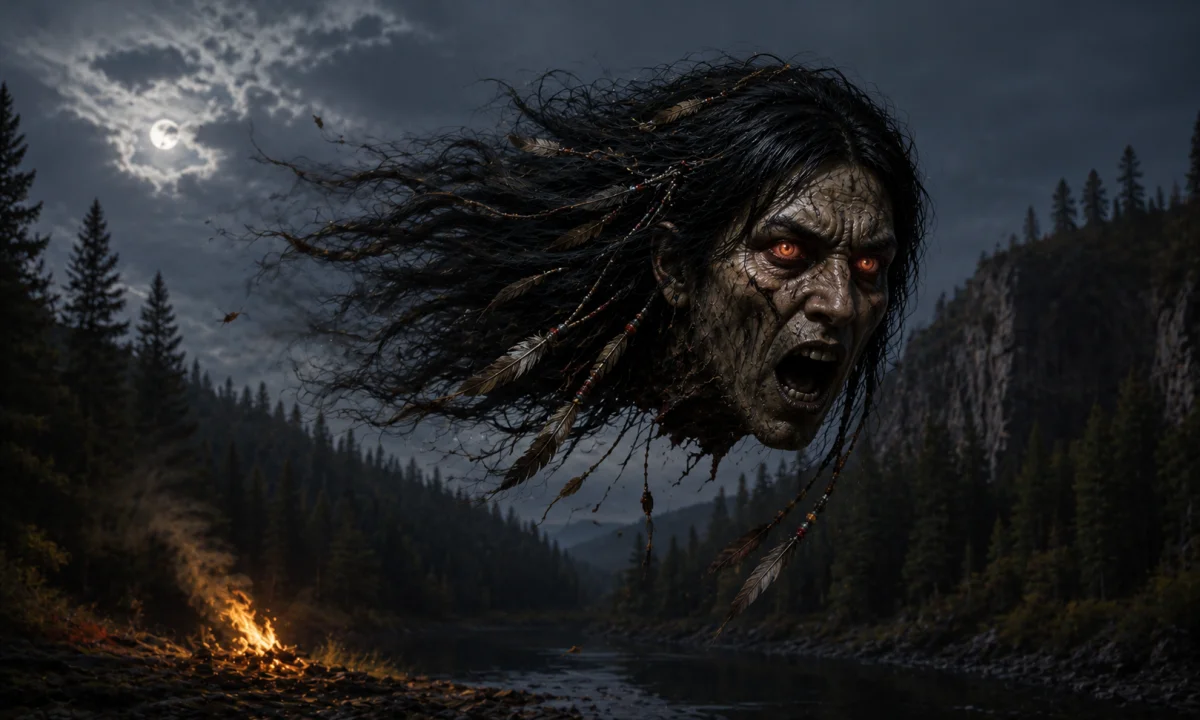
Flying Head is a frightening being associated chiefly with Seneca and other Haudenosaunee, or Iroquois, storytelling. In English-language retellings, it is usually described as a huge disembodied head that moves through the air or appears suddenly at night. Its size, manner of movement, and precise place in the story vary between accounts. “Flying Head” is best understood as an English descriptive name used for a traditional narrative figure, not necessarily as a single, uniformly defined creature shared by every Iroquois nation.
Origins and cultural setting
The Haudenosaunee Confederacy traditionally includes the Mohawk, Oneida, Onondaga, Cayuga, Seneca, and Tuscarora nations. These communities have distinct languages, histories, ceremonial practices, and bodies of oral tradition, even though they are connected through the Confederacy. As a result, the phrase “Iroquois mythology” can conceal important local differences. Stories identified in English as belonging to Iroquois mythology may come from one particular nation, especially the Seneca, rather than from all Haudenosaunee communities.
The Flying Head is most often associated with Seneca narratives recorded by outsiders or written down from oral accounts. Such records preserve valuable material, but they do not provide a complete or unchanged account of the tradition. Translators and collectors selected particular stories, gave them English titles, and sometimes arranged them according to European ideas of myth, legend, folklore, or monster tale. A title such as The Flying Head may therefore describe how a collector understood a story rather than reproduce an original Indigenous name.
Traditional Haudenosaunee narratives were not simply entertainment. Stories could preserve history, teach conduct, explain danger, express relationships between human beings and the wider world, or provide occasions for reflection and instruction. The same narrative might be told differently according to the storyteller, audience, season, or purpose. A frightening figure could function as a warning without belonging to a fixed system of “monsters” comparable to that found in modern fantasy fiction.
Name and identity
There is no universally accepted spelling or single Indigenous-language equivalent that can be confidently presented as the original name of the Flying Head across all Iroquois traditions. English sources use forms such as Flying Head, the Flying Head, or occasionally similar descriptive expressions. These names should not automatically be treated as the proper name of a pan-Iroquoian supernatural being.
The word “flying” can also be misleading. In modern English, it suggests wings or ordinary birdlike flight. In traditional descriptions, the being may instead be imagined as moving through the air, rushing toward people, or appearing to travel without a visible body. The emphasis is on the unnatural mobility of a severed head, not necessarily on feathered wings. Details differ among retellings, and some accounts are too brief to establish exactly how the being moved.
“Head” is the central feature of the figure. The body is absent, and the head is presented as enormous, animate, and threatening. This separation from the rest of the human form is what gives the being its disturbing character. It violates ordinary expectations about life, death, and the structure of the body, making it a powerful image of something that should not be moving but nevertheless does.
Appearance and behaviour
Descriptions commonly portray the Flying Head as a gigantic head with prominent facial features. Hair, eyes, ears, and mouth may be emphasized, although not every recorded version supplies the same details. The mouth can give the being an especially threatening appearance, while the enlarged eyes and hair contribute to its grotesque and uncanny nature. Some illustrations and later summaries add fangs, exaggerated facial features, or a more conventionally monstrous appearance; those additions should not be assumed to belong to every traditional account.
The Flying Head generally appears as a being of fear rather than as a helpful spirit, culture hero, creator, or ancestral guardian. It may approach people at night, frighten a household, or confront individuals who are isolated or unprepared. The threat is often psychological as well as physical. A person who sees a giant head moving through the darkness encounters a violation of the natural order before any attack has taken place.
It is not accurate to assign the Flying Head a fixed list of supernatural powers. Accounts may imply that it can fly, move rapidly, appear unexpectedly, or survive without a body. Beyond those basic features, claims about invisibility, possession, magical speech, or particular methods of killing it usually come from individual retellings or modern summaries rather than from a consistent body of tradition.
Stories and narrative patterns
The stories known in English are not identical. Some are presented as short encounters with a frightening apparition, while others develop the event into a longer tale involving a household, a traveller, or a group of people faced with an unexplained danger. Because the surviving written versions are selective and vary in detail, it is difficult to reconstruct one definitive plot.
A recurring narrative pattern is the arrival of an apparently impossible being at a vulnerable moment. Night, solitude, unfamiliar surroundings, and the absence of ordinary protection intensify the encounter. The Flying Head may be recognized only after witnesses have tried to explain what they see. Its identity as a head without a body is itself part of the shock.
In some retellings, the important question is not simply whether the creature can be defeated in combat. People may need to understand what they are facing, remain calm, use intelligence, or seek the right form of assistance. This pattern is common in traditional stories throughout the world, but it should not be turned into a universal formula for every Flying Head narrative. The surviving accounts do not support a single, standardized method of defeating the being.
Nor is there a securely established genealogy that makes the Flying Head the child, spouse, enemy, or transformed form of another major Haudenosaunee figure. Online lists sometimes connect unrelated beings because they share frightening features or because a collector’s title has been treated as a formal mythological name. Such connections require evidence from a specific tradition and should not be assumed.
Meaning and cultural significance
The Flying Head’s most immediate significance lies in its violation of boundaries. It is a head separated from the body, a humanlike form that is no longer properly human, and a dead or impossible thing that remains active. Its movement through the air further removes it from familiar categories. The figure therefore embodies the unsettling possibility that the ordinary rules governing bodies and the living world can be broken.
Its frightening appearance can also give shape to anxieties about death, isolation, and unseen danger. These themes are widespread, but their presence does not justify reducing the Flying Head to a symbolic code in which every detail has one fixed meaning. Haudenosaunee storytellers and audiences may have understood a particular narrative through its local setting, the behaviour of its human characters, and the purpose for which it was told.
Stories of dangerous beings can help define proper conduct without functioning as simple moral fables. A tale may encourage attention to warnings, respect for experienced people, caution after dark, or awareness of the limits of human knowledge. Yet the available material does not establish that the Flying Head had one official lesson shared by all Iroquois nations. Interpretation should remain connected to the individual story and its cultural context.
It is also important not to label the Flying Head a “demon” without qualification. “Demon” comes from religious and folkloric categories developed in other traditions, especially those shaped by Christian and classical European ideas. A terrifying supernatural figure in a Haudenosaunee narrative does not automatically occupy the same religious position. The Flying Head is more safely described as a frightening supernatural being or monster-like figure in English retellings.
Sources and the problem of classification
Knowledge of the Flying Head comes primarily through recorded folklore rather than through a single canonical scripture or sacred book. Haudenosaunee oral traditions were transmitted through performance and memory, and written collectors recorded only particular versions. The language used in the records may also reflect the collector’s assumptions about what counted as a myth, legend, tale, or supernatural belief.
Collections of Seneca and wider Iroquois stories helped bring the figure to the attention of English-speaking readers. They are historically useful, but a written transcription is not identical to an oral performance. Tone, gesture, audience response, pronunciation, and culturally specific meanings may not survive on the page. In addition, an English title can make a descriptive phrase look more standardized than it was in the original language.
The category “mythology” should therefore be used carefully. In ordinary modern English, mythology can mean a body of traditional stories about gods and supernatural beings. The Flying Head does not appear to be a major creator deity or a central figure in Haudenosaunee cosmology. It belongs more appropriately to the region of frightening traditional narratives, local supernatural lore, and stories about encounters with dangerous beings.
Distinction from similar figures
The Flying Head should not be confused with every severed-head or head-shaped creature found in world folklore. Many cultures have stories about disembodied heads, undead beings, witches, or flying spirits, but resemblance does not demonstrate a historical relationship. A similar motif can arise independently because the human head is a powerful symbol of identity, life, death, and personhood.
It should also be distinguished from the Dullahan of Irish folklore, the penanggalan of Southeast Asian traditions, and other modern horror figures that travel through the air without a body. These beings have different cultural histories, narratives, and religious or folkloric settings. Grouping them together as versions of one universal creature erases those differences.
Likewise, the Flying Head is not the same as the many “flying head” creatures created for contemporary fantasy, horror games, films, or internet folklore. Modern artists may add wings, glowing eyes, supernatural powers, or elaborate backstories. Those features belong to later invention unless they can be traced to a particular traditional account.
Later reception
The image of a giant airborne head is visually striking and has been reused in modern monster catalogs, paranormal lists, illustrated encyclopedias, and horror-oriented media. In these settings, the Flying Head is often presented as though it were a fully standardized creature with a fixed appearance and power set. That treatment reflects modern classification and entertainment more than the uneven evidence of the traditional record.
Responsible modern discussion keeps the cultural identification visible: the figure is associated especially with Seneca and other Haudenosaunee storytelling, the English name may be a collector’s descriptive label, and accounts vary. Treating the Flying Head only as a generic horror monster removes it from the oral traditions that give the figure its historical meaning.
The enduring force of the image comes from its simplicity. A head should not move independently, and certainly should not rush through the night toward the living. In Haudenosaunee-related folklore, that breach of ordinary reality creates a memorable figure of fear while also demonstrating why traditional stories must be read in their particular cultural and narrative settings rather than reduced to entries in a universal monster catalogue.