WORLD
WORLD
Hahgwehdiyu
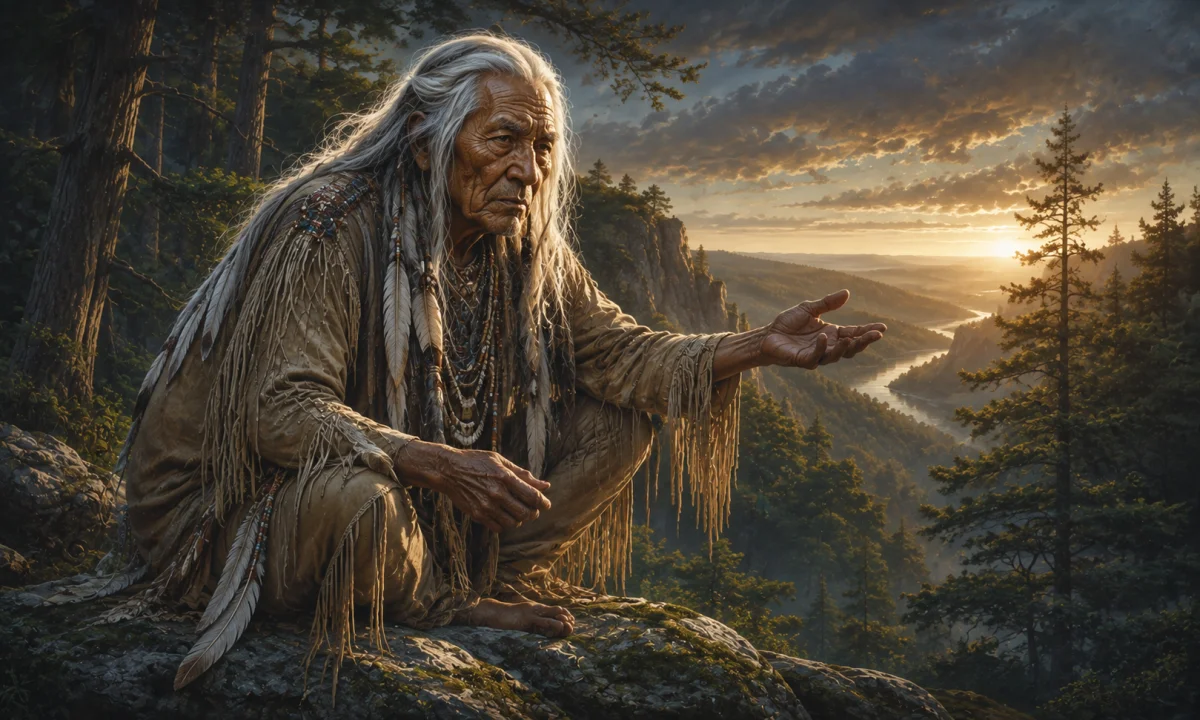
Hahgwehdiyu is a figure from Haudenosaunee tradition, especially associated with the Iroquois-speaking peoples of what is now northeastern North America. He is commonly described as the Sky Woman’s grandson or as the benevolent twin/paired figure who helps shape the world after its creation. Because Haudenosaunee traditions were preserved primarily through oral transmission and later recorded by outside observers and Indigenous writers, spellings, story details, and even the exact identity of Hahgwehdiyu can vary from source to source and from nation to nation.
Tradition and cultural setting
Hahgwehdiyu belongs to the mythic world of the Haudenosaunee, the confederacy often called the Iroquois Confederacy, which includes the Mohawk, Oneida, Onondaga, Cayuga, Seneca, and later Tuscarora nations. In these traditions, creation is not a distant, abstract event but a foundational set of teachings about the origin of the earth, the organization of life, and the responsibilities human beings owe to one another and to the world around them.
Haudenosaunee origin stories are not all identical. Different communities preserve different versions, and storytellers may emphasize different episodes or characters. Hahgwehdiyu is one of the names that appears in versions of the creation cycle in which a world-bearing and world-making drama unfolds around Sky Woman, the great turtle, and the forces that bring order, plants, animals, and human society into being.
Because these stories were transmitted orally, not every recorded version reflects the same language or the same religious emphasis. Some tellings present Hahgwehdiyu as a creator-like benevolent being; others stress his role in relation to his twin or counterpart, Hahgwehdaetgah or a similarly named opposing figure. The names themselves are often transliterated in different ways, and English renderings can obscure pronunciation and nuance.
Name and identity
The name Hahgwehdiyu is usually interpreted as referring to the “good mind” or “good-minded” aspect of creation in some Haudenosaunee languages and retellings, though translations vary and should be treated cautiously. In published materials, the spelling may differ, and the character may also be discussed under related or overlapping names depending on the linguistic source and nation-specific tradition.
Hahgwehdiyu is often identified as one half of a duality. In some versions, he and his brother or counterpart represent the contrast between harmony and disorder, life and harm, or constructive and destructive power. This dual structure should not be simplified into a straightforward moral allegory imported from outside traditions; within Haudenosaunee thought, the relationship is more complex and is tied to how the world comes into balance through struggle and differentiation.
It is important not to confuse Hahgwehdiyu with the more general category of a supreme creator in the later monotheistic sense. In Haudenosaunee traditions, creation can involve multiple beings, forces, and responsibilities, and stories may focus on how the world was shaped rather than on a single all-powerful deity in the way expected in some Christian or classical frameworks.
Role in creation stories
Hahgwehdiyu is best known from the creation narrative in which Sky Woman falls from the upper world and is received by animals who help her survive. In many versions, the earth is formed on the back of a great turtle, which becomes the foundation of the land. Hahgwehdiyu is linked to the shaping of this new world, especially to the ordering and beautifying of creation.
One common pattern in the stories is that Hahgwehdiyu represents the powers that make the world habitable. He is associated with light, growth, useful plants, and the conditions that support life. By contrast, his opposing twin or brother is often associated with hardship, pain, and obstruction. The stories are not merely about one good being defeating one bad being; they explain why the world contains both blessing and difficulty, and how human beings must live with both.
In some tellings, Hahgwehdiyu’s actions help establish the sun, the moon, or other features of the sky. In others, he contributes to the creation of the plants that sustain people, especially the so-called Three Sisters—corn, beans, and squash—which are central to Haudenosaunee agriculture and ceremony. These details can differ by community and source, but the broader theme remains that he is a force for ordered, life-giving creation.
Hahgwehdiyu and the twin relationship
The twin motif is one of the most important aspects of Hahgwehdiyu’s identity. In versions where he has an opposing twin, the pair may be born from Sky Woman or from another creation event. Their relationship often explains the presence of duality in the world. One brother may create in a careful, constructive way, while the other acts impulsively or destructively. The resulting world is a mixture of benefit and difficulty, reflecting the tension between balanced living and harmful force.
This twin pattern is sometimes compared by outsiders to other mythological dualities, but such comparisons can be misleading if they ignore Indigenous meanings. In Haudenosaunee storytelling, the duality is not necessarily a strict opposition of absolute good versus absolute evil. Rather, it helps explain why the world is made of relationships, choices, responsibilities, and consequences. The stories also encourage moral attention to balance, reciprocity, and the maintenance of order.
Because of the many published versions, there is some uncertainty about whether the opposing figure should always be called a twin, a brother, or another kind of close relation. The important point is that Hahgwehdiyu is often understood in contrast with a counterpart whose actions help define the shape of the world.
Attributes and symbolism
Hahgwehdiyu is usually not described with a fixed visual appearance in the way a deity might be depicted in a later artistic tradition. Oral tradition focuses more on his deeds and significance than on a standard image. When modern illustrations show him, they reflect later artistic interpretation rather than a universally traditional iconography.
Symbolically, Hahgwehdiyu is associated with:
- Creation and ordering of the world
- Light and the growth of life-sustaining things
- Balance in the face of opposition
- Responsibility toward the world and its living beings
- Agricultural abundance, especially in stories connected with useful plants
These associations matter not just as mythic motifs but as cultural teachings. Haudenosaunee traditions often link cosmology to social life: how people farm, how they share, how they honor gratitude, and how they understand their obligations to the natural world. Hahgwehdiyu’s role in creation therefore also carries ethical weight.
Stories and themes
Several recurring themes appear in stories about Hahgwehdiyu. One is the shaping of earth from an initially unstable or incomplete condition. Another is the transformation of conflict into a livable cosmos. Another is the emergence of the crops and natural features that make human life possible.
In some versions, the story moves from Sky Woman’s fall to the participation of animals, the growth of land on Turtle’s back, and the birth of twin beings who influence the world’s future. Hahgwehdiyu then becomes the figure who establishes beneficial features and guides the world toward livability. His acts are not isolated miracles; they are part of a larger chain of relations among human beings, animals, plants, and cosmic powers.
Another recurring theme is the explanation of suffering. If the world contains pain, injury, hunger, and death, the stories account for these not as random accidents but as the result of one aspect of the twin dynamic or opposing force. Hahgwehdiyu’s constructive power is thus meaningful precisely because it is set against a world that is not fully free of difficulty.
Some retellings also connect him to teachings about respect and gratitude. The world is not portrayed as a possession to be exploited, but as a shared and moral environment shaped by reciprocal gifts. In this sense, Hahgwehdiyu is relevant not only to cosmology but also to how people understand themselves as participants in a living order.
Relationship to Sky Woman and other figures
Sky Woman is central to the creation cycle in many Haudenosaunee traditions, and Hahgwehdiyu’s identity is often understood in relation to her. Depending on the version, he may be described as her grandson, her son, or part of the generational line that follows her arrival in the new world. Because different nations and storytellers preserve different variants, no single relationship should be treated as universally fixed.
The broader creation cycle also includes figures such as the animals who aid Sky Woman, the great turtle that supports the land, and the opposing twin or brother associated with destructive power. Hahgwehdiyu stands within this network rather than apart from it. His significance comes from his place in the unfolding of the world, not from an isolated heroic identity.
Some sources connect him with other culture heroes or creator figures, but caution is necessary. Similar roles in different Indigenous traditions do not mean the beings are the same. Names, functions, and meanings can be distinct even when outsiders notice broad similarities such as creation, agriculture, or the regulation of natural forces.
Sources, transmission, and variation
As with many Indigenous mythic figures, the surviving record of Hahgwehdiyu comes through a combination of oral tradition, Indigenous scholarship, and historical accounts written by outsiders. This creates important interpretive challenges. Spellings vary, translations differ, and some published versions may simplify or reshape the stories to fit non-Indigenous expectations.
It is also common for compilations of “Iroquois myths” to blend together traditions from different nations or to normalize them into a single story. That can obscure the diversity of Haudenosaunee teaching. Hahgwehdiyu may appear in one nation’s account more prominently than in another’s, or may be known under a related name that does not translate neatly into English.
Scholars generally treat the creation narratives as living traditions rather than fixed texts. That means the figure of Hahgwehdiyu should be understood through the voices of the communities that preserve these teachings, not solely through colonial-era summaries. Where a source is uncertain or disputed, the uncertainty itself is part of the historical record.
Distinction from similar figures
Hahgwehdiyu is sometimes confused with other creator or culture-hero figures from Native North American traditions, especially because many popular accounts blur distinct nations together. He should not be conflated with:
- Sky Woman, who is a separate and foundational figure in the creation cycle
- The opposing twin/brother, who is often given a different name and role
- Generic “Great Spirit” concepts, which are often imposed by outside interpreters and may not accurately reflect Haudenosaunee categories
He should also not be reduced to a simple “good twin” in a cartoon-like moral scheme. Although he is usually associated with beneficent creation, the stories are more nuanced. They explore the world as a place where order must be made and maintained, and where harmony exists alongside struggle.
Interpretation and cultural significance
Hahgwehdiyu has enduring importance because he helps express a Haudenosaunee understanding of how the world came to be and how people should live within it. The creation stories are not merely explanatory myths in a modern academic sense; they are teachings about relationship, obligation, and the structure of reality.
His connection with useful plants and the formation of the earth also reflects the deep importance of agriculture in Haudenosaunee life. The crops associated with the tradition are not just foods but sacred gifts tied to identity, seasonal cycles, and ceremonial practice. In this setting, Hahgwehdiyu is part of a wider moral ecology in which land, food, and community are inseparable.
Modern readers sometimes approach Hahgwehdiyu through the lens of comparative mythology and see him as a personification of the “good mind.” While that can be a useful shorthand, it should not replace the richer Haudenosaunee understanding of the figure’s place in creation, kinship, and responsibility. The stories carry religious, historical, and cultural meaning that cannot be reduced to a single abstract idea.
Modern reception
Hahgwehdiyu does not have a large independent presence in global popular culture, and that is significant in itself. He is far more important within Haudenosaunee religious and cultural memory than in mass-market entertainment. When he does appear in modern contexts, it is usually in educational materials, Indigenous cultural writing, children’s retellings, or discussions of Haudenosaunee creation stories.
Modern adaptations should be treated carefully. Some popular retellings simplify the twin relationship, flatten the religious context, or present the figure as a generic “Native American god.” That framing is misleading. Hahgwehdiyu belongs specifically to Haudenosaunee tradition, and his significance is tied to that particular cultural and spiritual world.
In contemporary Indigenous discourse, creation stories remain living teachings rather than museum pieces. Hahgwehdiyu continues to matter because the values embedded in the stories—balance, gratitude, responsibility, and respect for the living world—remain part of ongoing cultural life.