WORLD
WORLD
Cuaxolotl
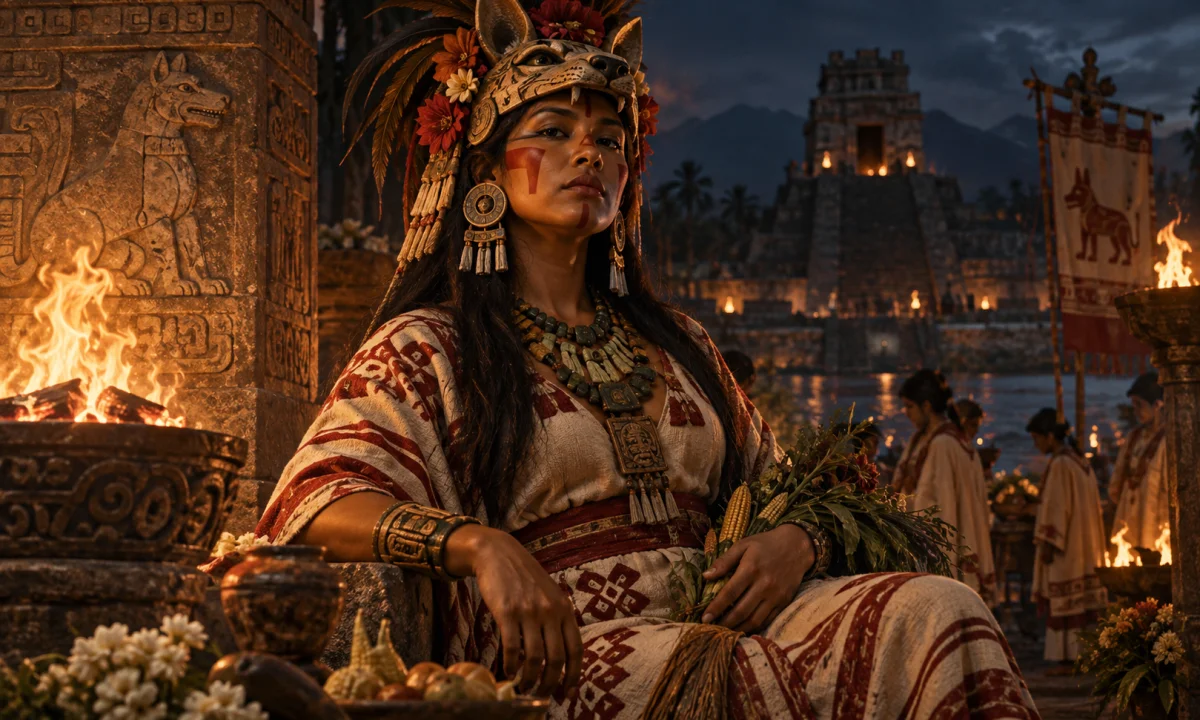
Cuaxolotl is a very obscure name associated in some modern reference works with Aztec or broader Nahua mythology. The evidence for Cuaxolotl is limited, and the figure does not possess the clearly documented mythology of better-known deities such as Quetzalcoatl, Huitzilopochtli, Tlaloc or Xolotl. Descriptions of Cuaxolotl as a two-headed goddess, a deity of twins, or a being connected with monsters and unusual births appear in secondary compilations, but these claims are not supported by a large, consistent body of surviving Nahuatl tradition.
For that reason, Cuaxolotl is best treated as an uncertain or poorly documented name rather than as a fully established member of the Aztec pantheon. The spelling, meaning, gender and religious classification of the figure may all be affected by the limited evidence and by later attempts to interpret an isolated name.
Cultural setting
The term “Aztec mythology” is a convenient modern label, but it covers religious traditions associated with several Nahua-speaking peoples of central Mexico. The Mexica of Tenochtitlan formed the most powerful state in the region at the time of the Spanish invasion, yet their religious world was connected with older and neighbouring traditions. Gods, sacred places, ceremonies and stories could vary between communities.
Most written knowledge of Nahua religion comes from sources recorded after the conquest. These include alphabetic texts written in Nahuatl or Spanish, descriptions produced by Christian missionaries, historical accounts, and painted manuscripts that were interpreted by later scholars. Such sources preserve a great deal of information, but they do not form a complete and neutral record of pre-conquest religion. Indigenous informants, artists and scribes worked within changing political and religious circumstances, while European observers sometimes translated Nahua concepts into categories that did not precisely match them.
A name that appears rarely, or only in later lists, can therefore be difficult to classify. It may represent a local deity, an epithet of a better-known being, a name copied with an error, a ritual title, or a figure whose traditions were not recorded in detail. Cuaxolotl belongs to this uncertain group.
The name Cuaxolotl
The form Cuaxolotl appears to contain Nahuatl elements, but its exact interpretation is not secure. The second element, xolotl, is familiar from the name of the god Xolotl and from Nahuatl vocabulary associated with a twin, companion, double or unusual form. Its meaning is complex, however, and should not automatically be translated in the same way in every compound.
The first element is sometimes connected with cuāitl, a Nahuatl word associated with the head. On that basis, Cuaxolotl is occasionally explained as something like “head Xolotl,” “head-twin” or “twin-headed being.” These translations are interpretive rather than definitive. Nahuatl compounds can be difficult to analyse when a name is transmitted without grammatical context, and the spelling used in colonial records does not always make the original structure clear.
Some modern sources instead treat the name as evidence for a being with two heads. That interpretation has influenced popular descriptions of Cuaxolotl as a double-headed goddess. It is possible that the name was understood in relation to doubling or unusual bodily form, but the surviving evidence does not establish a complete etymology or prove that a two-headed figure was worshipped under this name throughout the Aztec world.
Identity and classification
Cuaxolotl is often classified as a female deity in modern encyclopaedias and online lists. The same sources may associate the figure with twins, monsters, birth abnormalities or other forms of physical difference. These associations are plausible extensions of the name’s supposed connection with doubling, but they should not be presented as firmly documented attributes.
There is no widely preserved myth in which Cuaxolotl plays a central role. No securely established genealogy, temple cult, festival calendar or collection of prayers can be confidently assigned to the figure under this exact name. The absence of such material does not prove that no local tradition existed. Many religious practices were never recorded, and colonial sources concentrated on deities and ceremonies that missionaries or administrators considered important. It does mean that detailed claims require caution.
Cuaxolotl should therefore not be placed on the same evidentiary level as major Nahua gods whose names, images, temples and rituals are repeatedly documented. A brief or uncertain name can still be culturally meaningful, but its significance cannot be reconstructed with the same confidence as that of a major deity.
Reported appearance and attributes
The most common modern description presents Cuaxolotl as a woman with two heads or as a double-headed supernatural being. This image may reflect an interpretation of the name rather than a surviving, consistently identified representation. There is no universally recognized pre-conquest image that scholars can identify securely as Cuaxolotl.
Descriptions also connect the figure with twins and with beings regarded as physically unusual. In Mesoamerican religious thought, duplication and abnormality could carry sacred significance. Atypical births, multiple births and bodily differences might be interpreted through systems of omen, destiny and ritual classification. Yet such general features of Nahua belief should not be treated as proof of a specific cult of Cuaxolotl.
Nor is there reliable evidence that Cuaxolotl possessed a fixed set of powers. Statements that the figure protected twins, caused monstrous births, governed pregnancy or ruled over deformity go beyond what can be established securely. They may derive from attempts to construct a coherent profile from the proposed meaning of the name.
Doubling in Nahua religious thought
The possibility of a connection with doubling is not without cultural context. Nahua religion included several important ideas involving paired identities, transformation and unstable boundaries. The god Xolotl, for example, is associated in different traditions with the twin or companion of Quetzalcoatl, with transformation and with the evening aspect of Venus. He is also linked with dogs and with journeys through the underworld. His stories demonstrate that a “double” in Nahua thought was not merely a biological twin but could involve correspondence, opposition, transformation or an alternate form.
Nahua religious imagery also frequently joined complementary forces: life and death, heat and water, the celestial and the earthly, fertility and warfare. Such pairings do not mean that every unusual name represented a formal dual deity. They do show why a name interpreted through doubling might have attracted later interest.
Twins and multiple births could be viewed in ways that differed from ordinary birth. Across Mesoamerica, unusual births were often connected with divination and supernatural significance, although beliefs varied between communities and periods. A possible association between Cuaxolotl and twins should therefore be understood as a tentative interpretation within a wider cultural setting, not as a universally recorded doctrine.
Stories and relationships
No dependable cycle of myths about Cuaxolotl has survived. In particular, there is no firmly documented story establishing the figure as the spouse, mother, rival or companion of another major Aztec deity. Claims that Cuaxolotl was directly related to Xolotl may arise from the shared element in the names, but a similar word component does not prove a mythological relationship.
This distinction is important because Nahua divine names often contain recurring elements. A name can refer to a quality, image, place, ritual role or wordplay without identifying a family connection. Cuaxolotl should not automatically be described as a female counterpart of Xolotl, a consort of Quetzalcoatl or a member of a divine family simply because the name includes xolotl.
Likewise, the figure should not be merged with better-attested goddesses who have associations with childbirth, fertility or bodily transformation. Coatlicue, Cihuacoatl, Toci and other female powers have their own distinct traditions and iconography. Similar themes do not establish identity.
Distinction from Xolotl
Cuaxolotl is not the same figure as Xolotl. Xolotl is a well-known Nahua deity whose traditions are recorded in several colonial sources. He is associated with Quetzalcoatl, the evening star, dogs, lightning-like imagery in some interpretations, transformation and the underworld journey. His name and iconography are also connected with the idea of the twin or double.
Cuaxolotl, by contrast, is poorly documented. The shared element xolotl may indicate a linguistic relationship, a conceptual association or nothing more than a similarity created by transcription. Without a clear primary context, it is unsafe to infer that Cuaxolotl was simply another name for Xolotl or a standard female form of him.
Distinction from other double-headed beings
Images of two-headed or combined-bodied beings occur in Mesoamerican art, but visual resemblance alone cannot identify a deity. Ancient artists used doubled forms to express transformation, union, conflict, celestial cycles or supernatural power. An image from central Mexico may also have been produced in a different period or cultural region from the Mexica world.
Cuaxolotl should not be confused with every Mesoamerican figure represented with multiple heads. Nor should the name be used as a label for unnamed monsters in codices or for modern fantasy creatures inspired by Aztec art. Identification depends on a combination of context, inscription, style, accompanying symbols and historical provenance, not simply on the presence of two heads.
Evidence and scholarly caution
The limited status of Cuaxolotl illustrates a broader problem in reconstructing Indigenous religions from colonial-era records. Surviving sources preserve some names without explaining them, while later reference works sometimes turn a brief entry into a detailed biography. Once an interpretation is repeated, it can appear more certain than the original evidence warrants.
Descriptions of Cuaxolotl should therefore distinguish between three levels of information:
- Relatively secure: the name is associated in some modern discussions with Nahua or Aztec mythology.
- Possible but uncertain: the name may contain an element related to Xolotl or to the head, and may have inspired an interpretation involving doubling.
- Unestablished: a complete myth, fixed iconography, a definite divine genealogy, and specific powers over twins, childbirth or monsters.
This cautious approach does not make the name unimportant. It prevents an uncertain figure from being presented as though a rich traditional record existed when it does not. It also leaves room for future linguistic or historical work to clarify whether Cuaxolotl was a local deity, an epithet, a damaged transcription or a later construction.
Modern reception
Cuaxolotl is most visible today in encyclopaedic lists, mythology websites, fictional settings and discussions of unusual Aztec gods. Modern writers are often drawn to the apparent image of a double-headed goddess because it is visually striking and fits contemporary interest in monsters, twins and liminal beings.
These modern portrayals may use Cuaxolotl as a symbol of duality, transformation, otherness or supernatural birth. Such themes can be creative and meaningful, but they are modern interpretations rather than securely documented features of pre-conquest worship. A fictional character named Cuaxolotl, or a game depiction based on a two-headed goddess, should not be treated as evidence for ancient Nahua tradition.
The most responsible description of Cuaxolotl is consequently a limited one: a poorly attested name connected by some later interpreters with a double-headed or twin-related female being, but without a securely preserved mythology or universally accepted identity. Any fuller account should clearly mark where historical evidence ends and reconstruction begins.