WORLD

Copacati
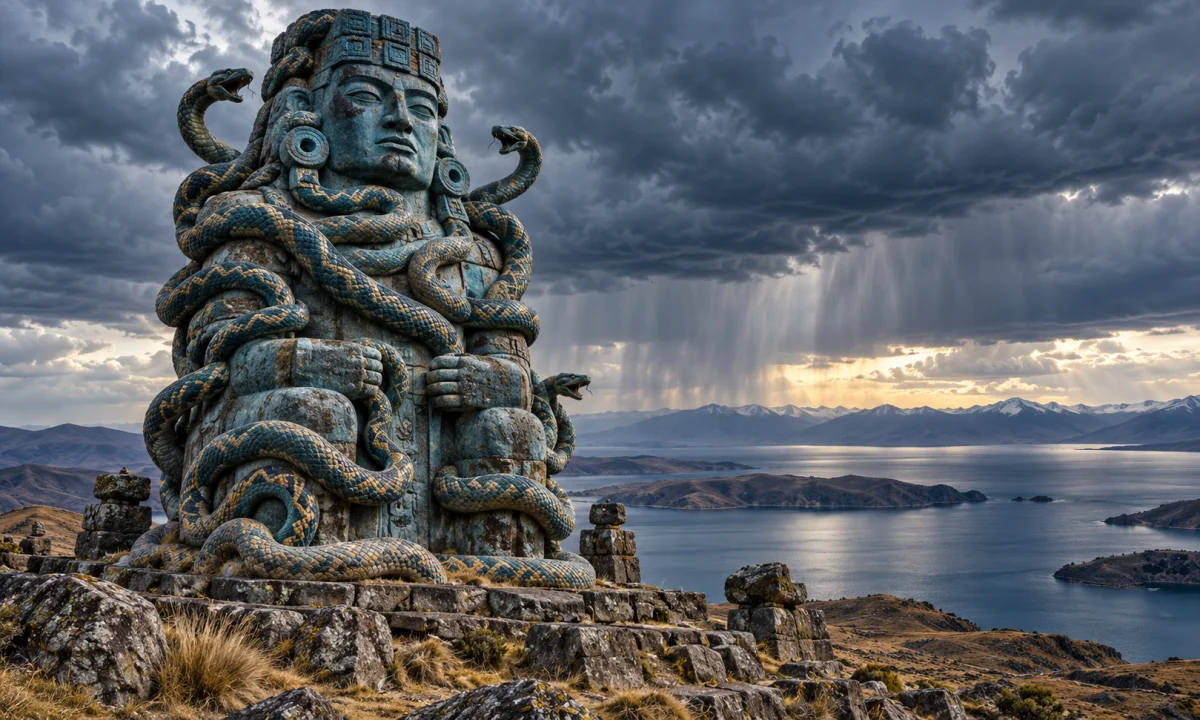
Copacati is a little-known water deity associated with the Inca religious world and, especially, with the region around Lake Titicaca in the southern Andes. She is commonly described as a goddess of lakes, springs, or water more generally. Unlike major Inca figures such as the creator god Viracocha, the sun god Inti, or the earth mother Pachamama, Copacati is preserved mainly through brief references and later summaries rather than through a large cycle of surviving myths.
Origins and cultural setting
Copacati belongs to the religious environment of the central Andes, where water was essential to agriculture, animal husbandry, travel, and settlement. The Inca Empire incorporated many communities and sacred places into a wider political and ritual system, but local religious traditions did not disappear simply because the Inca state expanded. A deity connected with a particular lake, spring, or landscape could remain important locally while being identified by later writers as part of “Inca mythology.”
Lake Titicaca was one of the most sacred places in the Andes. It lies high in the Altiplano, on the present-day border between Peru and Bolivia, and was connected with important origin traditions. In Inca accounts recorded during the colonial period, the first Inca ruler, Manco Cápac, and Mama Ocllo emerged from the waters or vicinity of Lake Titicaca before travelling to establish the Inca realm. The lake also held ancient significance for Aymara-speaking peoples and other communities whose traditions predated Inca rule.
This setting matters when considering Copacati. She should not automatically be understood as a goddess created by the Inca state or worshipped uniformly throughout the empire. The surviving evidence points instead to a water-related figure associated with the Titicaca region and subsequently classified within accounts of Inca religion. The boundary between “Inca,” “Aymara,” and local Andean religious traditions can be difficult to draw, particularly because Spanish chroniclers often grouped different beliefs under broad labels.
Name and identity
The name appears in several spellings, including Copacati and Kopakati. Colonial Spanish spelling did not consistently represent the sounds of Indigenous languages, and later authors have sometimes repeated or modified earlier forms. The meaning and linguistic origin of the name are not entirely secure.
Copacati is usually presented as a female deity, often called a goddess of lakes. Some modern reference works expand her domain to include water, rain, or fertility, but the surviving evidence does not support a detailed and universally agreed profile. The safest description is that she was a regional or locally important water divinity connected with the sacred landscape around Lake Titicaca.
There is also a risk of confusing Copacati with the place-name Copacabana. Copacabana is the name of a peninsula and town on the shore of Lake Titicaca, as well as the name of a famous Marian shrine established during the colonial period. The exact relationship between the deity’s name and the place-name is not straightforward. Some traditions and later accounts associate Copacati with Copacabana, while linguistic explanations of Copacabana often connect it with an Indigenous expression relating to the sight or view of the lake. The name of the pre-Christian deity, the local place-name, and the later Christian shrine should therefore be kept distinct.
Classification as a water deity
Copacati is commonly classified as a goddess of lakes and water. In Andean religious thought, water was not merely a material resource. Lakes, springs, rivers, mountain streams, and irrigation channels could all possess sacred force and could be approached through offerings and ritual observance.
Water was closely connected with agricultural fertility. Rain filled highland lakes and fed rivers; rivers and canals supported fields; and springs allowed communities to survive in otherwise dry landscapes. A water deity could therefore be associated indirectly with crops, livestock, abundance, and the continuity of human life. These associations are reasonable within the broader Andean context, but they should not be mistaken for a securely documented list of Copacati’s individual powers.
Copacati is sometimes described as a rain goddess. That description may reflect the close relationship between lakes, rainfall, and agricultural prosperity rather than a clearly preserved myth in which she commands storms. There is no well-established body of traditional stories showing her as a ruler of thunder, clouds, or every form of precipitation. Those functions belonged to other Andean sacred powers in different regions and traditions.
Appearance and representations
No widely accepted precolonial image of Copacati has survived with a secure identification. Descriptions of her appearance are correspondingly uncertain. Modern summaries may call her a woman or portray her as a female figure connected with a lake, but these descriptions do not amount to evidence for a standard iconographic form.
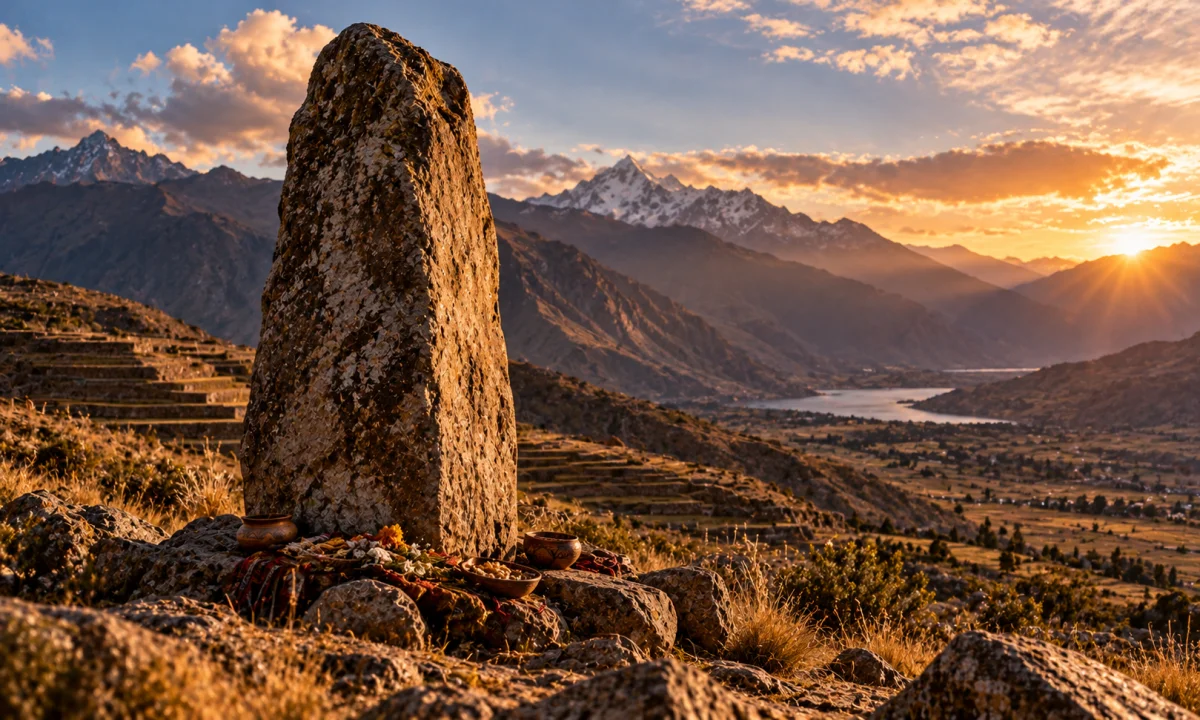
In Andean art, sacred beings could be represented through carved stones, precious objects, natural features, textiles, or places rather than through a single human-shaped statue. A lake or spring might itself be treated as a sacred presence. Some huacas—Andean sacred places or objects—were associated with origin stories, ancestors, natural forces, or local protective beings. It is therefore possible to discuss Copacati as a divine personality without assuming that worshippers everywhere imagined her in one consistent bodily form.
Accounts that provide elaborate details about her clothing, facial features, ornaments, or animal companions should be treated cautiously unless they can be traced to a specific tradition. Such details are often products of later artistic invention, modern encyclopedic embellishment, or confusion with other Andean deities.
Worship and ritual context
The exact rituals dedicated to Copacati are not securely recorded. There is no complete surviving liturgy, prayer collection, or temple account that allows her worship to be reconstructed in detail. Nevertheless, her association with water places her within a broader Andean pattern of offerings to powerful places and forces in the landscape.
Andean communities traditionally made offerings that could include food, drink, coca leaves, textiles, shells, precious materials, or other valued substances. The precise form of an offering depended on the community, the sacred place, the occasion, and the being addressed. It would be unsafe to claim that every one of these practices belonged specifically to Copacati. They do, however, illustrate the religious logic in which a lake or water power could receive gifts in exchange for protection, fertility, or continued abundance.
At Lake Titicaca, sacred geography was especially important. Islands, shores, rocks, caves, and waters could be associated with ancestors and divine origins. The lake was not simply a background for mythology; it was itself an active sacred setting. A deity such as Copacati would have been understood through that living landscape rather than through a separate mythology detached from particular places.
Relationship to other Andean water beings
Copacati is sometimes compared with Mama Cocha, often translated as “Mother Sea” or “Mother Water.” Mama Cocha is a broader Andean water figure associated in different traditions with the sea, lakes, rivers, or the generative power of water. The two names should not automatically be treated as referring to the same goddess.
Mama Cocha appears in wider discussions of Andean religion and may represent a more general maternal or cosmic water principle. Copacati, by contrast, is usually presented as a more localized figure linked with the Titicaca area. Some modern writers may place them in the same category or interpret Copacati as a local expression of a wider water cult, but the surviving evidence does not establish a single, uniform identity.
Copacati should also be distinguished from Chalchiuhtlicue, the Aztec water goddess of central Mexico, and from Yemaya, a deity of Yoruba origin whose modern worship has spread widely in the Americas. Both may appear beside Copacati in generalized lists of water goddesses, but they belong to entirely different religious traditions and historical settings.
She is likewise not the same as Pachamama. Pachamama is often translated as Mother Earth and is associated with the earth, cultivation, fertility, and reciprocity. Water is crucial to Pachamama’s domain, and the two may be discussed together in accounts of Andean agricultural religion, but that does not make them interchangeable.
Sources and historical uncertainty
Knowledge of Copacati is limited by the nature of the surviving record. The Inca did not leave an alphabetic written mythology comparable to the literary mythologies of ancient Greece or Scandinavia. Their history and ritual knowledge were transmitted through oral traditions, performance, material culture, sacred places, and systems of record-keeping whose full interpretation remains debated.
Most written descriptions of Andean religion were produced after the Spanish invasion. Colonial chroniclers recorded Indigenous traditions at different times and for different purposes. Some sought information about the history of the Inca Empire; some described religion in order to support Christian evangelization; others relied on interpreters or on informants from particular communities. As a result, a deity’s name might be transcribed inconsistently, a local tradition might be presented as an imperial one, and different beings might be grouped together under a familiar Spanish category such as “god” or “goddess.”
For Copacati specifically, the evidence is too sparse to reconstruct a long biography or a fixed mythological family. Claims that she was definitively the wife, daughter, or mother of a major Inca god should be regarded as uncertain unless tied to a clearly identified traditional source. There is no broadly accepted corpus establishing a detailed genealogy for her.
The same caution applies to statements that she ruled all lakes in the Inca Empire, controlled the weather, or had a major temple comparable to the best-documented imperial shrines. These claims may arise from attempts to make a brief reference fit the structure of a better-known pantheon. A limited record is not evidence that a figure was unimportant, but it does mean that interpretation must remain modest.
Copacati and Lake Titicaca
The association with Lake Titicaca gives Copacati much of her significance. The lake was a meeting point of natural power, ancestral memory, political history, and sacred geography. For the Inca, it was linked to the beginnings of their ruling dynasty. For local peoples, it formed part of older and continuing traditions that cannot be reduced to Inca imperial mythology.
A lake deity connected with Titicaca could symbolize more than the physical water. She might represent the life-giving capacity of the highland environment, the stability of communities that depended on the lake, and the boundary between ordinary human space and the realm of ancestors or divine origins. These are interpretive possibilities grounded in wider Andean religious patterns, not details preserved in a complete Copacati narrative.
The importance of place also helps explain why a relatively obscure figure can remain culturally meaningful. A deity does not need a large literary mythology to matter. Sacred presence may be expressed through a shoreline, a spring, an offering place, or an inherited name. In such traditions, the landscape itself can preserve religious memory even when written descriptions are brief.
Colonial transformation and the shrine at Copacabana
Following the Spanish conquest, Catholic missionaries and colonial authorities worked to replace or reinterpret Indigenous religious practices. Sacred places were sometimes rededicated to Christian figures, and existing pilgrimage centres could acquire new meanings. The town of Copacabana became famous for its Catholic shrine dedicated to the Virgin of Copacabana, whose image was created in the colonial period.
The Christian shrine should not be described as simply another name for Copacati. It belongs to a different religious tradition and has its own history. At the same time, the development of Christianity at an ancient sacred location illustrates how religious landscapes can be transformed without losing all of their earlier significance. Indigenous associations with Lake Titicaca, local pilgrimage, and the power of the place continued to shape the cultural setting in which the shrine was received.
Some later interpretations connect the Virgin of Copacabana with earlier water or lake worship through a process sometimes called religious syncretism. Such comparisons can be useful when carefully framed, but they do not prove that the Virgin and Copacati were identical or that pre-Christian worship survived unchanged. The historical relationship involves adaptation, suppression, reinterpretation, and the persistence of local memory.
Modern reception
Copacati has not become a major figure in global popular culture. She occasionally appears in modern lists of Inca gods, fantasy writing, games, illustrated mythology collections, and online discussions of South American deities. These presentations often give her a more elaborate personality or a standardized appearance than the historical evidence permits.
Modern portrayals are best understood as creative interpretations unless they clearly distinguish invention from traditional material. A fictional Copacati may be depicted as a queen of lakes, a beautiful water spirit, or a powerful rain-bringer, but those features should not be presented as securely documented aspects of the older Andean tradition. The historically responsible image is more restrained: Copacati is a sparsely documented female water divinity associated especially with the sacred region of Lake Titicaca, whose precise identity and original cult remain uncertain.