WORLD
WORLD
Chimalman
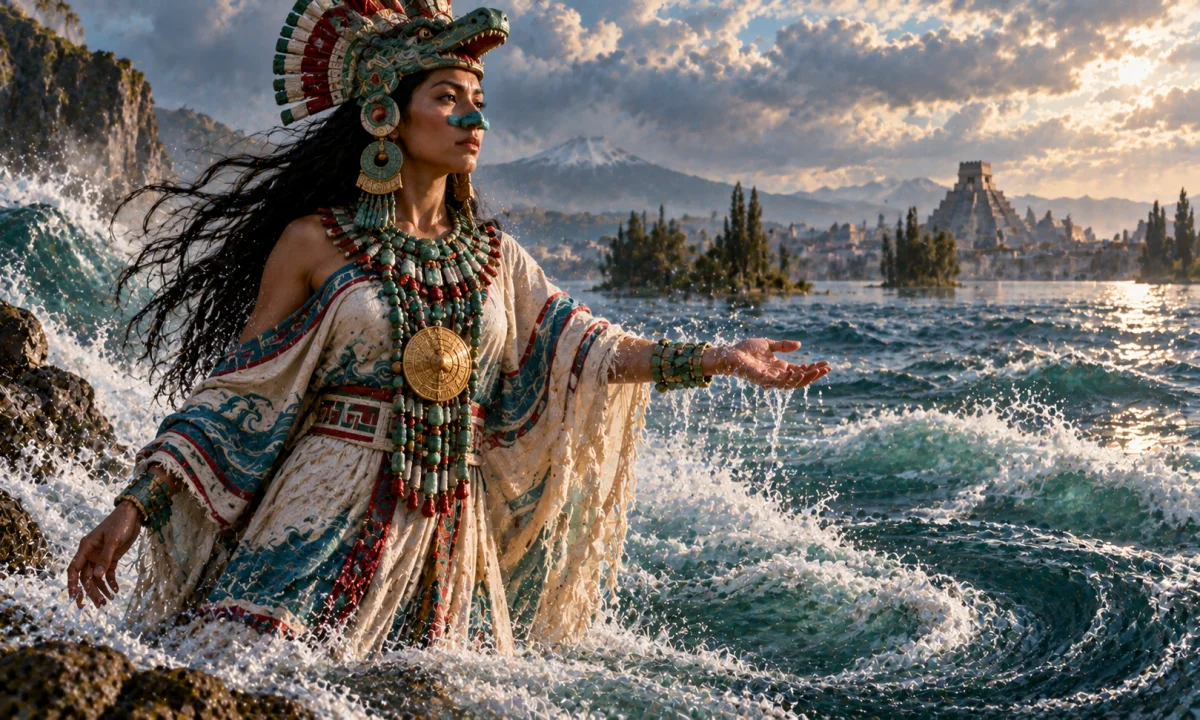
Chimalman, also written Chimalma, is a female figure in Nahua and Aztec-era mythological traditions, best known as the mother of Quetzalcoatl and the companion of Mixcoatl. She is important chiefly through her place in the genealogy and birth narratives of these better-known figures. Unlike major deities such as Coatlicue, Tlaloc, or Huitzilopochtli, Chimalman does not have a consistently documented cult, standardized iconography, or a single universally accepted myth. Her identity and story vary among the surviving colonial accounts, which recorded Indigenous traditions after the Spanish conquest.
Name and identity
The name Chimalman is commonly connected with the Nahuatl word chimalli, meaning “shield.” The related form Chimalma is often interpreted as involving maitl, “hand” or “arm,” producing a meaning such as “Shield-Hand” or “She of the Shielded Hand.” Nahuatl names were recorded by Spanish-speaking scribes in different ways, and the relationship between Chimalman and Chimalma may reflect spelling, dialect, grammatical, or transmission differences rather than two separate beings.
The precise meaning of the name is not completely certain. Colonial manuscripts do not always preserve names in a form that allows modern readers to reconstruct their original pronunciation or morphology with confidence. For this reason, the two spellings should not automatically be treated as evidence of distinct mythological characters.
Chimalman is most securely identified as a mythic mother and ancestral woman, rather than as a fully characterized goddess. Some modern descriptions call her a fertility, earth, or water goddess, but the surviving evidence does not establish a uniform independent divine personality with those attributes. Her importance comes primarily from her relationship with Mixcoatl and Quetzalcoatl.
Cultural setting
Chimalman belongs to the religious world of the Nahua peoples of central Mexico. “Aztec mythology” is a convenient modern label, but it can suggest a single fixed system where the historical evidence shows considerable regional and textual variation. Nahua-speaking communities shared many gods, stories, ritual concepts, and political traditions, while also preserving local versions of myths and genealogies.
Much of what is known about Chimalman comes from manuscripts produced in the sixteenth century. These works were written after the conquest, sometimes by Indigenous authors and painters working within colonial institutions and sometimes by Spanish friars recording information obtained from Nahua elders and informants. The manuscripts therefore preserve valuable Indigenous traditions, but they are not direct transcripts of a pre-conquest “mythology book.” Their wording, organization, and selection of material were shaped by the circumstances of recording.
Important bodies of Nahua tradition include historical and calendrical manuscripts, accounts of the origins of peoples and rulers, and narratives associated with Quetzalcoatl. Among these traditions, Chimalman appears most clearly in stories explaining the birth or ancestry of Ce Acatl Topiltzin Quetzalcoatl, the legendary ruler-priest of Tollan, as well as the divine figure Quetzalcoatl. These two aspects of Quetzalcoatl were closely related in later tradition but should not simply be assumed to be identical in every early account.
Relationship with Mixcoatl
Chimalman is commonly described as the wife or companion of Mixcoatl. His name means “Cloud Serpent,” and he was associated with hunting, warfare, the northern regions, ancestral migration, and the starry or cloudy sky. Mixcoatl was especially important in traditions connected with Chichimec peoples and with the ancestry of rulers.
In the genealogy surrounding Quetzalcoatl, Mixcoatl acts as the male progenitor and Chimalman as the mother. This relationship is not merely domestic. Mythic genealogies often explain the authority of a people, a city, or a ruling line by connecting human ancestors with powerful supernatural beings. Chimalman’s role helps place Quetzalcoatl within a network linking fertility, conflict, rulership, migration, and sacred ancestry.
The surviving narratives do not present one fully consistent biography for Mixcoatl and Chimalman. In some accounts, Mixcoatl encounters Chimalman in a dramatic episode involving hunting or warfare. The exact circumstances differ according to the text and its interpretation, and the stories can be difficult to translate because they combine poetic action, ritual symbolism, and genealogical explanation.
Stories of conception and birth
One group of traditions describes Mixcoatl shooting arrows at Chimalman. Rather than being wounded, she catches or evades them in extraordinary ways. The details vary: different retellings refer to her hands, body, or other parts of the encounter. The episode leads to their union and to the conception of Quetzalcoatl.
The arrow episode can be read on several levels. Arrows are associated with hunting, male power, warfare, and the penetration of a target. Chimalman’s ability to catch or withstand them presents her as an unusually powerful woman rather than a passive recipient of Mixcoatl’s actions. The narrative may also reflect a mythic pattern in which a divine or ancestral child is conceived through an encounter that is neither an ordinary marriage nor a simple human birth.
Other accounts give the conception a more miraculous form. In one tradition, Chimalman becomes pregnant after swallowing or receiving a precious object, sometimes described as a stone or jewel. Such stories belong to a broad Mesoamerican pattern in which sacred objects, feathers, stones, or other unusual substances cause conception. The precise object and narrative details are not uniform across the sources, so the “precious stone” version should not be treated as the only traditional account.
Some narratives also connect Chimalman’s death with the birth or early history of Quetzalcoatl. The sequence is not consistent enough to produce a single agreed chronology. In certain versions, Quetzalcoatl is born after a period of difficulty involving his parents, while other accounts focus more on his ancestry than on the circumstances of his upbringing. These differences are typical of colonial Nahua mythological materials, which often preserve several related traditions rather than a single canon.
Mother of Quetzalcoatl
Chimalman’s best-known role is as the mother of Quetzalcoatl. The name Quetzalcoatl means “Quetzal Serpent” or “Precious Feathered Serpent,” combining the sacred bird associated with beauty and preciousness with the serpent, a creature linked to the earth, fertility, renewal, and divine power. As his mother, Chimalman belongs to the foundational layer of his identity.
Quetzalcoatl was not only one god with one fixed function. He could appear as a feathered-serpent deity, a wind-associated power under the name Ehecatl-Quetzalcoatl, a culture hero, a patron of priestly learning, and the legendary ruler Topiltzin Quetzalcoatl of Tollan. The association of Chimalman with his birth therefore connects her indirectly with several different strands of Nahua religious and historical tradition.
It is important, however, not to transfer every attribute of Quetzalcoatl back onto Chimalman. The sources do not clearly portray her as a feathered serpent, a wind goddess, or a teacher of humanity. Nor do they establish that she shared all of Mixcoatl’s hunting or warrior qualities. Her role is primarily maternal, ancestral, and generative, with elements of strength suggested by the stories of her encounter with Mixcoatl.
Attributes and symbolism
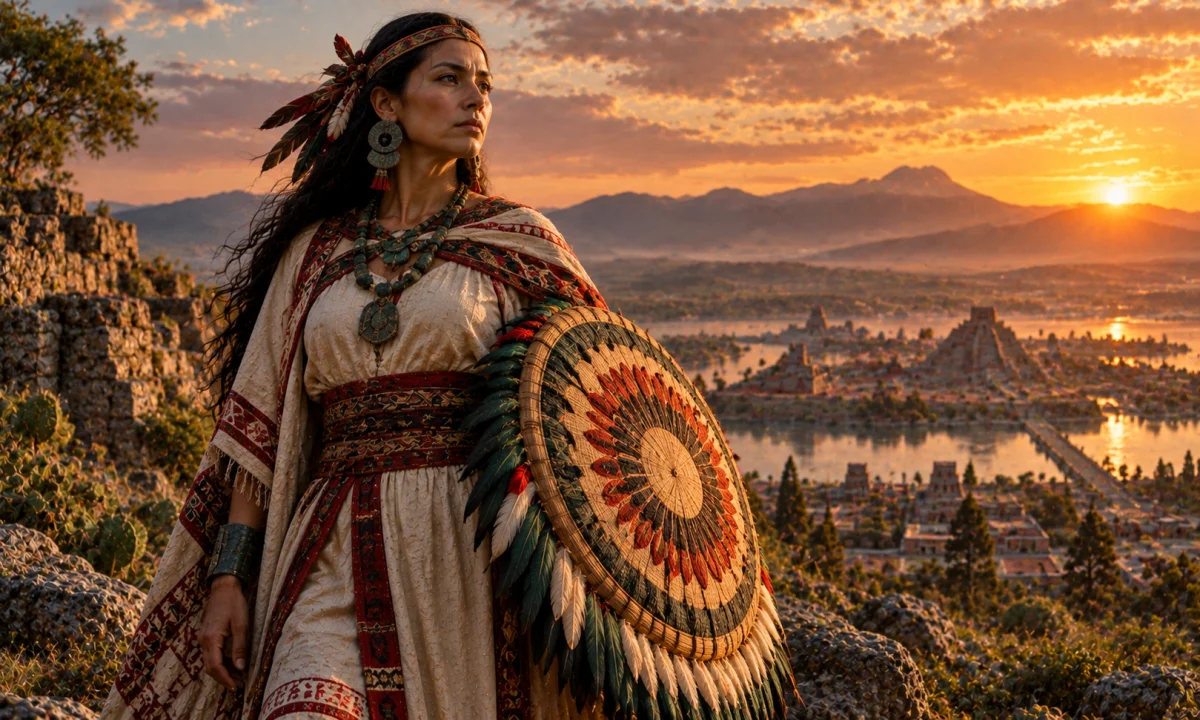
Chimalman has no securely identified visual form comparable to the famous images of Coatlicue or the serpent imagery associated with Quetzalcoatl. She is not known from a widely agreed set of pre-conquest sculptures, painted signs, or ritual objects bearing her name. This absence does not prove that she was never represented, but it does mean that modern attempts to assign her a standard appearance should be treated cautiously.
Her name, with its apparent reference to a shield or shield-bearing hand, has encouraged interpretations involving protection, defense, and martial strength. Shields were important objects in Nahua warfare and carried associations of status and military identity. Yet a name containing “shield” does not by itself prove that Chimalman was a war goddess. The name may describe an emblematic quality, a mythic action, or a personal name without defining a formal divine office.
The stories of arrows and miraculous conception give her a symbolic position between vulnerability and power. She is the woman who is approached by a renowned warrior or hunter, but she is also the figure capable of resisting or mastering his weapons. Through her, extraordinary birth becomes possible. Her role can therefore be understood as one of generative power, ancestral legitimacy, and female agency within a heroic genealogy, while recognizing that these are interpretations of the narratives rather than a fixed list of official attributes.
Chimalman and the traditions of sacred ancestry
Nahua origin stories frequently combine divine events with the histories of peoples, cities, and rulers. A legendary ancestor may be presented as both a supernatural figure and a participant in human political history. Chimalman’s connection with Mixcoatl and Quetzalcoatl fits this pattern.
Mixcoatl was associated with ancestral groups and migrations, while Quetzalcoatl became connected with Tollan and with the prestige of priestly and ruling traditions. Chimalman stands at the point where these lines meet. Her motherhood helps transform Quetzalcoatl from an isolated deity into a figure embedded in a family history. That history could be used to explain why a ruler, community, or religious lineage possessed sacred authority.
This function also helps explain why details of Chimalman’s story may differ. Genealogical traditions were not necessarily intended to form a single continuous narrative. Different communities could emphasize different ancestors, places, or miraculous events while retaining the basic relationship between Mixcoatl, Chimalman, and Quetzalcoatl.
Distinction from similar figures
Chimalman should not be confused with Coatlicue, the mother of Huitzilopochtli. Coatlicue’s famous conception story involves a ball of feathers that falls onto her while she is sweeping, after which she becomes pregnant. When her children react with hostility, Huitzilopochtli is born fully armed and defeats them. This story belongs to a different maternal genealogy and should not be combined with Chimalman’s traditions.
Chimalman is also distinct from Chimalma only with caution. In many modern works, the two names are treated as variants of the same figure, and this is often reasonable. However, spelling variation in colonial manuscripts can conceal differences in local tradition, so every occurrence of either name should be examined in its own textual context.
She should likewise be distinguished from other women associated with Quetzalcoatl. The legendary ruler Topiltzin Quetzalcoatl appears in traditions involving parents, foster figures, dynastic ancestors, and political enemies. Not every woman connected with his life is Chimalman, and not every account of Quetzalcoatl’s birth uses the same genealogy.
Historical evidence and interpretation
The evidence for Chimalman is textual and mythological rather than archaeological. There is no universally accepted monument or artifact that can be confidently identified as an image of Chimalman. Her presence in colonial Nahua narratives is significant, but those records must be read with attention to translation, Christian editorial frameworks, and the differences between Indigenous traditions.
Scholars may therefore describe her in different ways: as a mythic mother, a culture-heroine’s ancestor, a partner of Mixcoatl, or a figure whose characterization was reduced by the surviving records. Calling her a “goddess” is not necessarily impossible, since Nahua categories of divine and ancestral beings did not always match modern Western categories. Nevertheless, the surviving evidence is strongest for her maternal and genealogical role, not for a separate and extensively documented cult.
Interpretations that present Chimalman as a universal mother goddess, a fully developed goddess of the earth, or a direct equivalent of a named goddess from another Mesoamerican culture go beyond what the primary traditions securely establish. Comparisons may be useful when carefully framed, but they should not erase the specific Nahua context of her stories.
Later reception
Chimalman has received far less attention in modern popular culture than Quetzalcoatl. When she appears in contemporary retellings, she is usually presented as his mother and sometimes given expanded roles as a warrior, protector, or fertility deity. Such portrayals may draw inspiration from her name and from the stories in which she resists Mixcoatl’s arrows, but they often combine traditional material with modern reconstruction.
Modern fantasy, games, novels, and online mythology summaries may also simplify the distinction between Chimalman and Chimalma or assign her a fixed appearance that is not supported by surviving pre-conquest evidence. A careful account keeps the traditional core in view: Chimalman is a Nahua mythic woman associated with Mixcoatl and remembered above all as the mother of Quetzalcoatl, with her conception and birth stories preserved in varying colonial-era forms.