WORLD
WORLD
Centzonhuitznahua
Centzonhuitznahua is the collective name given in Nahuatl tradition to the “Four Hundred Southerners,” a group of divine or mythic brothers defeated by Huitzilopochtli at the beginning of the Mexica sacred past. They appear most prominently in the story of the birth of Huitzilopochtli, in which their sister Coyolxauhqui leads them against their mother, Coatlicue. The episode explains a cosmic struggle as well as the religious importance of Huitzilopochtli, the patron deity of the Mexica capital, Tenochtitlan.
Name and meaning
The name is commonly written Centzonhuitznahua, although spelling varies because Nahuatl was recorded in several different colonial writing systems. Forms such as Centzon Huitznahua and Centzonuitznahua are also encountered. The first element, centzon, means “four hundred” in a literal reading. In Nahuatl religious language, however, “four hundred” could also express a very large or countless multitude rather than a mathematically exact number.
The second element is generally understood as referring to the south or to southerners. For that reason, the name is usually translated as “Four Hundred Southerners,” “Four Hundred Southern Ones,” or, less literally, “the innumerable southerners.” The precise grammatical analysis and implications of the name are not entirely uniform in modern scholarship. It is safest to treat the term as the traditional collective designation of a large group associated with the southern direction, rather than as the personal name of one clearly defined god.
Centzonhuitznahua is a plural or collective designation. The group is sometimes described in modern retellings as a host of star gods, but the surviving accounts do not provide a separate personality, appearance, or biography for each member. Apart from their association with Coyolxauhqui and their conflict with Huitzilopochtli, they function mainly as a collective force.
Cultural setting
The Centzonhuitznahua belong to the religious world of the Nahua peoples of central Mexico, especially the Mexica, whom European writers often called the Aztecs. Their story survived through accounts recorded after the Spanish invasion, including Nahuatl-language materials collected by Christian missionaries and indigenous informants. These records are indispensable, but they are not direct transcripts of a pre-conquest oral performance. They reflect the work of native speakers, scribes, translators, and colonial editors.
The best-known narrative is preserved in versions of the Huitzilopochtli birth story associated with the Florentine Codex and other early colonial records. The story also had a powerful monumental expression at the Templo Mayor in Tenochtitlan. A large stone sculpture of Coyolxauhqui, discovered near the base of the temple’s Huitzilopochtli shrine, shows her dismembered body after her defeat. This sculpture is not a complete illustrated version of every detail found in written accounts, but it demonstrates the importance of the myth in Mexica state religion.
Religious narratives in Mesoamerica often operated on several levels at once. A story could describe the deeds of gods, explain the structure of the cosmos, provide a sacred history for a community, and support rituals performed at a temple. The conflict involving the Centzonhuitznahua is therefore not merely a tale about a family quarrel. It helped express the power of Huitzilopochtli and the ideological importance of Mexica rulership, warfare, sacrifice, and pilgrimage.
The birth of Huitzilopochtli
In the most familiar version, Coatlicue is performing a religious task on Coatepec, usually translated as “Snake Mountain.” While sweeping, she finds a ball of fine feathers and places it near her body. The feathers disappear, and she becomes pregnant. Her children are alarmed by the pregnancy. Coyolxauhqui, who is presented as a prominent daughter, tells her brothers that their mother has brought shame upon them or has been dishonoured. The exact wording and emphasis vary between accounts, but the central situation remains the same: the children decide to attack Coatlicue.
Coyolxauhqui leads the Centzonhuitznahua toward Coatepec. The group is armed and prepared to kill their mother. One of them, sometimes named Cuahuitlícac in versions of the story, secretly warns the unborn Huitzilopochtli about the approaching danger. Huitzilopochtli speaks from within the womb and assures the informant that he will protect Coatlicue.
When the attackers arrive, Huitzilopochtli is born fully equipped for battle. He carries a shield and a distinctive weapon called the xiuhcoatl, often translated as “fire serpent” or “turquoise serpent.” In the battle that follows, he attacks the Centzonhuitznahua and defeats them. Coyolxauhqui is pursued, struck down, and dismembered. Her body falls from the mountain, and the other attackers are overcome.
The details of the combat differ among surviving accounts. Some versions stress the destruction of the brothers, while others describe them fleeing or being pursued down the mountain. The narrative’s central pattern is stable: a threatened mother, a miraculous birth, a hostile group led by Coyolxauhqui, and the victorious emergence of Huitzilopochtli as a warrior deity.
Coyolxauhqui and the Centzonhuitznahua
Coyolxauhqui is often called the sister or leader of the Centzonhuitznahua. Her name is commonly translated as “She Who Is Adorned with Bells” or “She of the Bells on Her Cheeks,” although translations vary because Nahuatl compounds can be interpreted in more than one way. She is a distinct figure and should not be treated simply as another name for the group.
The myth gives Coyolxauhqui a more active role than it gives her brothers. She initiates the attack, directs the group, and faces Huitzilopochtli directly. In the best-known interpretation, the group represents stars and Coyolxauhqui represents the moon, while Huitzilopochtli represents the sun. The defeat of the night powers by the solar warrior would then dramatize the daily arrival of daylight.
That interpretation is widespread and has considerable explanatory value, but it should not be presented as an uncontested literal key to every version of the story. Colonial Nahuatl accounts do not always provide a simple sentence stating that the brothers are all the stars or that Coyolxauhqui is unambiguously the moon. Their names, actions, and position in the sky story encourage astronomical readings, yet the myth also concerns warfare, dynastic ideology, ritual violence, and the sacred landscape of Coatepec.
Stars, directions, and cosmic conflict
The association of the Centzonhuitznahua with the southern direction is central to their name. Scholars and interpreters commonly connect them with stars visible in the southern sky, or with celestial powers that belong to the side of darkness and night. The story’s movement up and down Coatepec can consequently be read as a cosmic drama: the forces of night gather together, but Huitzilopochtli rises suddenly and destroys them.
The number four hundred reinforces the idea of a multitude. In Nahua thought, groups of four hundred could signify abundance, an extensive army, or an almost uncountable host. The phrase does not necessarily mean that the tradition preserved an astronomical list of exactly four hundred individual stars. It gives the enemies of Huitzilopochtli scale and collective force.
The myth also presents the world as unstable and contested. Birth is immediately followed by danger; kinship does not guarantee peace; and order is established through violent victory. Huitzilopochtli’s triumph does not remove conflict from the cosmos. Instead, it makes conflict part of the continuing order of existence. The sun, the patron deity of the Mexica, and the victorious warrior all appear through the same image of a power that must overcome opposing forces.
Coatepec and the Templo Mayor
Coatepec, the mountain of the birth story, was both a mythic place and a model for sacred architecture. The name is associated with the landscape through which the Mexica passed during their migrations, although the relationship between a historical location and the mythic Coatepec is complex. In religious tradition, the mountain is the setting for Huitzilopochtli’s birth and victory.
The Templo Mayor in Tenochtitlan was organized around two principal shrines, one dedicated to Huitzilopochtli and the other to Tlaloc. Its architecture and sculptural program connected the capital to sacred mountains, origins, warfare, fertility, and cosmic renewal. The placement of the Coyolxauhqui stone at the base of the Huitzilopochtli side is especially significant. Worshippers approaching the temple stairs would encounter the image of her fragmented body, creating a ritual and visual parallel with the mythic defeat on Coatepec.
The sculpture does not show the Centzonhuitznahua as a row of individually identifiable beings. Instead, it focuses on Coyolxauhqui’s dismembered form. This emphasis reflects her importance as the leader of the attack and as the figure whose defeat could be represented in a powerful, recognizable image. The broader group remains present through the story and through the surrounding religious context.
Relationship to Huitzilopochtli
Huitzilopochtli is not simply a sun god in the same sense as every deity described with solar language in Mesoamerican studies. He is the Mexica patron deity of war, migration, rulership, and the sun’s victorious power. His birth story establishes him as a divine warrior from the instant of his emergence. The defeat of the Centzonhuitznahua therefore expresses his exceptional status and helps explain why he became central to Mexica state religion.
The conflict may also have served as a mythic foundation for Mexica warfare and sacrifice. Huitzilopochtli’s cult at Tenochtitlan was connected with military expansion and with offerings intended to sustain the gods and the ordered movement of the cosmos. Modern observers should avoid reducing the story to a simple justification for political violence, but its imagery clearly belongs to a religious system in which warfare, captive-taking, sacrifice, and cosmic maintenance were closely related.
The story should not be interpreted as evidence that the Mexica worshipped the Centzonhuitznahua as a rival pantheon equal to Huitzilopochtli. They are opponents in the narrative, and surviving sources do not present a broad independent cult dedicated to them as a group. Their significance comes primarily from their role in the sacred history of Huitzilopochtli and Coyolxauhqui.
Variants and interpretive cautions
Accounts of the birth of Huitzilopochtli are not identical. Names, speeches, weapons, motives, and descriptions of the battle can vary. Colonial-era sources also differ in how much attention they give to the celestial dimension of the story. This variation is normal for traditions preserved through oral transmission, multiple informants, and written records produced after conquest.
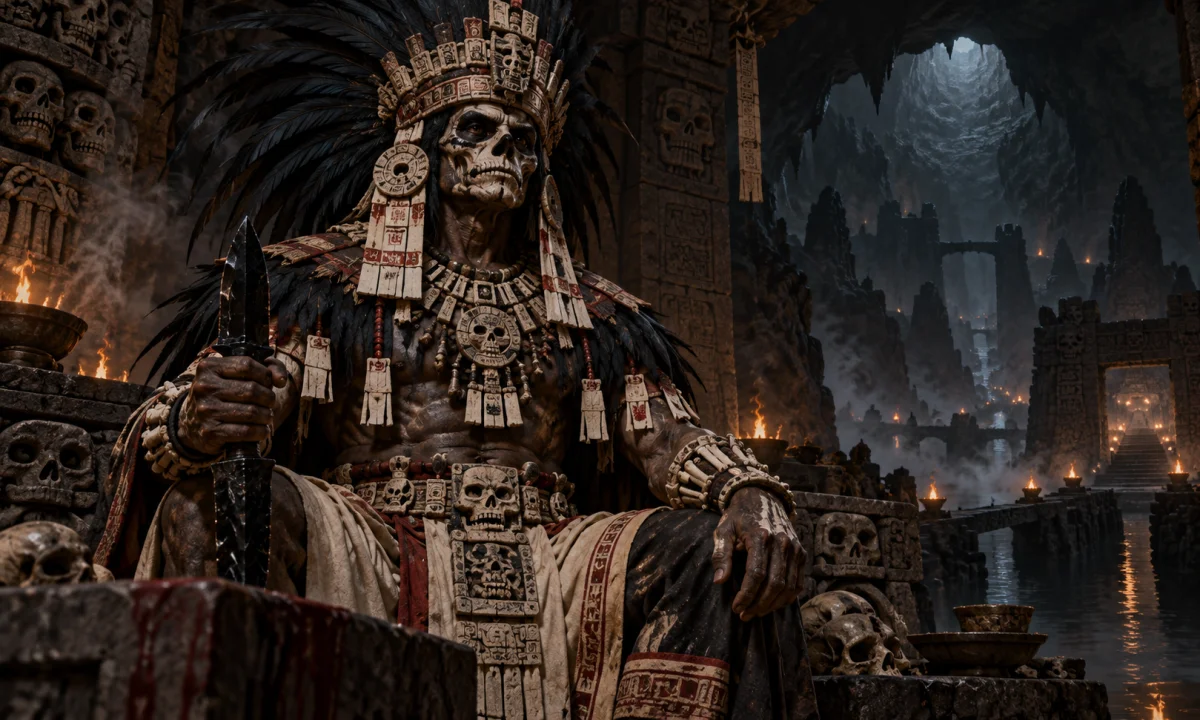
The Centzonhuitznahua should therefore not be assigned a single fixed appearance or a fully developed set of individual personalities. Artistic reconstructions often portray them as uniform warriors or as star-like figures, but such images are modern interpretations unless they are directly based on a specific historical work of art. The sources support their identity as a large hostile group associated with the south and with the story of Coyolxauhqui, but they do not provide a detailed costume catalogue for the entire host.
It is also important not to confuse them with every group of “four hundred” in Nahua mythology. The number appears in several contexts and can have conventional or symbolic force. Nor should they be merged with unrelated groups of stars, warriors, or supernatural beings whose names happen to have been translated using similar language. The Centzonhuitznahua are specifically tied to Coyolxauhqui’s attack on Coatlicue and to Huitzilopochtli’s birth at Coatepec.
Modern reception
In contemporary books, games, artwork, and online mythology collections, the Centzonhuitznahua are sometimes expanded into a named army of individual star deities. Some retellings give them personal identities, elaborate weapons, or powers associated with particular constellations. These creative treatments may draw inspiration from the traditional story, but they go beyond what the surviving Nahuatl sources securely establish.
Modern discussions also frequently present the conflict as a straightforward battle between the sun, moon, and stars. The astronomical reading is important and often illuminating, yet the original religious context is broader. The story connects celestial imagery with Mexica identity, the sacred mountain, royal power, warfare, and the ritual life of Tenochtitlan. Understanding the Centzonhuitznahua requires keeping those dimensions together rather than treating them as characters from an isolated star myth.