WORLD

Cagn
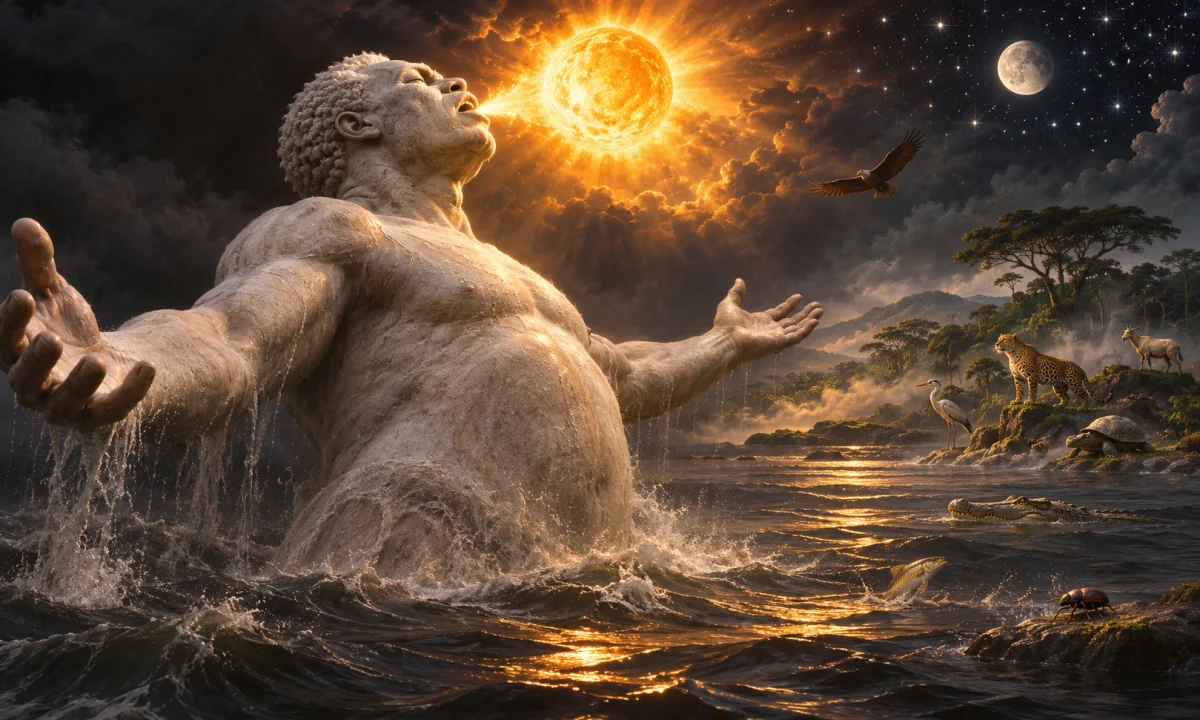
Cagn is a creator, trickster and culture-bearing figure associated especially with the mythology of the /Xam people of southern Africa. His name appears in several forms, including Kaggen, Kaang, Cagn and Kaggen. In many retellings he is connected with the praying mantis, although he is not simply a “mantis god” in every San tradition. His character combines creative power, mischief, vulnerability and transformation.
Cultural setting
Cagn belongs to the broad and diverse religious world of southern Africa’s San-speaking peoples. “San” is a modern umbrella term covering communities with different languages, histories and traditions. Their mythologies should therefore not be treated as a single uniform system. A story recorded among one community may have no exact equivalent among another.
The material most often associated with Cagn comes from the /Xam, a southern African people whose language is now no longer spoken as a living community language. During the nineteenth century, the linguist Wilhelm Bleek and his sister-in-law Lucy Lloyd recorded extensive narratives, beliefs and personal accounts from /Xam individuals in the Cape Colony. These records preserve important evidence about figures such as Cagn, but they also reflect the circumstances of colonial-era collection. They are written records of oral traditions rather than sacred scripture or a single authoritative mythology.
Other San communities have creator beings and trickster figures with different names, personalities and stories. Some traditions connect the creator with the mantis, while others give greater importance to beings such as the Great God, the First Bushman, or other local figures. Similarities between these traditions may reflect shared history, linguistic relationships or comparable ways of understanding the natural world, but they do not prove that every San community worshipped Cagn.
Name and identity
The spelling Cagn is particularly familiar in English-language writing based on /Xam material. Kaggen and Kaang are other common forms. Differences in spelling arise from attempts to represent sounds from southern African languages in European alphabets. The forms should not automatically be treated as the names of entirely separate beings, although the exact use of a name can vary according to the language, community and source.
In /Xam accounts, Cagn is often described as a powerful supernatural being and creator. At the same time, he behaves like a trickster. He makes mistakes, becomes angry, suffers loss and can be deceived or placed in danger. This combination is important: Cagn is not presented as an abstract, perfectly distant creator who stands outside the world. He participates in the world and is affected by the consequences of his actions.
English writers have sometimes called him a “god,” a “creator god,” a “hero” or a “trickster deity.” Each label captures part of his character but can also oversimplify it. The category of a single all-powerful god does not always correspond neatly to the way oral traditions describe Cagn. He can be creator-like in one story, a family member or traveller in another, and a mischievous animal or shape-shifter elsewhere.
The mantis and changing forms
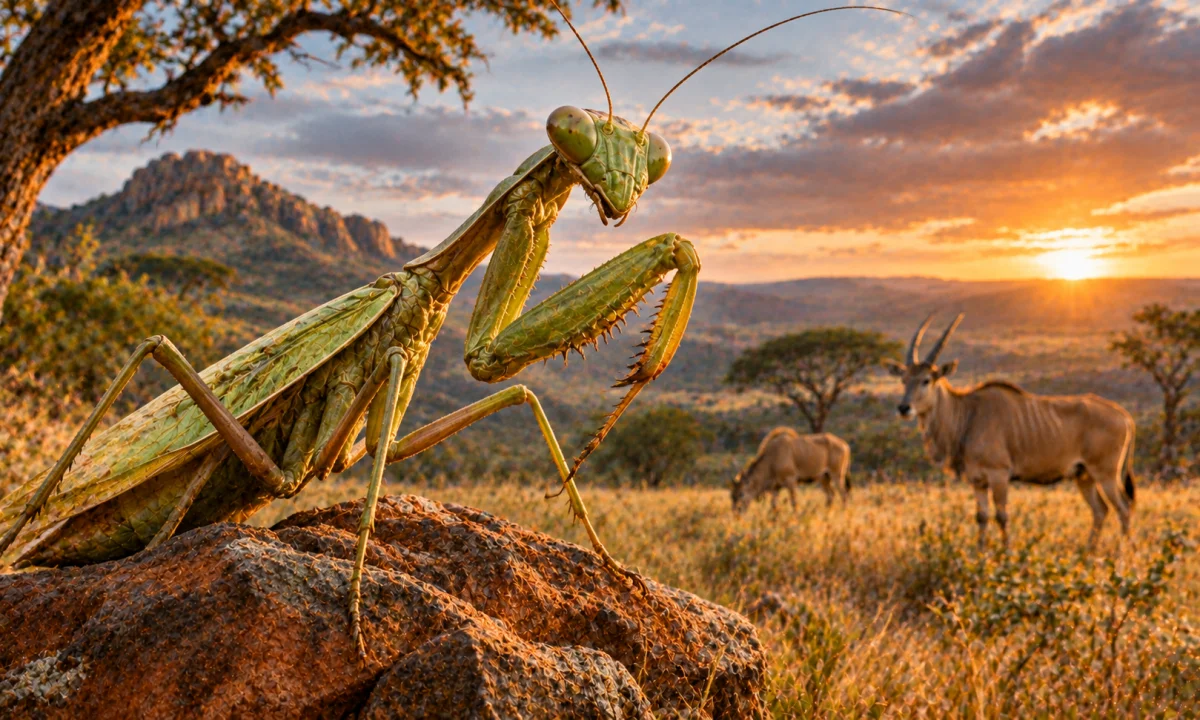
Cagn is strongly associated with the praying mantis. The mantis may be regarded as one of his forms, an appearance through which he acts, or a creature linked to him symbolically. Because of this connection, the mantis became one of the best-known visual representations of Cagn in later discussions of San mythology.
The association should not be reduced to a simple identification of every mantis with Cagn. Animals in San religious thought may have several meanings at once. They can be participants in stories, embodiments of supernatural powers, signs connected with particular events, or beings with their own independent significance. The mantis’s alert posture and unusual movements may have contributed to its mythic importance, but the surviving stories are more significant than any single symbolic explanation.
Cagn is also capable of taking other forms. Accounts associated with him describe transformations into animals or other beings, including forms connected with the eland and the snake. These transformations express his unstable and mobile nature. He does not remain safely within one category such as human, animal or spirit. His ability to cross boundaries helps explain why he can create, deceive, teach and disrupt the order of the world.
Creator and maker of living things
One of Cagn’s major roles is the making of animals and features of the world. He is particularly connected with the creation or shaping of the eland, an animal of exceptional importance in many southern African traditions. The eland is a large antelope associated in different communities with rain, fertility, initiation, dance and spiritual power. Cagn’s relationship with the eland therefore places him within a wider network of beliefs about animals, human society and the forces that sustain life.
Stories of creation do not always present Cagn as a remote designer who makes a finished universe according to a fixed plan. Instead, creation can appear as an active and sometimes hazardous process. New beings are produced, released or transformed, and their relationships lead to conflict. The creator himself may have to respond to what he has brought into existence. This gives the stories a dramatic quality that differs from a systematic account of creation arranged in a strict sequence.
Cagn’s creative activity is also connected with the establishment of human and animal relationships. The boundaries between humans, animals and supernatural beings are permeable in these narratives. Animals may speak, reason, marry, fight or possess knowledge. Such episodes do not necessarily claim that ordinary animals behave like humans at all times. Rather, they belong to a mythic period in which the structure of the world was still being formed and its distinctions were not yet fully settled.
Trickster qualities
As a trickster, Cagn is clever but not invulnerable. He may use disguise, deception or sudden transformation to achieve a goal, yet his plans can fail. The humour in these stories is often connected with the gap between his great powers and his very recognisable weaknesses. He can be boastful, impatient, jealous or careless, and his actions may bring trouble to himself and others.
Trickster figures are not necessarily evil. Their disruptions can expose hidden dangers, challenge arrogance or create new possibilities. Cagn’s behaviour can be destructive, but it can also help explain why the world contains suffering, danger and unpredictability. His stories resist the idea that creation produced a perfectly ordered environment without conflict. The world is alive and meaningful, but it is also difficult to control.
Cagn’s trickster character distinguishes him from a purely benevolent creator. It also prevents him from being understood only as a personification of the praying mantis. The mantis imagery highlights transformation and strangeness, while the trickster stories show a being whose intelligence does not make him morally flawless.
Fire, knowledge and culture
Some accounts connect Cagn with the control or distribution of fire and with the acquisition of useful knowledge. Such stories belong to a widespread pattern in world mythology in which a supernatural being obtains fire, tools, hunting knowledge or other necessities and makes them available to humans. The details vary, and not every story associated with Cagn gives him the same cultural role.
It is safest to describe him as a figure involved in the ordering of life and the transmission of powers rather than to assign him a single universally fixed invention. Oral traditions change through performance, memory and local interpretation. A version in which Cagn creates an animal may stand beside another in which he teaches, steals, loses or recovers something important.
These narratives can be read as reflections on dependence. Human beings require fire, animals, water, food and social knowledge, yet none of these things is entirely secure. Their origins are linked with powers that are generous but also dangerous. Cagn’s stories preserve that tension rather than resolving it into a simple lesson.
Family and relationships
Several /Xam narratives describe Cagn in family relationships. Names such as Coti, Cogaz and Gewi appear in accounts of his wife and children, but the spellings and genealogical details are not consistent across all retellings. These figures should not be treated as members of a universally fixed divine family comparable to the pantheons of ancient Greece or Egypt.
Family episodes make Cagn’s supernatural character more immediate. He is not only a distant originator of the world; he is involved in domestic arguments, dangers and obligations. His relationships can generate conflict and show the consequences of desire, anger and carelessness. The family setting also allows the stories to explore the responsibilities that accompany power.
Because the surviving material was collected from particular /Xam narrators, it is difficult to reconstruct one complete biography of Cagn. The narratives do not form a single continuous cycle with an agreed beginning, middle and end. Treating scattered episodes as chapters in a unified divine life can create a coherence that the oral tradition itself may not have required.
Religion, symbolism and interpretation
Cagn’s importance lies partly in the way he joins creation and disorder. He helps bring the world into being, but he is also part of the uncertainty within it. His stories can be interpreted as accounts of origins, explanations of animal and human conditions, or performances that entertain while preserving cultural knowledge. These purposes are not mutually exclusive.
The figure also illustrates the danger of imposing familiar religious categories on traditions from another cultural setting. Calling Cagn a “god” may be convenient in English, but it can suggest a rigid hierarchy, a formal priesthood or a clearly defined pantheon for which the evidence is lacking. Calling him merely a “folklore character” is equally misleading, because the stories belong to religious and cultural understandings of the world, not just to entertainment.
His association with the mantis has encouraged symbolic readings involving observation, patience and transformation. Those interpretations may be useful when carefully presented as scholarly or modern interpretations, but they should not replace the stories themselves. The surviving accounts show a complex figure whose significance comes from actions and relationships, not from one universally agreed symbolic meaning.
Distinguishing Cagn from related figures
Cagn is sometimes presented as though he were the single creator of all San peoples. That claim is too broad. San communities have distinct languages and traditions, and the names of creator beings differ. A story about a mantis-associated creator from one community should not automatically be transferred to every community described as San.
He should also be distinguished from other African creator and trickster figures. The Anansi traditions of West Africa, for example, centre on a spider figure and arise from Akan cultural contexts. Eshu or Elegba belongs to Yoruba religious traditions and has a different history, theology and ritual setting. Nyame, Unkulunkulu and other African creator figures likewise should not be merged with Cagn simply because all may be described in English as gods or culture heroes.
The word “Bushman,” found in older English-language literature about Cagn, is a colonial term that many people consider outdated or objectionable. “San” is now widely used as a broad term, although individual communities may prefer their own names. Older terminology may be encountered when discussing historical records, but it should not obscure the diversity and continuing presence of the communities whose traditions were recorded.
Later reception
Cagn became known outside southern Africa through European descriptions of San religion and through later comparative studies of mythology. In these settings, he has often been portrayed as a universal “Bushman creator” or reduced to a charming mantis trickster. Both presentations can flatten the diversity of the original traditions.
Modern writers, artists and educators sometimes use Cagn as a symbol of ecological connection, transformation or indigenous knowledge. Such uses can introduce the figure to new audiences, but they are interpretations rather than replacements for /Xam or other San traditions. Popular retellings may also combine details from different communities, simplify family relationships or treat separate versions as one canonical story.
The most responsible understanding of Cagn keeps several distinctions in view: the difference between /Xam evidence and traditions from other San communities; the difference between oral narratives and later literary summaries; and the difference between traditional religious meaning and modern symbolic adaptation. Within those limits, Cagn remains one of the most striking creator-trickster figures preserved in the mythological traditions of southern Africa.