WORLD

Bumba
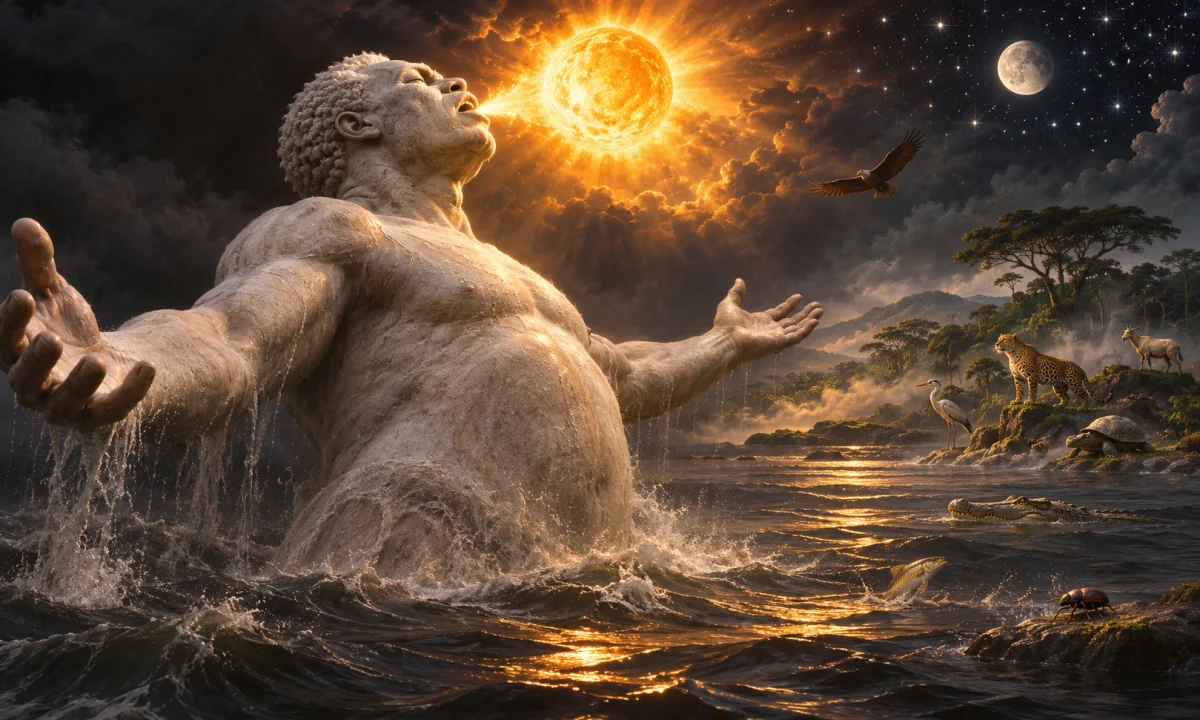
Bumba, also written Mbombo in many scholarly and ethnographic accounts, is a creator figure associated especially with the Bushongo, a historically important group within the Kuba cultural world of the present-day Democratic Republic of the Congo. In the best-known creation narrative, Bumba exists alone in a dark, watery universe and brings the sun, moon, stars, animals, plants and human beings into existence. The story is often described as “Kuba mythology,” although the tradition is more specifically connected with the Bushongo and should not automatically be treated as a belief shared in exactly the same form by every Kuba-speaking community.
Origins and cultural setting
The name Bumba became widely known through written accounts of Central African traditions gathered and published during the colonial period. Researchers and collectors recorded stories connected with the Bushongo kingdom, also called the Bushongo kingdom of the Kuba. These accounts preserved valuable information about local ideas of creation, kingship, nature and social order, but they were mediated through translation, interpretation and the assumptions of European observers.
For that reason, the surviving written versions should not be treated as direct transcripts of a single original text. The narrative belonged to an oral tradition, and oral traditions may vary according to storyteller, locality, audience and historical period. Different retellings change the spelling of the creator's name, the sequence of creation, the identities of divine or ancestral beings and the details of the world's first inhabitants.
The Bushongo were one of the peoples connected with the wider Kuba cultural and political sphere in the central Congo region. Kuba traditions have included elaborate royal histories, artistic systems, initiation practices and accounts of the origins of society. Bumba's creation story is therefore not simply an isolated tale about the beginning of the universe. It forms part of a broader cultural environment in which the natural world, political authority, ancestry and human society could be understood as parts of an ordered cosmos.
Name and identity
Bumba and Mbombo are the two spellings most frequently encountered in English-language discussions. The variation reflects differences in transcription and pronunciation rather than necessarily indicating two separate gods. Mbombo is often preferred in more careful discussions of the Bushongo tradition, while Bumba is common in encyclopedic summaries and comparative mythology.
Descriptions of Bumba as a “god” are convenient but can impose categories drawn from European religious language. In the recorded stories, the figure is a primordial creator and powerful being who exists before the ordered world. Some retellings call him a spirit, creator, king or giant. These labels do not always correspond to a fixed indigenous classification. The surviving accounts do not provide enough evidence to assume that Bumba occupied exactly the same religious role as a god in the pantheons of ancient Greece or Egypt.
Some popular versions describe Bumba as white or white-faced. This detail has generated much speculation, especially because European collectors sometimes interpreted African religious figures through racial and colonial frameworks. The exact significance of the description is uncertain, and it should not be treated as a universal or securely established feature of every Bushongo account. The central feature of the tradition is Bumba's primordial creative power, not a standardized physical portrait.
The world before creation
In the most widely circulated version, Bumba is alone in a dark and empty universe covered by water. There is no ordered land, human society, or visible sky. Bumba suffers from a severe pain in his stomach, sometimes described as a stomachache or internal sickness. In an act that is both bodily and cosmic, he vomits the first elements of the universe.
His first act of creation produces the sun. The appearance of the sun dries the waters and makes the earth visible. Bumba then brings forth the moon and stars, establishing the basic structure of the heavens. The narrative presents creation not as the result of a craftsman's deliberate construction of every object, but as an eruption from the body of a primordial being. Bodily processes become the means by which the cosmos comes into existence.
This imagery is important because it gives the universe an organic beginning. The world is not separate from the creator in the way a human artifact is separate from its maker. Instead, the sky, earth and living beings emerge from Bumba's body. Vomiting, usually associated with illness or rejection, becomes a creative force. The story therefore presents creation as powerful, involuntary and physically embodied.
Animals and the first living things
After the heavenly bodies appear, Bumba brings forth a series of animals. The exact list varies between retellings, but commonly mentioned creatures include the leopard, eagle, crocodile, fish, tortoise and a number of other animals. Some versions also include lightning among the early creations. These beings are not merely decorative additions to the landscape. They represent the establishment of the major forms of life that will inhabit the earth.
In some accounts, particular animals have distinctive relationships with the regions or environments they inhabit. The crocodile and fish belong to the waters; the eagle occupies the sky; the tortoise is associated with the earth; and the leopard represents a powerful terrestrial creature. Such associations should not be overinterpreted as a fixed symbolic code, since the recorded versions do not always agree. Nevertheless, the sequence shows a movement from cosmic elements to living creatures and then to the organization of the world into different habitats.
Some popular retellings say that Bumba created the first animals by vomiting them from his stomach, just as he had produced the sun, moon and stars. Other versions arrange the story differently or give a larger role to Bumba's children. The digestive and bodily imagery remains one of the most recognizable characteristics of the Bumba narrative in modern English-language mythology collections.
Bumba's sons and the completion of creation
Several versions state that Bumba had three sons who continued the work of creation. Their names are commonly rendered as Nyonye Ngana, Chonganda and Chedi Bumba, although spellings differ considerably. The roles assigned to them also vary.
Nyonye Ngana is often said to have produced white ants after vomiting. In some explanations, these ants later spread across the earth and helped make the land fertile. Chonganda is commonly associated with the creation of plants and vegetation. Chedi Bumba is sometimes connected with the completion or ordering of creation, but English retellings do not consistently agree about his particular contribution. Some accounts assign him a creative act of his own, while others mention him mainly as one of Bumba's sons.
The presence of the sons gives the narrative a generational structure. Creation begins with a solitary primordial being and then passes to a younger generation that helps populate and organize the world. This pattern can be read as an explanation of succession and the distribution of creative power, although interpretations must remain cautious. The story itself does not necessarily present the sons as a formal divine family in the sense of a fully developed pantheon.
Human beings appear later in the creative sequence. In some versions, Bumba or his sons create the first people after the animals and plants have been established. Certain retellings identify the first human as a particular ancestor, while others simply state that human beings were made after the rest of the living world. The variations make it difficult to assign a single canonical account of humanity's origin.
Light, darkness and the ordering of nature
The appearance of the sun is one of the story's most significant moments. Before it emerges, the universe is dark and dominated by water. Once the sun appears, the waters recede or dry, allowing the earth to become a habitable place. The narrative thus explains not only the origin of the sun but also the transition from an undifferentiated primordial environment to a world of land, sky and living things.
The moon and stars follow the sun, giving the heavens a patterned structure. Their creation establishes the conditions for time, cycles and orientation. The story does not necessarily offer a technical explanation of astronomy, but it places celestial bodies within a meaningful sequence: light first transforms the earth, and the remaining heavenly bodies complete the visible order of the sky.
The creative process also moves from the general to the particular. First comes light and the broad division between sky, water and land. Then come animals, plants and finally human communities. This structure allows the narrative to explain the dependence of human life on an older natural order. People are not the first or only important beings. They belong to a world already populated by powerful animals, plants and cosmic forces.
Interpretations of Bumba's creative body
Bumba's vomiting has sometimes been presented by outside commentators as comic, grotesque or primitive. Such descriptions say more about the attitudes of the commentators than about the religious imagination expressed by the story. In many mythological traditions, bodily substances and physical processes have generative or sacred significance. Birth, blood, breath, sexual fluids, excrement and food can all serve as images of transformation and life.
The Bumba narrative makes the creator's body the first source of material existence. This can be understood as a vivid explanation of how life emerges from a pre-existing being, but it may also express the intimate connection between the living world and the forces that produced it. The story does not separate the sacred from the physical. Cosmic creation is described through hunger, pain, vomiting and reproduction, making the origin of the world immediate and tangible.
The episode may also be interpreted as a transition from disorder to fertility. Bumba's sickness precedes creation, and relief follows the release of the elements and living things within him. This does not mean that every traditional storyteller would have explained the myth in symbolic terms. Symbolic interpretations are modern scholarly or comparative approaches, not replacements for the tradition itself.
Relationship to Bushongo religious thought
The creation narrative has often been discussed alongside Bushongo ideas about kingship and social order. The Bushongo political system had a prominent ruler, and outside observers sometimes drew parallels between the creator's authority and the status of a king. Such parallels may be suggestive, but they should not be mistaken for proof that Bumba was simply a divine version of the historical king or that the myth served only to justify royal power.
As with many traditions recorded by missionaries, travelers and colonial ethnographers, the distinction between creator, ancestor, spirit and king may have been simplified in translation. A story about the beginning of the world can have several functions at once: it can explain natural phenomena, locate human beings within creation, express ideas about succession and provide a sacred account of the order of society.
There is also no reason to assume that a single written account captures the full range of Bushongo religious practice. A creator narrative does not by itself reveal how Bumba was worshipped, whether regular rites were directed to him, or how his importance compared with ancestors, local spirits and other sacred powers. Evidence for these matters is limited and varies according to the account.
Variants and uncertainty
There is no universally fixed version of the Bumba story. The creator's name may be written Bumba, Mbombo or in other forms. The spelling of the sons' names varies, and their creative acts are not always reported in the same order. Lists of animals differ, and some retellings include elements that are absent from others.
Modern summaries also sometimes combine details from separate publications or add explanatory material that does not appear in the earliest recorded versions. Statements that Bumba created every individual species, ruled a complete divine kingdom or had a specific appearance should therefore be checked against the particular tradition being discussed. The safest description is that Bumba is a primordial creator associated with a Bushongo creation narrative in which the sun, moon, stars, animals, plants and human beings emerge through a sequence of acts involving Bumba and, in some versions, his sons.
Distinguishing Bumba from similar names
Bumba should not automatically be identified with every figure or festival bearing a similar name. In Brazil, Bumba-meu-boi is a major popular theatrical and festive tradition centered on the death and resurrection of an ox. Despite the shared word “Bumba,” it is not the same figure as the Central African creator. The Brazilian tradition developed within a different historical and cultural setting, shaped by Indigenous, African and Portuguese influences.
Nor should Bumba be merged with unrelated African creator beings simply because they are associated with the origin of the world or with vomiting, water, animals or celestial bodies. African mythologies contain many distinct traditions, and broad labels such as “African mythology” can obscure important differences between peoples and regions. Bumba belongs specifically to the Bushongo-associated tradition as it has been recorded and transmitted, not to a single pan-African system of belief.
Later reception
Bumba has become familiar outside Central Africa through comparative mythology books, museum education, encyclopedias and online lists of creator gods. These presentations often reduce the narrative to a short sequence: Bumba vomits the sun, moon, stars and animals, and his sons complete creation. Such summaries preserve the basic outline but may remove the story from its Bushongo setting and present it as a self-contained “myth” detached from oral performance, social context and uncertainty over the sources.
Contemporary discussions are increasingly attentive to the difference between an indigenous tradition and the colonial records through which it became widely known. The name Mbombo may be used to signal closer attention to the recorded Bushongo context, while Bumba remains common in English popular culture and reference works. Neither spelling alone resolves all questions about the history of the tradition, but recognizing the variation helps prevent the mistaken belief that every version comes from one standardized ancient text.