WORLD

Bukulu
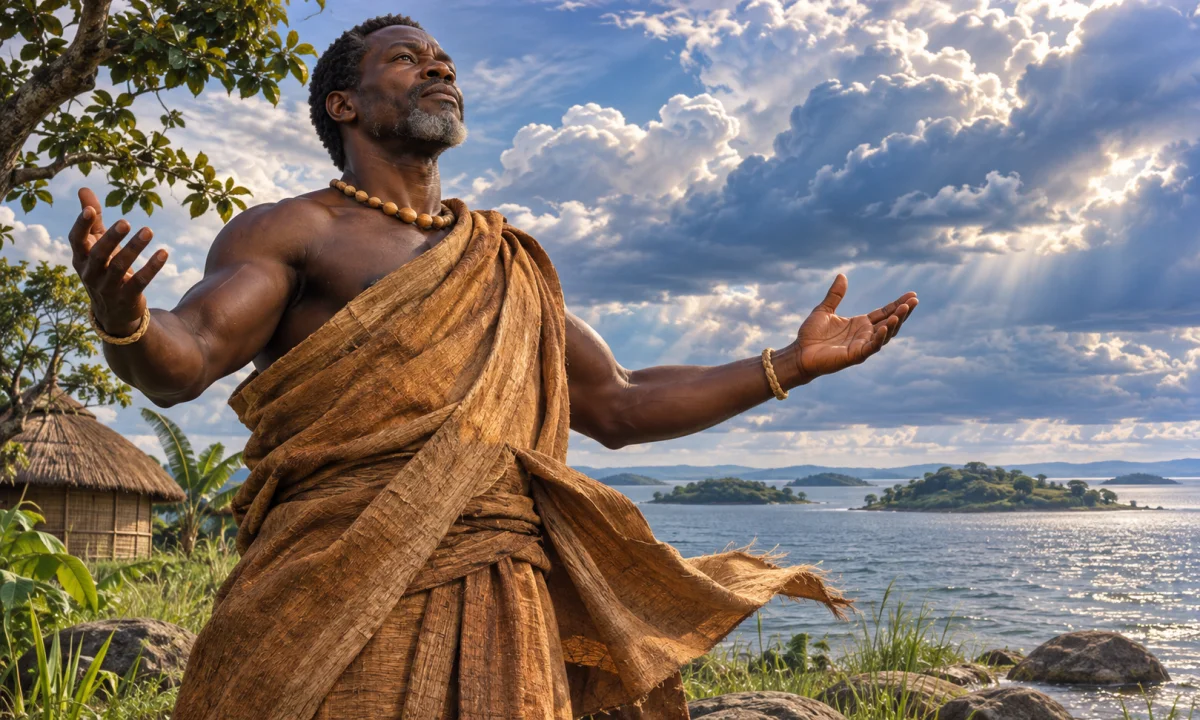
Bukulu is a creator figure associated in some published accounts with the Luba peoples of Central Africa, especially the cultural region of the Democratic Republic of the Congo and neighbouring areas. He is generally described as a high or supreme being who brought the world into existence and stands above the visible order of nature and human society. Information about Bukulu is limited, however, and the name does not represent a universally standardised figure across all Luba communities. Accounts may differ in spelling, classification and the amount of detail they provide.
Cultural setting
The Luba are a group of related peoples whose historic societies developed in the south-central part of the Congo basin and the savannah regions around it. “Luba” can refer to several culturally connected communities rather than a single uniform population. Their languages, political histories and local religious practices have varied across time and place.
Luba religious traditions have commonly included belief in a supreme or distant creator, spirits associated with natural places and forces, and the continuing importance of ancestors. These elements did not necessarily form a single systematic theology. Religious knowledge was conveyed through oral teaching, ritual practice, political institutions, initiation, family memory, artistic forms and stories told in particular local settings.
That context is important when considering Bukulu. The figure should not be treated as the African equivalent of a deity from a religion with one canonical scripture, a fixed creed or a single authoritative mythology. Names recorded by outsiders may also have been translated, simplified or detached from the local terms and ritual contexts in which they originally had meaning.
Origins and surviving traditions
Descriptions of Bukulu come chiefly from general accounts of African religions and from summaries of Luba religious ideas. There is no widely recognised ancient Luba book devoted to Bukulu, and no single, standard creation narrative can be assigned to every Luba community. Much of the relevant tradition was transmitted orally, which means that regional versions and changes in emphasis are to be expected.
In the accounts that identify Bukulu as a Luba creator, he is presented as the power responsible for the existence of the world, life and humanity. Such descriptions often place him at the beginning of creation rather than among the more immediately active spirits involved in healing, divination, illness, fertility, places or the fortunes of particular families.
The limited documentation makes it difficult to say exactly how widely the name Bukulu was used, or whether it always referred to a distinct personal deity. In some contexts, it may have functioned as a name for a supreme being; in others, it may have been a title, an epithet or a term interpreted through a particular language and locality. Claims that assign one detailed mythology to all Luba people should therefore be treated cautiously.
Name and identity
The spelling Bukulu reflects the way the name has been represented in English-language and other non-local writings. African names were often recorded by missionaries, colonial officials, travellers and later scholars using different spelling systems. A written form can therefore conceal variation in pronunciation or in the original language.
The meaning of the name is not securely established in all available accounts. It is sometimes treated as an ordinary personal name and sometimes as a descriptive designation for an elevated, ancestral or creator-like being. Assertions about a precise translation should not be made without identifying the particular Luba language and source involved.
Bukulu is best described as a creator or supreme being in some Luba traditions and summaries of Luba religion. He should not automatically be classified as a “god” in the narrow sense of a human-like figure with a large family, a clearly defined domain and a sequence of dramatic adventures. The available material supports a more restrained description: Bukulu belongs to the category of high creator powers whose importance lies primarily in cosmic origin and ultimate authority.
Attributes and role
The central attribute associated with Bukulu is creation. He is said to stand behind the existence of the world and its inhabitants. This role gives him a position above ordinary spirits and human ancestors, even where those beings remain more visible in daily religious practice.
As with many creator figures in African religious traditions, the supreme being may be understood as powerful yet not constantly approached through the same rituals used for local spirits or ancestors. A creator can be regarded as the source of life and order while practical religious attention is directed towards forces believed to influence illness, harvests, fertility, protection, conflict or family welfare more immediately.
It is not safe to assign Bukulu a fixed physical appearance. Some modern reference works use human language for creator beings, describing them as fathers, elders or rulers, but such wording does not necessarily indicate a traditional image or statue. No single canonical portrait of Bukulu is established across the traditions associated with the name.
Similarly, securely documented information about a consort, offspring, animal companions, sacred weapon or residence is lacking. Popular lists of African gods sometimes expand short descriptions into elaborate profiles, but details of that kind should not be attributed to Bukulu without firm evidence from a specific Luba tradition.
Creation and the ordering of the world
The creation role attributed to Bukulu places him within a broad African pattern in which a supreme being explains the beginning and continuing possibility of life. In these traditions, creation is not always presented as a single event in a fully developed narrative. It may instead be expressed through statements about who made the earth, gave life to people, established the sky or originated the powers on which existence depends.
For Bukulu, the surviving descriptions are too brief to reconstruct a complete creation story with confidence. There is no universally accepted account that specifies the materials from which the world was formed, the first human beings, the sequence of creation, or a definitive reason for a separation between heaven and earth.
Stories of a creator withdrawing from direct contact with humanity are found in several African traditions, but that motif should not be transferred to Bukulu simply because it appears elsewhere. Some summaries may portray the supreme being as distant, while others may leave the relationship between creator and people undefined. These possibilities should remain separate from claims about a particular Luba narrative.
Relationship with ancestors and spirits
Luba religious life has historically involved relationships with ancestors and with spiritual powers connected to communities, places and events. This does not make such beings identical with Bukulu. A creator figure and an ancestor can occupy different levels of religious thought: Bukulu may represent the ultimate source of existence, while ancestors remain connected to the history, protection and moral obligations of a particular family or community.
In practice, the distinction between a supreme being, spirits and ancestors may not always appear as a rigid theological hierarchy. Religious traditions are lived through ritual and social relationships rather than only through abstract categories. A person may acknowledge a creator while seeking assistance through ancestors, diviners, healers or local spiritual authorities.
This pattern also helps explain why a high god may receive relatively little description in surviving ethnographic summaries. The figure’s importance does not depend on a large cycle of stories. The creator may be invoked as the foundation of existence, whereas more detailed narratives concern spirits and ancestors whose actions are believed to affect everyday life.
Symbolism and cultural significance
Bukulu can be understood as a symbol of cosmic origin, ultimate authority and the dependence of human life on a power greater than society. As a creator, he belongs to a conceptual level that links the natural world, human community and the moral order. His significance is therefore broader than a particular natural feature such as thunder, a river, a forest or a single animal.
The idea of a supreme creator can also support reflection on human limits. People, rulers and ancestors may possess influence, but they are not the source of existence itself. In a Luba setting, such ideas would have been embedded in local understandings of kinship, authority, obligation and the relationship between living people and the dead.
It is important not to turn this symbolism into a universal statement about all African religions. Africa contains thousands of cultural and linguistic traditions, and creator figures differ substantially from one society to another. Bukulu belongs to a specific, though internally diverse, Luba-related context and should not be used as a generic name for African belief in a supreme god.
Variants and uncertainty
The main uncertainty surrounding Bukulu concerns the relationship between the name found in reference works and the traditions of particular Luba communities. Different authors may use broad ethnic labels, rely on different informants or translate local religious concepts into familiar categories such as “god,” “creator” or “supreme being.” Those categories can be useful, but they may not capture every local distinction.
Some sources may also place similar creator descriptions under other names. This does not necessarily mean that the names are alternate forms of Bukulu. The Congo region has many peoples and languages, and a creator figure from one community should not be merged with a figure from another merely because both are described as supreme or associated with creation.
For the same reason, claims about a fixed mythology, a detailed family tree or a distinctive set of sacred symbols require caution. The secure core of the identification is relatively narrow: Bukulu is associated in some accounts with the Luba and is described as a creator or high divine power. Beyond that core, regional tradition and source interpretation must be distinguished.
Distinction from similar figures
Bukulu should not be confused with Mbombo or Bumba, the creator figure associated with Bushongo traditions in the Kuba cultural region. The names and traditions belong to different cultural contexts, even though both figures appear in comparative lists of African creator beings.
He should also be distinguished from Mulungu, a name used for a supreme being in several eastern and south-eastern African traditions, and from Nzambi or Nzambi Mpungu in Kongo-related religious contexts. Similar descriptions do not prove that these figures are versions of one another. They reflect a recurring religious theme—the existence of a supreme creator—expressed in different languages and societies.
Nor should Bukulu be identified automatically with the supreme beings of the neighbouring Lunda, Bemba, Songye or other peoples. Historical contact and cultural exchange have occurred across Central Africa, but related geography is not enough to establish identical religious identities.
Modern reception
Bukulu has not become a major figure in globally circulated popular culture. The name appears mainly in encyclopedic lists, comparative discussions of African religions and general treatments of mythology. These formats often provide only a short identification and may give the impression that every deity has an equally complete and standardised mythology.
Contemporary writers, artists or game designers may reinterpret Bukulu as a powerful African creator deity, but such portrayals are modern adaptations rather than evidence for traditional Luba belief. A responsible representation should acknowledge the limited documentation, preserve the distinction between Luba cultural contexts and other African traditions, and avoid inventing visual traits or stories merely to make the figure resemble better-known mythological characters.