WORLD

Buk
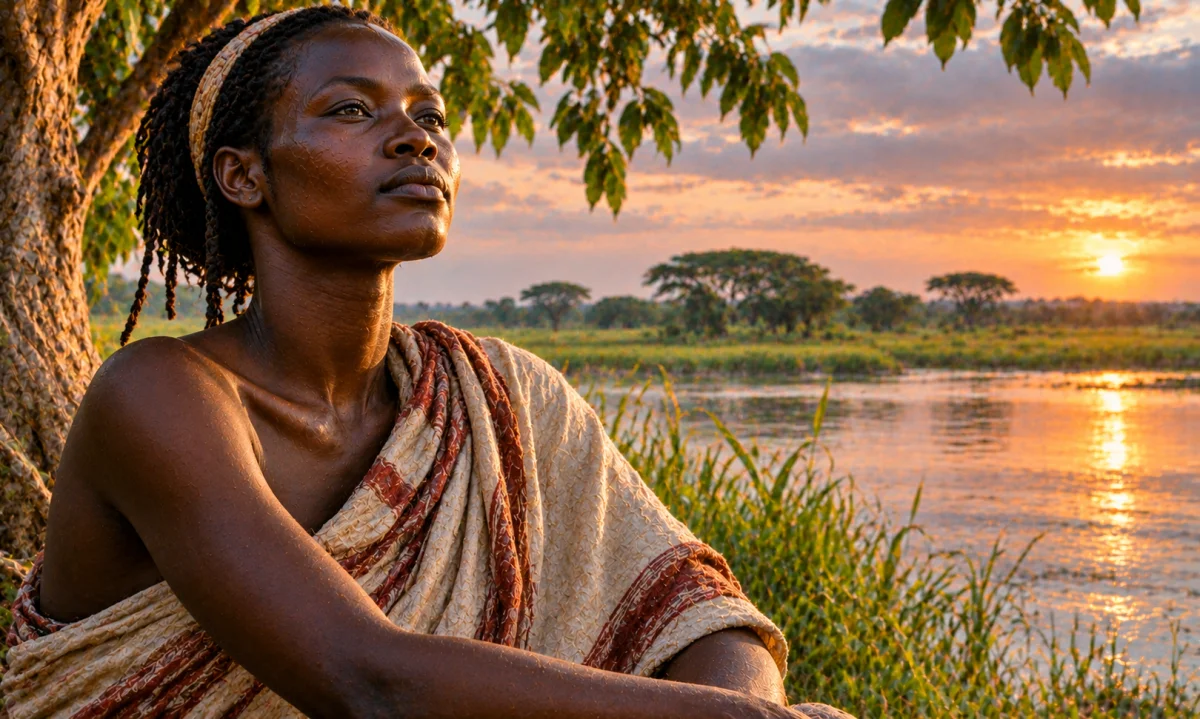
Buk is a name associated in some modern accounts with the traditional religious world of the Dinka people of South Sudan. She is usually described as a female spirit or goddess connected with rivers, water, fertility and the life-sustaining forces of the landscape. The evidence for Buk is limited and uneven, however. Unlike major Dinka religious figures such as Nhialic and Deng, she does not appear in a single, universally recognized body of myths. Her identity, relationships and exact status vary between summaries and may reflect different local traditions or later attempts to organize Dinka religious concepts into a familiar pantheon.
Cultural setting
The Dinka are a Nilotic people whose communities have traditionally lived across the grasslands, wetlands and river regions of what is now South Sudan. Their religious traditions developed in close relationship with cattle, seasonal movement, rain, rivers, fishing, cultivation and the changing availability of pasture. Religious knowledge was transmitted primarily through oral traditions, ritual practice, personal names, prayers, songs and the authority of ritual specialists and elders.
Dinka religion is not best understood as a fixed system of gods with identical roles everywhere. Beliefs differ between communities, and the same spiritual power may be understood through several names, titles or local expressions. Stories also exist in multiple forms rather than as a single canonical mythology. A figure associated with water in one locality may be described more broadly elsewhere as a spirit of fertility, a guardian of a place or an intermediary between human beings and higher powers.
The Dinka supreme creator is commonly known as Nhialic, although the spelling of the name varies in English-language writing. Nhialic is associated with the sky, creation and the ordering of life. Other major figures include Deng, often connected with rain, fertility, illness and healing, and Abuk, a female ancestral figure associated in many accounts with the first woman, cultivation and domestic life. These figures belong to a wider religious landscape in which natural forces, ancestors and localized spiritual powers are closely related.
Name and identity
The name Buk is not always treated consistently in descriptions of Dinka religion. Some accounts identify Buk as a goddess of rivers or water, while others use the name for a more general female spiritual power. The spelling may also be affected by differences in Dinka languages, English transliteration and the way individual researchers recorded oral information.
It is therefore important not to present Buk as though she had a universally agreed biography. There is no securely established ancient text that defines her character, appearance or family relationships. Most available information comes from oral traditions recorded in particular social settings and from later reference works that condense complex religious ideas into short entries. Such summaries can be useful, but they may make a diverse tradition look more uniform than it actually is.
Buk is generally classified as a female water or river spirit, and in some descriptions as a goddess. The word “goddess” can be convenient in English, but it may not exactly match the categories used within Dinka religious thought. Dinka traditions recognize the supreme creator, major spiritual powers, ancestral forces and spirits associated with particular places or functions. These categories do not necessarily correspond to the sharply separated pantheons familiar from ancient Greek or Roman mythology.
Buk and water
The strongest recurring association attached to Buk is water. Rivers and wetlands are central to life in the regions inhabited by Dinka communities. They provide drinking water, fish, reeds, transport routes and fertile ground, while also presenting dangers through flooding, disease, drowning and the movement of animals. A river is therefore not merely a physical feature. It can be a source of nourishment, a boundary between communities, a route of passage and a place where human beings encounter powers beyond ordinary control.
When Buk is described as a river goddess, her role may be understood as expressing the generative and unpredictable character of water. Water sustains cattle and people, supports crops and fish, and helps renew the land after seasonal changes. At the same time, rivers can destroy settlements or separate families. A spiritual figure connected with rivers would consequently represent both dependence and vulnerability rather than a simple personification of pleasant scenery.
Accounts that associate Buk with fishing may be reflecting this practical relationship between people and aquatic environments. Such associations should be treated cautiously, since the surviving descriptions do not establish a single set of rites or a universal body of stories specifically devoted to her. The connection with fishing, fertility or river resources may be stronger in some local traditions than in others.
Fertility and the renewal of life
Buk is also sometimes linked with fertility. In a Dinka cultural setting, fertility has several connected meanings: the birth of children, the reproduction of cattle, the growth of plants, the return of rain and the renewal of pasture. Water is essential to all of these processes, so a river spirit can naturally acquire associations with abundance and continuity.
This symbolism does not necessarily mean that Buk was worshipped as a fertility goddess in the same formal sense as some well-documented goddesses of the ancient Mediterranean or Near East. The available evidence does not provide a stable list of ceremonies, temples or priestly institutions dedicated to her. It is safer to say that traditions identifying her with rivers may also interpret her as participating in the wider life-giving powers of the natural world.
Her femininity may likewise carry several layers of meaning. Female spiritual figures in agricultural and pastoral societies are often connected by later interpreters with birth, nourishment, cultivation and protection. Yet the meaning of a female figure cannot be assumed solely from her gender. Local Dinka explanations, where preserved, are more important than comparisons with unrelated African or Eurasian goddesses.
Relationships with other Dinka figures
Some reference accounts place Buk in a relationship with Deng, the powerful figure associated with rain and fertility. She is sometimes called Deng’s wife or companion. This relationship is not consistently documented across descriptions of Dinka religion, and it should not be treated as an established feature of every Dinka tradition.
The pairing is understandable within a symbolic framework: rain descends from the sky, while rivers and wetlands gather and carry water across the earth. A relationship between a rain power and a river power could express the movement of water through the natural world. It may also reflect the tendency of interpreters to arrange related spiritual functions into family relationships. Whether such a relationship belongs to a specific oral tradition or results from later systematization is difficult to determine from the limited evidence.
Buk should not automatically be identified with Abuk. The names are similar in English-language spelling, and both may be presented as female figures in accounts of Dinka mythology, but they are not necessarily the same being. Abuk is commonly described as the first woman or as a female ancestral figure associated with cultivation and everyday human life. Buk, by contrast, is generally associated with water or rivers in the references that distinguish the two names.
Nor should Buk be confused with Deng, even when the two are linked in some summaries. Deng is usually treated as a major spiritual power with associations including rain, fertility, illness and healing. Buk’s identity is narrower and less consistently preserved, centering mainly on water and river environments.
Stories and the problem of limited documentation
No single famous narrative about Buk is securely known across all Dinka communities. Short descriptions may mention her name and function without preserving a complete story, genealogy or sequence of adventures. This absence does not prove that no stories about her ever existed. Oral traditions are often transmitted in forms that are not easily separated into “myths” in the literary sense, and knowledge about a spirit may appear in prayers, songs, ritual speech or explanations of a particular landscape.
Oral religious traditions can also change as communities move, intermarry, experience political upheaval or adopt new religious practices. The history of South Sudan has included warfare, displacement, colonial intervention, missionary activity and civil conflict. These forces affected the transmission and recording of cultural knowledge. Accounts written by outsiders may preserve valuable information, but they may also omit local distinctions or translate indigenous concepts into categories such as “god,” “goddess,” “spirit” or “devil” that do not map neatly onto Dinka usage.
For that reason, a responsible account of Buk must distinguish between what is frequently reported and what is firmly established. The association with rivers is the most consistent feature. Claims about a specific appearance, a fixed marriage, a particular parentage or a detailed cycle of adventures require stronger evidence and should not be repeated as universal facts.
Religious meaning
Buk’s significance, where the tradition recognizes her as a river power, lies in the moral and practical importance of the environment. Dinka religious life has often been described as deeply concerned with maintaining proper relationships among humans, cattle, ancestors, spiritual powers and the land. Rivers are part of these relationships because they affect movement, food, health, settlement and the survival of herds.
A figure such as Buk can therefore be interpreted as representing the presence of sacred power within a particular ecological system. She need not be imagined as a human-shaped ruler living in a distant divine court. Her importance may instead arise from the river itself and from the obligations, risks and benefits connected with it. Such a reading places Buk within a broader African religious pattern in which water bodies may be treated as spiritually charged without belonging to a standardized pantheon.
The name also illustrates why African mythology should not be treated as a single tradition. Africa contains thousands of peoples, languages and religious histories. A water spirit from a Dinka context belongs to a specific Nilotic cultural setting and should not be merged with unrelated river beings from West Africa, the Congo Basin, southern Africa or the Mediterranean coast merely because they share an association with water.
Modern representation
Buk has little established presence in major modern popular-culture franchises, novels or films. Her appearances are more common in general mythology lists, encyclopedic summaries and online treatments of African deities. These formats often provide only a name and a short description, which can give the impression that Buk is a widely standardized goddess with a complete mythology.
Modern writers and artists may understandably expand the limited record by imagining Buk with a distinctive appearance, sacred animals, magical abilities or elaborate stories. Such creations can be legitimate works of fiction or creative interpretation, but they should be identified as modern invention rather than presented as traditional Dinka belief. Traditional material is best represented with attention to its local setting, oral character and uncertainty.
Buk is therefore best understood as a cautiously documented Dinka-associated female water or river power, rather than as a universally defined African goddess. Her name points toward the spiritual importance of rivers, fertility and environmental dependence, while the variation in surviving descriptions reminds us that oral religious traditions cannot always be reduced to a fixed catalogue of gods and stories.