WORLD

Badimo
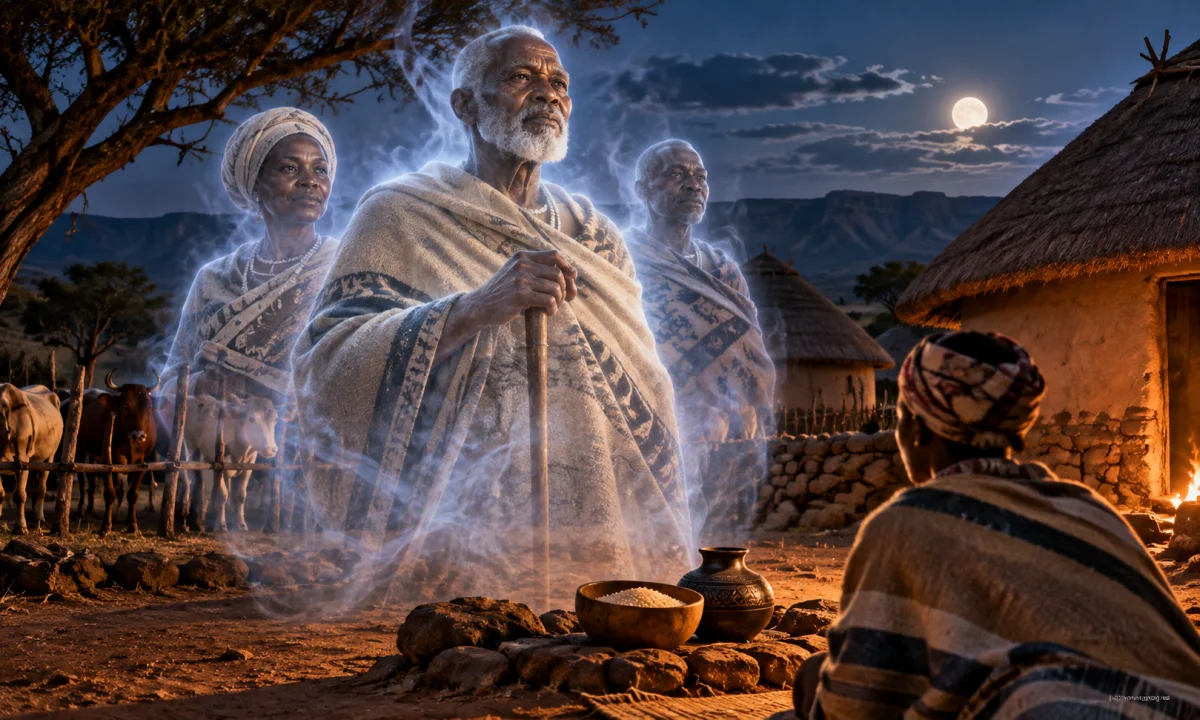
Badimo is a Setswana term commonly translated as “ancestors” or “ancestral spirits.” It belongs chiefly to the religious and cultural traditions of Batswana communities in Botswana and neighbouring parts of southern Africa, and is also related to concepts found among other Sotho-Tswana-speaking peoples. Badimo are not a single god, monster or legendary individual. The word generally refers to deceased members of a family, lineage or community who remain spiritually connected with the living.
Belief in badimo forms part of an ancestral religious system in which the dead may continue to influence family welfare, health, fertility, rainfall, social conduct and relations between generations. The precise meaning of the term differs according to language, community, historical period and religious setting. Some people understand badimo within a broader traditional cosmology centred on Modimo, a word that can refer to God or a supreme spiritual power. Others place greater emphasis on the ancestors as the immediate spiritual guardians of a household or lineage.
Origins and cultural setting
The idea of badimo developed within the societies of the Sotho-Tswana cultural and linguistic sphere. These communities include the Batswana of Botswana and South Africa, as well as related groups whose languages and customs share important features. The traditions are not identical across all communities. Differences may appear in the names used for spiritual beings, the ceremonies performed, the authority given to ancestors and the relationship between ancestral practice and Christianity or other religions.
Badimo belong to a world in which family identity extends beyond the living. A person is understood as part of a continuing line of parents, grandparents and earlier forebears. The dead do not necessarily cease to matter when physical life ends. Instead, deceased elders may remain associated with the family homestead, the land, the cattle of the household and the moral responsibilities of descendants.
These beliefs were transmitted primarily through oral tradition and customary practice rather than through a single sacred book. Stories, praise poetry, genealogies, rituals, dreams, divination and accounts of unusual events all helped preserve ideas about the ancestors. Historical knowledge of badimo therefore comes from a combination of living religious traditions, oral testimony, language, ethnographic observation and older written descriptions. Such records must be read carefully because early European observers often interpreted African religious ideas through Christian categories or treated diverse communities as though they had one uniform belief system.
The meaning of the name
Badimo is generally treated as a plural term in Setswana. Its meaning is often translated as “ancestors,” “ancestral spirits” or “the ancestral dead.” The related word modimo has a more complex history. In modern Setswana, Modimo is widely used for God, especially in Christian contexts, while older and broader religious uses of related terms may refer to a high spiritual power, a deity or a spirit.
This linguistic relationship does not mean that badimo and Modimo are simply the same beings. Nor does it establish one universal theology shared by every Tswana community. In some interpretations, ancestors are subordinate to a supreme divine power. In others, the practical religious relationship of ordinary people is directed mainly towards the ancestors, because ancestors are understood to be close to the family and able to intercede in everyday matters. The use of related words reflects a complicated history of language, religion and translation rather than a simple classification.
It is also important not to translate badimo merely as “ghosts.” A ghost in popular English usage is often imagined as the frightening or restless apparition of an individual dead person. Badimo are more commonly understood as persons who have entered an enduring spiritual role within the family or community. They may be respected, approached, thanked or asked for protection. Their presence is usually connected with relationships, obligations and moral continuity rather than with horror alone.
Who becomes one of the badimo?
In many traditional understandings, the ancestors are deceased members of a family or lineage, particularly those who were respected elders and whose descendants continue to remember them. The most immediate ancestors may include parents, grandparents and great-grandparents. More distant forebears can also be included, especially when their names, deeds or genealogical place remain known.
Not every dead person is necessarily treated in exactly the same way. Social standing, the circumstances of death, family memory and ritual recognition can affect how a deceased person is understood. A person who died without descendants, whose life was considered deeply harmful or whose death was viewed as ritually troubling may occupy a different place from a respected family elder. Beliefs concerning infants, people who died violently and those who were socially excluded also vary and should not be reduced to a single rule.
The ancestral community is often imagined as ordered in a way that reflects the living community. Senior ancestors may have particular authority, while recently deceased relatives may be regarded as especially close to their descendants. The living do not generally deal with an abstract, anonymous population of spirits. They relate to known lines of descent, named family members and the history of a particular homestead or clan.
Roles and powers attributed to badimo
Badimo are often regarded as guardians of the family and as participants in the welfare of their descendants. Their influence may extend to health, childbirth, fertility, prosperity, livestock, rainfall and the general harmony of the household. They can be approached for assistance during danger or uncertainty, although the exact ritual form of such requests varies greatly.
Ancestors may also be understood as protectors of moral and social order. Respect for elders, care for relatives, proper conduct within marriage, responsible use of property and attention to customary obligations can all be connected with ancestral approval. A person who seriously violates family expectations may be thought to risk misfortune or spiritual displeasure. In this sense, badimo are not only supernatural protectors; they represent the continuing authority of the family and the standards inherited from earlier generations.
Illness or repeated misfortune may sometimes be interpreted through an ancestral framework. A problem might be understood as the result of neglected obligations, a broken relationship, unresolved family conflict or failure to perform a customary act. Such interpretations exist alongside other explanations, including physical illness, social causes and Christian understandings of suffering. Traditional diagnosis may involve a diviner, who seeks to identify the source of the difficulty and determine what response is appropriate.
Some accounts describe the ancestors as connected with rain and agricultural well-being. In southern African societies where farming and livestock keeping have historically been central, rainfall has immense practical and spiritual importance. A community’s relationships with its ancestors may therefore be linked to the health of crops, herds and people. These associations should not be treated as a universal doctrine: the details of rainmaking, ritual authority and ancestral responsibility differ between communities and historical periods.
Communication with the ancestors
Communication with badimo may occur through prayer, spoken requests, family ceremonies, offerings, dreams and divination. The living may address ancestors at a family shrine, grave, homestead or another place regarded as spiritually significant. In some settings, the central hearth or a particular area of the household carries ancestral importance. There is no single arrangement used by every Tswana-speaking community.
Offerings can include food, drink or the sacrifice of an animal, depending on the community, occasion and resources involved. Cattle and goats have held important economic and ritual roles in many southern African societies, but the meaning of a sacrifice is not simply that of a gift to a hungry spirit. It can mark a relationship, honour a transition, ask for assistance, express thanks or restore balance after a disturbance. Ritual actions are usually governed by family elders or specialists who know the relevant customs.
Ancestors may be encountered in dreams, especially during moments of crisis or transition. A dream of a deceased relative can be interpreted as a message, a warning, a request or a sign of continuing connection. Dream interpretation is not automatic, however. The significance may depend on the dreamer, the deceased person, the circumstances and the judgment of family members or a diviner.
Diviners have traditionally occupied an important role in some communities. Their work may involve identifying the spiritual or social cause of illness and advising on the necessary response. A diviner is not simply a fortune-teller in the modern entertainment sense. Within the traditional setting, divination can address family history, obligations, conflict and the relationship between the living and the dead. Practices and terminology vary, and not every person who respects badimo consults a diviner.
Ritual and family responsibility
Honouring badimo is commonly tied to major events in family life. Birth, marriage, initiation, death, the establishment of a new household and serious illness may all call for attention to ancestral relationships. Rituals can affirm that a new member has entered the family, that a marriage joins lineages, or that a deceased person has been properly acknowledged.
Funeral customs are particularly significant because they address the movement of a person from the community of the living into the community of the dead. Mourning, burial, remembrance and later ceremonies may help establish the deceased person’s continuing place within the family. The exact sequence and terminology differ between communities, and many families now combine customary practices with Christian funerals or other religious forms.
Family elders may have responsibility for maintaining relations with the ancestors, but this does not necessarily mean that ordinary people are excluded. Respect can be expressed through remembering names, observing prohibitions, caring for relatives, preserving family history and participating in communal ceremonies. The relationship is reciprocal in a moral sense: the ancestors are expected to protect and guide the family, while descendants are expected to maintain respect and fulfil obligations.
Stories and representation
Badimo do not belong to one fixed cycle of myths with universally agreed characters and adventures. Stories about them are usually local, genealogical or family-based. A narrative may explain why a particular ancestor is remembered, how a family received protection, why a ritual became necessary or how a community understood a period of drought, illness or conflict.
In oral traditions, ancestral figures can appear as wise founders, former chiefs, powerful elders, protectors or warnings from the past. Their importance often comes from their relationship to living people rather than from a distinctive physical appearance. They may be encountered in human form in dreams or described through signs, voices and effects rather than through a stable visual image.
This makes badimo different from many figures in modern fantasy, where a supernatural being is often defined by a standard appearance, a list of powers and a single canonical story. The identity of an ancestor depends on memory, descent and ritual recognition. A badimo figure cannot be separated easily from the family or community that honours that figure.
Relationship to Modimo and other spiritual beings
The relationship between badimo and Modimo is interpreted differently. In contemporary Setswana Christian usage, Modimo usually means God, while badimo refers to ancestors. Many Christians who use both terms distinguish clearly between worship directed to God and respect shown to ancestors. Other people preserve or revive traditional practices in which ancestors serve as intermediaries or guardians within a wider spiritual order.
Terminology can also overlap with words for spirits or supernatural beings in related languages. This creates a risk of treating every use of a similar term as evidence of the same belief. The meaning of a word depends on its language, historical context and speaker. Badimo should therefore not be merged with unrelated African deities, nature spirits, trickster figures or demon-like beings simply because English translations use the word “spirit.”
Nor should badimo be confused with a single supreme creator figure. They are generally ancestral beings: people whose lives were once part of a human family and whose spiritual significance derives from that relationship. Their closeness to human affairs is one of the defining features of ancestral belief.
Christianity, colonial history and continuing practice
Christian missionaries and colonial administrations often judged ancestral customs according to European religious categories. Practices involving offerings, divination or communication with the dead were frequently condemned as paganism, superstition or witchcraft. Such descriptions reveal the attitudes of the observers more clearly than they describe the internal logic of the traditions.
Conversion to Christianity did not produce one uniform response. Some Christians rejected ancestral rites, while others maintained family customs alongside Christian prayer and church membership. In many communities, people distinguish between worship, which they direct towards God, and respect for ancestors, whom they may honour as family elders. Others regard the two systems as incompatible. These positions can exist within the same wider cultural community.
Urbanisation, migration, formal education and changes in family structure have also affected ancestral practice. A household may be separated from its ancestral village or burial place, and younger people may have less knowledge of genealogies or ritual procedure. At the same time, interest in language, heritage and customary identity has encouraged some people to preserve, reinterpret or publicly discuss traditions associated with badimo.
Cultural significance today
In contemporary Botswana and among Tswana-speaking communities elsewhere, badimo remain an important idea in discussions of family, identity, morality and heritage, even when individuals interpret the tradition differently. The concept can express respect for elders, the importance of ancestry and the belief that the past remains active in the present. It may also provide a framework for understanding grief and continuing responsibility after a death.
Modern references to badimo should be distinguished from fantasy portrayals of ghosts or supernatural creatures. Traditional understandings are rooted in kinship, ritual, land, memory and community history. There is no single official image of a badimo spirit and no universal catalogue of powers. Any account that presents badimo as one monster, one goddess or a standardized pantheon misrepresents the term and erases the diversity of the traditions in which it is used.