WORLD
WORLD
Aningan
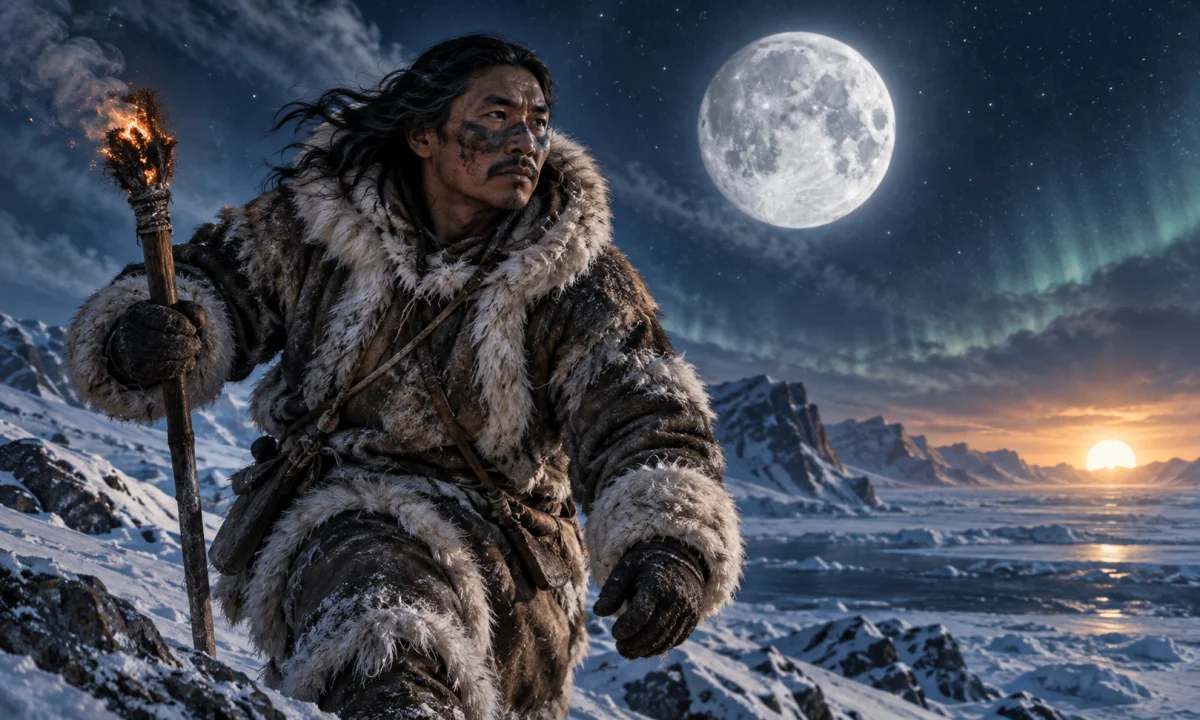
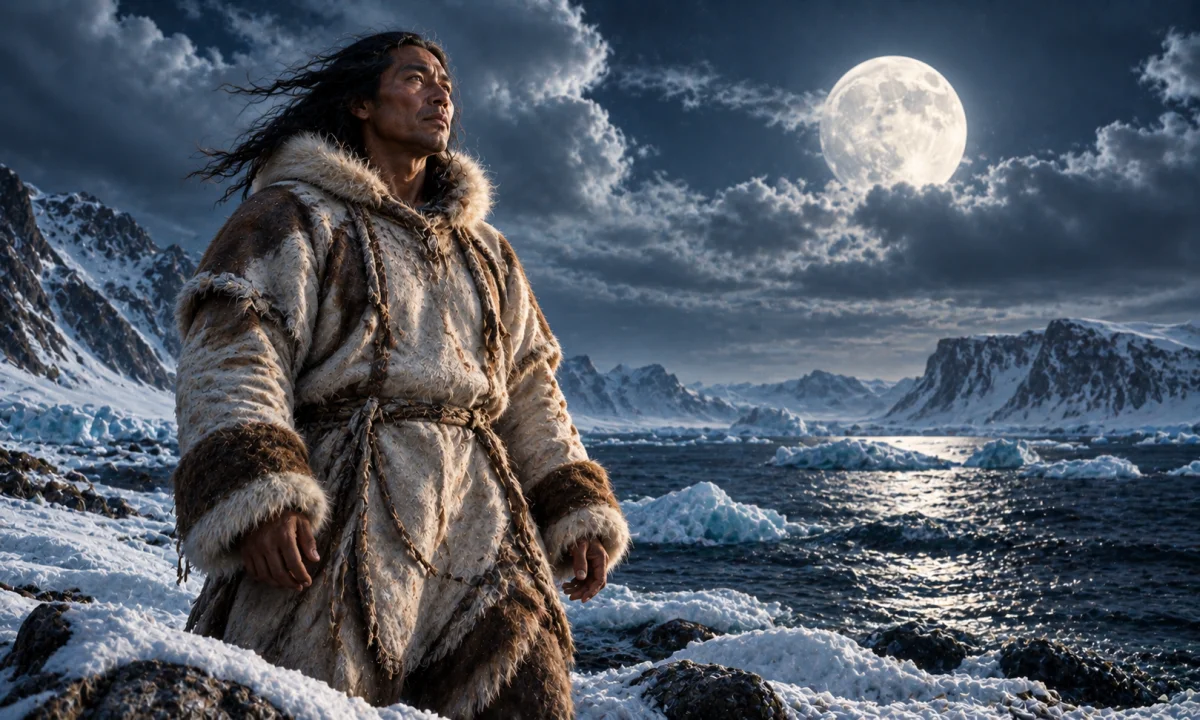
Aningan is a moon figure in some Inuit traditions, especially those recorded in Greenland and the eastern Arctic. He is commonly described as a male personification of the Moon and as the brother, pursuer, or estranged companion of the Sun. The relationship between the two explains the alternating presence of daylight and darkness, while the Moon’s changing appearance may be connected with his repeated disappearance and return.
“Inuit mythology” does not describe one uniform religious system. Inuit peoples live across a vast Arctic region, including Greenland, northern Canada, and parts of Alaska and Chukotka, and their traditions have been preserved through many local languages and communities. Names, genders, family relationships, and narrative details therefore vary considerably. Aningan should not be treated as a single universally recognized Inuit god with a fixed biography. In some accounts, related or corresponding moon figures are known by other names, including Anningaaq, Anninganeq, or Igaluk, although these names are not automatically interchangeable in every tradition.
Origins and cultural setting
Traditional Inuit religious life was expressed through oral narratives, ritual practices, relationships with animals, rules governing food and hunting, and respect for powerful beings associated with the landscape and sky. Stories about the Sun and Moon belong to this wider world of cosmology. They are not merely explanations of astronomical events in the modern scientific sense. They can also describe kinship, desire, taboo, conflict, bodily processes, seasonal change, and the consequences of breaking social or sacred boundaries.
Most traditional accounts were transmitted orally rather than through a single canonical scripture. Elders, storytellers, ritual specialists, and families preserved narratives in particular local forms. European missionaries, explorers, linguists, and ethnographers later recorded some of these traditions, often using their own spelling systems and categories such as “god,” “spirit,” or “myth.” Those records are valuable but incomplete. They may reflect a specific region, interpreter, storyteller, or historical moment rather than a belief shared by all Inuit communities.
For this reason, descriptions of Aningan need to distinguish between regional tradition and later generalization. The idea of a male Moon named Aningan is especially associated with Greenlandic material and with summaries of Inuit cosmology. It is misleading to claim that every Inuit community used this name or understood the Moon in exactly this way.
Name and identity
The spelling Aningan is one of several forms used in English-language discussions. Greenlandic and other Inuit-language spellings may differ because the languages have distinct sound systems and because early writers represented Indigenous names inconsistently. Forms such as Anningaaq and Anninganeq may refer to a moon being or to a name related to the same narrative complex, but their precise use depends on the language and source.
The word “god” also requires caution. Aningan is often called an Inuit moon god in modern reference works, but traditional Inuit categories do not necessarily correspond neatly to the European division between gods, spirits, ancestors, and personified natural forces. A being associated with the Moon could possess agency and sacred power without belonging to a formal pantheon. Inuit religious traditions generally do not present a single, standardized list of deities comparable to the Olympian gods or the Norse Æsir.
In some accounts, Aningan is the brother of the Sun, while in others the relationship is described in ways that emphasize pursuit, sexual danger, or a broken taboo. The female Sun is frequently identified in Greenlandic narratives as Malina, though the names and details vary. These stories should not be combined indiscriminately with traditions from other Inuit or Yupik-speaking communities.
The Sun and Moon relationship
The best-known narrative pattern presents the Sun and Moon as close relatives whose relationship becomes violent or socially unacceptable. Aningan pursues the Sun, often identified as his sister. She attempts to escape him, and the two figures continue their chase across the sky. The story provides a mythic image for the regular separation of night and day: the Moon follows the Sun but never permanently overtakes or joins her.
Different retellings explain the beginning of the pursuit in different ways. Some emphasize an improper encounter or an act that violates a serious kinship taboo. Others focus less on the precise offense and more on the endless chase itself. Because the narratives come from oral traditions, there is no single authorized version that settles every detail. Statements that Aningan and Malina always have one particular relationship, or that one exact event universally caused their separation, go beyond the evidence.
In certain versions, the Moon’s desire or pursuit is associated with the cyclical behavior of the two heavenly bodies. The Sun remains visible for part of the year or day, while the Moon appears, vanishes, and returns in changing forms. The narrative turns astronomical regularity into a story about a powerful relationship that can never reach a final resolution.
Appearance and powers
Aningan is usually understood not as a human figure who merely lives in the sky, but as the Moon itself in personal or spiritual form. Artistic depictions often show him as a man, yet traditional narratives do not provide one universal physical portrait. His visible “appearance” changes with the phase of the Moon: he may be present as a full, bright disc, partly concealed, or absent from the night sky.
The Moon’s movement was significant in Arctic life. Lunar light could affect travel, hunting, seasonal awareness, and the measurement of time, particularly during the long periods of darkness and light characteristic of high latitudes. Such practical importance does not prove that every activity was directly attributed to Aningan, but it helps explain why the Moon could be treated as an active and powerful being rather than as a distant object with no social meaning.
Some accounts connect the Moon with sexuality, fertility, childbirth, or bodily cycles. These associations are widespread in world mythology, but they should not be assigned automatically to every Inuit moon tradition. The Inuit Arctic contains many distinct local religious ideas, and the surviving records do not support a single universal list of Aningan’s powers.
In some retellings, the Moon’s repeated disappearance is explained by exhaustion or hunger. Aningan may lose strength while pursuing the Sun, become thin, and then recover as he returns to fullness. This interpretation links lunar phases with the bodily experience of eating and fasting. It is an example of a recurring motif in accounts of Arctic cosmology, but the exact story and its attribution to Aningan vary between sources.
Moon phases, darkness, and renewal
The changing Moon can be read as a visible cycle of loss and restoration. Aningan is not permanently destroyed when the Moon disappears; he returns after a period of darkness. This pattern can symbolize endurance, renewal, and the repeated movement of the natural world. It also illustrates how Inuit storytelling may connect cosmic events with ordinary human concerns, such as hunger, fatigue, desire, separation, and return.
Accounts of lunar eclipses sometimes describe the Moon as being temporarily obscured, threatened, or involved in a struggle. However, interpretations of eclipses differ among Arctic peoples and should not be assigned to Aningan without a specific traditional context. A general statement that every Inuit community saw an eclipse as Aningan being captured or punished would be inaccurate.
The Moon’s relation to time was also important. Lunar cycles offered a way to recognize recurring periods, although Inuit systems of timekeeping varied according to language, region, climate, and seasonal activity. Aningan’s mythic identity therefore belongs to a broader understanding in which celestial movement, environmental change, and human conduct are closely connected.
Relationship with Malina and other sun figures
Malina is often described in Greenlandic material as a female Sun and the sister of the Moon. Her name is sometimes paired with Aningan in modern accounts because their pursuit is one of the most recognizable Arctic sky narratives. The Sun and Moon are thus presented as relatives whose conflict organizes the heavens.
The pairing should not be mistaken for a universal Inuit doctrine. Across the circumpolar north, the genders and names of the Sun and Moon can change. Some communities describe the Sun as female and the Moon as male; elsewhere the identities, stories, or emphasis may differ. Even within a broadly related cultural area, a name recorded in one language may not function as the name of the same figure in another.
The relationship between Aningan and Malina is also unlike a simple romantic creation myth. Its central elements are kinship, pursuit, taboo, and separation. Reducing the story to a “love story between the Sun and Moon” removes the cultural importance of family boundaries and the danger associated with violating them.
Religious and cultural significance
Aningan’s importance lies partly in the way the story joins the human and cosmic levels. The heavenly bodies behave according to recognizable social patterns: they are related, desire or avoid one another, flee, and continue a relationship shaped by wrongdoing. The sky is therefore not an empty space but a landscape inhabited by beings whose actions have become permanent features of the world.
The narrative can also be understood as a warning about boundaries. Inuit societies, like all human societies, have rules concerning kinship, sexuality, obligation, and appropriate conduct. A story in which a forbidden relationship produces endless pursuit expresses the consequences of crossing those limits. It does not need to function as a simple moral fable; it can simultaneously explain the sky, evoke danger, and preserve knowledge about proper social relationships.
Moon stories may also have served as a way to make an uncertain and demanding environment intelligible. In the Arctic, the changing balance of light and darkness has profound effects on travel, hunting, rest, and seasonal life. Personifying the Moon gives this cycle a memorable form. The story does not replace observation: it provides a culturally meaningful way to interpret what people repeatedly see.
Traditional Inuit understandings of celestial beings were part of a larger network of relationships involving humans, animals, weather, the sea, the land, and the dead. It is therefore unhelpful to isolate Aningan as though he belonged to a separate “mythological universe” detached from everyday religious practice. The Moon narrative belongs to a wider worldview in which survival depends on respect, knowledge, restraint, and attention to forces beyond human control.
Distinguishing Aningan from similar figures
Aningan is easily confused with other moon beings because English-language sources often use “Inuit” as if it referred to one homogeneous tradition. The name Igaluk, for example, is widely presented in popular mythology books as the Inuit Moon god. In some contexts it may represent a related or corresponding figure, but it should not automatically be treated as another spelling of Aningan. The same applies to Anningaaq and other regional forms.
There is also a risk of merging Inuit traditions with those of neighboring Yupik-speaking peoples. Inuit and Yupik cultures share historical and geographical connections, but they are not identical, and their languages and religious narratives have their own local histories. A moon figure from Alaska cannot be assigned to Aningan’s Greenlandic tradition merely because both are male lunar beings.
Aningan should likewise be distinguished from generic “moon gods” in Greek, Roman, Norse, Japanese, or Mesoamerican mythology. Comparative mythology may identify broad patterns, such as lunar cycles or celestial siblings, but similarity does not establish a historical connection. Aningan is rooted in Inuit cultural contexts and should be described on those terms.
Written records and modern presentation
Knowledge of Aningan comes through a mixture of Indigenous oral tradition and later written documentation. Early collectors often translated sacred narratives into European literary forms and sometimes presented powerful beings as “gods” because that was the closest category available to them. Spelling conventions also changed over time. These factors can make apparently contradictory accounts difficult to compare.
Modern encyclopedias, mythology websites, fantasy fiction, games, and illustrated books often simplify Aningan into a clearly defined “Inuit moon god” with a standard appearance, powers, and family tree. Such presentations may be useful introductions, but they can conceal regional variation and the absence of a single Inuit canon. Invented costumes, weapons, divine ranks, and dramatic biographies should not be mistaken for traditional attributes.
Aningan is not a major figure in widely distributed modern popular culture in the way that Thor, Anubis, or other internationally marketed mythological characters are. When he does appear in contemporary fiction or games, the portrayal is usually an adaptation rather than a direct continuation of a living traditional narrative. Respectful treatment keeps that distinction clear and avoids turning Inuit religious heritage into a generic fantasy setting.
As a moon figure, Aningan remains most meaningful when understood through the traditions that place him in the Arctic sky: a powerful being whose changing presence is connected with kinship, taboo, pursuit, darkness, and return. The variations in his name and story are not flaws in the tradition. They reflect the regional and oral character of Inuit cultural history.